
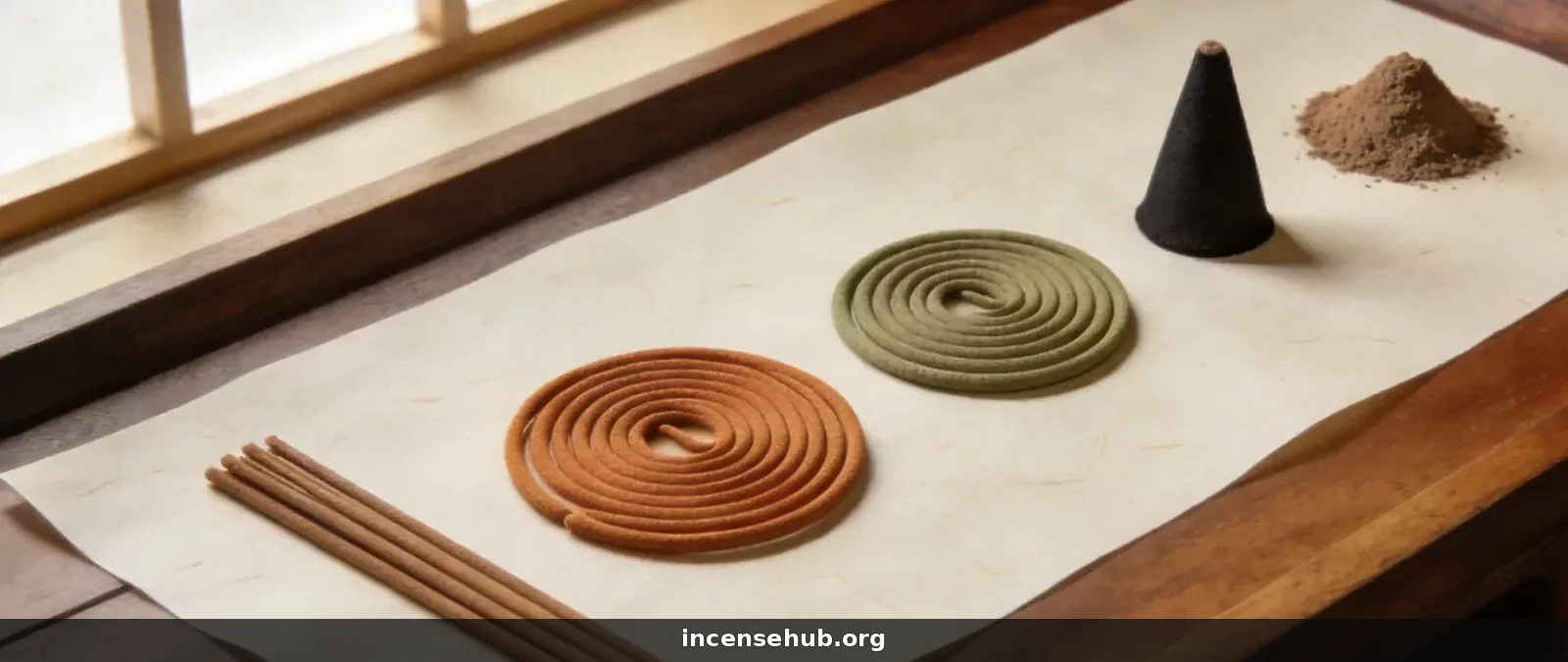
Direct answer: A backflow cone carries a channel down its axis, so the smoke it makes leaves at the bottom rather than the top. Seat it on a burner that has a hollow under the seat, and the descending stream collects there before sliding over an edge — which is the waterfall people buy it for. The scent is incidental; the descent is the product.
Key facts: The channel is the only structural difference from an ordinary cone: identical dough, identical fragrance load, comparable burn window. Smoke gives up heat against the channel wall, ends up denser than the surrounding air, and keeps dropping after it clears the base. Flat plates cannot stage the effect, and moving air cancels it outright.
Key Takeaways
- Three conditions must hold at once: a closed foot, a chamber under it, and still air. In practice the middle one is where most setups fail.
- There is no special backflow fragrance. The scent is whatever the dough smells like.
- Visible smoke means more particulate in the room, not less — the effect is bought with air quality.
- Almost every “faulty cone” is a setup problem, and setup problems are diagnosable in minutes.
- Buy it to watch it. For scent alone, a plain cone costs less and smokes less.
What the Object Is
Direct answer: A cone pressed around a tapered mandrel, leaving an internal void that opens through a pinhole in the base.
An ordinary cone is solid: the ember sits at the point, and smoke escapes wherever the geometry allows. The backflow version is formed around a core, so the finished shell contains a cone-shaped cavity — broad near the apex, narrowing toward the foot — plus a small opening where that cavity reaches the base. Nothing else about the batch changes; a maker can press solid and hollow pieces from one mix.
The geometry has consequences you can feel. The wall between channel and outside is thin, so the piece is more brittle than a solid cone and less tolerant of a jolt in transit. The channel is a fixed-length chimney, which means the airflow it can carry was settled at the press and cannot be adjusted later. And the base has to sit flat and closed against the burner, so a chipped foot leaks — the most frequent reason a cascade never begins.
Editorial note: hollow shells crack, and gift packaging that lets cones rattle in a box is asking for it.
Three Conditions, All Required
Direct answer: A sealed foot, an enclosed chamber, and still air — remove any one and the smoke simply rises like any other smoke.
| Condition | What it does | How it fails |
|---|---|---|
| Closed foot against the seat | Forces the pinhole to be the only exit | A rim gap lets smoke escape sideways at once |
| Chamber under the seat | Catches the stream, kills its momentum, feeds the spill | A decorative hole with no volume behind it stages nothing |
| Still air | Keeps the ribbon coherent | A draught shreds it into haze |
The three are not equally obvious, and the second is the one buyers miss. A burner can look correct — hollow-looking, with an opening — and still have no enclosed volume, which turns the whole exercise into a cone burning on a stand.
The Descent, Link by Link
Direct answer: Heat loss in the channel, density contrast with room air, a sealed path at the base, and motionless air. Each link depends on the one before it.
ember at the point → hot smoke pulled into the channel → wall contact strips heat from it → the stream becomes cool and particle-heavy → it leaves through the base opening → the chamber slows and collects it → it spills over the lip and runs down the outside.
Read the arrows as dependencies rather than as a sequence of separate events.
Wall contact. The channel is narrow, so the smoke touches wall for most of its travel; contact time is what transfers the heat. A wider void would let a hot core reach the base, and the stream would arrive without the density advantage it needs.
Density. Cool aerosol carrying unburned particles weighs more per unit volume than the warm, cleaner air in the room. A heavier fluid inside a lighter one descends — buoyancy working in reverse. That inversion is the entire physics of the format, and it is why the effect reads as engineering rather than as chemistry.
The seal. The base has to close against its seat so the pinhole is the only route out. Any gap hands the smoke a shortcut, and it exits at the foot instead of continuing downward. Nothing forms.
Still air. The fall is a ribbon of dense smoke dropping through ordinary air. Airflow shears it apart within seconds, and there is no half-strength version.
The same chain explains the two complaints owners repeat. The effect takes a minute or two to appear, because the channel must warm and the column must build. And it dies before the incense does: as the shell shortens the flow turns ragged, and the final third collapses inward.
What cannot be pinned down from published sources is how much of the cooling happens in the channel versus the chamber — the split is not something we can point to a measurement for [need-source]. The density account is the standard explanation, and it is consistent with what owners report.
Setting One Up
Direct answer: Five steps, in this order, take about two minutes and eliminate the majority of failures.
- Inspect the foot. A flat, unbroken base. Chips or a slant mean the piece will never seal; set it aside.
- Check the channel. Hold the cone to a lamp and look through the base. No light means ash is blocking it — clear from the base side with a pin, never from the top, which pushes debris deeper.
- Seat it. Lower the cone so the pinhole sits directly over the burner’s opening. Resting on the outer rim is not seating.
- Test the air. Put a lit candle beside the setup. If the flame leans, the ribbon will scatter; move the table rather than fighting the draught.
- Light the point and wait. Give it two minutes before judging. The first smoke is hot and rises; the fall establishes once the channel is warm.
Most of the ritual is inspection, and none of it is technical. The point of doing it in order is that each step is cheaper than the one after it.
When It Will Not Cascade
Direct answer: The symptom usually names the broken link, which is why diagnosis beats replacement.
| What you see | Likely cause | Test |
|---|---|---|
| Smoke climbing straight up | Foot not sealed, or no chamber behind the opening | Reseat, then confirm the burner is actually hollow |
| A thin trickle that dies | Channel partly blocked by old ash | Lamp test from the base |
| Cascade starts, then scatters | Moving air | Candle-flame test beside the burner |
| Fall on one side only | Cone tilted, or a damaged foot | Level the seat, retire the piece |
| Feeble from the first minute | Damp cone | Dry it and retest |
| Flow fades at two-thirds | Normal collapse as the shell shortens | Nothing to fix |
Two of the six are product faults; four are setup. That proportion explains why a replacement cone so rarely helps.
Editorial note: the table joins the mechanism to the complaints that recur in owner forums; it is not a manufacturer’s diagnostic sheet.
Backflow Against Standard Cone
Direct answer: Identical material, opposite smoke path, different job. One exists to be watched; the other exists to be smelled.
| Backflow cone | Standard cone | |
|---|---|---|
| Smoke path | Down the channel | Up and away |
| Hardware | Chambered burner with a matching opening | Any heatproof dish |
| Duration | Short, set by mass | Short, same order |
| Visible smoke | The deliverable | A by-product |
| Where residue lands | Chamber, lip, tray, table below | Ash in the dish |
| Scent tuning | None — geometry fixed at the press | None, but less aerosol to sit through |
| Handling | Thin wall, fragile channel | Solid, forgiving |
| Characteristic failure | Effect stalls; the cone keeps burning | Tips over; ash spills |
| What the price buys | A visible fall | Fragrance per gram |
A standard cone is a scent-delivery device whose smoke is tolerated. The backflow version reverses the terms: smoke is the point, scent the side effect. That single inversion is the buying decision.
What Ownership Costs After a Week
Direct answer: Residue, cleaning, short sessions, and hardware that only accepts cones of one size.
Smoke that you can see is smoke that lands somewhere. The dense stream leaves a film in the chamber, along the lip, across the tray, and on whatever sits beneath the spill. Wipe while the burner is cold, and start with a dry cloth — a damp one smears the film into unglazed pores rather than lifting it.
Sessions are short: roughly ten to thirty minutes depending on mass, with the visual payoff concentrated in the middle. Anyone hoping to scent a room for an evening has chosen the wrong format.
Hardware coupling is mild but genuine. The foot must match the seat, and a cone too wide for the opening will not seal, no matter how carefully it is placed. That constraint also limits what you can buy later: the burner decides the size, not the other way round.
One more thing rarely mentioned: this is tabletop theatre, so it wants a surface people look down at. On a high shelf the spill is invisible; on a low side table it works.
Smoke in the Room
Direct answer: This format adds more visible aerosol than a standard cone, and because that aerosol sinks, ventilation matters more here rather than less.
A calm cascade disguises what is happening: combustion aerosol produced continuously for the whole burn. Nothing about the motion means the smoke is cleaner. Dense smoke that settles near table height stays in the breathing zone longer than smoke that climbs to the ceiling and drifts away. The format therefore asks more of the room than a stick does.
Rules we apply, and label as ours rather than as regulation: burn near a window that opens, never under a ceiling fan; keep sessions short on purpose; avoid a closed bedroom; keep the burner off any surface you would not put a hot pan on. Background on indoor combustion smoke sits in the EPA indoor air quality pages and the American Lung Association’s indoor pollutant pages; the incense safety page covers surfaces, ash, pets, and clearing a room.
Nothing here is a health claim in either direction. The object is a small fire making visible smoke where people breathe, and the sensible response is dull: short sessions, open air, a cold burner wiped clean.
Where the Selling Overshoots
Direct answer: The fall is a real effect on a real object; most of the language wrapped around it is not.
Backflow burners are sold with copy about calm, focus, and zen. Watching a slow, deliberate descent is genuinely pleasant, and describing it as pleasant is fair. What the object does not do is change the air in a way that produces a bodily outcome.
The specific misconception worth naming: that a backflow cone “diffuses” fragrance better because the smoke is visible. Visible smoke tells you about particle density, not about how much aroma reaches your nose. Set a backflow cone beside a standard cone of the same dough and the difference is smoke volume, not scent character. Visibility is a design decision, not an efficiency gain.
Editorial view: as a kinetic ornament that happens to smell of something, this object holds up. As a wellness device, the buyer pays for a claim the product cannot carry.
Choosing Between Formats
Direct answer: Decide by what you want to watch, not by what you want to smell.
| Your goal | Choose | Reason |
|---|---|---|
| A centrepiece on a low table | Backflow cone plus chambered burner | The visible fall is the product |
| Room scent with little fuss | Standard cone or stick | No channel, no chamber, less aerosol |
| Hours without relighting | Coil | One lighting covers a long session — see incense coils |
| A short ritual with a clear end | Either cone | The window is brief by nature |
| Testing a fragrance cheaply | Standard cone or sample stick | Lower cost per test, no hardware |
One question settles it for most buyers: would you light this if the smoke rose normally? If not, buy the waterfall. If yes, buy the scent and skip the hardware. The wider comparison of formats is set out in which incense format, and the burner side in incense holder and burner guide.
Author’s Take
Position (editorial, not a verified fact): backflow cones are the cleanest example in this family of an object bought for one property and sold on another.
The scent is ordinary. The burner costs more than a dish. The effect is delicate enough that an open window ends it. What the buyer gets instead is a genuinely unusual thing to watch on a table, and that is worth something — it simply is not fragrance. Buyers who understand the trade stay happy; buyers sold on relaxing aromatherapy end up with a burner at the back of a cupboard.
The honest pitch is short: a small machine for making smoke fall. Charming, fragile, and scented with whatever you put in it.
FAQ
How does the smoke come out of the bottom?
The ember sits at the point and the only path is the channel. As the smoke travels down, the wall takes heat out of it, so what reaches the base is cooler and loaded with particles. Cooler, dirtier air is heavier than the warm room air around the burner, so it keeps sinking after it leaves. The burner’s chamber collects it and spills it over an edge.
Is the fragrance different from a normal cone?
No. Same dough, same scent; the channel changes where the smoke goes, not what it contains. Two things can make it feel different: the visible volume suggests more fragrance than is actually there, and a short burn means you notice the opening and the finish rather than the middle.
Why does mine go straight up?
One of the four links is broken. Check in this order: foot seal, alignment of pinhole and burner opening, blockage in the channel, moving air. A cone that has been relit several times is a fifth suspect, because partial burns distort the channel.
Can I drill an ordinary cone?
Not reliably, and we would not suggest it. A pressed cone is brittle, a hand-drilled channel wanders off-axis, and the wall crumbles where the bit exits — any of which breaks either the seal or the flow. The channel also needs a taper that a straight bit cannot produce. Here the geometry is the product.
Does it work outdoors or under a fan?
No. This is a hard limit rather than a tuning problem. The fall is a ribbon of dense smoke dropping through still air, and steady airflow shears it apart. A sheltered porch on a windless evening might hold for a few minutes; a fan, a breeze through a window, or a vent aimed at the table will not. Outdoors, a stick in a sheltered holder is the better answer.
Sources
- The mechanism described here — smoke cooled in the channel, denser than room air, collected in a chamber and spilled over a lip — is the standard account of the format, restated rather than measured.
- Cone, stick, and coil burn windows are compared in our format comparison.
- EPA indoor air quality — agency hub on combustion particles and room clearing.
- American Lung Association indoor air pollutants — reference on particulate from indoor flames.
Related Resources
- Which Incense Format Is Right for You? — the comparison this page belongs to.
- Incense Sticks — the low-aerosol default when scent is the goal.
- Incense Holder & Burner Guide — burner types, chambered ones included.
- Incense Safety — surfaces, ash, ventilation, and room clearing.
Natural next step: if duration matters more than motion, incense coils burn for hours on one lighting; if the format decision is still open, start from how to choose incense.
Summary
The object is simple: a pressed cone with a tapered channel and a pinhole foot, seated on a burner that has a hollow behind its opening. Smoke cools on the way down, becomes denser than the room, and spills over the lip. Every failure is a break in that line — seal, chamber, channel, air — which is why checking beats replacing. The economics are equally brief: you are paying for a shape and a piece of hardware, not for a better fragrance. Light one on a low table in still air, watch the ten or twenty minutes it lasts, air the room afterwards, and wipe the burner once it has cooled.