
Direct answer: A calming evening ritual is a short, repeatable wind-down — low light, screens put away, one soft scent, a quiet pause — performed at the same hour so your body registers that the day has closed. The fragrance marks that shift; it does not cause it.
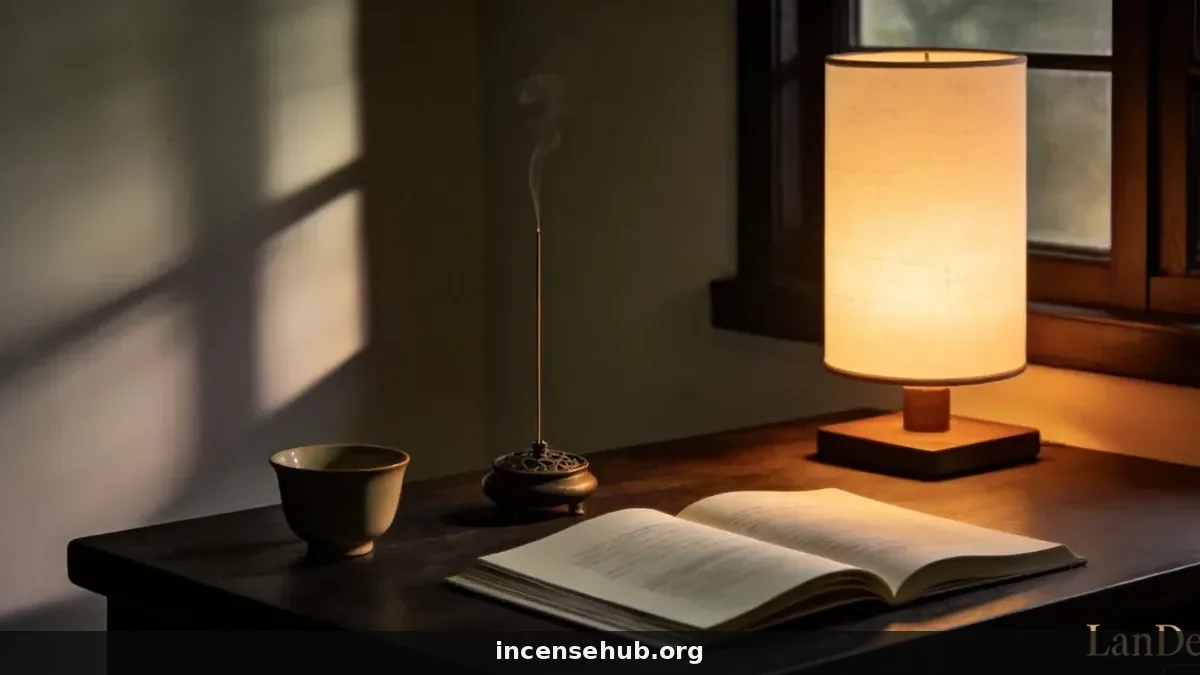
Key facts: This page makes no sleep or medical claims. Incense is not a sleep aid; it is one piece of a routine that helps you step out of the day.
What the Word “Sleep Incense” Is Really Doing
Direct answer: A package that names “sleep” as a fragrance effect is making a medical claim in disguise, and this page will not repeat it — the honest version of the idea is much narrower.
Search “incense for sleep” and the results will promise that a stick “promotes sleep” or “cures insomnia.” Neither phrase has evidence behind it; they are medical assertions attached to an otherwise ordinary fragrance, and they drag the product into regulatory territory it never needed to enter. The honest version of the same idea fits into three plain statements:
- Repeating a short evening routine, at a steady hour, helps mark the close of the day.
- One fixed fragrance, repeated every evening, gives the routine something steady to hang on (see how aromatherapy works).
- Notes that read warm and undemanding — sandalwood, lavender, gentle florals — get chosen out of habit and association, not from any drug-like action.
The dividing line lives in the verb. “Wind down,” “unwind,” and “calm” describe a state you are guiding yourself toward; “treats insomnia” promises a medical outcome no scent can deliver. Everything on this page stays on the honest side of that line.
What follows from holding the line is that the honest framing is the more useful one. If you believed the stick were a sedative, you would keep hunting for a “stronger” blend and stay disappointed, because no fragrance is a sedative. The moment you accept that the routine is the engine, you stop hunting and start repeating — which is the only thing that actually builds the effect.
Why Repetition Does the Actual Work
Direct answer: The ritual works by association — the scent becomes a learned signal for a relaxed state — not because the aroma changes your brain chemistry.
The mechanism matches any learned cue. You run the same small sequence each night → the same soft smell reliably arrives before the same quiet state → your brain links the smell to the state → eventually the scent alone begins to announce the wind-down. Association, in other words, not pharmacology.
That distinction steers how you should build the habit. Chasing a “more effective” fragrance is a dead end, because the active ingredient is the pairing, not the note. What you want is consistency above all: one scent, one hour, one order of actions, night after night, until the association settles in.
A second, quieter mechanism rides along that has nothing to do with smell. The ritual hands your evening a fixed shape — dim the lights, light the stick, read a page — and that shape fills the transition hour with deliberate, low-arousal movement. Most of the calming weight sits in that shape, not in the fragrance. The scent is simply the label you stick on the shape so your brain learns to recognize it and settle into it faster over time.
The Habit Loop Underneath the Scent
Direct answer: The scent only does its job inside a loop — a stable trigger, a repeated routine, and a felt reward — and the note matters far less than getting all three links to close.
A cue performs only as one part of a loop. The full shape of what you are building is: a stable trigger (the hour, the low light) → a routine (light the stick, do one quiet thing) → a reward (the way the room and your body settle as the evening softens). Missing any single link, and the loop never closes.
This framing explains why the specific note matters so little while the order matters so much. The trigger is what starts the sequence — a clock reading, a lamp switched low, the strike of a match. The reward is the felt release of tension. The scent is only the ribbon that ties the trigger to the reward in memory. A trigger without a routine is a stray reminder; a routine without a reward is chores; a reward without a trigger never repeats.
The practical instruction, then, is to build the loop deliberately rather than hope the smell does the work. Fix the trigger first: choose a time you can actually hold, and an environment cue you can produce every night — a lamp dimmed, a phone set to charge in another room. Then run the same small routine. The loop tightens with every repetition, which is the entire reason a ritual that feels flat in week one feels automatic by week four.
The author’s editorial view, not a verified fact.
When the Ritual Stops Working: A Troubleshooting Table
Direct answer: When a wind-down stops landing, the fault is almost always in the loop’s consistency — the scent, the hour, or the size of the sequence — and each failure has a specific fix.
A ritual that once worked can go flat, and the usual suspects are few enough to lay out in a table. Diagnose by symptom, then change one thing:
| Symptom | Likely cause | Fix |
|---|---|---|
| The cue never “lands” | Scent or hour keeps changing | Lock one scent and one time |
| It feels like a chore | Sequence is too long or too elaborate | Shrink it to two or three steps |
| The room feels smoky | Format too heavy or unventilated | Switch to a thin stick or heater, open a window |
| You keep skipping it | The hour is unrealistic | Move it to a time you already keep |
The rule behind the table is to change one variable at a time. Tinkering with the scent, the hour, and the length all at once makes it impossible to tell which lever moved, and a ritual you cannot diagnose you cannot repair. Most “it stopped working” cases are, at root, a consistency problem dressed up as a scent problem.
The author’s editorial view, not a verified fact.
The Smallest Ritual That Still Works
Direct answer: A workable wind-down can be two steps — light the scent, do one quiet thing — and a smaller ritual kept nightly beats a longer one kept rarely.
Scale is the hidden enemy. People design a ten-step sequence with a curated playlist, a specific tea, a specific cushion, and then abandon the whole thing the first week they are tired. The sequence only earns its keep through repetition, so the version you will actually run is the version that works. Strip it to the floor: one scent, one quiet action, one closing moment. If those three hold for a month, you can add a step back; if they do not hold, no amount of added ritual would have saved them.
The author’s editorial view, not a verified fact.
A Sequence Boring Enough to Keep
Direct answer: The ritual is a short, fixed order of steps, and its strength is precisely that it is dull enough to repeat every single night.
| Stage | Rough timing | Action | Why it belongs here |
|---|---|---|---|
| Signal | ~45 min out | Light a short stick or cone | One fixed scent tells the body the day is closing |
| Settle | While it burns | Read, journal, or do a quiet task | Low-arousal movement fills the transition hour |
| Close | When it finishes | Snuff out and air the room | The burn ends, and the routine ends with it |
As a plain list:
- Turn the lighting down and move the phone and any screen out of arm’s reach.
- Ignite the single soft fragrance you keep aside for the evening.
- Settle into one low-key activity — a few slow breaths, a diary page, tidying, several paragraphs of a book.
- Snuff the stick and consider the routine finished.
The sequence earns its effect through repetition, not through being elaborate. A routine you actually keep beats a fancier one you abandon after two nights.
The Two Ways a Ritual Falls Apart
Direct answer: The ritual keeps working only while two conditions hold — the scent stays the same, and the burn ends before you sleep — and it stalls the moment either one breaks.
Two failure modes account for most abandoned evening routines:
- Novelty. Swapping the scent or the hour each night breaks the association before it can form. Repetition builds the cue; novelty resets it.
- Unattended burn. Letting a stick smolder into the night in a closed room turns a wind-down signal into a source of smoke and fine particles with nobody watching it. The ritual ought to finish when the burn does, rather than bleeding into sleep.
The author’s editorial view, not a verified fact.
Both failures point the same direction: the ritual is a sequence with a clear end, and its value lives in the repetition and the finish — not in the smoke itself.
Cue, Ambience, and the Line Between Them
Direct answer: A cue is a signal you have trained yourself to read; ambience is just background atmosphere — the ritual needs the first, and the second is optional.
People confuse the two, and the confusion quietly derails the routine. Ambience is a pleasant smell in the room — nice while it lasts, forgotten the moment it stops. A cue is different: it is a smell that has become a switch, because you paired it with a specific closing sequence so many times that the smell now carries the sequence’s meaning on its own. The line between the two is the whole point of this page.
The distinction changes what you should optimize for. Ambience rewards variety — a new scent is more interesting tonight than last night’s. A cue rewards the opposite: sameness, because only a repeated pairing turns a smell into a switch. This is why a person who rotates scents nightly gets “nice ambience” but never gets a wind-down signal, while a person who burns the same quiet stick every evening eventually feels the shift the moment it is lit.
The author’s editorial view, not a verified fact.
The practical takeaway: if all you want is a room that smells good, rotate freely. If you want the evening to start closing on a cue, pick one scent and hold it. The two goals need different habits, and treating them as the same goal is the common mistake behind most “it stopped working” stories.
A Short History Note: Incense as a Time-Marker
Direct answer: Long before alarm clocks, the steady burn of incense served as a clock in parts of East Asia, and that old use explains why a single stick makes such a natural close for the day.
A stick, or a stamped trail of powder (印香, yìnxiāng), burned at a known rate, and the length consumed marked the passing of an interval — an hour of meditation, a shift of guard, a stretch of study. The practice survives today in the habit of timing a pause to the life of one stick.
That old use clarifies the modern wind-down. When incense is burned to mark time, the fragrance is nearly incidental; what matters is the steady, predictable progress of the ember. The evening ritual borrows the same idea: the burn gives the transition a beginning and an end, a small clock you can watch go out. It is the constancy of the burn, not the aroma, that turns it into a marker.
Traditional practice, cited as cultural context — not a health or efficacy claim.
Choosing the Least-Smoky Format for the Evening
Direct answer: For a wind-down, the quietest smoke profile comes from a thin coreless stick or a small dose of resin on a gentle heater — cones and coils burn longer and release more visible smoke than a short session needs.
The amount of smoke a format puts out is a property of how much material it burns and how fast. A broad cone or a multi-hour coil packs more combustible mass than a thin stick, so it sheds more particles into the room over its run. If the evening ritual is meant to be a faint background note rather than a smoky centerpiece, the format matters as much as the scent:
| Format | Rough burn time | Smoke profile | Fit for a wind-down |
|---|---|---|---|
| Thin coreless stick | 15–30 min | Light, steady | Strong |
| Cone | 15–25 min | Denser, more visible | Fair, keep short |
| Coil | Hours | Continuous, heavy | Poor for bedtime |
| Resin on a heater | 30–60 min | Very low, no open flame | Strong |
The table’s logic is simple: the shorter and thinner the burn, the less smoke lands in a room you are about to sleep in. A heater, in particular, warms the material without an open flame, so it releases aroma with the least combustion byproduct of the group. The trade is that a heater needs electricity and a bit more setup than a match and a stick. For most people the thin stick is the sensible default, and the heater is the upgrade when the smoke itself starts to feel like the problem.
The author’s editorial view, not a verified fact.
Reading a “Sleep Blend” Label Without Falling for It
Direct answer: Pick a scent you find warm and low-key, and ignore any package that names “sleep” as an effect — the label is marketing, while the association does the real work.
| What the package says | What it actually means | What it does not mean |
|---|---|---|
| “Lavender — calming” | A soft, familiar note by association | A sedative that forces sleep |
| “Sandalwood — grounding” | A warm, low-key base note | A substance with a measured effect |
| “Sleep blend” | A fragrance sold with a sleep claim | A product shown to induce sleep |
The rule behind every row: the scent is whatever you reliably find pleasant, and the “effect” is the repetition, not the note. Lavender earns its place because plenty of people find it soft and it is easy to buy — not because anyone proved it induces sleep. The association carries the weight.
Where the Smoke Enters the Equation
Direct answer: The one genuine cost of an evening incense habit is the smoke itself, and it is managed by three habits — ventilate, keep the burn short, and extinguish before you lie down.
Burning plant material puts smoke and fine particles into the air (see incense smoke and air quality). An evening ritual concentrates that release into the hour before bed, in the very room you are about to sleep in. The fix is not to drop incense; it is to keep the dose small and the air moving:
- Use a short stick or a cone rather than a coil — a brief burn, not a multi-hour one.
- Crack a window or door so the smoke does not pool in a closed room.
- Extinguish fully and let the room air before you actually lie down.
This is the honest trade the “sleep incense” marketing never mentions: smoke is the cost of the ritual, and ventilation plus a short burn is how you pay it without regret.
When Incense Is the Wrong Tool for the Job
Direct answer: Incense is one way to close the day, not the only way — if the smoke is a problem for anyone in the home, keep the routine and swap the medium.
A stick is not a requirement for a wind-down, and for some households it is the wrong choice. If someone in the home finds smoke irritating, if there are pet birds (which react badly to airborne particles), or if a smoke alarm sits close to the burning point, a scented candle, a diffuser, or a ritual with no combustion at all may serve better. The cue carries the ritual; the smoke is only one way to carry the cue.
This is a judgment boundary, not a rule: incense earns its place only when the smoke is acceptable to everyone who breathes that room. A home where it is not acceptable should keep the sequence and change the medium — light a candle instead, or skip the burn and keep the dimming, the quiet task, and the closing moment. What you lose is only the scent; what you keep is the loop.
The author’s editorial view, not a verified fact.
Common Mistakes
- Treating the stick as a sleeping pill. It marks a routine; it does not sedate. Do not burn one as you sleep — the safety guide lays this out.
- Switching notes every night. The cue is built by sameness and dissolved by novelty.
- Burning right up to the moment of sleep in a sealed room. Ventilate, and snuff it out before bed.
- Hunting for a “stronger” sleep scent. No stronger cue exists — only a steadier one.
Key Takeaways
- What you are building is a sequence, and the scent is a single cue inside it — never a drug.
- Sameness beats strength: one scent at one hour is what forges the association.
- Any package that sells “incense for sleep” is making a medical claim this page refuses to make.
- The honest vocabulary is wind down, unwind, and calm; “treats insomnia” steps over the line.
- Put the stick out before you sleep, and never leave one burning with no one there.
FAQ
Q: Will incense actually make me sleep?
Short answer: no, and this site will not claim otherwise. A burning stick cannot make anyone fall asleep, and any fragrance sold as a “sleep aid” is overstating what a smell can do. The narrower truth is this: run the same small ritual each evening, with the same gentle scent, and the repetition itself becomes the signal that the day has closed. The scent is a learned trigger, not a drug, and the calm comes from the routine it anchors. Two safety notes never change: put the stick out before you lie down, and never burn one while you sleep or leave it going with no one in the room. See the safety guide for the rest of the precautions.
Q: Which scent should I pick for the evening?
Whatever you find gently pleasant and can stand to repeat. Sandalwood, lavender, and light florals show up often because they come across as warm and undemanding, but the correct answer is whichever note you will still enjoy on the hundredth night. The link is learned, not chemical — the smell turns into a wind-down cue only through being paired over and over with the same quiet sequence. A familiar note you like will outperform an exotic one you try once.
Q: What are the safety rules for an evening burn?
A few standing rules cover it. Set the stick in a holder that will not tip, on a surface that will not scorch, well clear of curtains, paper, and other fuel, and where children and pets cannot reach it. Let air move through the room — combustion adds smoke and fine particles, so an open window or door stops them from collecting. Snuff the stick out completely before you go to sleep, and never leave one burning without supervision. The routine ends with the burn, not after it. See the safety guide for the full precautions.
Q: How do I turn this into a lasting habit?
Make it tiny and make it the same every night. Choose one scent, one rough time, and one quiet task — a page of reading, a journal entry, tidying, or several slow breaths — and run them in a fixed order. Light the stick as the wind-down opens, and put it out when the sequence closes. The cue strengthens through repetition, not through effort or a stronger note, so starting with a few minutes is enough. A change of scent or hour on any given night erodes the very signal you are trying to build.
Q: Does a backflow cone work for a wind-down?
You may, though it rarely suits the job. A backflow cone is built to pour a thick, visible ribbon of smoke downward — a showpiece, not a background scent. A wind-down wants the opposite — a faint, low-smoke presence resting quietly in the background. A slim coreless stick, or a mild electric heater carrying a pinch of resin, produces that softer, lighter outcome. If the cascading visual appeals, save it for a short, watched stretch earlier in the evening and keep the air moving.
Q: Does a stronger scent make the ritual work better?
No, and this is the misconception the whole page exists to undo. A stronger or more “potent” fragrance does not deepen the wind-down because the effect is not chemical — it is learned. What deepens the ritual is a scent you find pleasant enough to repeat, at an hour you can hold, in a sequence you can finish. If anything, a loud or overwhelming note works against you, because it draws attention to the smell rather than letting it fade into the background as a cue. Pick quiet, pick consistent, and let the repetition carry the rest.
Q: Does the burn length matter, or just the scent?
The length matters more than most people assume, because the burn doubles as the ritual’s clock. A short stick gives the wind-down a defined finish — when it goes out, the sequence ends — which is cleaner than a coil that smolders on for hours after you have lost interest. The scent is what you smell; the burn length is what tells you when the ritual is over. For an evening close, a shorter, self-terminating burn is usually the better fit, and it also caps how much smoke accumulates before bed.
Q: Do I need a special censer or holder for the evening?
No special vessel is required. A stable, fireproof dish or tray that catches the falling ash is enough, as long as it sits on a surface that cannot scorch and stays clear of anything that could catch fire. What matters is that the stick stays upright or flat without tipping, and that the ember cannot reach anything burnable. A dedicated censer is a nice-to-have, not a requirement — the ritual runs just as well from a plain ceramic dish as from an heirloom.
The Honest Answer to the Placebo Question
Direct answer: If someone calls the ritual “just a placebo,” the honest reply is yes — in the sense that its power comes from expectation and conditioning rather than chemistry, which is exactly the mechanism, so it is not a weakness.
The word “placebo” gets used as an insult, but here it names the correct mechanism. A placebo works through belief and learned association, and that is precisely what a wind-down cue is — a signal whose meaning you trained into it. The scent does not need a chemical effect to do its job, because its job is to trigger a state you have already paired with it. Calling that “just a placebo” is like calling a wedding ring “just metal”: it misses the point of what the object does.
What this means for the reader is that the honest framing is also the resilient one. A claim built on chemistry collapses the moment a study fails to replicate; a cue built on conditioning holds as long as you keep the pairing. The ritual is not weakened by admitting it works through association — that admission is the whole explanation.
The author’s editorial view, not a verified fact.
What This Borrows From Older Wind-Down Habits
Direct answer: The evening ritual is a modern recombination of very old wind-down habits — a warm drink, low light, a screen-free pause — and it works for the same reason those habits always did.
Across cultures, the last hour of the day has long been structured around the same few gestures: a cup of something warm, a dimmed lamp or a candle, a quiet task done by hand, a deliberate slowing of the day’s pace. Tea, a bath, a book, candlelight — none of these is a sedative either, and none of them needed to be. Each one signals the same thing the incense stick signals: the work of the day is over, and the body can now downshift.
The incense ritual slots into this older pattern rather than replacing it. It adds a scent and a small fire to a sequence that was already about warmth, dimness, and quiet. That is why it pairs so naturally with the habits people already keep — the cup of tea and the low lamp do not compete with the stick; they reinforce the same closing signal, and the more of those signals you stack at the same hour, the stronger the cue becomes.
The author’s editorial view, not a verified fact.
Run It as a Two-Week Experiment
Direct answer: Treat the first two weeks as an observation rather than a performance — run the same ritual nightly, note what you feel, and let the record tell you whether to keep, shrink, or swap it.
Framing the start as an experiment removes the pressure that kills most new habits. There is no pass mark; you are gathering observations. Pick one scent and one hour, run the sequence, and at the end of each evening jot a single line about how the room and your body felt. After fourteen nights you will have a small, honest record instead of a vague impression.
What you should expect to see, and what you should not: the cue strengthens on a curve, flat at first and then more automatic, so the first three nights prove nothing. The absence of a dramatic feeling in week one is normal, not failure. The one signal worth watching is consistency itself — whether you actually ran the sequence — because that number predicts the outcome better than any single evening’s mood.
The author’s editorial view, not a verified fact.
Incense vs Candle vs Diffuser: Same Signal, Different Smoke
Direct answer: A candle, a reed diffuser, and a stick of incense can all carry the same wind-down cue; they differ in smoke, setup, and how active the scent is — and the ritual survives a swap of any one of them.
The cue does not care about the medium. A flame, a warm wax pool, or a slow evaporation from reeds can all release a room scent, and any of them can be the thing you light or set out at the same hour. What differs is the cost in smoke and the effort of tending:
| Medium | Flame | Smoke/particles | Tending needed |
|---|---|---|---|
| Incense stick | Yes | Yes | Light, snuff, ventilate |
| Candle | Yes | Low | Trim wick, never leave unattended |
| Reed diffuser | No | None | Occasional reed flip |
| Electric warmer | No | None | Electricity, occasional resin top-up |
The takeaway for the evening ritual: if smoke is the thing that makes incense a poor fit for your household, the cue does not collapse — you move it to a candle or a diffuser and keep the hour and the sequence. The scent is the ribbon, not the engine, and a different ribbon still ties the same knot.
The author’s editorial view, not a verified fact.
Adapting the Hour to the Season
Direct answer: The ritual’s hour can drift with the season — a little earlier when the days grow short, a little later in summer — because the point is a steady relative anchor, not a fixed clock reading.
Daylight shapes when the body feels the day winding down, and the ritual reads best when it tracks that shift. In the darker months the same sequence can start a touch earlier; in the long summer evenings it can slide later without breaking anything, as long as the cue itself stays regular week to week. What matters is that the scent, the sequence, and the closing moment stay glued together, while the clock hand is free to drift with the season.
The author’s editorial view, not a verified fact.
The Honest Verb, Side by Side
Direct answer: The words you reach for matter: “wind down,” “unwind,” “settle,” and “decompress” describe a shift you guide yourself toward, while “treat,” “cure,” “sedate,” and “medicate” promise an outcome no fragrance delivers.
| Honest framing | Dishonest framing |
|---|---|
| Wind down, unwind | Treats insomnia |
| Settle, ease into the evening | Cures sleeplessness |
| A cue, a signal, a marker | A sedative, a medication |
Keeping to the left column is not pedantry; it is the difference between a ritual you can honestly describe and a product claim you cannot defend. The moment the language moves to the right column, the scent is being sold as medicine, and the whole honest structure of the ritual collapses under the weight of a promise it never needed.
The author’s editorial view, not a verified fact.
Sources
- A compiled account of common incense-usage practice, written so that the scent descriptions stay qualitative and avoid any physiological-effect claim.
- Notes on incense’s cultural and historical roles, taken from the site’s in-house research files.
- American Lung Association on indoor air pollutants — how combustion particles behave indoors, which underlies this page’s repeated emphasis on airflow and snuffing the stick before bed.
- EPA indoor air quality — a general reference on indoor combustion sources and the ventilation that prevents buildup.
Related Resources
For the wider context on how scent and routine work together, and on the safety rules that frame any burn, these pages continue the thread:
Where to go next: pair the evening scent with slow breathing over in incense and breathwork, or zoom out to incense in daily ritual.