
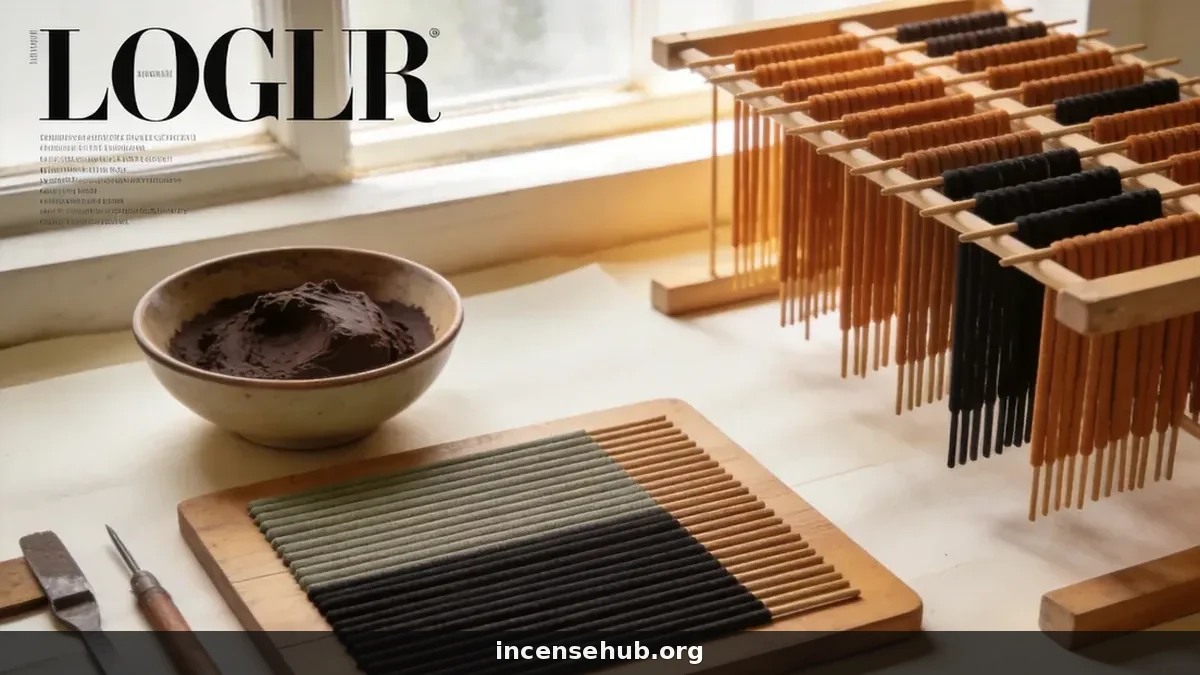
Direct answer: A formed stick leaves the table wet, soft, and aromatically undecided. Drying turns it into a solid object; curing turns that object into a single smell rather than a stack of separate ones. Both stages happen out of sight, and both are readable later in how the stick lights, how it burns, and how it opens.
Key facts: Fresh paste is held together by water, which has to leave slowly and evenly or the stick splits, bows, or traps water under a sealed skin. Once dry, a blend still needs rest before its materials stop reading as a list. No duration or moisture figure applies across the craft; both follow from the powder, the binder, the shape, and the room.
Key Takeaways
- “Drying” is two jobs wearing one coat: water has to leave, and the blend has to settle. Only the first is about water.
- The classic defect is a footrace. The outside shrinks while the inside is still swollen, and something has to give.
- A sealed skin is worse than a split. It makes a wet stick pass an inspection.
- Rest is work, not storage. Molecules spread, some react with air, and the stick stops interrupting itself.
- The Chinese recipe tradition writes the wait into the instructions as 窨, which is what a culture does when it counts time as a material.
- Directions travel; digits do not. Humidity, thickness, and binder load move every figure.
- Heat is the enemy at every bench from the mill to the rack, because whatever smells good is also what evaporates.
- A better-made stick burns more evenly, and even burning still fills a room with particles. Open a window.
Two Stages, One Determined Difference
Direct answer: Water leaves in one stage, and in the other the mixture stops contradicting itself. Nothing about the second is implied by the first.
A fresh stick is two problems in one object. As a structure it is useless: soft, damp, unwilling to hold an ember. As a scent it is a committee, with each material speaking over the others. The rack solves the structure. The jar solves the committee.
This is the distinction that pays for itself, because it turns a vague complaint into a question. Something wrong with the body of the stick — a bend, a split, an ember that sulks — belongs to the drying room. Something wrong in the nose — a first minute that never blends into a second — belongs to the rest. A buyer who cannot make that split ends up blaming the recipe for a scheduling problem, or the schedule for a formula that was never balanced.
Drying: A Race Between Skin and Core
Direct answer: Damage during drying comes from a speed difference, not from wetness itself. When the outside loses water faster than the inside, the two zones stop fitting together.
Track it step by step. Water leaves the outer layer → that layer contracts → the interior is still carrying water and still expanded → the set skin is now too small for the body it covers → the mismatch releases as a split, a hairline, or a bow. Every crack in a dried stick can be traced back along that line, and so can every bend.
A second route runs through the same room. Drive the drying hard and the surface can close into a crust while the interior is still wet → the crust slows the exit → the stick feels dry and is not → the flame struggles, the ember weakens, and a sealed box can grow mold. A sealed skin is harder to catch than a split, because it presents as a finished stick.
Rhythm, not total time, is what the maker manages: enough air to carry moisture away, spread across every face, with nothing so warm that the surface outpaces the core. Traditional shops use shaded moving air and turn the rack; industrial rooms use the same logic with sensors. Neither method is inherently better — what matters is whether the surface and the interior stay in step.
The Three Kinds of Water in a Wet Stick
Direct answer: Water leaves a formed stick in stages because it is held in three different ways, and the last stage is where the craft’s risks concentrate.
Free water sits in the open gaps between particles. It leaves easily, which is why a fresh stick sheds most of its weight early and why the first hours of drying feel forgiving. Capillary water occupies narrow channels and pores; it has to travel to reach a surface and leaves more slowly, keeping the interior plastic after the outside has stiffened. Bound water is held by the binder’s starch or fibre and needs the most energy to move, which makes it the last fraction to leave and the one that decides whether a stick is stable in storage.
That structure produces a curve with two personalities. Early on, everything is moving and small differences in air speed barely register. Later, the surface is rigid and the remaining water has to migrate through set material, so the risk of internal stress climbs while the visible drying slows. Improvised schedules tend to fail exactly here: they push at the start, when nothing needs pushing, and ease off at the end, when the stress is highest.
No proportion between the three kinds belongs in a general article, because the split follows the powder, the binder, and the mixing water. The shape of the curve is what travels between workshops, and the practical warning is that the quiet final phase is the one that decides the batch.
What a Bad Dry Looks Like
Direct answer: A dried stick carries a record of how it dried, and most of that record is legible before you light anything.
| What you see | What it points to |
|---|---|
| A long, even arc down the length | One face gave up its water first |
| A split at the tip, or a hairline below it | The skin set while the centre was still swollen |
| Surface reads finished, the flame sulks | A sealed shell over a wet middle |
| Ends dusty, centre still giving | Air reached the tips and missed the middle |
| Half the box good, half suspect | Each stick dried on its own schedule |
| Grey bloom a month later | Water left inside, in still air |
This is a diagnostic table, not a grading scale. A slight curve is not a defect in every tradition, and a straight stick is not proof of a careful dry — it can be perfectly straight and still hold water in the middle. What the marks give you is a direction to look, which a sealed box otherwise withholds.
Curing: Fusion, Not Waiting
Direct answer: Curing is the interval in which a mixture stops behaving like a list. The materials are still there; what changes is whether the nose can separate them.
Take a blended stick that has just finished drying and burn it. The experience tends to arrive in layers: resin first and loud, wood underneath, a floral or herbal note floating above both without connecting to either. This is not a flaw in the recipe. It is what an unsettled mixture does, in the same way that a fresh stew tastes of its parts and a rested one tastes of itself.
The Chinese craft gives the interval a name and a place in the procedure. 窨 covers maturing a blend, and the term is shared with the scenting of tea, where one material is left to take on another’s character. Recipes treat the wait as an instruction alongside proportions: the 江南李主帐中香 formula records that the mixture should be aged a long while (久窨) before use. Once a culture writes the wait into the recipe, it has stopped treating time as overhead. The compositional logic behind those formulas is laid out in the 合香 system; the recipe library shows how often an ageing instruction turns up.
What makes curing hard to teach is that nothing visible happens. There is no colour change that reliably marks readiness, no test that gives a date. A maker works from experience with a given formula: how it smelled on day five, how it smells now, whether the edge has softened enough to suit the intent.
What Actually Changes During Rest
Direct answer: Rest does three separate things to a blend, and lumping them together is why the stage is so often described in vague language.
The first is redistribution. Aromatic compounds evaporate at different rates, and in a fresh stick the fastest ones dominate the opening. Given time inside a sealed mass, they spread through the material instead of sitting at the surface, so the first minute of a burn becomes less of a shout. Nothing has been added or removed; the same molecules are simply arriving in a different order.
The second is slow reaction with air. Oxygen works on the more reactive aroma molecules over weeks, softening harsh edges and shifting green or sharply resinous notes toward something drier and sweeter. Heat cannot substitute for this, because heat drives the compounds off rather than letting them change. It is the part of curing that a schedule can only approximate.
The third is mechanical. A rested stick holds its shape better in the flame, smoulders more evenly, and tunnels less. Some of that is the last of the water equalising through the body; some is the binder completing a slow set that no drying room can hurry. A stick that behaved unpredictably in its first week often behaves well in its fourth with no change to anything but time.
In a workshop these effects overlap, and no one separates them. For a reader, the useful split is diagnostic: a sharp opening suggests redistribution has not finished; a lingering harshness that never softens points to the material or the processing rather than to a short rest.
Why Nobody Can Give You a Number
Direct answer: Every moisture target and rest period is a local decision, and a page that quotes one figure for all incense is describing a habit rather than a standard.
Four variables move the answer. The powder: a resin-rich mix holds water differently from a lean wood mix. The binder: one that gels keeps water longer than one that does not. The form: a thick coil carries more water and releases it over a longer tail than a thin stick. The room: humidity and air movement change the last phase of drying more than the first.
Because those four interact, two workshops following the same recipe can need different schedules and both be right. A maker in a wet season who finishes with controlled warmth and a maker in a dry season who never heats anything may produce comparable sticks, and neither schedule would work in the other’s building.
What transfers is direction. More air movement speeds loss. More heat speeds loss and costs aroma. Thicker forms take longer. More binder means a longer tail. A maker who knows the directions can build a schedule for their own room; a maker who copies a forum number inherits a stranger’s climate along with it.
The same reasoning applies to rest. A blend built for brightness is often used early; a blend built for depth is left for months. When a recipe names a long ageing step, it records a decision made for that formula, not a rule for the craft.
Heat Is the Shared Enemy of Drying and Grinding
Direct answer: Aromatic compounds evaporate, and heat makes them evaporate faster. That single fact ties the grinder, the drying rack, and the curing jar into one problem.
Grinding creates heat through friction, so careful powder work runs in short passes and lets the material cool between them. Drying applies heat from outside, which adds a second risk: in a wet mass, warmth can carry volatile compounds away with the water leaving the surface. A hot room therefore removes water faster and removes the lightest part of the aroma at the same time.
The failure is quiet. The stick’s body is fine, the colour is normal, and nothing cracks. What is missing is the top of the profile, and it cannot be restored later. This is why shade and moving air are preferred wherever the climate allows, and why a maker with a heated room treats temperature as a limit rather than a setting.
The chain continues upstream. Powder production makes most of the aromatic decisions, and the drying room can only preserve or waste them, which is why the two stages are described together in how incense powder is made.
The Binder’s Double Life
Direct answer: The binder is both the skeleton of a stick and a reservoir of water, and those two roles explain why identical powders can dry to opposite results.
Mechanically, a natural binder such as makko supplies the fibres and particles that everything else grips. When the mass contracts, that skeleton takes the load. A binder that is well sieved and fully dispersed spreads the load evenly, so shrinkage happens without local stress. A coarse or poorly mixed binder leaves soft spots, and the stress concentrates there until the stick fails.
Chemically, the same material holds water. It absorbs at mixing and releases slowly afterwards, which is why binder-rich sticks need longer tails in the drying room and why they tolerate more residual moisture later without becoming brittle. The two roles are not separable: change the binder to fix cracking and you change the drying curve as well.
For a maker, most of the leverage sits before the rack. Sieve the binder, hydrate it fully, and mix until it is evenly distributed; the drying stage then has less to fight. For a buyer, a single cracked stick means little, while a pattern of cracks in the same place points at this interaction rather than at the fragrance. The material itself is covered in the makko and natural binder guide.
Drying Routes Compared
Direct answer: Shade, sun, and controlled warmth are three different tools rather than three intensities of the same one, and each trades speed against what survives.
| Route | What it does | Where it suits | What it costs |
|---|---|---|---|
| 阴干, shade and still air | Draws moisture off slowly, under cover | Small runs, delicate recipes, damp climates with patience | Time, and a schedule set by the room rather than the clock |
| 晒干, direct sun | Strips free water quickly with light and breeze | Sturdy shapes, dry seasons, utility grades | The lightest notes, and a skin that can tighten ahead of the middle |
| 焙, gentle applied heat | Gives the batch a controlled finish | Wet seasons, repeat runs, thicker shapes | Attention; a little too much and the surface seals |
Production usually combines them: a shaded period for the bulk of the water, then a controlled finish. The order matters more than the label, because the objective never changes — keep the outside from setting before the inside has moved.
The vocabulary is a useful signal in itself. A language that names shade, sun, and heat separately is describing three techniques with different risks, not one technique at three speeds. When a supplier says “naturally dried”, the honest follow-up is which of the three they mean; sun drying is natural, and it is also the hardest on delicate material.
A Seasonal Reading
Direct answer: Weather does not change the goal, it changes the schedule, and a maker who ignores the season is really letting the season decide.
Wet months slow the final phase, when the remaining water has to travel through set material to escape. The temptation is to compensate with heat, which is exactly the wrong lever, because it sets the surface harder and drives aroma off. The safer compensation is air: more movement, more turning, and a longer shaded period before any warming.
Dry months invert the problem: water leaves the skin so quickly that the skin can seal before the rack is full, and thin forms suffer first. Slowing the air or working in a cooler hour does more good than any instrument.
Between the seasons sits the ordinary case, which is where most production lives: moderate air, moderate temperature, and a maker watching the rack rather than the calendar. The point is not that weather is destiny; it is that a schedule copied from a different climate is a guess wearing the clothes of a method.
Moisture and the Burn: Direction, Not Digits
Direct answer: The right level is local; its effects are not. A damp stick fights the flame and risks mold, an over-dried one shatters and burns too fast.
At the wet end, everything is reluctant. The flame takes hold badly, the ember crawls, the stick may go out between puffs, and a sealed box gives mold a place to start. At the dry end, everything is impatient: the stick snaps under light pressure, catches quickly, and delivers its whole arc in less time than intended, which flattens the middle of the profile where most of the interest lives.
Between those failures sits a window the maker picks per formula. Resin-rich and binder-heavy mixes tolerate more residual water; lean, high-wood mixes turn brittle sooner. The window is narrow enough that small workshops judge by feel and weight rather than by timer, and consistent enough that a batch can be checked for internal agreement.
Two field tests need no instrument. Weight in the hand: a dried stick should feel light for its size, and sticks in one box should match. Flex: a properly dried stick gives slightly before it breaks, while an over-dried one snaps without warning. Neither gives a figure, and both catch the fault that matters most, which is a box whose sticks disagree with each other.
Disclosure, kept in the body: a well-dried stick burns more predictably and still produces smoke and fine particles. Ventilation and session length matter for good stock as much as for poor stock.
Reading a Shelf Product
Direct answer: The stages are invisible, and their consequences are not. A finished box still tells you something about both, if you read behaviour rather than appearance.
| Signal when you burn it | What it suggests |
|---|---|
| Sharp, layered opening that softens after minutes | Young stock, or a short rest |
| Thin from the first moment | Possible heat damage upstream, in drying or grinding |
| Sticks differ in weight, flex, or shade within a box | Uneven drying across the rack |
| Cracking clustered at the tips | Air or heat arriving from one side |
| Musty note under the fragrance | Storage moisture rather than a stylistic choice |
| Round profile, steady ember, repeatable across sticks | Time was given to both stages |
None of this is proof. A lifted opening can be deliberate, and a quiet stick can be a light formula honestly made. In practice the table is most useful as a set of questions rather than verdicts, and it is worth saying that a well-rested stick is not automatically a better one — it is a different one, matched or mismatched to what the maker intended.
Where the Buyer’s Leverage Ends
Direct answer: A buyer can read evidence of drying and curing, and cannot audit either. Knowing where that line sits keeps the conversation honest in both directions.
You cannot test moisture through a sealed box. You cannot date a rest by smell, because different schedules can arrive at similar places, and you cannot tell a careful slow dry from a lucky one after the fact. What can be judged is consistency — the property that most directly reflects process discipline. A maker who controls the room produces sticks that agree with each other; a maker who does not leaves variation in the box.
The line cuts both ways. It stops a buyer from asserting things about stages nobody witnessed, and it stops a seller from dressing a rushed batch in tradition. The workable middle is a question about conditions rather than a request for a number: was the batch dried slowly, and was it rested before packing? A seller who answers with specifics is describing a process even when the specifics cannot be verified.
What Rest Cannot Fix
Direct answer: Curing improves integration, and it cannot rescue proportions, materials, or heat damage. Knowing that boundary saves buyers from expensive patience.
Four failures survive any amount of resting. A blend whose chief material is too weak stays weak; the rest may smooth it, and the absence will still be audible. A material that arrived already degraded — stored damp, overheated in transit, ground too hot — does not recover, because the compounds that were lost are lost. A stick dried into a crust keeps its trapped moisture and its poor ignition. And a formula whose proportions were wrong stays wrong, only more politely so.
The distinction matters because “it just needs time” is the most convenient explanation in the trade. Sometimes it is true: a young stick with a sharp opening genuinely softens. Sometimes it is a way of deferring a defect until the buyer has stopped asking. The test is repeatability — a stick that improves over a month is curing; a stick that starts thin and stays thin was never going to arrive.
For a buyer, the practical use is a rule of thumb: buy the first box on behaviour, and judge rest only by change over time within that same batch. If the second stick from the same box, burned a month later, behaves better, the rest is real. If nothing changes, time was not the missing ingredient.
What the Two Stages Cost the Maker
Direct answer: Waiting is not free. The stages that decide quality also consume floor space, calendar time, and working capital, which is why they are the first thing a pressured workshop shortens.
A drying rack is inventory that cannot be sold yet. Every square metre holding sticks is a square metre not holding finished boxes, and the slower the dry, the longer that space stays occupied. Cure a blend for months and the material sits idle while the next order waits behind it. None of this appears in a price list, and all of it shapes the product a buyer receives.
The pressure has a predictable shape. Orders cluster, a large batch arrives at once, the rack fills, and the only lever left is speed. That is the moment when a heated finish gets pushed too far, when sticks are packed before their rest is done, and when the variation inside a box appears. A workshop that plans capacity around the slow stage avoids the problem; one that treats the slow stage as slack creates it.
For a buyer, this explains a pattern that otherwise looks arbitrary. Small workshops often produce more consistent sticks than large ones, not because their recipes are better, but because they can afford to let a batch sit. Scale is not automatically an enemy of quality. Scale without reserved space and reserved time is.
The same arithmetic explains why a supplier’s answers about the slow stage reveal more than their answers about fragrance. A seller who can say how much rack space a batch occupies, and how the schedule holds when orders stack up, is describing a workshop that has thought about the constraint. A seller with no answer has either never needed one or never noticed, and both possibilities matter more than the adjectives in the description.
What the English Word Hides
Direct answer: “Curing” is borrowed from leather and tobacco, and the loan carries assumptions that do not quite fit a stick of incense.
In those industries curing means a chemical set — a material becomes a different material. A blend of aromatics does not become a different substance; it becomes a more integrated version of itself. The molecules are the same ones that were there on day one, rearranged in time and partly altered by air. Calling that curing is convenient and slightly misleading, because it suggests a threshold that can be declared.
The Chinese term carries no such promise. 窨 describes a stay in a container, and it is used wherever one material is left to take on the character of another — including tea scented with flowers. Nothing in the word implies that the process terminates at a fixed point. That is closer to what actually happens: a direction of change that the maker stops at a chosen moment.
The practical correction is small: ask not “is it cured?” but “how long did it rest, and what changed?” The first invites a yes, the second a description.
Common Mistakes
Direct answer: Most bad reasoning about this stage comes from compressing two processes into one word, then expecting a single number to describe both.
The first mistake is treating drying as passive. Nothing about it is passive: the rate, the air path, and the temperature are decisions, and an uncontrolled room makes them by default.
The second is using the two terms interchangeably. Water removal and aroma integration fail differently and are fixed differently. A stick can be dry and raw at once, and that combination confuses more buyers than any other.
The third is assuming dry means ready. Dryness is a structural threshold. Whether the blend reads as a whole is a separate question answered by the nose.
The fourth is expecting a universal figure. No shared moisture percentage or rest period covers different powders, binders, and climates. Quoted numbers usually describe one workshop’s conditions at one time of year.
The fifth is blaming the recipe for a rushed batch. A thin, sharp, or disjointed scent is often a stage problem, and reformulating to fix it treats a symptom. There is a common myth that a bad smell always means bad materials; in practice the stages are the cheaper explanation far more often.
A Buying Checklist
Direct answer: Ask about the process in the order the process happens, and listen for conditions rather than adjectives.
- Route. Shade, sun, or applied heat, and whether it changes with the season. A humid workshop with no controlled finish is either careful or vague.
- Agreement inside the box. Whether sticks match each other in weight and flex. This is the one claim a buyer can check at home.
- Rest before packing. Whether a rest happens at all, and roughly how it is decided. The exact period can stay private; the existence of a decision matters more.
- Binder. Which one, and roughly how much, because binder and drying pull on each other.
- Storage guidance. Whether the seller mentions humidity and mold, or only fragrance.
Three specific answers are worth more than five enthusiastic ones. A seller who describes conditions has a process; a seller who describes moods has a brochure.
FAQ
Q: What separates drying from curing?
Drying is plumbing; curing is blending. The first takes out the water that let the paste hold a shape, and stops when the stick can stand, light, and keep an ember. The second is a rest during which the materials stop announcing themselves in turn. A stick fresh off a rack can pass every physical test and still smell like three separate products in one tube.
Q: How long should a blend rest?
Long enough for the recipe, which is another way of saying there is no shared answer. Recipes built for a bright, high opening are often used young; recipes built for depth are left for months. When a classical formula specifies a long ageing step, it is recording a choice made for that formula. Anyone quoting one period for all incense is describing their own shelf, not the craft.
Q: Why does a stick split or bend while drying?
Because one part of it lost water before another. The outer layer contracts while the core is still swollen, and the difference has to escape somewhere: a split where the material is weakest, a curve where one face dried ahead of the other. A hard, fast dry makes it worse by sealing the outside first. Slow air on all faces is the reliable fix, and it cannot be replaced by a longer dry at the same speed.
Q: How does moisture level change the burn?
In one direction, consistently. A damp stick resists the flame, crawls, and risks mold in the box. An over-dried stick shatters easily and burns fast, delivering the whole arc before you have settled into it. The comfortable middle depends on the powder and binder, so the useful knowledge is the direction, not a figure.
Q: Is longer always better when it comes to rest?
No, and the assumption causes real disappointment. Rest keeps moving the balance of volatiles, so a blend designed for a sharp, lifted opening will lose that edge if left too long. That is not spoilage; it is a different product from the one the maker intended. The right duration is the one the formula was built to reach.
Sources
- A synthesis of ordinary workshop practice: slow and even water loss, the behaviour of skin against core, and the way aroma settles during rest.
- Traditional 合香 material covering the maturing step 窨, including recipes that instruct the maker to age a blend before burning.
- US EPA, indoor air quality — background on what indoor burning puts into a room.
- American Lung Association, indoor pollutants — a plain account of fine particles indoors.
Related Resources
- The making sequence, end to end — this stage in its place among the others.
- Powder before paste — how grinding decisions set what the rack can still save.
- Batch checks and tolerances — what a finished run should be measured against.
- Keeping stock after the rack — humidity, seals, and the slow drift of aroma.
- Binders that hold water — the material at the centre of every cracking argument.
Summary
Direct answer: Drying makes a stick possible; curing makes it coherent. Neither is decoration on the process, and neither can be judged from a sealed box.
The physical story is a race between skin and core, run slowly enough that neither outruns the other, with the quiet final phase carrying most of the risk. The aromatic story is a slow redistribution in which volatiles spread, some react with air, and the blend stops interrupting itself. The tradition names that wait, writes it into recipes, and treats it as an ingredient rather than a delay.
What a reader can carry away is diagnostic. A split belongs to the drying room, a sharp and layered opening to a short rest, a thin aroma to heat somewhere upstream, and variation inside a box to process control. That is more than a finished product usually offers, and it is enough to ask a question a maker can actually answer.