
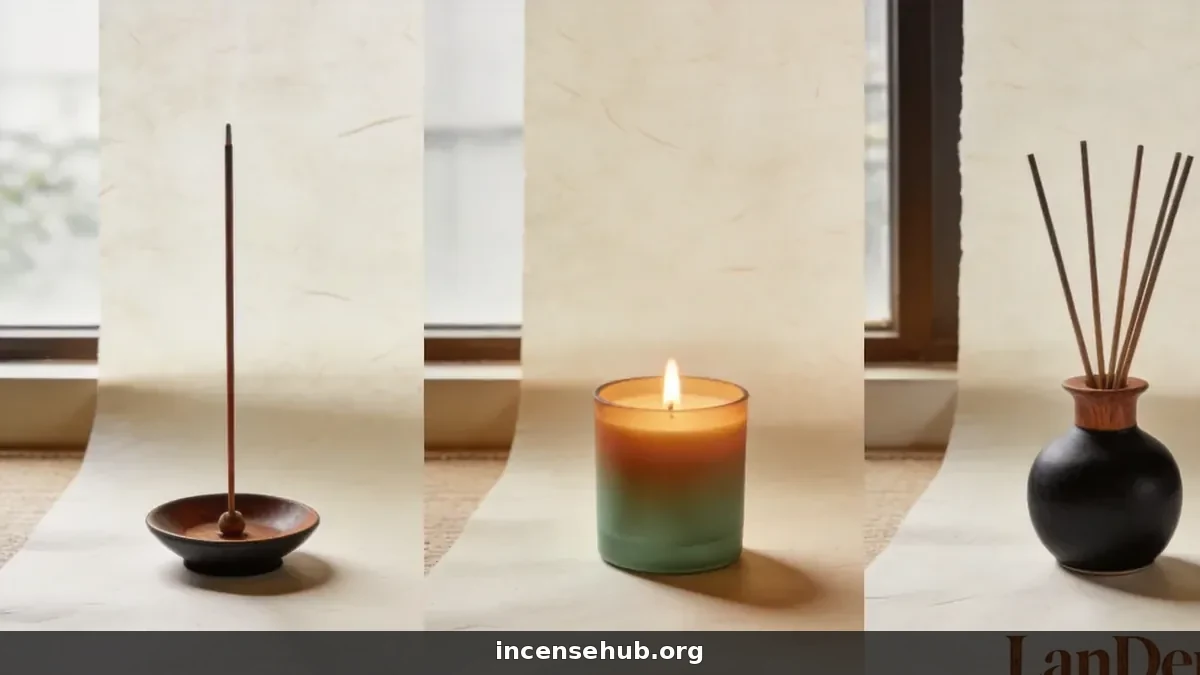
Direct answer: Incense burns a solid aromatic material, a candle burns wax, and a diffuser evaporates oil without burning anything. The choice follows from what the room can absorb and how long you want the scent to last: a short supervised burn, hours of flame with light, or an untended background level.
Key Takeaways
- Three formats, three energy paths: an ember, a flame, and room-temperature evaporation or a vibrating plate.
- A diffuser has no soot and no plume to account for, because there is no flame to make either.
- Thin smoke is not the same as no smoke — burning wax still releases fine carbon.
- None of the three filters air; a diffuser merely adds scent to what is already there.
- Ritual weight and convenience pull in opposite directions, and most buyers are really choosing between those two.
Three Fuels, Three Physics
Direct answer: Each format releases scent by a different physical route, so the comparison is not three brands of the same thing but three separate systems that happen to end in a smell.
Incense is the only one that consumes a solid aromatic material. Heat from the ember drives volatile compounds out of the plant matter and binder just ahead of the burn line → those compounds condense into the visible plume → the plume carries both the aroma and the combustion notes that come with charring. That is why an incense stick can smell resinous and smoky in the same breath: the smoke is not a side effect to be apologized for, it is the vehicle. A bamboo core adds its own burnt-wood character; a coreless extruded stick carries only the paste, so the note stays closer to the material.
A candle works as a small heat engine. The flame melts a pool of wax → liquid wax climbs the wick by capillary action → the fuel vaporizes and burns in the flame zone → fragrance leaves the pool surface and the hot wax around the wick. The wax is fuel and fragrance reservoir at once, which is why the wax type and the fragrance load cannot be judged separately.
A diffuser removes the fire from the sequence entirely. Fragrance leaves a liquid surface at room temperature, or a plate vibrating at high frequency breaks a water-and-oil mixture into a mist. Nothing oxidizes, nothing chars, and no flame shapes the smell.
| Incense | Candle | Diffuser | |
|---|---|---|---|
| Fuel consumed | Aromatic plant material, binder, sometimes a bamboo core | Wax plus wick | None — oil is carried, not burned |
| Energy source | Glowing ember | Open flame | Room heat, or a vibrating plate |
| What carries the scent | Smoke | Warm vapor off the melt pool | Evaporating oil, or a water mist |
| What the room has to absorb | Ash, smoke, a lingering char note | Soot, heat, spent wax | Oil film and water; nothing combusted |
Read the last row first. It is the row that decides more purchases than the scent description does.
Start With What the Room Receives
Direct answer: Ask what byproduct the space can tolerate, and the three-way question collapses: a visible plume, an open flame with a thin soot tail, or nothing burning at all.
Most buyers begin at the wrong end, with the fragrance. The fragrance is the easy part; the constraint is the delivery. A room with a working window and a patient household can take a plume. A room with a low ceiling, a smoke detector near the door, or a sleeping child cannot. A room with no window can take a diffuser and very little else without some mechanical air movement.
The question “do I want smoke?” is useful because it is the one axis on which the three genuinely differ, rather than merely varying in degree. Say yes and only incense qualifies. Answer no, and the field splits again on whether you will accept a flame.
| Your constraint | The fit | Why it follows |
|---|---|---|
| Visible smoke is unacceptable | Diffuser | No combustion, so no plume and no soot |
| An open flame is unacceptable | Diffuser or incense | An ember is not a flame, but it is still a live heat source |
| You want light and scent from one object | Candle | The flame supplies both |
| You want a defined beginning and end | Incense | The stick’s burn sets the session length |
| You want the room scented all day, untended | Diffuser | It runs while filled and powered |
| You want the least equipment | Incense | A stick and a heatproof holder |
The second row deserves a note. An incense ember is not an open flame, but it is not “flameless” in the sense a diffuser is: it glows, it can reignite, and it drops ash. That distinction matters for rental agreements, insurance wording, and households with curious pets.
What Each One Leaves in the Air
Direct answer: Combustion is the dividing line for airborne residue, and the three sit on it in a fixed order — diffuser adds none, candle adds a thin soot, incense adds a visible plume.
A flame is never perfectly complete. Wax vaporizes, rises into the flame, and burns; at the flame tip and in the cooler zone around it, some carbon escapes before it can oxidize. That carbon is soot, and soot is what settles on a shelf above a candle and what tints the wall behind it after a winter of evening burns. The chain runs: melt pool forms → vapor rises into the flame → combustion is incomplete at the tip → fine carbon leaves with the exhaust → the particles cool and deposit on nearby surfaces.
Incense follows the same logic at a larger visible scale. The ember pyrolyzes material ahead of it, the plume carries condensed oils and carbon, and the room receives both aroma and particulate. The output is obvious, which is an advantage in one sense: nobody forgets that a stick is burning.
The diffuser sits outside this chain because nothing oxidizes. A reed diffuser evaporates oil from a wetted surface; an ultrasonic unit aerosolizes a diluted mixture. No soot, no plume, no ash. Beyond that, the packaging should promise little: scent goes in, and no filtration or neutralizing happens at any stage. “Purifying” language on a fragrance product describes the smell, not a mechanism.
This is an editorial distinction, not a laboratory claim: “clean” here means “no combustion byproducts”, and nothing more.
Flameless does not mean emission-free. Mist and evaporated oil still enter the air; what disappears is the fire, not the output.
Sticks, Cones, and Coils: The Dose Question
Direct answer: Incense is a family of geometries rather than one product, and the shape sets how fast material is released — a variable that matters as much as the scent.
A stick is a thin column: the ember front stays small → material is heated a little at a time → output is steady and the burn is easy to time. A cone is dense and short, and its ember front widens as it descends → more material burns at once → output per minute climbs and the session is short and dense. A coil is a long extruded spiral → the ember travels a long path → the burn stretches across hours at a lower rate, with a total output that can still be large. Same paste, three dose curves.
The practical consequence is that “incense is too smoky for this room” often describes a geometry mismatch rather than the material itself. A full stick in a bathroom, or a coil in a sealed bedroom, uses up the room’s air faster than ventilation can replace it. Break the stick, use a short cone, or move the coil to a larger, aired space.
This does not mean a smaller piece is always the better choice — a cone’s intensity suits a large room or a brief clearing, where a thin stick would barely register. Match the shape to the space, then choose the scent.
Room by Room
Direct answer: Volume and air exchange decide the format more reliably than mood does, because a small sealed room multiplies whatever you release into it.
| Space | Best first choice | Reasoning |
|---|---|---|
| Small bathroom | Short incense cone, or a small diffuser | Low volume, often poor extraction; a full-size stick or candle overwhelms it |
| Bedroom | Diffuser | No flame and no ember to manage while you sleep |
| Open living room | Candle, or a diffuser for all-day scent | Larger air volume needs a sustained source, not a short plume |
| Windowless office | Diffuser | No combustion, and no window to clear smoke |
| Rental with a no-burn clause | Diffuser | Nothing burns, nothing leaves ash or soot |
| Entryway or hallway | Reed diffuser | Passive, constant, and needs no outlet |
A still room concentrates. A drafty room dilutes, which cuts both ways: smoke clears faster, and a diffuser’s output may never build to a noticeable level. Before choosing, notice whether air moves through the space — an open window, a door that is always ajar, a ceiling fan, an extractor. That single observation predicts satisfaction better than the scent pyramid on the box.
How Flameless Scent Actually Works
Direct answer: Reeds and ultrasonic plates are two different machines with one shared property — fragrance reaches the air by evaporation or dispersion, never by burning.
A reed diffuser is a passive wicking rig. Oil climbs the narrow channels inside each reed by capillary action → the exposed upper surface stays wet → oil evaporates from that film into the room → the rate is set by how many reeds are exposed and how much air moves past them. The mechanism also explains the most common complaint. Once the channels are saturated and the exposed surface has thickened, evaporation slows → the scent fades while the bottle still looks half full → turning the reeds exposes a fresher surface, and replacing them restores the rate properly.
The ultrasonic type is powered and active. A plate vibrates at high frequency under a water-and-oil mixture → the surface breaks into a fine mist → the mist carries oil droplets into the room air → the water evaporates and leaves the fragrance behind. Oil does not dissolve in water, so what sits in the reservoir is a dispersion, not a solution; that is why the water level and the plate’s cleanliness both matter, and why a mineral film eventually dulls output. Wipe the plate, empty the reservoir between uses, and do not run it dry.
Both devices share a limit worth stating plainly: “set and forget” describes the fire risk, not the maintenance. Reeds need turning and eventual replacement; ultrasonic plates need cleaning; oil needs topping up. The upkeep is light, but it is not zero, and a neglected diffuser is one common reason people decide diffusers “don’t work”.
Candle Craft: Wax, Wick, Pool
Direct answer: A candle is a balance of three parts — wax, wick, and fragrance load — and every visible fault, from soot to tunneling, is that balance failing somewhere.
| Wax | Burn character | Fragrance behavior | Practical consequence |
|---|---|---|---|
| Paraffin | Hot, bright, steady | Carries a heavy load well | Can soot more; ventilate and trim |
| Soy | Cooler, slower, softer | Throws gently, sometimes faintly | Cleaner-looking burn, quieter scent |
| Beeswax | Hot, bright, long-burning | Limited load; own honey note | Expensive, and the wax speaks for itself |
| Coconut and blends | Slow, creamy | Often blended with soy for balance | Soft burn, variable quality |
The wax table is not a health ranking; it is a description of what the flame is consuming. A paraffin candle can hold a strong fragrance load and throw it across a room, at the cost of more soot if the wick is neglected. A soy candle burns cooler and often throws more softly, which some buyers read as “weak” when it is simply a different fuel. Neither fact makes one wax superior in the abstract.
The first burn sets the pattern for the candle’s life. On the first light, the flame melts a pool → if that pool reaches the container’s edge, the wax wall thins evenly to the rim → later burns follow the same ring and consume the candle evenly. If the first burn is cut short, the pool freezes as a narrow circle → every later burn follows that circle → the wick sinks and the outer wax is never reached. That is tunneling, and it is a formation problem, not a defect that appears later.
Wick length is the throttle. An untrimmed wick mushrooms at the tip → the flame grows to consume more fuel than it can burn cleanly → incomplete combustion throws soot and the pool overheats → the throw turns uneven and the glass blackens. Trim to a few millimeters before each light, and the flame returns to a small, steady shape with an even pool.
Read the flame as a report. Tall, flickering, and smoking means over-fuelled. Low and guttering in a deep pool means the wick is drowning. A steady medium flame with a clear pool edge means wax, wick, and fragrance are in balance.
The Scent Is Not the Same Scent
Direct answer: The same fragrance name in three formats gives three different smells, because combustion, warm wax, and cold evaporation each reshape what reaches the nose.
A sandalwood stick carries a charred, resinous edge because part of what you smell is the burn itself. The same sandalwood in wax arrives rounded and warm, softened by the fat note of the pool. In a diffuser it reads cooler and more literal, closer to the raw oil, with the top notes intact for longer. None of these is the “true” version; each is the material filtered through a delivery method.
The common misconception is that a fragrance is a fixed quantity poured into three containers. The container is part of the recipe, not a neutral vessel for it. The formula is not the same either: a candle fragrance must survive flame heat and a wax medium, an incense paste is built to release volatiles as the ember passes, and a diffuser oil is designed for cold evaporation and, in ultrasonic units, dilution in water. Pouring a candle fragrance into a diffuser is not a like-for-like swap, and it may not disperse well at all.
The practical rule: choose the delivery for the character it adds. The quietest error in this comparison is assuming a delivery method leaves a fragrance untouched.
Cost in Shape, Not Numbers
Direct answer: The three differ less in sticker price than in how spending is distributed — per session, per hour of flame, or one device plus a slow consumable.
Incense is bought as a box and spent one stick at a time. The cost is granular and tracks how often you light up; a box can last months for a twice-weekly user and weeks for a daily one. A candle is a single object consumed over its burn hours, so a larger candle spreads its price across more evenings — provided it burns evenly and does not tunnel away half its wax. A diffuser splits into a device, a recurring oil or reed purchase, and, for ultrasonic units, electricity.
That shape produces three different questions. For incense: how many sessions per box? For a candle: how many clean burn hours before the pool misbehaves? For a diffuser: how many weeks of real output does one refill give before the reeds go flat? A per-purchase comparison flatters the candle and the diffuser; a per-use comparison usually flatters incense, and a per-month comparison depends entirely on habit.
Two hidden costs are worth naming. Tunnelled wax is paid for and never burned. A full stick lit in a small room is scent you did not need and smoke you did not want — the cheap format can be the wasteful one when the dose is wrong.
Time and Rhythm
Direct answer: The formats differ in how a session begins, peaks, and ends, and that arc often matters more than the scent itself.
| Moment | Incense | Candle | Diffuser |
|---|---|---|---|
| First minute | Scent arrives with the plume | Wax is still melting; little throw | Barely perceptible |
| Half an hour | Near the end of a short stick | Pool established, steady throw | Building toward a plateau |
| Two hours | Finished; room still holds residue | Still burning, unchanged | Constant, unchanged |
| Stopping | Burn out or extinguish | Blow out; wick smokes briefly | Unplug or remove reeds |
Incense is an event with edges. That is its appeal for a meditation session, a bath, or a transition between work and evening: the stick ends, and the session ends with it. A candle is a stretch of hours, and it suits an evening that is already long. A diffuser is a background condition, and its weakness is that it has no climax — nothing marks the moment.
Failure Modes When Nobody Is Watching
Direct answer: Each format fails in its own way when left alone: an ember, a flame, or a reservoir of water beside electricity.
| Unattended | Incense | Candle | Diffuser |
|---|---|---|---|
| Heat left behind | A glowing ember | An open flame | A plate that runs warm |
| Solid residue | Falling ash | Re-solidified wax | Mineral film on the plate |
| What can go wrong | Ember contacts a surface or drops ash | Flame near curtains, pets, or a draft | Dry run, spill, or stale water |
| What to check | Holder, ash bed, nearby fabric | Wick, pool, clearance above | Water level, cable, plate |
The safety rules are not interchangeable either. Burning incense needs a heatproof holder on a stable surface, clear of fabric, and it should be extinguished before you leave the room or sleep — an ember can smolder quietly after the visible flame is gone. A candle should never be left burning unattended, and the wick should be trimmed before every light. A diffuser removes the fire question, which is a genuine advantage, but it introduces water near a power source and a device that can be knocked over.
Removing the flame removes one hazard and leaves others. Fire risk falls to zero; spill, electrical, and hygiene questions take its place.
Two Scents, One Room
Direct answer: Layering a candle and a stick, or a diffuser and a candle, rarely produces “the best of both” — it produces two delivery signatures and two residue sources in the same air.
Each format has a character that behaves like a filter: smoke, warmth, or cool mist. Two filters at once muddle the nose’s reading, and when both sources burn, their particles add up rather than cancel out. A candle for light plus a diffuser for scent is the one pairing that works reliably, because only one of the two is a combustion source and the diffuser’s output is easy to keep low.
The air rule applies to all three. Anything that burns releases material into the room → a sealed room lets that material accumulate → concentration, not the source alone, is what people notice → moving air carries it away and keeps the level low. Open a window, run an extractor, or use a fan. A diffuser benefits too: still air lets mist settle instead of spreading.
What to Check Before Buying
Direct answer: Each format has a short list of specifications that predict satisfaction better than the fragrance description does.
For incense, check the core. A bamboo-core stick is the familiar format and carries a woody note from the core; a coreless extruded stick is a column of aromatic paste and burns differently. Check the binder and the finish — dipped sticks carry fragrance on the surface, compounded sticks carry it through the paste — and buy a holder with an ash catcher rather than improvising with a saucer.
For a candle, check the wax, the wick, and the container. The wax tells you how it will burn and how loudly it will throw. The wick should be sized to the container’s diameter; a wick that is too small will tunnel, and one that is too large will overheat the glass. The container should be heat-tolerant and wide enough for a full melt pool.
For a diffuser, check the reed count and the oil volume. More reeds mean more surface area and a stronger output, which is not automatically better in a small room. Check whether the oil is ready to use or requires dilution, and whether the unit has a timer or auto-shutoff. For ultrasonic models, a removable, washable reservoir is worth more than an extra feature on the box.
FAQ
Q: What actually separates these three?
A: The energy path. Incense sustains a smoldering ember in solid plant material, a candle sustains a flame in vaporized wax, and a diffuser has no combustion step at all — oil leaves a liquid surface or a mist and drifts into the room. Everything else, including the smoke question, the ritual feel, and the maintenance, follows from that difference.
Q: Which one is cleanest?
A: The diffuser, in the narrow sense of adding no combustion byproducts. A reed diffuser evaporates oil passively; an ultrasonic unit disperses a diluted mixture as mist. No flame is involved in either. Burning wax leaves carbon whether or not you can see it, and a stick leaves an obvious plume. The word describes an absence of burning, not an ability to scrub a room; existing particles and smells stay where they are.
Q: Can I use the same fragrance oil in all three formats?
A: No, and this is a costly assumption in home fragrance. Candle fragrance is formulated to survive flame heat and to blend with wax. Incense fragrance is built into a paste that releases volatiles as the ember passes. Diffuser oil is designed for cold evaporation and, in ultrasonic units, for dispersion in water. An oil that performs well in one medium can fail in another — weak throw, separation, or a clogged wick.
Q: Is a candle with a stronger scent automatically better?
A: No. Fragrance load has to balance against wick size and wax type. An overloaded candle can smoke, tunnel, or throw unevenly because the wick cannot consume the fuel cleanly. A moderate, well-balanced candle often smells stronger across the room than a heavily loaded one that burns badly. Judge by an even pool and a steady flame, not by how intense the cold sniff is.
Q: Why does my reed diffuser stop smelling while the bottle is still half full?
A: The reeds have saturated. Once the internal channels are full and the exposed surface has thickened, evaporation slows even though oil remains. Turning the reeds exposes a fresher surface for a while; replacing them restores the rate. A stuffy room, a cold corner, or a bottle placed where air barely moves will also flatten the output.
Sources
- EPA — Indoor Air Quality: the agency’s indoor air pages, consulted for how combustion sources and airborne particulate are described.
- American Lung Association — Indoor Air Pollutants: a second reference placing candles and incense in the same combustion category.
- Editorial synthesis of format behavior; no therapeutic or air-purifying claims are made on this page.
Related Resources
- Incense vs Essential Oil Diffuser — combustion against vaporisation, worked through.
- Incense Sticks vs Candles — an ember’s smoke set against a wick’s soot.
- Incense vs Reed Diffuser and Wax Melts — three routes, one of them warmth without fire.
- Best Incense for a Small Room — dosing scent where the air volume is small.
- Chinese Incense vs Essential Oils vs Candles — material and method, compared at length.
- Incense safety — holders, ash, air movement, supervision.
Summary
The three formats are not rivals on a single scale. Incense converts solid aromatic material into smoke and gives a short, supervised, material event. A candle converts wax into warm vapor and light and gives an evening a duration. A diffuser lifts oil into the air with no fire and turns scent into a background condition.
Choose by the byproduct the room can take and the length of time you want the scent to exist. Then choose the fragrance, knowing that the delivery will change it. The ranking question disappears once the constraint is named.