
Direct answer: An incense shipment crosses two systems on its way to a warehouse: a physical one, where packing has to keep a fragile, aromatic product intact, and a legal one, where a trade term, a tariff code, and a destination rule decide who pays and whether entry is allowed. Fix the packing spec, the term, the code, and the destination check in that order, before booking.
Key facts: Three linked decisions carry this page — how the goods are packed, which trade term assigns cost and risk, and how the shipment is classified at the border. References point to the U.S. tariff schedule, the U.S. import authority, the ICC trade terms, and the body that maintains the classification system. Freight, duty, and transit figures are left out on purpose: they vary by lane, season, and product, and belong in a quotation for one shipment.
Key Takeaways
- Three duties share one carton: keeping the goods intact, keeping the scent in, and keeping the label lawful. They compete.
- A trade term is a risk map, not a price list; CIF is routinely read as if the seller carried the voyage.
- Classification decides both the rate and whether the goods may enter at all.
- Document checks compare pages against each other, so internal agreement is the real standard.
- Freight, duty, and transit figures are lane-specific and quoted per shipment; none are fixed on this page.
What the Package Is Actually Doing
Direct answer: Incense packaging has three simultaneous jobs — protect a fragile product, hold aroma inside the pack, and carry the labeling your market requires — and the three pull against each other more often than buyers expect.
| Job | In incense terms | Failure if skipped |
|---|---|---|
| Physical protection | Thin sticks fracture, cones lose their tips, coils flatten when stacked | Breakage allowance consumed; retail units unsellable |
| Scent retention | Volatiles in dried plant matter move into air and disappear | Delivered batch reads flatter than the approved sample |
| Legal and retail finish | Material disclosure, origin mark, warning text, shelf presentation | Consignment held, relabeled, or refused by the channel |
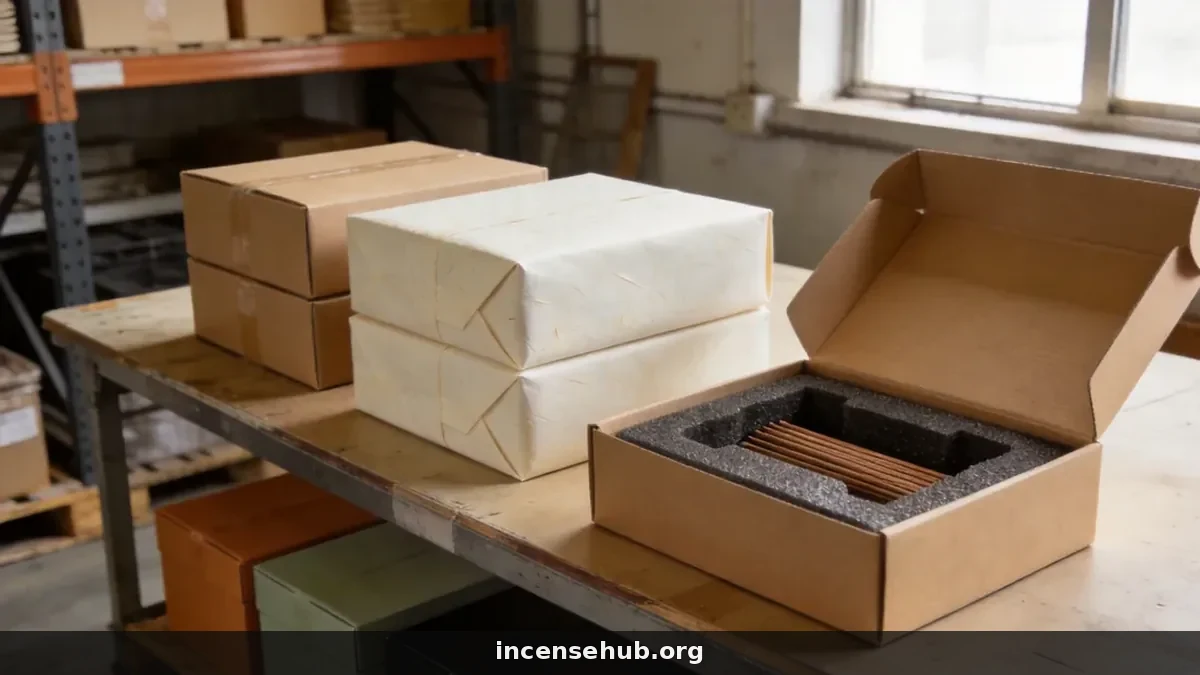
The conflict is structural rather than a matter of carelessness. A windowed retail carton displays the goods and, in doing so, interrupts the barrier at the one place a buyer will look. A double-wall shipper survives a rough pallet and then charges for its cube on the freight invoice. A foil pouch holds aroma beautifully and reads as packaging for spare parts on a shelf. Picking a pack means deciding which job leads for that channel, then checking that the loser is not damaged beyond repair.
Four questions settle most of it before a production run starts: whether the channel wants bulk or shelf-ready units, which barrier the material actually needs, what text the destination market requires on the pack, and how much breakage the buyer will accept as normal. A supplier who answers those in writing has given you something to inspect against. The post-arrival half of the problem — how long the product holds once opened — belongs with incense storage and longevity.
The Moisture Path: How Scent Leaves a Carton
Direct answer: Aroma loss in transit is a physical process, not a vague matter of freshness, and it runs through the same route every time: volatile compounds leave the botanical material, enter the air inside the pack, and are carried out wherever that air can escape.
Trace the route. Dried aromatic material holds volatile compounds within resin and cell structure → those compounds migrate into the headspace of any container that is not airtight → a carton that exchanges air with the outside refreshes that headspace continuously → every exchange removes a fraction of the aroma and admits humidity → the moisture softens the binder and dulls the surface → the stick that arrives is not the stick that was approved.
The barrier is the only interruption in that chain, and it has to be a real one. A plain polyethylene bag slows the exchange; a coated film or metallized foil with a heat-sealed closure reduces it much further. A desiccant pack handles moisture already inside the headspace, and it does nothing about vapor leaving the product, which is a distinction buyers miss when they specify “a desiccant” and consider the aroma question closed. The seal is the specification. The desiccant is a secondary control.
There is a second-order effect worth naming. A carton that sits in a hot container pulls its contents through repeated temperature swings, and warm air holds more moisture than cool air. As the box cools, that moisture condenses on the coolest surface available — often the product or the inner film. Goods can arrive damp in a carton that never touched water, which is why “sealed” and “dry” are different claims.
Matching Package to Product: A Grading Table
Direct answer: The right pack follows from two product properties — how fragile the shape is and how quickly it loses aroma — and the table below maps the combinations that actually occur.
| Product form | Main physical risk | Aroma sensitivity | Package that usually fits | What to check |
|---|---|---|---|---|
| Bamboo-core stick | Snapping at the thin end | Medium | Rigid box, foam or paper cradle, sealed inner bag | Whether the stick can flex against the box wall |
| Coreless stick | Bending and crushing | High | Rigid tube or sleeve, individual wrap | Wall stiffness, not just thickness |
| Cone | Crumbling at the tip | Medium | Molded tray or divided box | Movement inside the cavity |
| Coil | Deformation under stacking | Medium | Flat carton, sealed bag, no top load | Stack height on the pallet |
| Loose powder | Spillage and moisture pickup | High | Sealed jar or foil pouch inside a carton | Closure integrity after drop |
| Resin and chips | Drying, surface oxidation, sticking | High | Foil or vacuum pouch, jar | Seal quality at the zip or weld |
Read the table as a set of trade-offs rather than a menu. The coreless stick is the clearest case: it is thin, it has no bamboo core to hold it straight, and it is usually the most aromatic product in the range. That combination means the pack has to be rigid and sealed at the same time, and the cheap solution — a paper bag inside a box — fails on both counts. A coil is the opposite: flat, tolerant of stacking, and forgiving of a simple sealed bag, so money spent on foam cradles there buys nothing.
Fragility also decides how much of the breakage problem is solved by packaging and how much should be solved by accepting an allowance. A product that chips at the edge will chip at some rate no matter how it is packed; the honest move is to agree the rate in the purchase terms rather than to keep adding foam.
Incoterms: Where Risk Moves, Not Just Who Pays
Direct answer: An Incoterm is a three-letter contract term that fixes two things at once — which costs each side bears and the exact point where risk in the goods passes from seller to buyer — and it must be agreed in writing before the shipment moves.
| Term | Seller pays as far as | Risk moves to buyer | Buyer then handles |
|---|---|---|---|
| EXW | Factory premises | When goods are set aside for collection | Export filing, carriage, import, delivery |
| FOB | Loading at origin port | Once the consignment is on board | Ocean freight, cover, import, onward |
| CIF | Destination port, with freight and cover paid | Once on board, even though seller pays the voyage | Import clearance, duty, onward carriage |
| DAP | Named destination, ready to unload | On arrival at that destination | Import clearance and duty |
| DDP | Named destination, duty settled | On arrival at that destination | Unloading and nothing more |
Two rows cause most of the confusion. Under CIF the seller pays freight and cover to the destination port, yet risk moved at the loading rail — so a buyer who assumes the seller carries the voyage has misread the term. Under DAP the seller delivers to the destination while the buyer still clears the goods for import, which means a buyer without an import registration can find the consignment stuck at the border after the seller has discharged its side.
Run the difference as a chain. A buyer sets an FOB price beside a CIF price → the CIF figure looks higher because the seller has folded in carriage and cover → the buyer chooses FOB to “save” the difference → carriage and cover are then bought separately, often at a worse rate and with a gap between them → landed cost comes out higher and exposure has sat with the buyer since loading. The term changed nothing physical. It changed who was holding the risk at each stage.
The ICC publishes the authoritative definitions, and the current edition is the one to cite in a contract: ICC Incoterms rules. Naming a term without the edition and the named place is an incomplete instruction, and disputes over “FOB” usually turn out to be disputes over which port and which edition.
Customs: Classify Before You Declare
Direct answer: Duty and admissibility both hang on one code. The harmonized system classification decides what the goods are for customs purposes, which sets the rate and any control that applies; choosing it by analogy is the error that costs the most in this trade.
Work through four moves in sequence. Begin with the heading: preparations burned for their scent occupy particular HS positions, and the correct one follows from composition and shape, not from the trade name on the carton. Next align the declaration with the invoice and the payment record — value, production country, quantity — because mismatch here is what pulls an entry into review. Then screen every material, since agarwood and several sandalwoods carry CITES-style controls and may need a permit before loading, as the agarwood guide sets out. Finish with the paperwork: invoice, packing list, and destination certificates all consistent.
The failure chain is worth spelling out because it is entirely avoidable. A wrong classification means the wrong duty is assessed or the wrong restriction applies → the discrepancy surfaces at the border, not at the desk → the shipment is held for examination while storage accrues → the correction happens after the fact, with broker fees, demurrage, and a delivery date that has already slipped. Nothing about that sequence is exotic. It is paperwork, and paperwork is cheaper to fix before departure than after arrival.
For U.S. imports, the Harmonized Tariff Schedule is searchable through the USITC HTS tool, and import rules are administered by U.S. Customs and Border Protection (cbp.gov). The classification system itself is maintained by the World Customs Organization, which is the reference to cite when a supplier’s proposed code and your broker’s proposed code disagree.
Documents: What Each Paper Establishes
Direct answer: Each document in an export file answers a different question, and a file is only clean when every answer agrees with the others.
| Paper | What it establishes | Where it usually breaks |
|---|---|---|
| Invoice | Seller, buyer, goods, and the money owed | A value that does not match the remittance |
| Packing list | Contents of each carton | Counts that conflict with the transport document |
| Entry declaration | The heading claimed and the duty that follows | A code lifted from a neighbouring product |
| Origin certificate | Country where the goods were produced | Origin claimed at the trading office, not the plant |
| CITES-style permit | That a controlled material may cross | Species or weight outside the permit’s scope |
| Phytosanitary certificate | That plant material met health rules | Issued for the pallet rather than the goods |
The pattern behind the table is simpler than it looks: a customs officer reads the file across pages. A value that differs between invoice and declaration is not a clerical slip; it triggers an examination. Consistency is the deliverable, and it comes from one data sheet feeding every page.
Landed Cost: The Number the Unit Price Hides
Direct answer: Landed cost is the total of goods, freight, insurance, duty, brokerage, port charges, and inland delivery, and comparing a factory unit price against a delivered quote without those layers is comparing two different numbers.
Layers add in sequence: goods value, then freight (incense is bulky for its mass, so cube often drives the number), then insurance, then duty set by the heading, then brokerage and port charges that weigh heaviest on small orders, then inland delivery and any storage at destination. Compare two quotes only after both are built up to the same point. A low FOB figure that leaves carriage, cover, duty, and delivery to the buyer can end up above a delivered quote that looked expensive on the page — not because the goods cost more, but because the term decided which costs were visible.
Destination Rules Lead the Shipment
Direct answer: Destination requirements — duties, restricted materials, labeling, and origin marking — must be checked before the goods move, because none of them can be fixed in transit.
Start with the material list rather than the product name. A blend sold as “sandalwood incense” may contain a species that is controlled in one market and unrestricted in another, and the restriction attaches to the species, not to the trade name. Agarwood and certain sandalwoods are the usual examples, and the permit question belongs to the exporter’s compliance file, not to the buyer’s optimism.
Labeling follows the same logic. Ingredient disclosure, country-of-origin marking, and any warning text are destination-specific, and a label designed for one market is frequently non-compliant in another. Retail-ready packaging raises the stakes, because a mislabeled retail unit cannot be relabeled at the warehouse without destroying the presentation that justified the packaging spend.
The broader compliance layer — CITES, documentation, and the restrictions that differ by market — is unpacked in incense export considerations. Buyers who are still choosing a supplier will find the audit side in the factory vetting guide, which covers what to verify before a packaging specification is even meaningful.
Pre-Shipment Checks
- Trade term in the contract, with edition and named place.
- Packing chosen per form; the barrier named by material, not by the word “sealed”.
- Classification from the supplier in writing, checked against the destination schedule.
- Every material screened, not only the wood on the label.
- One data sheet feeding invoice, packing list, and declaration.
- Cargo cover matched to the term and the route.
- Sample carton sent ahead on the same service.
- Breakage tolerance written into the purchase terms.
Two Mistakes That Cost the Most
A misclassification is an administrative error with physical consequences
The mistake buyers expect is a late ship. The mistake that actually costs is a customs code that was never checked, because its consequences arrive as storage charges, examination fees, and a delivery date that has already been promised onward. My position, stated as editorial judgment: ten minutes with the tariff schedule and the supplier’s material list is worth more than any discount negotiated afterward, and the asymmetry is extreme — the cost of checking is trivial, the cost of not checking is not.
The same reasoning explains why the classification should be confirmed by the supplier in writing rather than inferred from the product name. A supplier who has exported the product before knows which heading its shipments have cleared under. A supplier who has not will guess, and a guess is what the broker inherits.
This is the author’s view, not a verified fact.
Overpacking is not insurance
The failure people discuss is breakage. The one that quietly erodes margin is overbuilding. Packaging has an optimum, not a maximum: a triple-wall carton around a flat coil, or a foam cradle around a dense resin, buys protection the product does not need and then charges for it twice, because freight is billed on weight and cube.
The misconception to correct is “more protection means a better shipment.” It does not. A pack needs to survive the handling it will actually receive and the transit it will actually make. Beyond that point, every extra layer is cost with no corresponding benefit, and it can even work against the product by adding handling steps. Specify against the real threat — drop, crush, moisture — for the specific form, and let the freight math set the ceiling.
This is the author’s view, not a verified fact.
FAQ
Q: Which tariff heading covers incense?
Burning preparations made from aromatic plant material sit inside particular HS headings, and the right one depends on what the product contains and how it is formed. That is why the same catalogue item can be classified differently when its binder or wood base changes. Confirm the heading against the destination’s published schedule rather than adopting a code from a similar product; for U.S. entry the HTS search tool shows the applicable line and rate. The heading carries both the duty and any restriction, so it is a cost decision as much as a compliance one.
Q: FOB or CIF — where does the risk actually sit?
Risk crosses to the buyer at the same moment under both terms: when the consignment is loaded on board at the origin port. What differs is the seller’s spending afterward. With FOB the buyer books and pays the ocean leg and the insurance. With CIF the seller pays those to the destination port while risk has already moved, which is the detail buyers miss. If the goal is for the seller to remain exposed until the goods reach the destination, neither term does that; a delivered arrangement does.
Q: Are permits needed for every incense shipment?
No — the requirement follows the material, not the product category. Common botanical blends normally clear on the standard entry file. Agarwood and several sandalwood species are controlled, and a permit may be required before the goods are loaded. Build the material list from the formula rather than from the label, check each line against the destination’s rules, and ask the supplier which certificates the shipment will carry. The agarwood guide sets out why that wood is treated separately.
Q: What packing actually protects a stick of incense?
Three things, in order of effect. The stick needs support along its length so it cannot flex against a box wall. The pack needs a barrier film with a closed seal, because a plain bag slows air exchange without stopping it. The label needs the text the destination requires, applied before the cartons are closed. A desiccant helps with moisture already inside the pack and does nothing about aroma leaving the product, so it belongs after the seal in the priority list, not instead of it.
Q: How can I test packaging before committing to a full order?
Ship a sample carton through the same route the order will travel, and open it the way a customer would. A courier sample is not a perfect model of a palletized container load, but it catches the failures that matter most at low cost: crush at the corners, movement inside the box, a seal that opens in handling, and a product that arrives smelling flatter than it left. Ask the supplier for the pack’s transit-test reference as well, and treat a supplier who cannot describe how the pack was tested as a supplier whose packaging is improvised.
Sources
- Harmonized Tariff Schedule — USITC — searchable U.S. schedule for a heading and its rate.
- U.S. Customs and Border Protection — the agency behind U.S. entry rules.
- Incoterms rules — ICC — definitive text on what each term transfers.
- World Customs Organization — custodian of the classification system national schedules derive from.
Related Resources
- Wholesale guide — the buying sequence upstream of packing and shipping.
- Incense storage and longevity — what happens to aroma after the carton opens.
- Agarwood incense — the material most often touched by CITES controls.
- Factory vetting guide — supplier checks that precede a meaningful packing spec.
- Incense export considerations — the compliance layer behind the checklist.
Buyers comparing supply routes can start from the wholesale overview; the quotation route is there for buyers who already hold a specification and want it priced against a defined term.
Summary
- One carton, three duties — intact goods, retained scent, lawful label — and the channel decides which one leads.
- Scent escapes through air exchange, so film and closure carry the specification; a desiccant only supplements them.
- Cost and risk move at different moments, and CIF is the term most often mistaken for seller-carried risk.
- The heading fixes duty and admissibility; settling it early costs far less than defending it later.
- Customs reads the file across pages, so agreement outranks volume.
- Destination rules — materials, label text, origin marks — belong in the pre-booking check, since transit repairs nothing.