
Direct answer: The 博山炉 (“Boshan censer,” “universal-mountain burner”) is the signature incense vessel of the Han dynasty: a bronze burner whose lid is cast as a miniature mountain range, pierced so that smoke rising from the bowl below reads as mist drifting between the peaks.
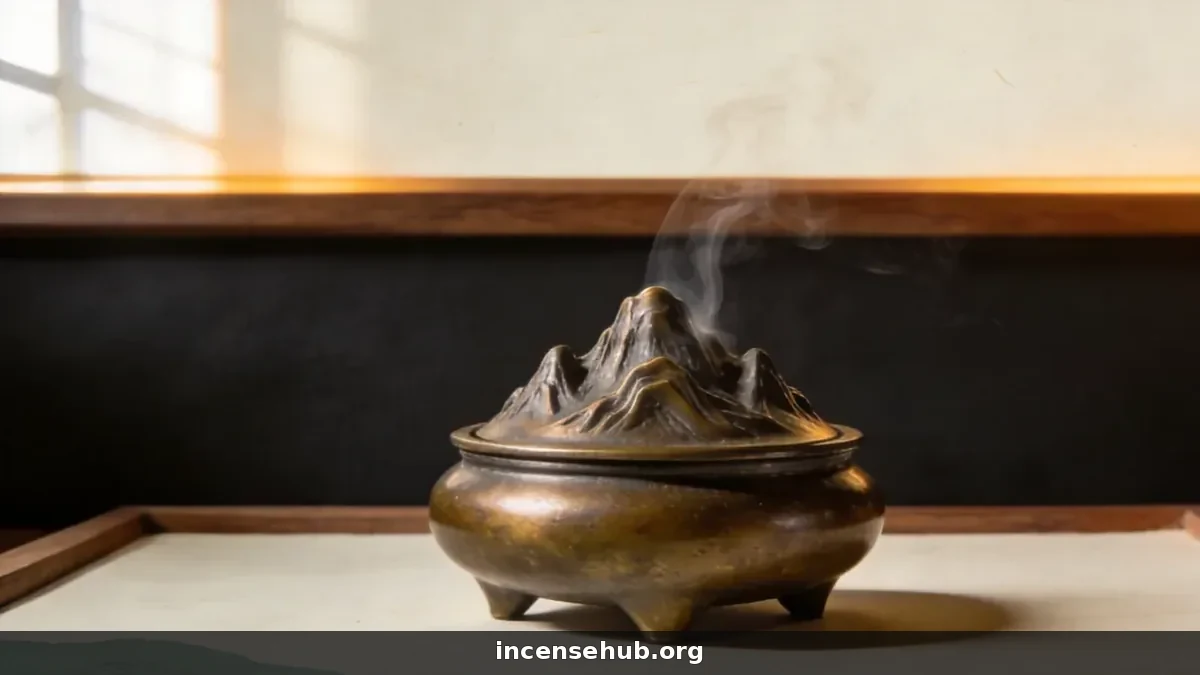
Key facts: The mountain is not scenery. It stands for the isles of the immortals — 蓬莱, 方丈, 瀛洲 — and for the Daoist hope of transcending death that ran through Han court culture. This is a page of cultural history, not a wellness claim.
Key Takeaways
- Three parts carry the object: a base, a bowl for the fuel, and a pierced mountain lid.
- The piercings are the design, not ventilation added afterwards — they break the smoke into threads that read as cloud.
- Han practice burned raw aromatics loose in the bowl; the smoke was the experience, not a by-product.
- The mountain encodes a cosmology: a sacred island range, miniaturised onto a desk.
- The form belongs to a different aesthetic from later low-smoke burners, and the contrast is the clearest way to understand it.
Three Parts, One Effect
Direct answer: A 博山炉 is a base, a bowl, and a pierced mountain lid, and the three exist to produce one illusion together.
| Part | What it does |
|---|---|
| Base (炉座) | Lifts the bowl; often a stemmed dish or a figure bearing the vessel |
| Bowl (炉身) | Holds the burning aromatic material |
| Lid (炉盖) | Cast as layered peaks, pierced so smoke escapes through the mountain |
The base is the least discussed part and the most structural. A stemmed dish lifts the bowl clear of the surface beneath it and gives the vessel a silhouette that reads as an object, not a pot. Figure bases — a crouching animal or a human figure supporting the bowl — turn the support into part of the story, so the mountain appears to rest on a living bearer. The bowl is the working chamber, and its depth sets how much material can burn and how long the session lasts. The lid is where the craft becomes theatre.
The lid is not a cover with holes punched for safety. Its peaks, figures, and animals are cast in relief, and the openings are placed among the ridges so the smoke has to negotiate the terrain on its way out. That placement is why the effect works: a hole in a flat lid produces a jet; a hole tucked behind a ridge produces a curl.
The Smoke as the Real Subject
Direct answer: The vessel is built around a single causal chain, and every part of the design serves it.
Fuel sits in the bowl → heat lifts smoke → the smoke reaches the pierced lid → the openings split one column into many thin streams → the streams curl around cast peaks and troughs → the eye reads moving mist on a mountain. Stop the chain at any point and the object is just metal.
This is why the burner is best understood as a performance piece. The bronze supplies the stage, the peaks supply the scenery, and the smoke supplies the weather. An unlit 博山炉 is a mechanism waiting to run; the sculpture is complete only when the bowl is burning and the mountain has cloud.
The same chain explains why the design is fragile in practice. A draught in the room pushes the threads sideways and the illusion collapses into a smear. Too much fuel produces a column that overwhelms the piercings. Too little produces nothing visible at all. The object asks for a still room and a modest fire, which is exactly the condition the later refined tradition would turn into a principle. Editorial reading of the design, not a documented rule.
What Went Into the Bowl
Direct answer: Han practice used raw aromatic material — resins, woods, dried herbs — placed loose in the bowl, not the pressed sticks and cones of later centuries.
That difference changes what the object is for. A modern stick is engineered to burn evenly and cleanly, with smoke treated as something to minimise. Loose material in a Han bowl burned unevenly and smoked freely, and the smoke was the point. The vessel did not tolerate the smoke; it staged it.
The reversal came later. 隔火焚香 — warming material over buried charcoal, with a mica or metal plate between fire and aromatic — deliberately suppressed combustion. Heat rose through the plate, the wood or resin gave off scent without burning, and the smoke dropped to almost nothing. The reward was a cleaner, more detailed scent and a longer session. The cost was the visible plume.
Set the two methods side by side and the history of the object becomes legible: a form built to display smoke lost its purpose when the culture decided smoke was a defect. The pierced mountain lid did not become ugly; it became irrelevant to the new goal.
The Mountain as a Cosmological Model
Direct answer: The lid depicts the isles of the immortals, and that makes the burner a small model of a sacred geography rather than a decorated container.
The three isles — 蓬莱, 方丈, 瀛洲 — belonged to a traditional belief about immortals living beyond the reach of ordinary life. Han court culture was saturated with the pursuit of longevity, and the burner translated that pursuit into an object small enough for a desk. Lighting it was a daily act of placing oneself in view of that imagined world.
Read this way, the object’s scale is part of its argument. A mountain range that fills a horizon has been reduced to something you can lift in two hands, and the smoke that would be weather on a real peak becomes a thread you can watch from a chair. The miniaturisation is not a convenience; it is the point. The sacred distance is collapsed into a room.
For a modern viewer, the risk is to see only the craftsmanship and miss the programme. The peaks are not an ornamental excuse for a lid. They are the content, and the piercings are placed to make that content move.
Boshan and the Later Plain Burner
Direct answer: The 博山炉 and later plain burners such as the 宣德炉 represent opposite priorities within one tradition, and comparing them is the fastest way to see what the Han object valued.
| Signal | 博山炉 (Han) | Later plain burner (e.g. 宣德炉) |
|---|---|---|
| Lid | Cast mountain, pierced | Simple, low, often open |
| Priority | Visible smoke as spectacle | Subtle scent, smoke suppressed |
| Symbolism | Isles of the immortals | Understated refinement |
| Viewer’s reward | Watching the illusion | Noticing the aroma |
The contrast is not a ranking. A 宣德炉 serving a quiet room and a 博山炉 staging a small weather system are answering different questions. One asks how little can be sensed; the other asks how much can be shown. Both are incense vessels, and the tradition contains both without contradiction.
What the comparison does establish is that the 博山炉 was never a neutral delivery device. It was an argument, cast in bronze, that scent could be seen as well as smelled.
Reading a Piece: Programme Before Patina
Direct answer: A buyer should read the iconography first, the material second, and the dealer’s story last, because the programme is the hardest thing to fake and the easiest thing to check.
| What to look at | What it tells you |
|---|---|
| Peak layers | Whether the lid is a mountain or a generic cone with holes |
| Figures and animals | Whether the sacred landscape is populated or merely textured |
| Piercing placement | Whether the holes follow the terrain or sit in a flat pattern |
| Base form | Whether the vessel was designed as a stemmed object or a simple pot |
| Surface and weight | Whether the metal is consistent with age or with a modern cast |
A lid with holes and no programme is a pierced cover. A lid whose openings sit inside a rendered landscape, with figures moving between the ridges, is a 博山炉 in the full sense. That distinction is the practical payoff of reading the object as an image rather than as a container.
On material, the surviving record is dominated by bronze because bronze was the prestige medium and because it survives burial far better than ceramic. Ceramic versions existed in cheaper everyday forms and are rarer in museum collections precisely because they broke. A buyer should not assume that metal is the only authentic material; the form crossed media, and what differed was cost and survival.
Patina and casting are reading aids, not a certificate. Layered, uneven surface colour that appears to grow through the metal is a better sign than a uniform finish sitting on top, and old castings often show slight irregularities at seams. None of this replaces expert authentication for a claimed antiquity. Editorial guidance, not an authentication method.
What the Name Does and Does Not Mean
Direct answer: “博山” points at the mountain programme, not at a hole pattern, and a modern reproduction shares the look without inheriting the original’s context.
The common misconception is that any burner with a pierced mountain lid is a 博山炉. The name describes a specific Han conception — a sacred island range rendered as a vessel lid — and a later or modern object can copy the silhouette without the cosmology. For a buyer, that is not a reason to avoid reproductions; it is a reason to know which purchase you are making. A reproduction is a display object or, if properly made, a usable burner. An antique is a document of the Han. The two markets share a shape and almost nothing else.
A second misconception concerns use. A decorative cast in resin or thin alloy will soften or scorch if lit. A bronze or lined ceramic reproduction with open piercings can hold a small coal or loose aromatic, provided the base is stable and the surface beneath is protected. Check the material before the first burn, not after. Editorial view, not a verified fact.
FAQ
Q: What exactly is a Boshan censer?
The 博山炉 is the Han-dynasty bronze incense burner whose lid is cast as a miniature mountain range. Smoke rising from the bowl passes through piercings in the peaks and reads as mist over a sacred landscape. The effect is deliberate stagecraft, and the vessel is understood as a cosmological object rather than a simple container.
Q: Where does the name 博山 come from?
It translates roughly as “broad mountain” or “universal mountain.” The name refers to the mountain form of the lid and, more deeply, to the isles of the immortals — 蓬莱, 方丈, 瀛洲 — that the peaks represent. The mountain is a sacred geography in miniature, not a generic landscape.
Q: What fuel went into the bowl?
Raw aromatic materials: resins, woods, and dried herbs placed loose in the bowl. Pressed sticks and cones belong to later practice. Because the fuel burned directly, the smoke was abundant, and the pierced lid turned that abundance into the visual effect the object was designed around.
Q: Why did the design fall out of use?
Because the fuel practice changed. When 隔火焚香 and other low-smoke methods became the refined standard, visible smoke stopped being a virtue and became a defect. The pierced mountain lid had been built to stage smoke, so it lost its function when the culture chose subtlety over spectacle.
Q: Is a modern reproduction the same object?
No. It shares the silhouette and can share the function if it is made of metal or lined ceramic with working piercings, but it does not carry the Han context or the original’s programme. Buy a reproduction as a display or usable object; treat an antique as a document that needs expert authentication.
Sources
- Background reading on Han incense practice and the mountain-lid vessel form.
- Incense burner, China (The Met)
- Meng Liang Lu (夢粱錄) full text on Wikisource
Related Resources
- Chinese Incense Burners & Tools
- History of Chinese Incense Culture
- Xuande Censer (宣德炉)
- Which Incense Format Is Right for You?
Natural next step: see the later, plainer aesthetic in Xuande censer (宣德炉), or compare vessel types in Chinese incense burners and tools.
Summary
- The 博山炉 is the Han-dynasty mountain-lidded bronze censer, built to turn smoke into mist.
- Base, bowl, and pierced lid work as one mechanism; the piercings are the design.
- It burned loose raw aromatics, and the visible smoke was the experience.
- The mountain models the Daoist isles of the immortals, making the vessel a cosmological object.
- Its spectacle stands opposite the later low-smoke aesthetic, and the contrast explains both.