
Direct answer: Chinese incense covers roughly three thousand years, and the clearest way to read that span is through four technical shifts rather than a dynasty list: aromatic material burned as an offering, the Han turn that made scent an object of private pleasure, the Song mastery of heating wood without flame, and the Ming standardisation of the thin stick. Dates below stay deliberately conservative, because the written trail begins with a single character on oracle bone.
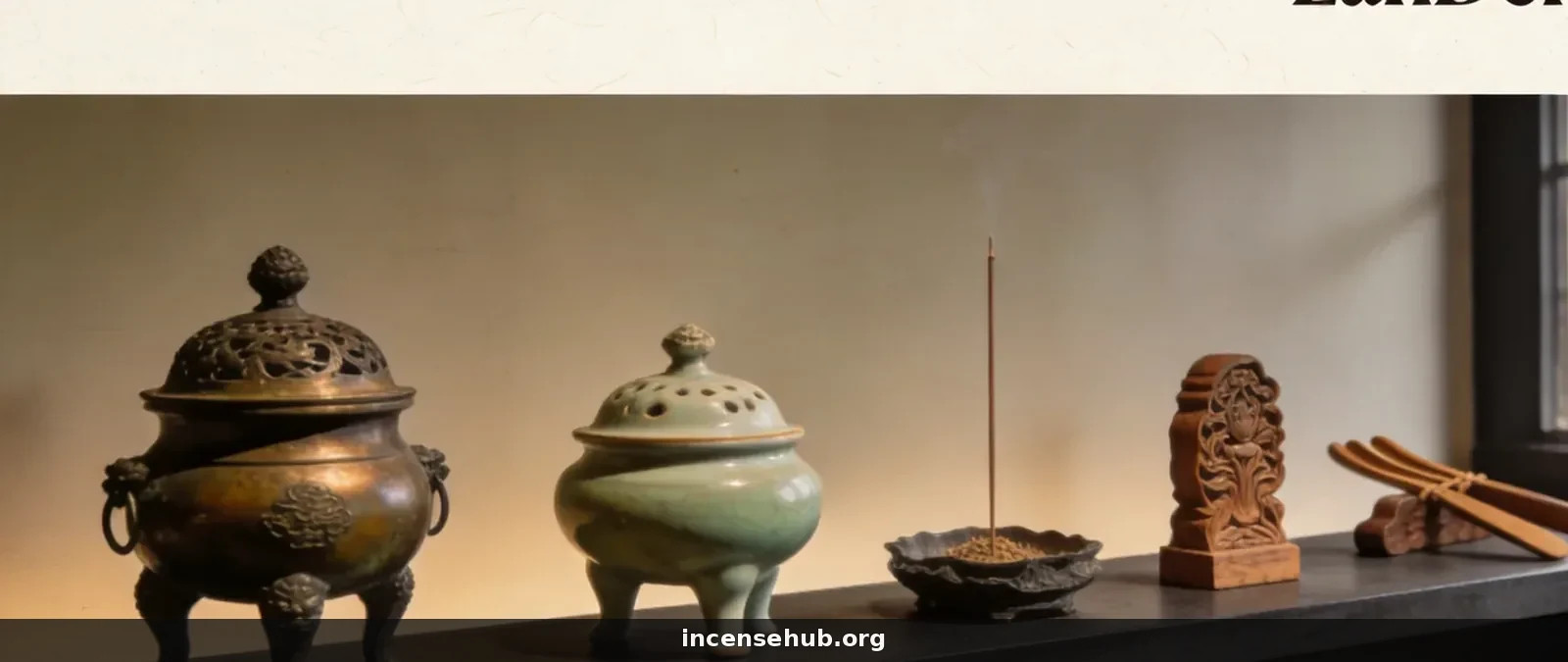
Key facts: Late Shang oracle bones carry the character 香 — the documentary trail begins there, conventionally dated 1600–1046 BCE. Scent moves indoors as a pleasure during the Han, and the 博山炉 censer is the object that records the change. Technical mastery arrives in the Song — heat without flame, trails that mark time, printed formulas — while the Ming supplies the format most people still burn.
Key facts
Direct answer: Five points carry most of this page; everything after them is argument about what those points allow you to say.
- Earliest trace. 香, written into sacrificial formulas on late Shang oracle bones, conventionally 1600–1046 BCE.
- Turn to taste. By the Han, a mountain-shaped 博山炉 censer has made burning a private pleasure rather than only a public rite.
- Technical peak. The Song adds heat without flame, seal trails used as clocks, and printed books of formulas.
- Everyday form. The Ming leaves the 线香 stick and the 宣德炉 bronze.
- Rupture and rebuild. The 1900s reduce the practice to temples and studios; the 2000s begin the reconstruction.
What the Record Can and Cannot Prove
Direct answer: Claims about early incense rest on four kinds of evidence, and each kind answers a narrower question than most retellings assume.
A burnt seed, a bronze censer, a printed recipe, and a temple still burning today are not interchangeable proofs. They sit on different rungs of an evidence ladder, and the rung decides what a sentence is allowed to say. Laying them side by side is the fastest way to see where a popular history has quietly welded two claims together.
| Evidence class | A concrete case | What it establishes | What it leaves open |
|---|---|---|---|
| Inscribed characters | 香 on late Shang oracle bones | Fragrance sat inside ritual language | The material, the recipe, the audience |
| Buried objects | 博山炉 censers from Han tombs | Censers were status goods worth a grave | Whether anyone burned daily |
| Technical texts | 香谱 manuals, 香乘 | A vocabulary for mixing, and a theory behind it | Whether practice matched the page |
| Living transmission | Temple and studio use into the 1900s | The craft outlived the rupture | Continuity of any single formula |
The ladder matters because mixing rungs is the commonest way a long history overstates itself. A Ming compiler describing a Song method tells you what a Ming reader was taught; it does not put you inside a Song workshop. That gap does not mean the manuals are unreliable. It means they are arguments about best practice, written by people with a stake in the answer — closer to a style guide than to a laboratory notebook.
Follow the failure through and it has a shape: written formulas survive → everyday practice does not → later readers treat the text as the workshop → the written version becomes “the history” → the unwritten majority disappears from the account. Nearly every confident sentence about Song incense inherits that distortion.
Survival is not random either. Bronze, stone, and printed paper last; wood, powder, cloth, and the inside of a workshop do not. The archive therefore over-represents what was expensive enough to be buried or collected and under-represents what was cheap enough to be used up. Any sentence beginning “the Chinese have always” should be read against that bias, because the objects that could have tested the claim are the ones that did not survive.
Four Shifts, and the Dates Behind Them
Direct answer: The chronology is easy to memorise; the useful summary is a short list of technical thresholds, each with the period that produced it.
| Shift | What changed | Era |
|---|---|---|
| Ritual burn | Plant smoke as an offering | Late Shang, c. 1600–1046 BCE |
| Private pleasure | Mountain-form vessels | Han, 206 BCE–220 CE |
| Controlled heat | Heat without ignition | Song, 960–1279 |
| Everyday object | Sticks become standard | Ming, 1368–1644 |
Between those thresholds sit the periods that supplied material and occasion. The Wei–Jin centuries, roughly 220–589, brought imported resins along trade routes and added Buddhist demand to the market. The Sui–Tang, roughly 581–907, turned blending into a courtly pursuit. The Qing and the 1900s form the contraction that the 2000s began, unevenly, to reverse.
Read as a list of problems, the sequence stops looking like steady refinement. Reaching the unseen, enjoying a scent indoors, sourcing material, composing a formula, holding a temperature steady, distributing a product, surviving a rupture: these are separate tasks, and an era can be strong at one while weak at the others. The question “which dynasty had the best incense” has no answer until the task is named, and that is why the argument usually ends in taste rather than evidence.
Shang and Han: Fire, Smoke, and a Mountain in Bronze
Direct answer: The Shang supplied the ritual frame and the first written trace; the Han supplied the object that turned burning into something a person could enjoy privately.
In the earliest layer, fire is the transfer mechanism. Aromatic plant matter goes onto embers, smoke lifts, and the offering is understood to leave the human space and travel upward. The idea that smoke carries an offering is a traditional belief, recorded in ritual usage rather than demonstrated in any text we can cite. What can be said with more confidence is the social consequence: the sequence runs from material placed on fire → smoke rising → contact with the unseen → a specialist who controls the fire → aromatic material acquiring a value separate from its smell. Once the value sits in the material, not only in the act, trade in that material becomes worth organising.
The Han adds a second shift, and it is visible in bronze. The 博山炉 (Bóshān lú) is a mountain-shaped censer, its silhouette a small landscape rather than a plain bowl. A vessel shaped like terrain is doing more than holding embers; it is staging the burn, giving the smoke a miniature mountain to drift across. That is the moment incense becomes interior design as well as ritual — something placed in a room and looked at while it works.
One boundary is worth holding. A censer recovered from a tomb proves the object mattered enough to bury; it does not prove the owner burned incense every day. Funerary goods are claims about status and belief, and reading them as a diary of habits is where archaeological caution usually gets lost.
Ports, Resins, and the Birth of the Blend
Direct answer: The Chinese tradition became a blending art because imported material kept arriving, and a wider shelf turns “burn one thing” into “compose something.”
Local fragrant plants can sustain a ritual. They cannot sustain a formula. The change begins at the ports, where caravans and then sea-going ships unloaded clove, borneol, myrrh, frankincense, sandalwood and agarwood. The chain is straightforward: new material reaches the ports → the shelf holds more than local plants → a single-substance burn stops being the only option → 合香 becomes a design problem → the formula needs a grammar, and the classical vocabulary of 君臣佐使 (chief–minister–assistant–guide), borrowed from pharmacy, supplies one. Under that vocabulary a material can be the main note, a supporting note, a modifier, or a guide that carries the others.
Buddhism arrives along the same routes and adds both substances and occasions, which matters more than it first appears. A religion with regular offering practice creates steady demand; steady demand supports long-distance trade; long-distance trade is what puts agarwood in front of a Chinese blender in the first place.
A port list is not a price list. The appearance of a resin in a trade record says it moved, not that it was common, and the imported woods stayed luxury goods for most of the tradition. The blends that survive in the manuals lean on them precisely because they were scarce — a formula that used a little agarwood to lift a cheaper base was solving an economic problem as much as an aesthetic one.
Scarcity shaped the grammar of the formula as well. When one material costs more than the rest combined, the blender’s skill shows in how little of it can carry the whole composition; a recipe that leans on a cheap base and lifts it with a trace of resin is an economic document as much as an aesthetic one. That logic explains why the surviving recipes read as ratios rather than shopping lists.
The causal reading in this section is the author’s framing; the movement of specific materials along specific routes is documented in the sources below.
The Song Settlement: Heat Without Flame
Direct answer: The Song is the peak because three techniques arrived together and reinforced each other — heating that never touched flame, a burning trail that measured time, and manuals that turned practice into text.
Indirect heating (隔火焚香). An ember was buried in ash, a thin plate of mica or silver bridged the gap over it, and the aromatic chip lay on that plate. Nothing ignites. Heat crosses the gap and drives aroma out of the wood. The mechanism explains the prestige: gentle heat → aromatic compounds release in order of volatility → the smoker smells a progression instead of one blast of combustion → attention shifts from “is it burning” to “what is it doing” → appreciation becomes a skill. That skill is what Japanese kōdō later formalised, and the Chinese method is widely described as its ancestor.
Seal incense (篆香). Powder is packed into a carved die, lifted out as one ribbon, and touched with a flame at its tip, so the fire has only a single path to travel. Because the powder burns at a roughly known rate, the trail marks intervals. The boundary: this is a clock only under stable conditions. Loose powder, a draught, or damp air all change the rate, which is why the practice belongs to a closed room rather than a busy workshop. It marked time the way a candle marks an evening — usefully, not precisely.
The manuals (香谱). The genre rests on a trio — Chen’s 香谱, Hong Chu’s 香谱, and Zhou Jiazhou’s 香乘, the third an encyclopedic sweep of formulas, material notes and lore. It is commonly described as the fullest surviving corpus of incense writing anywhere, and the greater part of it has never been translated. Read a manual as an argument about method, not a transcript of practice; that is where its value lies, because the reasoning survives alongside the quantities.
The Four Leisure Arts (四般闲事). Wu Zimu’s 梦粱录 sets 烧香 beside 点茶, 挂画 and 插花, then appends 不宜累家 — a caution against letting such pastimes burden a household. The company tells you what it was: an amateur pursuit, ranked with tea rather than ritual.
Read the four achievements as a system rather than a list. Indirect heat lowers smoke; lower smoke makes subtle material legible; legible material rewards attention; attention creates a class of connoisseurs; connoisseurs pay for manuals and better wood. Each step funds the next, which is why the Song aesthetic looks inevitable in hindsight and was probably not planned at all.
Put the four together and the Song settlement reads as one movement: altar → study → heat control → timekeeping → codification. The Tang had the luxury; the Song built the method.
Ming Standardisation and the Stick
Direct answer: The Ming takes a courtly and monastic craft and gives it a format almost anyone can use — the thin stick — plus a bronze censer that became the collector’s benchmark.
线香, the slender stick, is a distribution technology as much as a product. Loose powder needs an ash bed, tongs, and a sense of timing. A seal trail needs a press, a level surface, and a room without a draught. A stick needs a holder. That lower threshold changes who can burn incense and how often, which in turn changes what manufacturers are rewarded for: consistency rather than virtuosity.
Standardisation changes what quality means. In a craft built on one-off preparation, reputation rests on the maker’s hand; in a craft built on a uniform stick, reputation rests on consistency across thousands of units. The second model rewards process control and punishes variation, and it is the model that survives into modern manufacturing.
| Format | What it asks of the user | What it gives | Where it fails |
|---|---|---|---|
| Loose powder on charcoal | Ash bed, tongs, a feel for heat | Temperature under hand control | Too hot a bed turns leaf into smoke |
| 篆香 seal trail | A press, a flat surface, still air | Pattern and a timed burn in one | A draught or damp air breaks the line |
| 线香 stick | A holder | Uniform, portable, repeatable | Weak material has nowhere to hide |
Bronzes from the Xuande reign (1426–1435) sit in the same period and carry a later prestige of their own, valued for casting and for the imperial association. Their fame distorts the record in a small way: the vessel survives in catalogues, while the stick most people actually lit does not. A history written from museum cases will always overstate how aristocratic this practice was.
The format comparison is the author’s editorial framework for modern readers; the dating and attribution of the Xuande bronzes follow the sources below.
Contraction: How a Practice Loses Its Middle
Direct answer: The tradition did not die, and it did not survive intact; it lost its middle — the ordinary practitioners — while temples and a few studios kept the technique alive.
Three pressures stack. Sumptuary restrictions limit who may display what. Western perfume changes what “smelling good” means and who supplies it. Then the 20th century adds political rupture, above all the Cultural Revolution’s campaign against the “four olds,” which targeted old customs directly. The sequence is legible: demand narrows → workshops lose the volume that pays for apprentices → training stops being worth the years it takes → knowledge retreats into temples and family lines → transmission turns oral and local → the written record thins at exactly the moment it would be most useful.
Both popular versions of this story are wrong. “It died out” ignores the temples and studios that kept working. “It survived unchanged” ignores how much was lost — the ordinary customer, the neighbourhood workshop, the everyday vocabulary of use. What survived was the core technique and a thin chain of practitioners, which is a very different thing from a living market.
Reconstruction leaves fingerprints. A technique passed hand to hand tends to keep local quirks — a particular way of banking ash, a preference for one plate thickness — while a technique rebuilt from texts tends to be tidy, consistent, and slightly bookish, because it follows what was written rather than what was done. That difference proves nothing about authenticity in either direction. It does mean a claim of continuity can be tested by asking what the practice does that no manual would specify.
Five Questions to Ask of Any Incense Timeline
Direct answer: Most timelines are accurate in their dates and misleading in their shape, and five questions expose the difference quickly.
Does it date by dynasty or by technique? A dynasty is a political unit with fixed edges; a technique has a life of its own and often crosses those edges. Indirect heating, stick rolling, and manual writing each arrive at a different moment, and a timeline that files all three under one reign is smoothing over the interesting part.
Does it say who could afford the practice? A court inventory and a village burner are not evidence of the same thing. When a history quotes a luxury object and then describes “the Chinese” as a whole, it has quietly changed the subject.
Does it separate a recipe from a habit? A formula in a manual is a proposal. Whether anyone cooked it that way is a separate question, and the answer is usually unknown.
Does it name the manuscript? “Ancient texts say” is not a citation. A title, a compiler, and a rough century are the minimum, and their absence usually means the claim came from a secondary summary.
Does it admit what it cannot know? The honest version of this history has holes in it — prices, household habits, regional variation — and a timeline with no holes is usually a timeline with no sources.
A reader who applies those five questions will notice that disagreements between popular accounts are rarely about dates. They are about what a date is supposed to prove.
These questions are the author’s editorial checklist, not a historiographical standard drawn from a single source.
What the Revival Is Rebuilding
Direct answer: The revival that began around the 2000s is rebuilding three separate layers — material supply, technique, and language — and the third is the slowest.
The visible layer is commercial: studios, museums, teaching practices, and a new generation of brands. The technical layer is quieter: heat control, forming, and the judgement that tells a good burn from a scorched one, passed on through demonstration. The linguistic layer is slowest of all, because the manuals remain largely untranslated and the vocabulary of the craft has to be rebuilt in English term by term.
That order has consequences. When teaching depends on demonstration, quality varies with the teacher; when buyers cannot check a claim against a text, the market rewards packaging; when the source language is unavailable, the English account of the tradition gets written by whoever publishes first. None of this means the revival is hollow — it means the least photographed layer is the one that decides how good the others become.
A Question of Credit
Direct answer: A common English summary hands Japan the credit for refined low-smoke incense. The method is Chinese, attested in the Song, and Japan systematised it later as kōdō.
Trace how the error forms and it looks less like a mistake than a pipeline: the 香谱 tradition stays untranslated → English readers meet refined incense through Japanese scholarship and teaching → the method reads as Japanese → the Chinese origin drops out of the sentence → a correction sounds like nationalism rather than bibliography. That last step is the trap, and it is worth naming plainly. The correction is a sourcing point, not a patriotic one.
What matters is a shared root and then separate development. Japanese kōdō descends from the Chinese method and then becomes an art in its own right, with its own games, vocabulary, and discipline. Saying so takes nothing from kōdō. Calling the Chinese original “Japanese” does erase the source, and it leaves English readers with a history that begins in the wrong country.
How the two traditions parted is set out in Japanese incense & kōdō.
Which Era Should You Study First?
Direct answer: “Important” means nothing until you say important for what; the honest answer is that the right entry point depends on what you intend to do with the knowledge.
| If you are | Start with | Because | Leave for later |
|---|---|---|---|
| Vessel collector | Ming bronzes | The 宣德炉 sets the market’s benchmark | Shang ritual context |
| Scent practitioner | Song technique | Heat control is the transferable skill | Dynastic chronology |
| Raw-material buyer | Wei–Jin to Tang trade | Explains agarwood’s role in the canon | Manual genealogy |
| General reader | The Han turn | Quickest route to scent as an art | Everything else |
The table is an editorial sorting, not a ranking of eras. Its purpose is to stop the common mistake of treating a chronological list as a syllabus. A collector who begins with the Shang learns about ritual and then has to unlearn it before they can judge a bronze; a practitioner who begins with the Ming learns a format and misses the technique that makes the format worth using.
A Working Glossary for Primary Sources
Direct answer: Nine terms recur in every account of Chinese incense, and knowing whether each names a material, a method, an object, or a book keeps a translation from blurring them together.
- 香 (xiāng) — the general word for fragrance and for the substance burned. Seeing it in a text does not by itself prove a formal craft; the surrounding sentence decides.
- 合香 (hé xiāng) — blended incense. The compound, not the single wood, is the unit of composition.
- 隔火焚香 (gé huǒ fén xiāng) — “separated-fire” heating: charcoal under ash, a plate above, wood warmed rather than burned.
- 篆香 (zhuàn xiāng) — seal incense; powder pressed into a stamped trail and lit at one end.
- 线香 (xiàn xiāng) — the thin stick, the format that turned incense into a household purchase.
- 香谱 (xiāng pǔ) — a manual of formulas; the term marks a genre, not one title.
- 博山炉 (bó shān lú) — the Han mountain-form censer.
- 宣德炉 (xuān dé lú) — bronzes tied to the Xuande reign, later the collector’s benchmark.
- 君臣佐使 (jūn chén zuǒ shǐ) — chief, minister, assistant, guide: the roles a material can play inside a formula.
Two entries repay a second look. 香谱 is often rendered as “incense book,” which hides the fact that these works argue about method rather than merely list ingredients. 隔火焚香 is often rendered as “indirect burning,” which hides the purpose of the ash bed: the buffer is what separates a warm aroma from scorched smoke. A reader who holds on to those two distinctions will catch most of the mistranslations that circulate in secondary writing.
Questions the Record Leaves Open
Direct answer: A history built from texts and tomb goods answers some questions well and others barely at all, and the second list is as informative as the first.
- What did it cost? Trade records show that material moved; they rarely show what a workshop paid or what a customer handed over. Any modern price comparison across dynasties is a reconstruction, not a quotation.
- Who burned it at home? Court and monastic use is documented because institutions kept records. Household practice has to be inferred from objects, which is weaker evidence.
- How was a formula taught? Manuals record proportions; they cannot record the hand that judged a charcoal bed. The tacit half of the craft is exactly the half that text loses.
- How much did practice vary by region? A capital and a port city did not hold the same shelf of materials, and the surviving sources lean toward the centre.
- What counted as good? Modern writing about “refinement” tends to project a present-day aesthetic backwards. The manuals’ own criteria — balance, longevity, restraint of smoke — are the only period standard a reader can actually cite.
One pattern sits behind all five: institutions write and households do not. That is why the surviving history reads as courtly and monastic even though the practice was probably broader and messier than the archive suggests.
Summary
- The documentary record starts with 香 on late Shang oracle bones; that attestation is the basis for the three-thousand-year figure.
- Han bronze shows the shift: censers built as miniature mountains, and scent entering private life.
- The Song supplies technique — warming without ignition, powder trails that measured time, printed recipe collections — and later revivals still cite it.
- The Ming supplies the objects most people picture: the slender stick and the bronze censer.
- The 1900s narrowed the practice without extinguishing it; recovery since the 2000s has moved unevenly across supply, skill and translation.
FAQ
Q: Why is the Song the peak rather than the Tang?
Court appetite ran larger under the Tang; the Song is where technique hardened into a system. Three things crystallise in the Song at once: indirect heating that releases aroma without combustion, seal incense that turns a burn into a timed trail, and manuals that record formulas and the judgement behind them. Fold in the Four Leisure Arts — incense set beside tea, painting and flowers — and the era holds both a method and a social frame. A peak needs both.
Q: Is Japanese incense a descendant of the Chinese tradition?
A common root, then separate paths. Japanese kōdō descends from the Song-dynasty indirect-heating method, carried over alongside tea and Buddhism, and it developed into a formal art with its own games and vocabulary. Chinese incense stayed one strand of a broader leisure culture rather than a standalone discipline. Shared origin, separate development — the distinction matters because collapsing it erases the Chinese source without adding anything to Japan’s achievement.
Q: What caused the decline?
Three pressures arrive in sequence rather than at once. Spending limits and imported perfume shrink the market through the Qing; political rupture in the 20th century, above all the campaign against the “four olds,” severs the chain between teachers and students; the ordinary customer vanishes before the technique does. Through much of the 1900s the craft held on inside temples and a few workshops. Since about 2000, studios, museums and collectors have driven a reconstruction.
Q: How can a reader tell a sourced incense history from a marketing one?
Four checks do most of the work. Does the text date its claims to a period and a document, or does it round up to a memorable number? Does it name the manual or the object it relies on? Does it separate what is recorded from what is reconstructed, and editorial judgement from evidence? Does it admit the gaps, such as the untranslated manuals or the thin archaeological record for everyday use? A history that passes all four is not necessarily right, but it is checkable — which is the only thing a reader can ask of a three-thousand-year story.
Q: Does a stick improve with age, the way a wine does?
Two processes get folded into that one word. A finished stick is powder held by a binder, and what shifts on a shelf is moisture and the lightest top notes — a sealed jar in a dry room keeps it crisp, while damp air flattens the aroma and invites mould. Raw resinous wood is the older claim: traditional belief holds that 沉香 settles and deepens as it dries, which is why collectors pay for grain rather than for a label. Neither process comes with a certificate. A buyer can test the claim before paying: open the container and smell the empty headspace. When the air above the wood is louder than the wood itself, the piece has been venting, and less is left inside it.
Sources
- Meng Liang Lu — full text, Wikisource (夢粱錄) — the passage listing the Four Leisure Arts.
- Xiang Cheng — full text, Wikisource (香乘) — the encyclopedic manual tradition.
- Bencao Gangmu — ctext.org edition — materia medica background.
- 光明日报 (Guangming Daily) — reporting on Song-period 香文化 and 合香.
- China Daily / Feuerle Collection — revival coverage.
- Research synthesis: docs/research/chinese-incense-pillar-notes.md (R-003).
Related Resources
Natural next step: the history explains why the materials matter, so start with what Chinese incense is, then follow the two woods that shaped the blend canon — sandalwood and agarwood.