
Quick answer: The inner block of a Santalum tree — Indian sandalwood (Santalum album) is the famous example — yields a material that reads as cream, warm bread, and soft timber rather than as resin or smoke. The label is where certainty ends: it may name that tree, a cousin from Australia or the Pacific, or a factory formula that never met a plant, and those four things are not sold at the same price.
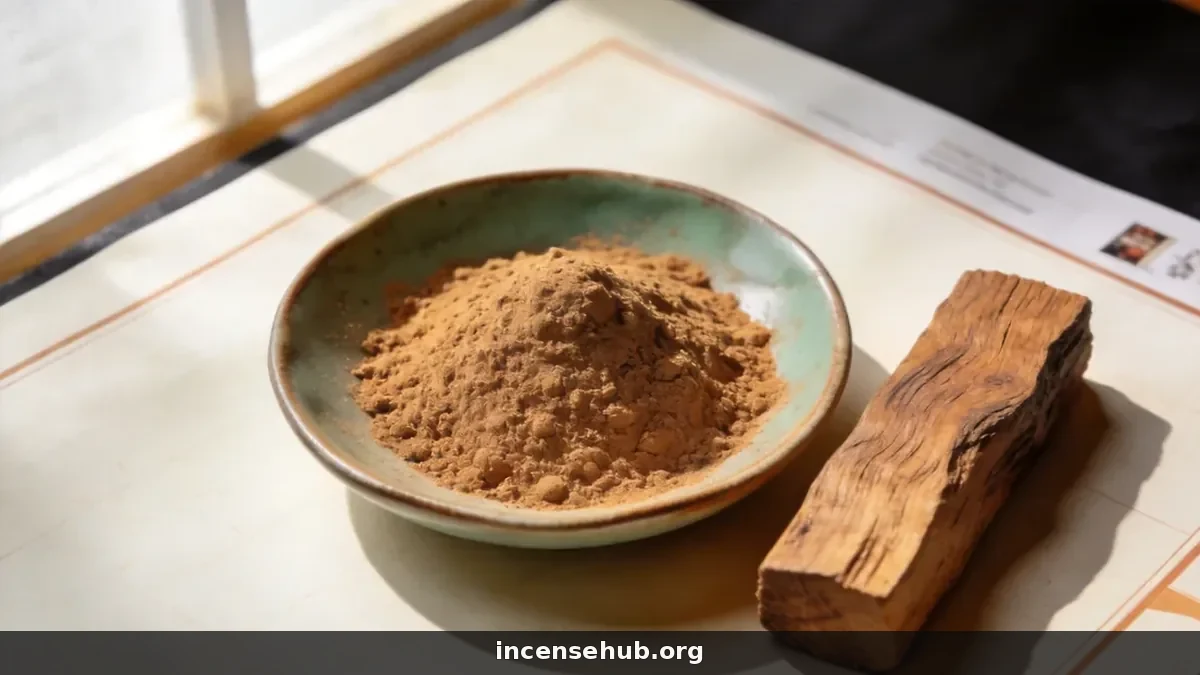
Key facts: Santalum album sets the reference. S. spicatum (Australia), S. austrocaledonicum (New Caledonia), and S. paniculatum (Hawaii) supply most of what arrives as relatives. Decades of growth and a tight legal supply are what make honest goods dear — and what make bargains suspicious.
Key Takeaways
- Aroma sits in the inner block, laid down over decades, so age and tree both leave marks on the asking price.
- Cream rather than resin: the heavy santalol alcohols give the material its butter quality and its long, quiet finish.
- Four goods answer to one word — milled solid, bound stick, distilled liquid, built smell — and just two of them contain much of the tree.
- Promises about sleep and worry are old cultural claims, not findings; the English web repeats them without buying.
- Extract two facts first: the plant, and the form. Treat cost as a third check rather than a verdict.
Two Questions Before Any Other
Direct answer: Every sandalwood purchase resolves into which tree and which form. Answer those two and the rest of the label turns into detail; skip them and the rest of the label turns into persuasion.
Which tree is a question with a checkable answer. Santalum album is a claim backed by paperwork, “Indian sandalwood” is a claim about origin, and “sandalwood” alone is a claim about nothing in particular. Each step down that ladder moves you further from anything a seller could be held to, and the wise default at the bottom is the cheapest plausible tree, priced as such.
Which form decides what you can expect from the burn. A milled solid opens slowly and keeps unfolding. A bound stick carries the binder’s habits into the smell. A distilled liquid arrives fast and departs fast. A built scent does the same thing every time, because it was designed to.
The Plant and the Trade
Direct answer: Santalum belongs to Santalaceae and lives half off its neighbours, taking part of its nutrition from their roots while still feeding itself from light.
That habit shapes everything downstream. A seedling on its own tends to sulk; planted beside a companion it prospers, so raising the crop is really a decision about what to plant nearby and how long to wait. Aroma accumulates with age, which puts the prized portion decades past the planting decision. Grown stands are normal and honest; they are simply younger than the old wild stock, and younger stock holds less of what the price is for.
Four trees matter. Santalum album carries the reference grade — Indian, or white, sandalwood — and it is scarce, licensed, and dear. S. spicatum is the Australian alternative, drier and woodier in the nose. S. austrocaledonicum comes from New Caledonia and reads close to its Indian cousin. S. paniculatum is the Hawaiian tree, sold in small volume. Climate and age move each of them, so the name is a starting point rather than a verdict.
Chinese practice knows it as 檀香 (tánxiāng). It turns up in 香道 sessions, in Buddhist and Taoist temple use, in beads and small votive carvings, and in the old pharmacopoeia, where the 本草纲目 lists it among fragrant woods. In a formula it takes the floor rather than the headline: warm, rounded, generous enough to hold louder notes up without arguing.
Why Cream Reads as Cream
Direct answer: Heavy alcohols called santalols — α-santalol and β-santalol above all — carry the creamy quality, and their weight explains both the softness and the staying power.
Three things follow from that molecular weight. These molecules are large → they lift slowly → the opening of a burn feels restrained and the middle arrives late, which is why a good stick seems to grow rather than announce itself. Their weight also places the smell low on the nose, closer to butter and fresh bread than to peel or pine. And strength rises with the age of the wood → two blocks of one species can differ more than two species grown side by side.
None of that is a claim about the body. Knowing why the note is creamy tells you what to expect and how long to wait. It says nothing about what the material does inside a person, and a page that jumps from molecule to medicine has changed the subject mid-sentence.
What You Are Actually Buying
Direct answer: The shelf holds four different products under one word, and telling them apart is mostly a matter of reading the ingredient line rather than smelling the box.
| Purchase | Contents | Behavior on heat | What the mistake costs |
|---|---|---|---|
| Milled solid | Ground inner wood, nothing added | Opens slowly, keeps going | Solid prices paid for pale outer wood |
| Bound stick | Powder plus binder, sometimes a core | Binder and smoke join the smell | The tree judged by the binder |
| Distilled liquid | Volatile fraction only | Fast in, fast out | Liquid expected to match solid |
| Built scent | Composed smell, no wood content | Flat and repeatable | Tree prices paid for a formula |
Powder and liquid are the pair most often conflated. Distilling lifts the lightest part of the wood and leaves the heavy, creamy part behind, so the liquid reads sharper and more perfumed than the solid it came from — and a stick wetted with that liquid does not smell like a stick cut from the block. Both products are honest. Confusing them is what costs money.
Species Swaps and How They Show
Direct answer: Most sandalwood stand-ins come from inside the family, which makes it quieter and harder to spot than the outright fakes that plague the resin woods.
Read the shelf this way. When the box claims Indian wood, expect Australian or New Caledonian material in the cheaper examples — drier, woodier, shorter in the tail. When the box says “Mysore,” expect either licensed S. album or a prestige word attached to something else, and let paperwork rather than aroma settle it. When the box sells a “sandalwood stick,” expect powder with a scent booster: loud when cold, flat when lit. When the box sells oil, expect either distilled wood or a blended compound, and read the price and the ingredient line together.
The pattern worth remembering: the closer the stand-in, the softer the deception. A factory scent gives itself away the moment you compare cold and warm. A swap from Indian to Australian wood is not fraud at all — both are true Santalum, both can be good — but it changes what you are buying, and the price ought to move with it. An honest version of that trade names the tree and prices so.
One name collision deserves its own warning. “Red sandalwood” belongs to an unrelated plant and is not a stand-in for the fragrant wood in any sense; the comparison page sorts that out in detail.
Mysore and the Paperwork Question
Direct answer: “Mysore” carries real history and almost no enforcement at the point of sale, so it buys a story unless the seller can produce papers.
The history is sound. Santalum album was cut so heavily through the last century that the species is widely treated as depleted in the wild, and Indian output moved to licensed estate growing. Licensing is a large part of why the material costs what it does, and a licensed product genuinely is the yardstick.
The trouble begins when the word travels without the paper. A “Mysore” stick may be licensed S. album, or Australian wood wearing a famous place name, or a compound with a romantic label. The nose cannot settle it — closely related woods fool seasoned buyers — which is exactly why origin belongs to papers and not to descriptions.
Editorial position: an honest Australian block beats a counterfeit Indian one. Pay for origin when it is papered; pay nothing for a word.
From Felled Trunk to Powder
Direct answer: Freshly cut wood does not smell like the sandalwood in a finished stick. It has to dry, and often to rest, before the aromatic fraction settles into something worth heating.
Follow the chain. A trunk is sawn and the pale outer wood stripped away → that outer layer carries little aroma and becomes waste or filler → the dark inner blocks are stacked to dry, moisture leaving slowly and the wood tightening → as water departs, the aromatic fraction gathers and the note shifts from green and sappy toward cream → milling follows, and powder is what most incense actually contains. Rushed drying leaves the powder thin and faintly sour; time makes the same log rounder.
Two trade-offs sit inside that order. Speed buys cash flow and costs depth, which is why a maker’s drying practice is a better question than a species claim alone. And the split between inner and outer wood is where quiet dilution happens: powder that includes the pale fraction is still “sandalwood powder” by a loose reading, and it will smell paler than a pure lot at the same price.
What Happens at the Mill
Direct answer: Four decisions between the block and the stick — grind, binder, moisture, drying — each leave a fingerprint on how the finished product behaves.
Grinding comes first. A mill running hot degrades the aromatic fraction as it works, so a slow cool pass smells fuller than a fast one from the same wood. Particle size then sets the burn: fine powder packs tight and releases quickly, coarse powder leaves gaps and burns unevenly. A maker building sticks usually wants consistency over maximum fineness, because a stick that crumbles is worse than one that is slightly coarse.
The binder is second. Plant gums such as makko burn cleanly and add little of their own voice; charcoal constructions hold shape well and add smoke with a faint ashy edge. Neither is dishonest, and both appear in the ingredient line for anyone who reads it. A stick listing only wood and a plant binder is telling you something about its ambitions.
Rolling and drying come last, and that is where cheap output shows. Rolled too wet, a stick warps and splits as it dries. Dried too fast, it hardens outside while the core stays damp, and the burn turns sour later. Slow drying in a stable room costs floor space and time — costs that a low price per box has to have been removed from somewhere.
Judging Before the Flame
Direct answer: Most of what you need to know arrives before ignition, in the cold smell, the surface, the break, and the weight.
The cold-versus-warm gap is the first read. True inner wood keeps its aroma inside → the unlit stick smells mild → heat releases the fraction gradually → the burn is richer than the wrapper promised. Coated stock reverses it: loud in the box, thin in the burner. A large gap in that direction is a coating rather than a material.
Then the surface and the break. A rolled stick has a granular skin and a matte finish; a dipped one can look glossy, even, and too smooth. Snap one in half: rolled stock shows the same material through the cross-section, while a coated core shows a pale interior beneath a dark shell.
Weight and ash offer smaller signals. Dense inner wood feels heavier in the hand than a filler-heavy lot, and good material tends to leave a pale fine ash rather than grit — a hint, not a certificate. The sticks versus candles comparison is a useful check on what a stick is actually delivering.
Heat, Ash, and the Burner
Direct answer: The burner is a thermostat you already own. Distance from heat, depth of ash, and airflow around the stick decide which part of the wood reaches you.
The physics repeats across every form. Heat reaches the material → light compounds leave first → heavier santalol-rich fractions need more heat and more time → the note deepens as the burn proceeds, provided the heat stays moderate. Push the heat and everything leaves together, mixed with char. An ash bed is the old answer to keeping heat moderate: the stick sits in a bowl of ash, the coal is insulated, combustion slows. An electric warmer answers the same problem by removing combustion altogether. A bare metal holder with a stick standing free is the least restricted version — hottest at the base, quickest to char.
Two notes follow. Sandalwood tolerates gentle heat better than most stock and rewards a warmer over a flame. And the nose adapts within minutes, so the honest moment to judge a burn is the moment you walk back into the room.
Ash depth is the variable most people never touch. A thin bed lets the coal sit hot and close to the surface; a thick bed insulates it and slows the burn, which changes both the pace and the smoke. Moving a stick from a shallow dish into a deep bowl of ash is a real experiment, and it costs nothing but a handful of ash and ten minutes.
Placement matters too. A burner set beside a window loses its note to the draught; one set in a corner keeps it, sometimes too well. The same stick, the same room, two spots, two different sessions — which is why a complaint about a product should always be checked against a complaint about the corner it was placed in.
Powder and Grind
Direct answer: Grind decides how a powder behaves on heat, and the change is easy to feel between finger and thumb.
Surface area drives it. A fine mill exposes more material to the same heat → the aromatic fraction leaves sooner and more completely → the note arrives quickly and can turn sharp if the heat is high. A coarse mill exposes less → release is slower and patchier → the note builds gradually but can leave unburned residue. Neither is better in the abstract; the right grind depends on whether the powder goes into a stick, a cone, or a warmer.
For a buyer, consistency is the practical read. A well-milled lot is even in colour and texture, without pale streaks of outer wood and without the grit that suggests mineral filler. Clumping is a storage symptom rather than a milling one — moisture got in, and the powder will smell flatter than it should.
At the Bottom of a Blend
Direct answer: Sandalwood behaves like a base note by temperament: heavy, slow, and round enough to hold other material up without covering it.
In the 君臣佐使 structure — chief, minister, assistant, guide — it usually takes a secondary seat. It gives a brighter note a floor to stand on: citrus reads cleaner with something warm beneath it. A formula built only from bright material feels rootless; add a sandalwood base and it acquires a bottom.
For a buyer, the practical result is that sandalwood is often present in a blend without being the headline. A stick sold as “jasmine and sandalwood” may be mostly accord with a little wood, or mostly wood with a floral top, and the order of the ingredient line is the only clue. The blending page goes further into how those roles get assigned.
Beads, Carvings, and the Offcut Trade
Direct answer: A large share of the world’s sandalwood never becomes incense. It becomes beads and carvings, and the powder trade lives partly on what those workshops leave behind.
Carving has its own logic. A bead needs dense, sound wood that will hold a shape and take a polish; a carving needs a piece big enough to work. What remains — shavings, flawed sections, sawdust — is where a lot of trade powder starts, which is not a scandal, just a fact worth knowing: powder quality varies with what a workshop was making that week.
That explains two things for a buyer. Powder can cost less than chips by weight because it is partly a by-product stream. And a bead or small carving is sometimes the most reliable way to smell real wood, since a solid object shows its material honestly and the warmth of a hand is enough to lift the note. The catch is unchanged: carvings are easy to fake with a scented stand-in, and a bead that shouts when cold is more likely coated than genuine.
Storage and Time
Direct answer: Sandalwood keeps better than most aromatic material, which is one of its practical virtues, but heat, light, and moisture still take a toll — and the loss shows first in the creamy top of the note.
The aging chain is slow. Volatile material is always trying to escape → warmth speeds that escape → a tin left on a sunny shelf flattens within a season → moisture clumps powder and dulls the surface of chips → air oxidizes oils and turns the note slightly waxy. What survives longest is the heavy middle, which is why an old lot can still smell recognizably of the wood while feeling thinner than it once did.
Storage is unglamorous and effective: sealed container, dark cupboard, stable temperature, date on the lid. Powder is more fragile than sticks, and liquid more fragile than either. A short rest can even help a freshly milled lot settle — the same logic that makes aged blocks worth waiting for, applied at a smaller scale.
Smoke and Other Occupants
Direct answer: Sandalwood smoke is still smoke. Natural material produces fine particles when it burns, and a small closed room gathers it faster than an open one, whatever the wood.
Combustion, not botany, sets the terms. Material smoulders → incomplete burning releases fine particles and gases → a sealed room traps them → strength climbs with time and falls with moving air. Calling a wood clean because it grew in the ground confuses where the material came from with what burning does to it.
So the practical rules are the ordinary ones, and they belong inside the buying decision rather than a footnote: burn briefly, leave a window or door open, keep the burner out of a draught, and keep smoke away from anyone with breathing trouble, infants, and pets, whose lungs answer airborne smoke particles faster than an adult’s. The safety notes cover placement, ash, and how to put out a stubborn stick. A small room wants a smaller dose — the small-room guide works through the sizing.
A Buying Sequence
Direct answer: Buy in the order that removes the most doubt per step: solid before stick, named tree before famous place, small before large.
- Begin with powder or a chip. The least processed form tells you what the wood itself does, before a binder joins the argument.
- Ask for the plant, not the place. S. album if you want the reference grade, S. spicatum if you want an affordable and honest alternative. A refusal is an answer.
- Ask whether the lot is pure inner wood. The answer changes both price and smell, and it is easy for a supplier to give honestly.
- Buy small, then repeat. One lot tells you about a supplier; a second tells you whether the first was typical.
- Judge the burn, not the wrapper. A wide gap between cold and warm points at a coating.
Where Price Lies
Direct answer: Sandalwood pricing is a stack of costs rather than one number, and knowing the stack tells you which discounts are plausible.
Four components set the floor. The species decides raw material cost, with S. album above its relatives. Age decides how much aromatic fraction is present, since younger grown wood carries less. Purity decides how much pale outer wood and dust are mixed in. Paperwork decides whether the material moved legally, which in a restricted trade is a real cost rather than a formality.
Discounts come out of one of those four. A cheaper lot is usually younger, less pure, a related tree, or unpapered — sometimes several at once. The useful question is which component the discount came from, since a seller who can answer it is a seller who knows the material.
The implausible case is the one to watch. When a claimed S. album product costs about as much as a factory-scented stick, at least one component has been removed, and the likeliest candidate is the material itself.
Two Corrections Worth Making
Direct answer: Two beliefs cost sandalwood buyers money — that Indian is always better, and that a higher price proves a better material. Both swap a proxy for a judgment.
Indian Is Not Automatically Better
Santalum album is the old reference point, and a reference is not a preference. Australian wood is drier and less sweet; some noses prefer that, and a well-handled Australian lot beats a badly handled Indian one every time. Species tells you the character. It does not tell you the quality of the specific batch.
The boundary: if you want the classic creamy profile, S. album is the reference and worth the premium when papered. If you want a smell you enjoy, species is one input among several, and how the material was dried, milled, and stored matters at least as much.
Price Is a Floor, Not a Score
Price reflects shortage and licensing, not a ranking of pleasure. A costly stick can be a costly compound; a modest one can be exactly right for an evening. What price does tell you is where suspicion belongs: genuine inner wood cannot be produced cheaply, so a very low price on a claimed S. album product is a detail about the material rather than a bargain.
A judgement, not a finding: a lot is worth what its character and its paperwork say it is. Price belongs to the plausibility check and to nothing after it.
Sandalwood Against Agarwood
Direct answer: Different trees, different families, different failure modes: sandalwood’s exposure is a swap between relatives, while agarwood’s is resin grading and outright fakery.
| Sandalwood | Agarwood | |
|---|---|---|
| Plant | Santalum, Santalaceae | Aquilaria, Thymelaeaceae |
| What holds the scent | Inner wood laid down with age | Resin formed after injury or infection |
| Shape of the note | Creamy, soft, rounded, slow | Resinous, layered, sweet-deep, slower |
| Usual deception | Relative swap, pale wood, scent compound | Resin loading, grade markup, fakes |
| Price position | Middle of the market | Top of the market |
In practice they are partners rather than rivals. Classical compounds often use both — agarwood as the deep centre, sandalwood as the warm floor beneath — and the agarwood guide explains the grading vocabulary (沉水, 奇楠) that governs the more costly material.
Three Traditions, One Wood
Direct answer: Chinese, Indian, and Japanese practice all burn the same wood for different purposes, which is why it turns up in temple use, in 香道 sessions, and inside blended sticks.
Chinese practice treats it as a blending material as much as a solo one: 檀香 supports a formula, rounds a sharper note, gives a blend a floor. Indian settings tie it to ritual and to carving, where paste and bead carry as much weight as smoke. Japanese incense often places it inside a structured exercise where the point is telling scents apart rather than setting a mood.
A Grading Frame for Blocks and Powder
Direct answer: Sandalwood has no single worldwide grade, so the useful approach is a private frame of four checks — density, colour, smell, and honesty of paperwork — and a consistent order in which to apply them.
Here is a frame that works on a bench, stated plainly because it is a working method rather than an official one:
| Check | What you do | What a good result looks like | What a bad result suggests |
|---|---|---|---|
| Density | Weigh, then feel the block for heft | Heavy for its size, cool and close-grained | Light, spongy, or visibly banded |
| Colour | Cut a fresh face and look | Even, deep, slightly oily sheen | Pale streaks, sharp bands |
| Smell | Warm a pin-head of powder | Cream, bread, timber — no sharpness | Sour, waxy, or sharply perfumed |
| Paperwork | Ask what the invoice names | A plant and a place that match | A trade word and nothing else |
The order matters. Density and colour can both be imitated — a dense stand-in exists, and staining is old practice — so neither settles anything alone. Smell is the best single signal, and the least transferable: it cannot be photographed or faked convincingly at the block level. Paperwork comes last because it is the only check that can contradict a convincing block, and when it does, believe the paper.
A private frame beats a certificate in one specific way: it is yours, it stays consistent across purchases, and it does not depend on a body that may not exist. What a certificate adds is third-party check of a claim, which is worth having and worth asking for by name.
A Burn Test, Step by Step
Direct answer: A burn test is a comparison, not a verdict. Its value comes from running the same procedure on two samples and writing down what changed.
Set up first. One burner, one heat source, one room, one nose, and change a single variable at a time. Note the airflow and the dose, since those are the first explanations anyone offers for a disappointing result.
Warm a small quantity and smell it cold, at arm’s length, before any heat. Then apply gentle heat and note the first minute, the fifth, and the end. Let the room clear, step outside for a few minutes, and repeat with the second sample — the nose adapts fast, and a comparison made without that reset measures fatigue rather than material.
Buying at Volume: What Changes
Direct answer: Buying a small quantity tests a material; buying at volume tests a supplier. The questions shift from “is this good” to “will the next batch match this one.”
Batch consistency is the first thing to settle. Ask how a lot is named, whether samples are retained, and whether the same lot can be reordered rather than merely the same product. A supplier who can answer those is running a process; one who cannot is running a shop.
The second is paperwork. At volume, the invoice becomes the record: what plant, what grade, what quantity, what date. That record is what lets you compare one delivery with the next, and it is what a dispute is settled with. None of it requires a certificate industry; it requires a supplier willing to write things down.
Third is the sample habit. Keep a small sealed reference from each delivery, labelled with the date and the lot. Over a year, that shelf becomes the most useful quality instrument in the workshop — more reliable than memory and cheaper than testing.
One caution belongs here. Consistency is not the same as quality: a supplier can be perfectly consistent at a mediocre grade. Settle both, in that order — first that the material is what you want, then that it will keep arriving that way.
Five Questions Worth Asking
Direct answer: A supplier’s ease with specific questions tells you as much as the answers do. These five are ordinary, checkable, and impossible to fake for long.
Which plant is this, and where was it grown? A binomial plus a region is a real answer. A trade name plus a gesture is not.
Is the lot pure inner wood, or blended with the outer fraction? Almost every supplier knows. The ones who answer plainly are usually the ones whose material you want.
How was it dried, and for how long? A rough timescale is enough. The question is whether anyone has thought about it at all.
Can I have a small sample from the current lot? A yes costs nothing and says a great deal. A no, with an explanation, is also telling.
What is the invoice going to say? The answer tells you what you would be able to prove later.
Ask them in that order and listen for fluency rather than for the perfect answer. A supplier who pauses, then answers exactly, is a better sign than one who answers everything instantly.
If It Smells Like Something Else
Direct answer: Sandalwood has neighbours that are cheaper and often sold in its place, and each one misses the cream in a different direction.
Cedar is the usual stand-in for a woody note: dry, sharp, closer to pencil shavings than to butter, and it turns almost bitter when it chars. Cypress reads leaner and slightly resinous, with a sawmill edge. Pine is sweeter and louder, carried by the turpentine sharpness of its resin. Juniper is greener and more piercing, closer to gin than to furniture. Rosewood is the closest impersonator in texture — dense and sweet — but it lacks the milky middle that makes sandalwood soft.
The test is not whether the note is woody but whether the wood has a middle: cedar and cypress present a surface and stop, while the real thing opens, rounds, and keeps going.
There is also a modern stand-in with no tree in it at all. A built scent can copy the opening of sandalwood convincingly — the sweet, slightly powdery lift — and then sit there, unchanged. That flatness is the tell. Development is expensive to fake; the top of a note is not.
What the Powder Looks Like
Direct answer: Powder is where a swap is easiest to hide and easiest to catch, because the eye can see structure that the nose has to work for.
Under a hand lens, good milling shows a fairly even field of pale tan to warm brown particles with a slight sheen where the aromatic fraction sits. Streaks of near-white dust suggest the outer wood was included. Grit that catches and grinds between the teeth is not wood at all — sand, clay, or mineral filler added for weight. Fibrous strands mean the mill was coarse or the material was stem rather than block.
Water offers a crude second look. A pinch dropped into a glass tends to float at first and then take up water slowly; a heavy mineral fraction sinks quickly and leaves a gritty ring. Aromatic powder also oils the surface of the water faintly. Neither test is a certificate — both point a direction, and the direction is worth knowing before a large order.
The same lens explains price in a way adjectives cannot. A pure inner-wood powder is even, slightly oily, and consistent from bag to bag. A blended bag is patchy: lighter patches, darker patches, and a texture that changes as the scoop moves through it. Patchiness is the cheapest fraud in the trade, and the easiest to catch with the eye.
Wear, Repair, and the Age of a Piece
Direct answer: Age shows on a carved piece in ways a scent cannot fake — patina, cracks, repairs, and the softened edges of long handling — and reading those marks is a separate skill from reading the wood.
A genuine old bead develops a polish that follows use: the high points of the carving go smooth and slightly dark, the recesses stay matte and hold dust. That pattern is hard to fake quickly, because it comes from years of fingers rather than from a buffing wheel, and a piece that is glossy in the hollows as well as on the ridges has probably been polished rather than worn.
Cracks tell a history too. A straight split along the grain suggests drying stress and is common in thick sections; a starburst pattern around a hole suggests the piece was forced onto a pin. Repairs appear as a different colour in a filled gap, or as a ring of adhesive where two fragments meet. None of that automatically means a bad object — old things get mended — but it does mean the price should reflect a mended object rather than a perfect one.
The useful caution is that age is not the same as quality. An old piece made from pale wood is still pale wood, and a well-carved modern bead can out-smell a tired antique. Age adds a story and a patina; it does not add aroma, and a seller who leans hard on the first while saying nothing about the second is telling you which of the two they are selling.
Scent, Smoke, and What You Are Actually Inhaling
Direct answer: Part of what reaches you from a burning stick is the wood, and part is the burning itself — and separating the two is the difference between judging a material and judging a fire.
A smouldering ember does two things at once. It drives aromatic compounds out of the material, which is the part you came for. And it burns the material itself, which produces char, soot, and the acrid edge that collects at the back of the throat. Early in a burn, the first dominates. As the ember works down the stick, the second accumulates — which is why the last third of a stick often smells harsher than the first, and why a stick that has been relit twice rarely recovers its opening.
Airflow decides how much of that mixture you meet. Still air lets the plume rise and disperse slowly; a draught pushes smoke across the room at nose height. The same stick in the same holder can read clean in one position and dirty in another, and the material has not changed at all.
Three things follow. Judge a material early in the burn, before the char builds. Prefer a holder that keeps the ember away from your face. And when a stick smells ashy from the first minute, suspect combustion rather than the wood — a damp stick, a tight roll, or too much heat at the base will all produce that edge before the aroma has had a chance to arrive.
Six Lines You Will See, Decoded
Direct answer: Listing language repeats, and the same half-dozen phrases appear on boxes at every price. Each one can be read for what it actually commits the seller to.
“Pure sandalwood.” Pure relative to what? The line says nothing about plant or form, so it excludes only the obvious — that the product is not sandalwood at all. It is the weakest claim in the category, and it is the most common.
“Aged wood.” Aging is real and it matters, but the phrase carries no date, no duration, and no method. A useful version of the claim names how long and how it was stored. Without those, “aged” is a mood.
“Hand-rolled.” A statement about labour, not material. Hand-rolling can be excellent and it can be a way to charge more for the same powder. Ask what was rolled, not who rolled it.
“Mysore sandalwood.” A place name with genuine history and no enforcement at the point of sale. Treat it as a request for paperwork, not as a grade.
“Long-burning.” A promise about duration that any binder and any diameter can produce. A slow stick is not automatically a good one; a tight roll of mediocre powder will also burn for an hour.
“Naturally calming.” The one line worth refusing outright. It presents an association as an effect, and no stick can support it. A page that describes the wood as warm and rounded is telling you something; a page that says it will settle your nerves is selling you a feeling.
Read six lines this way and the shelf becomes legible. The pattern is consistent: claims about process and place are checkable, claims about effect are not, and the vaguest words are doing the most selling.
The Tap, the Heft, and the Ring
Direct answer: A block of dense aromatic wood answers a knuckle with a short, dry click and feels cold and heavy for its size; a pale or hollow piece answers with a dull thud and feels light.
Tap it near the end grain. Sound travels through dense material quickly and comes back brief; through spongy or fissured material it comes back flat and slow. A hollow note usually means a hidden crack or an insect channel, and both will show up later as a split.
Weigh it against a known piece. Density is the closest thing the trade has to an objective measure, and the hand is a decent scale once it has a reference. Two blocks of the same size that differ noticeably in weight are not the same grade, whatever the labels say.
Then look at the end grain under light. Tight, even pores and a faint oily sheen suggest slow growth; wide bands and pale streaks suggest a faster, younger tree or an admixture of outer wood. None of these readings is conclusive alone — a single tap proves nothing and a single weigh-in can be fooled by moisture — but three of them agreeing is a strong signal, and it costs a minute at the counter.
Terms You Will Meet on Chinese Labels
Direct answer: A handful of characters cover most of what appears on a Chinese-language package, and knowing them removes the guesswork that English translations introduce.
| Term | Reading | What it means in practice |
|---|---|---|
| 檀香 | tánxiāng | The Chinese name for the wood itself |
| 白檀 | byakudan | The Japanese name, used on Japanese-style sticks |
| 老山檀 | lǎoshān tán | “Old mountain” — trade shorthand for older, denser Indian material |
| 新山檀 | xīnshān tán | “New mountain” — shorthand for younger, cultivated material |
| 线香 | xiànxiāng | Stick incense, the everyday form |
| 盘香 | pánxiāng | Coil incense, used for longer sessions |
| 香粉 | xiāngfěn | Loose powder, the raw form a blender buys |
| 香炉 | xiānglú | The censer or burner itself |
| 香灰 | xiānghuī | The ash bed a stick or coal sits in |
| 香篆 | xiāngzhuàn | An incense seal: powder pressed into a trail through a template |
| 香插 | xiāngchā | The small holder a stick stands in |
| 香盒 | xiānghé | The lidded box or tin the sticks are stored in |
| 檀香木 | tánxiāngmù | Sandalwood timber, as a material rather than a finished stick |
| 香匙 | xiāngchí | The small spoon used to portion powder |
| 香箸 | xiāngzhù | Incense chopsticks, for handling a hot coal or a chip |
The pair worth memorising is 老山 against 新山. It is the compressed version of the whole quality conversation — age and density on one side, youth and volume on the other — and it appears on packaging far more often than any statement about species.
How a Stick Changes in the Box
Direct answer: A sealed box is not a paused product. The stick keeps drying, the binder keeps curing, and the note keeps shifting for weeks after it was packed.
The first change is moisture. A stick packed slightly damp smells dull and burns reluctantly; a few weeks in a dry cupboard will often rescue it, which is why a disappointing fresh delivery deserves a second trial rather than an immediate return. The second is the binder. Plant gums continue to set, and a stick that was soft when new can firm up and burn more evenly a month later. The third is the aromatic fraction itself, which migrates slowly toward the surface and can make a young stick smell louder cold than it will ever smell warm.
None of that is infinite. Over years, the volatile top of the note leaves and what remains is the heavy, creamy middle — pleasant in its own right, but no longer the same product. The practical version: buy what you will burn within a season or two, keep it sealed and dark, and write the date on the lid. A stick is a small, slow clock, and the buyer who knows it is running gets more out of the box.
FAQ
Q: Does sandalwood incense help with sleep or worry?
No medical claim is made here. A long cultural history with quiet evenings exists, and many people enjoy the smell while winding down — that is mood, not medicine. The claims about worry and broken sleep that circulate online are traditional belief or untested assertion; early laboratory work on isolated compounds is not a demonstrated effect in a person. Scent accompanies a routine. It does not replace care.
Q: Is all sandalwood the same?
No. The classic is Santalum album; Australian, New Caledonian, and Hawaiian trees appear as close relatives with their own shapes; and some goods contain no Santalum whatsoever. Ask which plant, then whether the form is solid or liquid.
Q: How long does a stick burn?
Broadly twenty minutes to an hour, set by length and how thick the stick is — thin coreless Japanese styles near half an hour, heavier bamboo-cored sticks three-quarters of an hour or more. Those are rough bands, not numbers; a maker’s stated figure outranks them. The smell also outlasts the ember.
Q: Oil or powder — which am I getting?
Liquid is the distilled volatile part; powder is ground wood. The still takes the light compounds and leaves the creamy weight behind, so liquid reads brighter and solid reads deeper. A stick wetted with oil is not a stick cut from wood, and the label should say which.
Q: Is it safe around pets?
Burning makes smoke, and smoke carries particles that animals may notice sooner than we do. Air the room, keep the plume away from where an animal rests, and stop if unease appears. A pet with breathing trouble needs a vet, not a scent page.
Summary
Ask which tree, then which form; those two answers settle what is actually in the box, and only afterwards does cost become a useful signal rather than a score. The material itself is among the friendlier ones in the category — creamy, forgiving, slow to open, slow to leave — and a modest consignment handled with care will beat an expensive one handled badly. Read the health language as folklore, treat the smoke as smoke, and trust the plant name over any adjective printed beside it.
Sources
- Flora of China — Santalaceae entry, used for plant placement of Santalum.
- 本草纲目 — materia-medica entries for 檀香, read as custom rather than clinical evidence. Wikisource
- 周嘉胄《香乘》(Ming) — the wood as it appears in old blending literature. Wikisource
- Trade and hobbyist sources noting the solid-versus-liquid line and the price signals used above.
- Research notes held in the project archive: docs/research/sandalwood-tanxiang-notes.md (R-002).
Related Resources
- Agarwood (沉香) Incense — the costlier wood and the grading system built around it.
- What Chinese Incense Is — forms, technique, and the vocabulary assumed here.
- Natural vs Synthetic Incense — telling material from compound.
- Sandalwood vs Frankincense — wood against resin, side by side.
- Sandalwood vs Red Sandalwood — the name collision worth knowing.
- The Scent Guide — where this wood sits on the bright-to-deep axis.
Natural next step: once the material is settled, the format decides the rest — see essential oils in incense for the liquid route, or read the agarwood guide to compare the other great incense wood before committing to a direction.