
Direct answer: 花蕊夫人衙香 is a rich court 合香 attributed to 花蕊夫人 (Lady Huarui), consort of the Later Shu ruler 孟昶. Its core is the classic court trio — agarwood, sandalwood and musk — with frankincense, borneol and the shellfish fixative 甲香 adding depth.
Key facts: 衙香 (yamen incense) names a category of court and office incense, not one fixed scent; the 花蕊夫人 version is the best-known member. It is the deliberately opulent counterweight to the lean scholar blends, and its proportions are recorded in the 香乘.
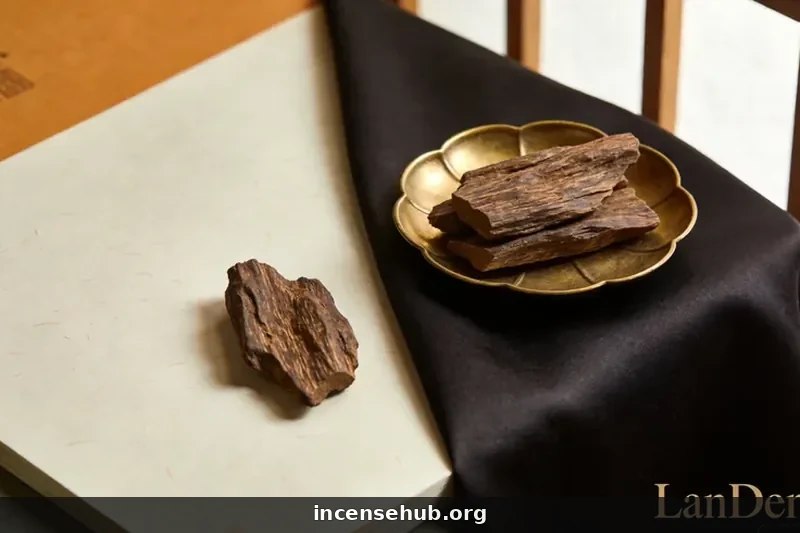
The Formula as the Text Records It
Direct answer: The 香乘 gives the recipe as 沉香三两、栈香三两、檀香一两、乳香一两、龙脑半钱、甲香一两、麝香一钱 — six liǎng of agarwood across two grades, three one-liǎng supports, and small qián-scale accents.
The instruction that follows the list is as important as the list itself. Everything except the borneol is ground together; charcoal-bark powder (炭皮末) and 朴硝 are added at one qián each; the mixture is blended with raw honey; the sealed vessel is warmed over boiling water (重汤) around ten times; the mass is aged (窨) for seven days; then it is formed into cakes and burned.
Read as a procedure, the formula has four stages: reduce the aromatics to a powder, add the two combustion aids, bind with honey, and condition the paste with gentle heat and rest. The order is not arbitrary. Grinding first lets the resins and woods meet as particles; the honey then coats those particles; the water bath warms the whole mass evenly; the rest lets the newly combined materials settle into one scent.
What Each Material Is Doing
Direct answer: The formula is a 君臣佐使 structure — a chief, ministers, assistants and guides — and every ingredient has a job beyond smelling pleasant.
| Role | Ingredient | Function in the blend |
|---|---|---|
| 君 (chief) | 沉香 + 栈香, two agarwood grades | Carries the deep resinous weight |
| 臣 (minister) | 檀香 sandalwood, 乳香 frankincense | Adds warm wood and bright resin around the core |
| 佐 (assistant) | 龙脑 borneol | Lifts the surface with a cool crystalline edge |
| 使 (guide) | 甲香, 麝香, 炭皮末, 朴硝, honey | Holds the scent and keeps the cake alight |
The role names are not decoration. They describe a hierarchy of quantity and function: the chief materials dominate the weight, the ministers round out the body, the assistant changes the surface, and the guides make the mixture hold together and burn. A maker who swaps an ingredient without asking which role it fills is guessing.
Reading the Proportions
Direct answer: The recorded quantities form a 3:3:1:1 balance — six liǎng of agarwood against one liǎng each of sandalwood, frankincense and operculum — with the precious accents at a tenth of a liǎng or less.
| Ingredient | Recorded quantity |
|---|---|
| 沉香 agarwood | 三两 (3 liǎng) |
| 栈香 non-sinking agarwood | 三两 (3 liǎng) |
| 檀香 sandalwood | 一两 (1 liǎng) |
| 乳香 frankincense | 一两 (1 liǎng) |
| 龙脑 borneol | 半钱 (0.5 qián) |
| 甲香 operculum (onycha) | 一两 (1 liǎng, treated) |
| 麝香 musk | 一钱 (1 qián) |
| 炭皮末 charcoal-bark powder | 一钱 (1 qián) |
| 朴硝 saltpetre | 一钱 (1 qián) |
Weights from the period will not convert cleanly. A 两 (liǎng) sat near 37 g in Song–Ming practice, yet the figure moved with the dynasty, somewhere between roughly 31 and 41 g. Ten 钱 (qián) made a liǎng, so a qián came to about 3.7 g, and ten 分 (fēn) made a qián at about 0.37 g. All of these are approximations. Use the proportions, not the gram figures, if you want the blend to resemble the record.
That is the first judgment boundary of the page. A modern maker who converts every line to grams and follows the arithmetic may still produce a different incense, because the historical units were not standardized and the materials themselves vary. The ratio is the portable part; the gram weight is a guess dressed as precision.
The Method: Heat, Rest and Shape
Direct answer: The water bath and the seven-day rest are the two steps that turn a pile of powders into a single scent, and skipping either produces a blend that reads as separate ingredients.
Start with the heat. Honey and ground aromatics are sealed in a vessel → direct fire would scorch the resins and drive off the delicate notes → the vessel sits over boiling water, which caps the temperature near boiling → the mass warms evenly from all sides → the volatiles mingle and the honey loosens → the paste becomes coherent. The step is repeated about ten times, and the repetition is the point: each cycle deepens the melding.
Then the rest. Freshly ground materials carry sharp, separate top notes → sealed together for seven days, the volatiles migrate across the mass → the harshest edges soften → the blend reads as one scent rather than a list. The number seven is a convention, not a chemical threshold; what matters is that the mixture is given time before it is judged.
The final stage is shape. A honey-bound paste can be pressed into cakes, and the cake form suits a court incense: it can be handled, stored and placed on a burner without a holder. The shape is a consequence of the binder, not a separate design decision.
Why Two Agarwood Grades
Direct answer: The formula stacks 沉香 (sinking-grade agarwood) with 栈香 (a non-sinking grade) because the two solve different halves of one problem: one sustains, the other catches.
Trace the pairing. 沉香 is dense with resin → it burns slowly and holds a deep, long note → but it resists ignition. 栈香 is lighter → it catches the ember readily and gives the front a steady path → but it lacks the deep staying power. Together, the 栈香 carries the flame and the 沉香 sustains the body → the blend ignites without difficulty and smoulders long → the base reads even and deep instead of flaring and dying.
A single grade would trade one property for the other. A pure sinking-grade base would be hard to light; a pure non-sinking base would fade quickly. The stacking is the quiet engineering of the recipe: two cuts of one wood, each chosen for the half of the burn it handles best.
Editorial judgment, not a measured finding.
The Accent Tier: Why Borneol and Musk Stay Tiny
Direct answer: Borneol at half a qián and musk at one qián are dosed small because both are intense materials whose value is to shape the blend from the edges, not to join its body.
Borneol’s cool, crystalline note is volatile. Increase it and the warm agarwood base turns into a cold fog; at half a qián it lifts the heavy materials without replacing them. Musk is denser and animalic. At one qián it acts as a fixative, slowing the escape of the lighter notes and adding a quiet warmth; at a larger dose it would bury the woods.
The pattern is a general lesson in 合香: a strong material measured small can change the character of a blend without becoming its subject. The agarwood stays dominant precisely because the accents are kept from competing. A maker who “improves” the formula by doubling the musk has not improved it; the balance that made it a court blend is gone.
The Guide Team: Fixatives and Combustion Aids
Direct answer: The 使 role is a small team — 甲香 and musk hold the scent, while 炭皮末 and 朴硝 keep the dense cake burning — and each member solves a different physical problem.
甲香 is the shell door of a sea snail, a hard disc that closes the opening. Classical practice treats it (法制) before it enters a blend, a step that strips the marine edge; what remains works as a fixative, slowing the loss of volatile notes so the cake unfolds over an evening rather than flashing off in a minute. Think of it as a timekeeper rather than a note. The onycha ingredient entry goes further into the material.
The combustion aids address the opposite problem. A resin-heavy cake packs tight and holds moisture → an ember struggles to travel → 朴硝 releases oxygen as it heats → the ember finds fuel where it would otherwise stall → the charcoal-bark powder adds a light, dry carrier → the cake burns evenly instead of smothering. The lesson is that even a luxurious formula is an engineering problem at the fire. A court incense that could not stay lit would be no incense at all, whatever its materials cost.
What 衙香 Actually Means
Direct answer: 衙香 is a class of compound incense burned in the yamen (官署, official offices) and at court, not a single recipe — the 陈氏香谱 alone lists fifteen of them.
The word points at a workplace, not a province or a botanical. Officials burned scent in the yamen, the building where administration happened, and the practice carried a message about rank. Recipes grouped under the label share a costly spine — 沉香, 檀香 and 麝香 — which is what makes them read as palace material rather than study material. Ask what a 衙香 cost and you are closer to its identity than asking what it smelled like.
Fame and typicality are different things here. The 花蕊夫人 entry is the best known, yet its character comes from a particular choice: two cuts of agarwood, a borneol lift and a complete 君臣佐使 ladder. Treating 衙香 as one smell flattens the class; treating it as one price band flattens the variety inside the class.
Court Blend Against Scholar Blend
Direct answer: The clearest way to read this recipe is against its humble opposite, because the contrast shows the full social range of one tradition.
| Signal | 花蕊夫人衙香 (court) | 柏子香 (scholar) |
|---|---|---|
| Core materials | Two agarwood grades, sandalwood, musk | A single seed |
| Cost register | Deliberately opulent | Deliberately cheap |
| Structure | Full 君臣佐使 ladder | One material, no ladder |
| Proportions | Weighed in 两 and 钱 | No fixed measure recorded |
| What it signals | Wealth and official standing | Patience and modesty |
Neither side wins this comparison. A household with money could afford woods and resins, and the materials announced that fact without a word; a scholar with a small budget could roast seeds by a window and lose nothing in seriousness. The tradition holds both, and calling one more authentic than the other mistakes expense for depth. Put the two side by side and the social range becomes visible; the cypress-seed recipe shows the lean end.
What to Treat With Care
Direct answer: Three caveats frame the recipe: the attribution is traditional, the weights drifted by dynasty, and 甲香 is an animal-derived fixative that many modern makers omit.
The 花蕊夫人 attribution is a traditional label, not a signed document. Lady Huarui was a real figure — a consort and poet of the Later Shu — and her name carries genuine weight, but nothing connects her hand to this particular formula. The recipe survives in the 香乘 as a recorded formula, and the name functions as a title rather than a byline.
The units are the second caveat. A liǎng was not a fixed mass across dynasties, and the conversion to grams is approximate at best. The ratio is the reliable content.
The third caveat is the material itself. 甲香 comes from a sea snail, and its inclusion makes the recipe unsuitable for vegetarian or vegan makers. Musk is also animal-derived, and many contemporary makers avoid it. A modern reproduction is therefore an interpretation, not a copy, and the page treats it that way.
Reproducing It Today
Direct answer: The structure of 花蕊夫人衙香 survives reproduction better than its materials: a two-grade base, trace-level accents and a combustion guide can be borrowed even when the original ingredients cannot be sourced.
Start with what is portable. The two-grade wood base teaches how to build a core that both catches and sustains. The qián-scale accents teach how to dose a strong material so it shapes without dominating. The guide team teaches how a dense, resin-heavy mix is kept burning. None of those lessons depends on owning sinking-grade agarwood or genuine musk.
Then separate substitution from imitation. Replacing 甲香 with another fixative changes the material but preserves the function; omitting it changes both. Replacing musk with a synthetic or a botanical substitute is a different formula, not a reproduction. The honest label for such a blend is “in the style of,” not “the original recipe.”
The judgment boundary is worth stating: a maker who cannot source the original materials can still learn the structure, and the structure is the recipe’s real content. The incense itself was an example. See the 合香 blending system for the wider grammar this formula belongs to.
What a Court Blend Was For
Direct answer: A court blend was a public statement of resources and taste, read by guests who knew the luxury trade.
A recipe like this one was never only a smell. In an office or a reception hall, the burning cake announced the rank of the household, the depth of its stores and its familiarity with the luxury trade. The materials did the talking: sinking agarwood, genuine musk and frankincense were expensive enough that their presence alone carried meaning.
That reading explains why the formula is so layered. A host who wanted to impress did not choose one spectacular material; the host stacked several, each recognisable to a guest who knew the market. The two agarwood grades signalled discernment as much as wealth — anyone could buy one wood, but a blend that used a sinking grade for depth and a lighter grade for carriage suggested a maker who understood how the materials behaved.
The same logic explains the small accents. Borneol and musk were costly, and a host who used them at trace levels demonstrated restraint as well as access. Excess would have been vulgar; a whisper of each was the more sophisticated display. The formula’s proportions are therefore a social document as much as a technical one.
None of this requires believing that the smoke changed anyone’s fortune. The point is narrower: the blend was designed to be read, and the reading happened through the nose and the guest’s knowledge of the trade. A modern maker who reproduces the structure without that social setting is left with a fine incense and a lost context.
A Checklist for Reading Any Classical Formula
Direct answer: A historical recipe becomes usable when you can name each ingredient’s job, normalize the units, separate the fixatives from the aromatics, and test the result — in that order.
Name the roles first. Sort every line into chief, minister, assistant or guide before touching a scale. The largest quantities usually carry the body; the smallest usually steer it or preserve it. A formula whose smallest line is a strong aromatic is telling you that restraint is part of the design.
Normalize the units, then ignore them. Convert historical weights to a common unit so the proportions become visible, then work from the ratio. The gram figure is a period estimate; the ratio is the part that survives translation.
Separate function from fragrance. Some lines exist to fix, bind or carry combustion rather than to smell. Operculum, honey and the two combustion aids in this formula are examples. A maker who treats every ingredient as a note will misread the structure.
Check the attribution. A famous name attached to a recipe is often a label of register, not a record of authorship. Note it, then set it aside and read the formula on its own terms.
Test the burn before judging the scent. A dense, resin-heavy cake can smell harsh when it is first mixed and settle after resting; it can also fail to stay lit if the guide tier is wrong. Burn a small cake, observe the ember, and adjust the combustion aids rather than the aromatics.
The checklist is not specific to this recipe. It works on any entry in the 香乘, and it keeps a reader from mistaking a translated list of quantities for an understanding of the blend. Run it once on a formula you already know, and the gaps in your reading become obvious: a role you cannot assign, a unit you cannot place, a line you had been treating as a fragrance that turns out to be a fixative. Those gaps are the useful part.
FAQ
Q: What is 花蕊夫人衙香, in one paragraph?
An opulent compound scent named for Lady Huarui, the Later Shu consort of 孟昶. Six liǎng of agarwood, split between two grades, form its spine; sandalwood, frankincense and operculum sit at one liǎng each; borneol and musk appear only in qián amounts. Within the 衙香 class, it is the celebrity entry.
Q: Where does the word 衙香 come from?
From the yamen, the office where officials worked. Scent burned in that setting signalled rank, so the label describes a milieu and a budget rather than a single smell. The 陈氏香谱 records fifteen variants, all built around agarwood, sandalwood and musk.
Q: Why does the formula call for 甲香?
甲香 is operculum, the shell door of certain sea snails. Treated first to strip its marine harshness, it acts as a fixative — it holds the lighter notes in place so the cake releases its scent gradually. Modern makers often skip it: the material is awkward to source and animal-derived, which rules it out for vegetarian work.
Q: Was Lady Huarui the author?
No documented link exists. She was a tenth-century consort and poet at the Later Shu court, and poems attributed to her survive; the incense carries her name by tradition. Read the attribution as part of the recipe’s lore, not as a signature.
Q: Why so little borneol and musk?
Because a trace is enough to steer the blend. Half a qián of borneol cools and brightens the resinous base; one qián of musk deepens it and slows the escape of lighter molecules. Increase either and the agarwood stops being the subject of the composition.
Sources
- 香乘 (Xiang Cheng), the Ming compilation by 周嘉胄 that preserves this formula. Wikisource text.
- 陈氏香谱, the Song-era collection whose 衙香 section supplies the category count.
- 本草綱目, the materia medica that documents the individual aromatics. ctext edition.
Related Resources
- Chinese Incense Recipes (香方) — the recipe index this entry belongs to, with the unit notes.
- Agarwood Incense Guide — background on the wood at the centre.
- Frankincense Incense Guide — the resin behind the bright middle.
- Cypress-Seed Incense (柏子香) — the lean scholar contrast.
- The 合香 Blending System — the 君臣佐使 grammar in practice.
Summary
花蕊夫人衙香 is a palace-grade compound built on six liǎng of agarwood across two grades, with one-liǎng supports of sandalwood, frankincense and operculum, and trace accents of borneol and musk. Its method — grind, bind with honey, warm over water, rest seven days, press into cakes — is as much a part of the formula as the ingredient list.
- The 3:3:1:1 ratio is the portable content; the gram weights are period approximations.
- 衙香 names a class of office and court scents, not a single fragrance.
- The attribution to Lady Huarui is traditional, and 甲香 is an animal-derived fixative that many modern makers leave out.