
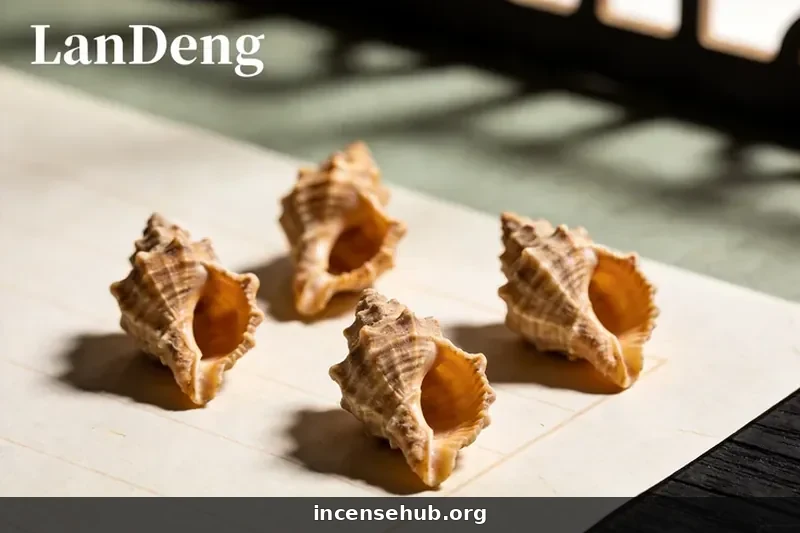
Direct answer: Onycha (甲香, jiǎxiāng) is the operculum — the hard lid that closes a sea snail’s shell — used in classical Chinese blended incense as a fixative rather than as a fragrance in its own right. It is an animal material, not a plant, resin, or mineral. Trade in it is now negligible, and modern reconstructions of old formulas generally omit or replace it.
The entry treats onycha as history. That is not a downgrade. A material can be historically important and commercially dead at the same time, and the second fact is part of what a reader needs to know. The page explains what the object is, what the old formulas asked it to do, why the request made sense within the technology of the time, and why the same request is hard to satisfy today.
Key facts
| Question | Short answer |
|---|---|
| Chinese name | 甲香 (jiǎxiāng) |
| What is it? | The operculum of a marine gastropod — a mollusc, not a plant |
| Which animals? | Sea snails of the class Gastropoda; the historical material is not attributed to one species |
| What does it do? | Acts as a fixative in 合香 (blended incense) |
| How was it prepared? | 法制 — a treatment step specified before use |
| Does it smell strong? | No; faint marine, briny, animalic notes at most |
| Is it used today? | Largely obsolete; omitted or substituted in modern work |
| Dietary status | Animal-derived; unsuitable for vegetarian or vegan products |
| Classical references | 香乘, 香譜, 本草綱目 (介部) |
What an operculum actually is
Direct answer: An operculum is a hard plate attached to the muscular foot of many sea snails. The animal pulls the foot in and the plate seals the shell opening like a door, protecting the soft body from predators, drying, and mechanical damage.
Picture a snail retreating into its shell. The foot contracts, the animal withdraws, and a rigid flap swings into the aperture. That flap is the operculum. It is not the shell, and it is not a secretion laid over the shell; it is a separate structure, grown on the back of the foot, that fits the opening closely enough to make a seal.
Opercula vary enormously across gastropods. Some are thin, horny, and flexible; some are thick and heavily mineralised; some are circular, some oval, some claw-shaped. The variation is one reason the historical material is hard to pin to a species: the texts describe a class of object, not a zoological specimen.
The structure is animal tissue, hardened. That single fact settles the category questions that follow: it is not botanical, it is not a resin, and it cannot be treated as a plant-derived aromatic for purposes of diet, ethics, or labelling.
Why a shell lid belongs in a fragrance book
Direct answer: Because the classical Chinese incense tradition classified materials by function, not by origin. A material that made a blend hold together earned a place in the formula book whether it came from a tree, a mineral, or a snail.
Modern readers expect incense materials to be woods, resins, roots, or flowers. The classical pantry was wider. It included minerals, animal secretions, shell parts, and processed substances whose role was technical rather than aromatic. 甲香 belongs to that technical shelf.
The distinction is between a note and a function. A note is what you smell. A function is what the material does to the mixture: it may fix volatiles, slow combustion, modify the smoke, or bind the powder. 甲香 was valued for function. The old formulas dose it accordingly, in a small proportion relative to the aromatic woods and resins.
Once that is clear, the oddity dissolves. A fragrance book is a book about mixtures, and mixtures need materials that are not themselves fragrant. The same logic explains why a perfumer keeps odourless solvents and why a cook keeps salt.
The two names
Direct answer: 甲香 means “shell fragrance” — 甲 for the hard covering, 香 for aroma. The English “onycha” comes through Latin from Greek onyx, “nail” or “claw,” a reference to the shape of the operculum.
The Chinese name is descriptive and slightly misleading. 甲香 labels the object by its origin (a shell part) and its use (in aromatics), not by any scent it carries. A reader who expects the name to promise a fragrance will be disappointed by the material itself, which is close to odourless until treated.
The English name is older and stranger. Greek onyx names a fingernail, a claw, and a banded gemstone — the common thread being a hard, curved, translucent-looking object. Latin took the word, and European incense and pharmacology inherited it. The same term appears in the list of incense ingredients in Exodus 30:34, where it is often identified with an operculum; the identification is scholarly tradition rather than a chemical demonstration.
Two names, two metaphors — shell and claw — and neither is a botanical description. That is appropriate for a material that was never a plant.
The fixative claim, examined
Direct answer: The classical texts say 甲香 binds and stabilises a blend. Modern writing repeats the claim, but no controlled modern study of this material as a fixative is cited here, so the mechanism should be treated as traditional technical lore rather than established chemistry.
What would “fixing” mean in practice? A fixative slows the loss of volatile aromatic molecules, so that a blend smells for longer and changes more slowly as it ages. In perfumery the effect is real and is produced by materials that evaporate slowly, dissolve volatiles, or form a film that retains them.
Several mechanisms could plausibly apply to a hard, porous, protein-rich disc:
- Adsorption. A porous matrix can hold aromatic molecules at its surface, releasing them slowly as the material warms.
- Barrier formation. A finely divided hard material can slow diffusion of volatiles through a compressed powder.
- Combustion modification. A mineral-rich or protein-rich additive can change how a stick or cone burns, which changes the rate at which aromatics are released.
None of these is documented for 甲香 specifically in the sources consulted here. They are plausible physical routes, not proven ones. The honest position is that the classical claim is a record of practice, and the modern explanation is a hypothesis.
Mechanism chain — the classical logic of a fixative:
- Volatile aromatics evaporate from a blend → the top notes disappear first → the mixture smells thin.
- A slowly releasing material holds some of those volatiles → evaporation is spread over a longer period → the blend keeps its character.
- The fixative itself must be stable under heat → a hard, mineralised or proteinaceous structure survives the coal → it keeps working while softer materials have burned away.
- The result is a longer, flatter scent curve → less excitement at the start, more continuity through the burn.
That chain is a reconstruction of why the material was used. It is not a lab result, and the page labels it accordingly.
法制: the treatment step
Direct answer: Every classical formula that calls for 甲香 specifies 法制 — “treated” — before use. The raw operculum was not added as it came off the animal; it was cleaned and processed first.
The word 法制 is a marker of a prepared material. In Chinese technical writing it signals that the substance requires handling before it can enter a formula: washing, soaking, heating, or combining with another material to correct an unwanted property.
For 甲香 the unwanted property is obvious. A raw operculum carries the smell of dried marine tissue. That smell had to be reduced before the material could sit in a blend without announcing itself. The treatment was therefore both a cleaning step and a deodorising step.
The texts do not agree on a single method, and this page does not invent one. What they agree on is the requirement: treated, then used. That requirement is the strongest evidence that 甲香 was understood as a functional ingredient rather than a aromatic one. You process a material you need; you do not process a material you are merely enjoying.
There is a wider lesson here for reading old formulas. When a recipe says 法制, it is telling you that the ingredient is not a raw commodity. It is a prepared intermediate, and the preparation is part of the recipe’s technology.
Reading the Huarui Furen formula
Direct answer: The best-known appearance of 甲香 is in the Huarui Furen court incense (花蕊夫人衙香), recorded in the 香乘, where it is dosed at 一两 alongside frankincense and borneol and specified as treated before use.
A formula is a document, and this one documents a court blend: agarwood and sandalwood for body, frankincense and borneol for lift, musk for animalic depth, and 甲香 as the fixative. The proportions tell you what the formulator thought the material was for. One liǎng against the aromatic woods is a supporting dose, not a lead.
The recipe also shows the social setting. Court incense was a display of resources as much as a smell: the materials were expensive, the formulas were guarded, and the result was meant to be recognisable. A fixative that made the blend last was part of that display.
For a modern reader, the formula is more useful as evidence than as instruction. It proves that 甲香 had a recognised place in high-status blending. It does not prove that the material is available, legal, ethical, or safe to reconstruct today.
The texts behind the record
Direct answer: 甲香 appears in the 香乘 (Xiang Cheng) and the 香譜 (Xiangpu) as a formula ingredient, and in the 本草綱目 (Bencao Gangmu) in the 介部 — the section for shelled animals. Those are three different kinds of source, and they should be read as such.
The 香乘 is a compiled incense manual: formulas, materials, and commentary. The 香譜 tradition is earlier and more varied, a family of texts rather than a single book. The 本草綱目 is a materia medica, organised by category, with entries on flavour, nature, preparation, and uses.
A material that appears in both an incense manual and a materia medica has two reputations. In the manual it is a technical ingredient. In the materia medica it is a substance with properties and cautions. The two descriptions are not always consistent, and the inconsistency is informative: it shows that different crafts observed the same object through different questions.
The shelled-animal section of the materia medica is the right home for 甲香 by the logic of that text. The classification is by origin, not by use, which is why an incense material sits among shells, scales, and other hard animal parts.
Why it fell out of use
Direct answer: Three pressures converged: the material is animal-derived, the supply is tied to shellfisheries rather than to a dedicated trade, and modern incense practice has alternatives that are easier to justify. None of these is a formal prohibition; together they made 甲香 a historical curiosity.
The first pressure is ethical and dietary. A material that comes from an animal cannot serve a vegetarian or vegan product, and a maker who wants a clean label has an incentive to omit it. The second is logistical: opercula are a by-product of snail harvesting, not a crop, so supply is irregular and quality is inconsistent. The third is technical: a modern formulator can choose from a range of plant resins and gums that behave predictably and carry no animal-origin complications.
The result is not a ban but a drift. The material stopped being ordered, the formulas that used it stopped being made, and the knowledge of its preparation survived mainly in texts. That is how most technical materials disappear: not with a decision, but with a generation of purchasers who no longer ask for them.
There is an irony in the drift. The same period that made 甲香 obsolete also made classical formulas fashionable again. Reconstruction projects revive the recipes, then substitute or omit the ingredient that no longer exists in trade, and the result is a blend that is faithful on paper and different in the censer.
Onycha, musk, and ambergris
Direct answer: The three are the animal-derived materials of the classical canon, and they are not interchangeable. 甲香 is the shellfish fixative; musk is the deer-gland material with a strong animalic scent; ambergris is the whale-derived substance valued as both fixative and note.
| 甲香 (onycha) | Musk (麝香) | Ambergris (龙涎香) | |
|---|---|---|---|
| Origin | Operculum of a sea snail | Glandular secretion of a deer | Intestinal secretion of a sperm whale |
| Sensory role | Faint marine, briny, animalic | Strong, warm, animalic | Marine, sweet, animalic |
| Technical role | Fixative | Fixative and note | Fixative and note |
| Historical status | Formula ingredient | Prestige ingredient | Rare prestige ingredient |
| Modern status | Largely obsolete | Regulated and restricted | Protected and restricted |
| Ethical issue | Animal-derived | Animal-derived, welfare-critical | Animal-derived, conservation-critical |
The table makes the category clear. All three are animal materials, but only 甲香 is almost purely functional. Musk and ambergris are wanted for what they smell like as well as for what they do. 甲香 is wanted for what it does.
That difference explains the modern outcomes. A material with a unique scent can justify its complications; a material with no scent of its own has to justify itself entirely on performance, and performance claims from pre-modern texts are hard to defend in a modern market.
Why the format changes a fixative’s job
Direct answer: A stick, a cone, and a heap of loose powder burn differently, so a material that stabilises one format may do little for another. The classical formulas were written for specific formats, and the fixative’s role has to be read in that context.
A stick is a compressed composite. Powder, binder, and water are worked into a paste, extruded or rolled, and dried. Once lit, the coal front travels along the body of the stick, and the binder holds the structure together as it burns. A fixative in this format is part of a solid matrix: it affects density, air gaps, and the rate at which heat reaches unburned material.
A cone is the same idea with a different geometry. The mass is greater at the base, the airflow is different, and the coal front moves inward as well as upward. A material that works well in a thin stick may smother a cone, or may simply be present in too small a proportion to matter.
Loose powder burned on a coal or in a heater is a different problem again. There is no binder and no self-supporting structure. The material sits on a hot surface, and the question is how it blankets the heat, how it smoulders, and how much of the aromatic fraction escapes before the charge is spent.
The classical formulas were not written in the abstract. They were written for the incense forms of their time, and the dose of a fixative reflects the format as much as the fragrance. A modern reconstruction that changes the format while keeping the recipe has changed one of the recipe’s variables.
Terms that recur in the record
Direct answer: A handful of technical words carry most of the meaning in the classical incense texts. Knowing them makes the difference between reading a formula and reading a list of unfamiliar nouns.
| Term | Literal sense | Working sense in incense writing |
|---|---|---|
| 合香 (hé xiāng) | Blended fragrance | The craft of composing multiple materials into one incense |
| 法制 (fǎ zhì) | Method-processed | A required treatment step before an ingredient enters a formula |
| 修制 (xiū zhì) | Prepared and corrected | Processing that removes or modifies an unwanted property |
| 香乘 (Xiāng Chéng) | The incense record | A compiled manual of formulas and materials |
| 香譜 (Xiāng Pǔ) | Incense register | A family of earlier texts listing materials and recipes |
| 介部 (jiè bù) | Shell section | The division of the materia medica covering shelled animals |
| 两, 钱 (liǎng, qián) | Weight units | Historical measures indicating proportion, not modern grams |
The last row deserves a caution. Historical weights are not directly convertible into modern units without knowing the period and the standard in use. What travels across the centuries is the ratio, not the gram. A formula that doses one material at a few 两 and another at a few 钱 is telling you which is the body and which is the accent, even if the absolute weights are uncertain.
That is why this page discusses doses qualitatively. The arithmetic of a formula is evidence about function; the exact mass is evidence about a particular workshop on a particular day.
The shell as a workshop object
Direct answer: An operculum is brittle, light, and awkward to handle. It arrives as a mixed batch of discs in different sizes and conditions, and the first workshop job is sorting rather than blending.
Picture the material on a bench. The discs are small, hard, slightly convex, and varied: some whole, some chipped, some stained with dried tissue, some carrying grit from the shell. They do not look like an aromatic substance, and they do not behave like one. They rattle rather than rustle, they do not crumble between the fingers, and they have almost no smell until they are heated or treated.
Sorting is therefore the first operation. Whole discs are separated from fragments, clean from encrusted, thick from papery. The categories matter because the treatment step acts on surface area: a thick disc needs longer than a thin one, and a fragment exposes more surface than the formulator intended. A batch that is not sorted will not process evenly.
Storage is the second. The material is hygroscopic enough to soften in damp air and brittle enough to crack when dry. A sealed container in a stable room is the ordinary answer. Heat and sunlight are not, because both accelerate the breakdown of the protein matrix and leave the disc smelling of old fish.
The bench reality explains why the classical texts are so insistent about preparation. A raw batch is not a standardized ingredient. It is a heap of variable animal parts, and the recipe’s success depends on turning that heap into a uniform intermediate.
What “fixative” means in different crafts
Direct answer: In perfumery a fixative is a material that slows evaporation and extends a composition’s life; in incense the word often means something broader — a material that holds the blend together, modifies combustion, and gives the smoke continuity. 甲香 belongs to the second, looser sense.
The ambiguity causes a great deal of confused writing. A perfume fixative is judged by how it changes the evaporation curve of a solution on skin. An incense fixative is judged by how it changes a burning powder: the rate of release, the density of the smoke, the way the stick holds together, the persistence of the note in a room.
These are different problems with different physics. A material that excels at one may be useless at the other. A heavy resin that fixes a perfume may clog an incense powder; a mineral that modifies a coal bed may be irrelevant in alcohol.
For 甲香, the evidence points to the incense sense. The material appears in formulas, dosed alongside woods and resins, specified as treated. Nothing in the record describes it dissolved in a solvent or applied to skin. The claim is about a burning mixture, not about a perfume.
That distinction is worth keeping in view when a modern writer calls 甲香 “a fixative” without qualification. The word is doing different work in different crafts, and the classical source is talking about a censer.
Reading the arithmetic of a formula
Direct answer: In a classical formula, the dose tells you the job. A material measured in 两 against aromatic woods measured in larger quantities is a supporting ingredient; a material measured in 钱 or less is a modifier. 甲香 sits in the first group.
Old Chinese formulas are recipes with a ledger structure: each ingredient, a quantity, a note on preparation. The quantities are not arbitrary. They encode a theory of proportion in which the chief material dominates, the supporting materials fill out the body, and the minor materials correct or extend.
甲香 at 一两 in the Huarui Furen blend is a supporting quantity. It is large enough to affect the mixture and small enough not to dominate it. That is exactly what a fixative dose should look like: present in the body of the blend, absent from the headline.
The arithmetic also exposes a modern error. A reconstruction that keeps the aromatic woods and drops the fixative changes the proportions of everything else; a reconstruction that substitutes a strongly scented resin changes the balance in a different way. Fidelity is not a matter of matching the list of names. It is a matter of matching the functions those names performed.
Three ways to handle an obsolete ingredient
Direct answer: A reconstruction can omit the material, substitute something else, or include it and label the result as an approximation. Each choice is defensible; pretending the choice was not made is not.
The first route is omission. The formula is rebuilt without 甲香, and the result is presented as a modern interpretation. This is honest if it is stated, and it is the most common practice, because the material is not commercially available and its animal origin raises objections.
The second is substitution. A plant resin or gum takes the functional slot, and the blend is presented as a reconstruction with a modification. The risk is that the substitute brings its own scent and the result drifts from the original without anyone noticing which change caused the drift.
The third is inclusion. A maker who can obtain and process the material rebuilds the formula as written. This is the highest-fidelity route and the most complicated one, because it requires a supply chain, a treatment method, and a clear statement of what the material is.
The unacceptable fourth route is silent substitution: using something else and presenting the result as the classical formula. That is not reconstruction. It is relabelling, and it erodes the documentary value of the exercise.
Animal materials and the modern label
Direct answer: A blend containing 甲香 is not vegetarian, and no amount of historical framing changes that. Modern makers should disclose the material plainly rather than rely on the obscurity of the name.
Disclosure is the practical issue. A consumer reading a ingredient list may not recognise 甲香, and may not know that it is an animal part. A label that lists it without explanation is technically accurate and practically opaque. A label that omits it is neither.
The ethical question is separate from the historical one. A material can be fascinating, well documented, and still unsuitable for a product that promises plant-based ingredients. The page’s position is that the history should be preserved and the material should be labelled, not that the material should be revived.
There is also a conservation dimension, though it is indirect. Opercula come from wild-caught snails, and the trade in shell products is regulated differently from the trade in aromatic plants. A maker who sources animal materials should expect to answer questions that a maker who sources sandalwood does not.
None of this is a reason to erase the material from the record. It is a reason to write about it accurately.
What a modern maker uses instead
Direct answer: There is no direct substitute for 甲香, because no modern material is used in the same way for the same documented purpose. Makers who need a fixative in a plant-based blend turn to resins and gums, and accept that the result is a different formula.
| Material | Role in a modern blend | Relation to 甲香 |
|---|---|---|
| Benzoin | Resinous fixative and sweetener | Plant-derived; adds its own vanilla-balsamic note |
| Labdanum | Heavy, leathery fixative | Plant-derived; strong colour and scent |
| Styrax | Balsamic fixative | Plant-derived; can be sticky in powder |
| Frankincense | Resin with fixative-adjacent behaviour | Plant-derived; adds a bright resinous top |
| Sandalwood | Woody base with lasting power | Plant-derived; contributes its own creamy note |
| Synthetic fixatives | Odourless or low-odour retention aids | Not traditional; used in perfumery, not classical incense |
The table is a map of replacements, not equivalents. Each plant material brings a smell that 甲香 did not have, so substituting changes the blend rather than merely restoring a technical function. A formulator who wants historical fidelity has to accept the omission; a formulator who wants a workable blend has to accept the change.
This is the ordinary condition of reconstruction. You can preserve the recipe or the result, rarely both.
Quality, as the old texts understood it
Direct answer: Historical quality turned on the condition of the disc and the completeness of its treatment: sound, clean, and properly 法制. There is no modern commercial grading, because there is no modern commercial trade to grade.
| Signal | Historical meaning | Why it mattered |
|---|---|---|
| Soundness | Disc intact, not crumbled | A broken operculum was harder to clean and dose |
| Cleanliness | Free of dried tissue and sand | Residue carried the raw marine smell |
| Thickness | Substantial, not papery | A thin disc was fragile and less useful as a fixed element |
| Treatment | Properly 法制 | Untreated material contaminated the blend |
| Odour after treatment | Neutral or faintly marine | A strong smell meant incomplete processing |
Read the table as a description of a craft standard, not as a shopping guide. A contemporary buyer cannot apply it, because the material is not offered in a contemporary market with those categories. It is included because it shows what the classical formulator was looking at when judging a batch.
The maritime supply
Direct answer: Opercula come from sea snails, and the historical trade in them rode on shellfisheries rather than on a dedicated harvest. That origin explains both the material’s variability and its eventual scarcity in commerce.
A shell fishery produces snails for food; the opercula are a remnant. Where large species are gathered, the discs can be collected in quantity, but the supply depends on the fishery, not on demand for incense. The material is therefore irregular in size, species, and condition.
Historical trade moved such materials along the same routes as other marine goods: coastal collection, regional markets, and long-distance carriage for the small fraction that reached inland workshops. The value came from the function, not from the abundance, and a material that is cheap at the coast can be expensive at the point of use.
For a modern reader, the supply story is a caution about provenance claims. A seller who offers “甲香” today is offering something that has no established commercial chain, no standard grading, and no agreed species. The label carries no guarantee.
Traditional use and the evidence line
Direct answer: The documented facts are the material’s identity, its formula role, and its treatment requirement. The medicinal entries in the materia medica are traditional belief, and no clinical claim is made here.
Three layers, kept separate:
- Documented. The operculum of marine gastropods; use as a fixative in classical Chinese blended incense; the 法制 requirement; appearances in the 香乘, the 香譜, and the 本草綱目.
- Traditional belief. The materia-medica entries describe properties and uses that belong to the humoral and categorical language of their time. They are not clinical evidence.
- Unresolved. The exact species used, the precise treatment methods, and the physical mechanism of the fixative effect are all open questions in the sources consulted here.
The page takes no position on whether 甲香 “worked” in a chemical sense. It takes a firm position on what the texts say and on what they do not say.
Safety
Direct answer: Onycha is a historical material with no modern safety dossier in this page’s sources. The general rules for incense apply: combustion produces smoke and fine particles, ventilation is necessary, and concentrated smoke should not be inhaled.
Two specifics are worth adding. First, an animal material of uncertain provenance carries the ordinary risks of unregulated biological material: contamination, spoilage, and inconsistent preparation. Second, anyone experimenting with a reconstructed formula should treat the ingredient as an unknown rather than as a food-safe substance.
Nothing on this page is medical advice, and nothing here recommends reviving the material for use. The site’s safety guide covers smoke, ventilation, and household precautions in general.
FAQ
What is onycha (甲香)? The hard operculum of a sea snail, used in classical Chinese blended incense as a fixative. It is an animal structure, not a plant or resin, and it is largely obsolete in modern practice.
Is onycha still available? Not as a normal commercial material. There is no established modern trade with standard grading, and reconstructions of classical formulas generally omit or replace it.
Why was it used if it barely smells? Because it was valued for function, not for scent. The classical texts describe it as binding and stabilising a blend, and they specify that it be treated before use.
What does 法制 mean? “Treated” — a preparation step that cleaned and deodorised the raw operculum before it entered a formula. The texts agree that treatment was required; they do not agree on one method.
Is onycha suitable for vegetarians? No. It is animal-derived, so it is unsuitable for vegetarian and vegan products, and any label claiming otherwise would be wrong.
Is onycha the same as musk or ambergris? No. All three are animal materials used in classical incense, but they come from different animals and do different jobs. 甲香 is the functional fixative; musk and ambergris are valued for scent as well.
Where does the English name come from? Through Latin from Greek onyx, meaning a nail or claw — a description of the object’s shape. The same word appears in the incense list of Exodus 30:34, traditionally understood as an operculum.
Summary
甲香 (onycha) is the operculum of a marine gastropod: a hard, animal-made lid that sealed a snail’s shell and, in classical Chinese blended incense, was asked to seal a fragrance in the same way. It appears in the 香乘 and 香譜 as a fixative, most memorably in the Huarui Furen court formula at 一两 with a 法制 treatment, and in the 本草綱目 among the shelled animals. It has almost no scent of its own, which is precisely the point: it was a functional ingredient in an aromatic craft. The material is now largely obsolete, animal-derived, and without a modern supply chain, and this page documents it as history rather than as a shopping recommendation.
Sources
The zoological anchor is the GBIF record for Gastropoda, the class that bears the operculum: Gastropoda on GBIF. The historical anchor is the Chinese textual record: 甲香 in the 香乘 (Xiang Cheng) and the 香譜 (Xiangpu) as a 合香 fixative, including the 花蕊夫人衙香 formula with its 一两 dose and 法制 requirement, and the 甲香 entry in the 本草綱目, 介部.
These sources support identity and historical use. They do not support a modern medicinal claim, and none is made. The treatment details and the exact species behind the historical material remain unresolved in the sources consulted.
Related Resources
- Musk (麝香) — the animalic fixative that outlived onycha in prestige, if not in controversy.
- Ambergris (龙涎香) — the marine animal material with a scent of its own.
- Huarui Furen court incense recipe — the formula where 甲香 is best documented.
- Material comparison matrix — where the animal materials sit against the plant catalogue.
- Scent guide — the vocabulary used for marine, briny, and animalic notes.
- Safety guide — smoke, ventilation, and household precautions.