
Direct answer: Incense scent runs on a single axis. Bright, clarifying notes sit at one end — citrus, frankincense — and deep, enclosing resins at the other — agarwood — with floral accords and creamy woods filling the space between. What most people are really choosing is an atmosphere for a room, so the useful skill is placing a scent on that axis, then checking which material the label actually names.
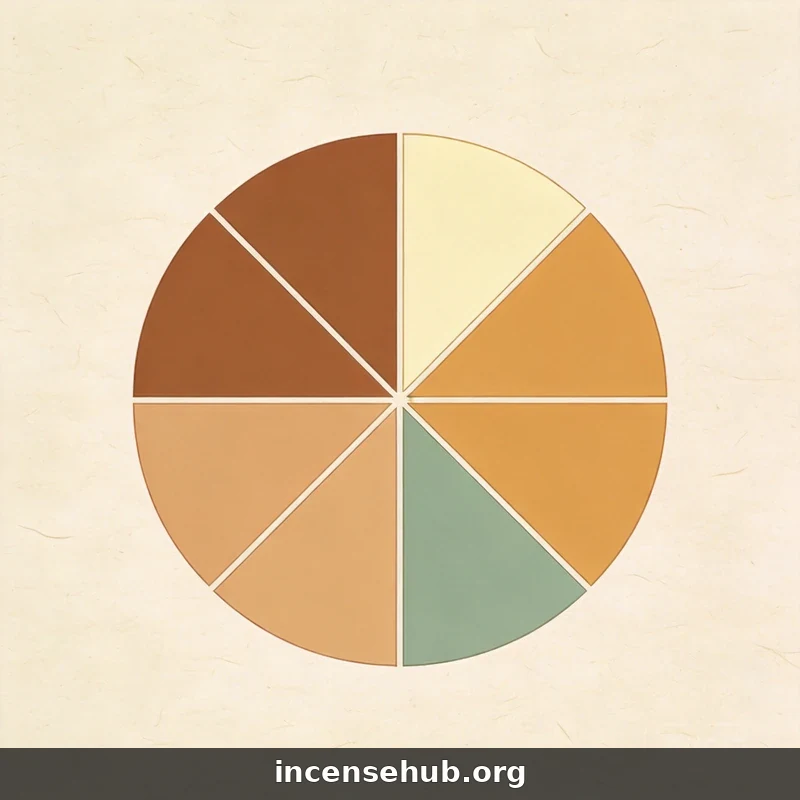
Key facts: Four substances anchor the Chinese tradition — two woods (agarwood, sandalwood) and two resins (frankincense, myrrh). Flowers and fruit peel arrived later, mostly as symbol or as composed scent. Nothing in this guide is a treatment for a condition, and no page in this cluster claims otherwise.
Key Takeaways
- One axis settles most of the questions buyers ask in practice: how bright, how deep. Everything else is detail inside a chosen half.
- The canon is woody and resinous at its core. A flower or a citrus peel on the box usually marks a modern impression, not something harvested.
- A single word can hide three products — real material, composed fragrance, classical compound — and the three behave quite differently once lit.
- Loudness and weight are separate properties. Mixing them up is the most common misread on a shelf.
- Terms such as “calming” or “grounding” describe character and association. They are not measurements of anything happening in a body.
The Single Axis: Bright to Deep
Direct answer: Nearly every “which scent should I burn” question reduces to one decision — do you want the room brighter or deeper — and the rest is refinement inside that half of the axis.
Bright stock reads clean, quick, and upward: it lifts the air, then leaves — citrus peel is the clearest example. Deep stock reads dense, slow, downward: it settles and stays. Between the two poles sit the creamy timbers and the softer petals, which is why sandalwood and lotus so often act as the bridge in a formula — they borrow sparkle from one side and ballast from the other without committing to either.
Four registers cover the whole span, and none of them is a grade. The clarifying end is peel and bright resin: it opens a room up and then exits fast. One step down, the softening register — lotus, lavender — takes the hard edge off a bare space without putting any weight back into it. Warming notes such as sandalwood sit low and keep the middle steady. The enclosing register, agarwood above all, rises slowly and is still there after the fire is out. Read those as behaviors rather than benefits. A bright note does not make a person alert; it makes a room feel less loaded, and the two are different sentences. The axis is a map of character, and character is the one thing you can verify with your own nose.
One more thing the axis is not: a ladder. There is no top end. Deep is not more advanced than bright, and a preference for citrus says nothing about a buyer’s sophistication. Placing a scent on the axis tells you what it is like, never how good it is.
Aroma Is Not Atmosphere
Direct answer: Aroma is what the material smells like; atmosphere is the feeling people hang on that smell. The two travel together in conversation and come apart the moment someone turns a feeling into a claim about effects.
Trace the sequence and the distinction stops being academic. A wood keeps volatile compounds locked inside its cells → heat frees them → the nose registers a specific smell, buttery and faintly sweet in sandalwood’s case → memory and culture hang a mood on that smell, settled and grounded in the same case → the mood then appears on packaging as though the wood itself carried it. Each step is real. The last one is where trouble enters, since a mood belongs to the person doing the associating, not to the plant.
Sandalwood shows the split cleanly. Its aroma is a fact about the material — buttery, soft, faintly sweet. Its atmosphere is a cultural layer: temples, carving benches, old furniture, quiet rooms. Both are worth knowing. Neither says anything about what the wood does to a body, and a page that blurs them is selling the mood as if it were the material.
Editorial position rather than a finding: keeping aroma and atmosphere in separate sentences is the single most useful habit a buyer can build, because it makes every “benefit” line in the category legible for what it is.
The practical test is a rewrite. When a description says a scent “calms the mind,” ask what the same sentence looks like with the claim removed — “a warm, rounded wood that people associate with quiet evenings.” If the second version still sells the product, the first was decoration. If removing the claim empties the sentence, there was nothing underneath it.
The Classical Materials, One Line Each
Direct answer: The Chinese canon can be reduced to four one-line readings — agarwood is quiet depth, sandalwood is warm cream, frankincense is bright resin, myrrh is dark balsamic — and those four lines place almost any traditional blend.
| Material | In a single line | The first thing to verify |
|---|---|---|
| Agarwood 沉香 | Depth that arrives slowly and refuses to leave | How much resin the piece carries (沉水, 奇楠) |
| Sandalwood 檀香 | Cream, warmth, and the friendliest landing point | The Santalum species, then wood against oil |
| Frankincense 乳香 | Bright resin with a lemon-peel edge | Actual tears, not a stick scented with oil |
| Myrrh 没药 | Dark, bitter, closer to root than to sugar | That the bitterness has not been sweetened away |
Agarwood carries the heaviest price and the heaviest fakery. Its grades are built on resin density — the wood that sinks (沉水) outranks the wood that floats, and 奇楠 sits above both — which means the buyer’s first question is not “does it smell good” but “how much resin is in it.” The grading reference and the 奇楠 entry handle that in detail.
Sandalwood is the most substituted name in the category. Genuine Santalum album is scarce, so Australian, New Caledonian, and Hawaiian species, plus outright fragrance oil, fill much of the shelf. None of that is automatically dishonest — an honest Australian sandalwood beats a fake “Indian” one — but the species line is what separates the cases. The sandalwood guide walks through the checks.
Frankincense and myrrh are the two resins that most often arrive as actual resin, which makes them the easiest classical entry point. Frankincense tears smell of lemon peel and pine resin; myrrh is darker, more bitter, closer to licorice root than to sweetness. Both sit on the bright-to-middle band and both behave well on gentle heat.
| Material | Relative price | The way it usually fails |
|---|---|---|
| Agarwood | Highest — 奇楠 tops the market | Substitution and resin loading, not aroma |
| Sandalwood | Mid — true S. album is scarce | Species swap or a fragrance coat |
| Frankincense | Low to mid | Oil-scented sticks sold as resin |
| Myrrh | Low to mid | Sweetened blends that bury the bitterness |
Treat the price column as a direction, not a quotation. It tells you where the cheap end becomes suspicious, nothing more.
Three Kinds of “Scent” on a Label
Direct answer: A name on a box can stand for one real material, a manufactured fragrance accord, or a classical compound blend (合香). The three smell different in the burn, age differently, and are checked in different ways.
| Type | What it actually is | How it moves once lit | What gives it away |
|---|---|---|---|
| One material | A single wood, resin, or herb, milled and bound | Opens, settles, then thins on its own schedule | A plant name plus a form, with little else claimed |
| Composed scent | A built smell, assembled to resemble a flower or fruit | Nearly flat end to end, repeatable batch after batch | “Fragrance,” “parfum,” or “scent” buried in the small print |
| 合香 compound | Several substances arranged by the classical logic | Takes turns, with designed contrast and a considered close | A recipe the maker will discuss, or a named formula |
The distinction rescues the whole guide from a common trap. A “lotus” stick is almost certainly a composed scent, because a petal cannot take an ember — it scorches into something bitter and unrecognizable. A “sandalwood” stick may be true timber or a spray, and only the fine print separates them. A 合香 compound is the third case: a deliberate arrangement in which, say, a cooling note is set against a warm floor so the two take turns instead of arriving together.
Knowing which of the three you are buying is more useful than knowing the name, because each promises a different kind of experience. A single material promises development. An accord promises consistency. A blend promises arrangement. A buyer who expects development from an accord will call it flat; a buyer who expects consistency from a single material will call it inconsistent. Both judgments are really category errors.
A Burn Has a Beginning, a Middle, and an End
Direct answer: Very few materials hold one note from the match to the last ember. Most move through three stages the classical vocabulary names 头香, 本香, and 尾香, so picking a scent means picking an arc rather than a snapshot.
- 头香 (tóu xiāng, opening) — what arrives as the material first warms. Bright, volatile, brief.
- 本香 (běn xiāng, heart) — the sustained middle, where the material’s own character sits.
- 尾香 (wěi xiāng, close) — the slow residue that stays after the fire is out.
The mechanism is evaporation order. Aromatic material holds many compounds, each with its own boiling point → the lightest fractions leave first, which is why the opening reads bright and thin → the heavier fractions need more heat and more time, so they arrive later and stay longer → the scent therefore changes shape while it burns, without anything being added or removed. This is not a defect or an artistic choice. It is what a mixture of compounds does when you heat it.
The result is that “what does it smell like” is a harder question than it appears. Ask when. A citrus opening can be gone before the room has filled; a woody tail can outlast the stick by an hour. Two people smelling the same burn can give honest, opposite descriptions and both be right, because they walked in at different points on the arc.
That has a buying consequence. If a seller describes a scent from a single moment, you are hearing about one slice. The more informative description names the opening, the middle, and the close, and says which one the seller likes. A page that says only “creamy and sweet” has told you the body and left you guessing about the rest.
Heat Decides Which Part of the Wood You Smell
Direct answer: The same material smells different on an ember than on a warmer, because combustion drives off every fraction at once while gentle heat releases them in order. Format is part of the scent, not a footnote to it.
The chain runs through temperature. Aromatic material holds compounds with a spread of boiling points → a smoldering stick pushes the material well past most of them → light and heavy molecules vaporize together, mixed with smoke and a scorched edge → the scent arrives loud, fast, and slightly charred. A low heater — an electric warmer, or the 隔火焚香 stack of ash and a buried coal — keeps the material just above the point where the lightest fractions lift → only the lowest-boiling compounds escape, one layer after another → the scent unfolds slowly, clean, and without smoke.
Same wood, two experiences. This explains why a sandalwood stick can read sharp where the same wood on a warmer reads buttery, and why the classical tradition reserved the warm method for fine material: at low heat, nothing is masked. It also sets a limit on reviews. A scent described from a heater session will not be the scent a burning stick delivers, so a description that does not name its method is only half a description.
The format question has a second half — pace. A thin stick burns fast and throws hard for a short window; a coil or a long stick stretches the same material over a much longer session. A bright top note on a long coil exhausts itself in the first minutes and leaves the rest of the burn flat. The format comparison covers duration and smoke level in detail; the point here is that scent and format are one decision viewed from two ends.
Matching Weight to Room, Hour, and Season
Direct answer: The atmosphere you want and the room you are in are two separate inputs. A deep scent in a small sealed room turns oppressive, and a light scent in a large aired room disappears — so weight has to match the space as well as the mood.
Start with airflow, since it does most of the work. Warm air and open windows carry a light note away and make a heavy one feel thick → spring and summer therefore lean toward the airy, green, leafy side → cold air and shut rooms hold scent longer, which lets depth sit without suffocating → autumn and winter lean toward timber and resin. The seasonal custom is only that physics dressed up as tradition: petals and young leaves in spring; camphor and borneol answering humid air in summer; cedar-type timber under closed windows in autumn; agarwood and other dense material once the rooms are sealed for winter.
Room size is where most buyers stop thinking, and it changes the answer more than mood does. A deep resin in a narrow bathroom with the door shut turns dense within a few minutes — the note has nowhere to go. Carry the same stick to a long living room with high ceilings and a hallway open at each end, and it behaves like a different product: it spreads, thins, and reads refined. Bright citrus runs the opposite way. In an open, breezy space it is gone before anyone notices it; in a small bedroom it lingers and can feel sharp.
A workable rule, stated as an adjustment rather than a prescription: shrink the dose when you shrink the room, and move to a longer format only when the space can absorb it. If a scent you liked elsewhere disappoints at home, reach for the burner before the shopping cart.
Weight is also not volume, which is the confusion worth naming out loud. A quiet agarwood can hold a room without raising its voice, while peel notes often pass through as barely more than a suggestion. The axis tracks density and pace; it says nothing about decibels. Read “deep” as strong and a subtle wood will disappoint you; read “bright” as gentle and a sharp one will surprise you.
The Families Behind the Headline Scents
Direct answer: The named headliners sit inside six broader families, and placing an unfamiliar scent in one of them is faster than trying to memorize individual materials.
| Family | What belongs to it | How it reads | Where it lands on the axis |
|---|---|---|---|
| Citrus | Peel of orange, bergamot, 陈皮 | Sharp, sunlit, gone in a breath | Outer bright edge |
| Herbal | Mugwort, chrysanthemum leaf | Leafy, faintly bitter, cooling | Upper middle |
| Floral | Lotus, jasmine, osmanthus, rose | Petal-sweet, sometimes syrupy | Middle |
| Earthy wood | Cedar, vetiver, patchouli | Dry, dark, close to soil | Lower middle |
| Balsam | Frankincense, myrrh, benzoin | Sticky-sweet or bright-resinous | Middle down to base |
| Deep resin | Agarwood, sandalwood | Dense, layered, slow to end | Base |
Two questions place almost anything on this map: how bright is it, and how heavy is it. Cedar answers bright-ish and dry; vetiver answers dark and heavy; benzoin answers sweet and low. Once a scent has coordinates, you can predict how it will behave in a room before buying it, which is the whole practical value of a family system.
The middle families do the connective work in blends. Green and herbal notes cut sweetness; balsamic resins hold a composition together and lengthen the tail. A formula built only from the two poles — something very bright over something very deep — tends to read as two scents taking turns rather than one scent, and the middle is what glues them. That is also why classical recipes reach for herbs, roots, and spices that never appear in a headline: they are the mortar, not the brick.
Five Questions That Read Any Label
Direct answer: Five questions — the species, the form, the binder, the format, and whether the name is a substance or an impression — catch most of the misreads in this category in about the time it takes to read a box.
- Name the plant. A Latin binomial is the one line on a package that adjectives cannot counterfeit.
- Name the form. Milled heartwood, resin tear, distilled oil, and composed fragrance are four different purchases wearing one word.
- Name what holds it together. Makko and other plant gums point toward a stick built from material. A black charcoal core points toward one that was dipped or coated.
- Name the session. A thin stick, a cone, a coil, and a warmer deliver the same material at different speeds and different smoke levels.
- Name the gap. If the front of the box says lotus and the ingredients say fragrance, the box is describing a target smell, not a harvest.
Run those five and the choice stops being a guess. They also expose the quietest form of dishonesty in the trade: a grand name with no species anywhere on the packaging. When the two disagree, believe the smaller print, because that is the part a seller could be held to.
The fifth question deserves a note on why it is not cynicism. A fragrance accord is a legitimate product — many people prefer a consistent lotus to a variable real one — and a good accord is a piece of craft. The problem is never the accord; it is the accord sold as a flower. Naming the category correctly is what lets a buyer choose deliberately instead of by accident.
Where Price Speaks, and Where It Stays Silent
Direct answer: Price is a one-way signal. A very low price on a scarce material is near-certain evidence of substitution; a high price on a common one proves nothing about quality.
The chain is short. A slow-growing, scarce material cannot be produced cheaply → the honest floor for a genuine product sits above the cost of the material plus the work → a price far below that floor can only be met by a substitute, a dilution, or a fragrance coat → so at the cheap end, price is informative. At the expensive end, the logic reverses into noise: a costly “lotus” stick is usually a costly accord, and the premium buys brand, packaging, and scent design rather than a rare flower.
The asymmetry is worth holding onto because buyers tend to read price in both directions. A cheap “agarwood” is a red flag, and a pricey “sandalwood” is a choice — not a proof. Read the label for everything the price cannot tell you: species, form, base, and the honesty of the naming.
Editorial position: judge the material on its character and on whether the label lets you verify it. Price belongs to the first question — is this plausible — and to no other.
A Starter Set: Three Scents, Added in Order
Direct answer: Three scents cover nearly every mood — one warm, one bright, one deep — and the order to add them follows the axis, because the warm middle teaches you what real wood smells like before the expensive end tests you.
Start with sandalwood. It is approachable, forgiving, and the clearest reference for the difference between real heartwood and a fragrance approximation. A buyer who knows what honest sandalwood smells like has a calibration point for everything after.
Add a bright note second: citrus peel or a frankincense resin tear. Frankincense is the more traditional bright choice and the easier one to buy honestly, because it usually arrives as actual resin. Citrus teaches speed — the top note that leaves early — which is a lesson about the arc rather than about the material.
Add agarwood last. That is where substitution risk is highest and price is least forgiving, and it is a poor place to learn. Once you can tell a real wood from a coated stick, the deep end is worth the money; before that, it is an expensive way to learn the same lesson.
The rotation matters more than the collection. A single signature scent is a perfume habit, and incense does not work that way: a bright note that suits a morning desk feels thin at midnight, and a deep resin that suits a slow evening sits heavy over a working afternoon. Most experienced burners rotate by hour and season rather than committing to one bottle.
A small set you actually know beats a shelf you cannot describe. Three scents — a warm wood, a bright note, a deep resin — cover most hours, and once you can place each one on the axis and say what it is made of, every new scent has somewhere to go: brighter than the sandalwood, deeper than the frankincense, or somewhere in the middle you have not tried yet.
Two Corrections Worth Making
Direct answer: Two beliefs cost buyers money — that deep scents are for experts, and that a calm scent acts like a sedative. Both confuse a property of the material with something it does not have.
Deep Is Not Difficult
The reasoning behind the myth is that agarwood is precious and complex, so it must be a connoisseur’s material. The shelf says something narrower: a cheap bright citrus is easy to make badly — flat, chemical, air-freshener — while a deep wood, even a modest one, tends to smell like what it is. Depth is not difficulty. The real barrier at the deep end is price and substitution risk, not the complexity of the smell, and a quiet agarwood is often more obviously real than a loud synthetic citrus.
The boundary: none of this means a beginner should start at the deep end. It means the reason to wait is money and fakes, not the sophistication of your nose.
Calm Is a Room, Not a Dose
A warm sandalwood builds a still, familiar room. That room may help someone settle as a setting — the way dim light or a cleared desk might — and the honest description stops there. A scent is not acting on the nervous system the way a drug does, and a page that slides from “calming atmosphere” to “calming effect” has changed the subject without saying so.
The distinction matters because it is the difference between a pleasant ritual and a medical claim. Incense produces smoke and particulate matter, which is a real consideration in a small room and a real consideration around pets and children; that belongs on the label and in the room, not in a footnote. Anyone treating fragrance as a substitute for care has been sold the wrong thing by someone who should know better.
Reading a Description Like a Skeptic
Direct answer: Most scent descriptions mix three kinds of statement — what a material is, what people associate with it, and what it supposedly does to a body — and separating them is a two-minute exercise that changes what you are willing to pay.
The first kind is verifiable. A species name, a form, a country of harvest, a named binder: these are claims that could be checked, and a seller who makes them is inviting a check. The second kind is cultural. “Temple scent,” “scholar’s study,” “the smell of an old library” — these are associations, and good ones, because they tell you what the maker thinks the material is for. They are not facts about the material, and they do not need to be.
The third kind is the problem: any sentence where the smell is said to fix a condition. Trouble sleeping, low mood, poor concentration, tension — a stick cannot do those things, and the category has a long history of pretending otherwise. The tell is grammatical. A description of character uses nouns and adjectives (warm, resinous, dry). A description of effect uses verbs aimed at a person (relieves, soothes, balances, helps you). Once you notice the verb, you cannot unsee it.
Editorial judgment: a page that describes character honestly is more useful than one that promises outcomes, even when the honest page is less exciting to read. The dull version is the one you can act on.
When a Scent Fails in the Room
Direct answer: A disappointing burn is usually a mismatch rather than a bad material, and the mismatch is diagnosable — dose, airflow, room volume, and format account for most of it.
Start with the symptom, then work backward. The scent is overwhelming and thick: the dose is too large for the space, or the room is sealed, or the material is heavier than the hour calls for. The scent is thin and gone: the space is too open, the stick too thin, or the note too volatile to survive the airflow. The scent is harsh and ashy: the material is burning too hot, which pushes past the aromatic fractions into char. The scent is flat and uniform from beginning to end: you are probably burning a composed fragrance rather than a material, and no change of room will give it an arc it does not have.
| What you notice | Most likely cause | The adjustment that usually works |
|---|---|---|
| Dense, oppressive, headachey | Too much material for the cubic space | Halve the dose before changing the scent |
| Faint, gone in minutes | Airflow carrying a volatile note away | Move out of the draught, or use a warmer |
| Sharp, acrid, campfire edge | Combustion too hot or too fast | Lower the heat; try the same material on a warmer |
| Same smell from start to end | Composed fragrance, not a material | Accept it as an accord, or buy the material instead |
| Pleasant cold, nothing when lit | Fragrance on the surface, not in the stick | Set it aside; a coated stick will not improve |
That last row is worth dwelling on. A stick that smells strong in the box and silent in the burner has its scent on the outside — a dip or a spray — and the interior is filler. The failure is not the room and not your nose. It is the construction, and it will behave the same way in every room you try.
What the Censer Changes
Direct answer: The vessel is not neutral furniture. Distance from the heat, the depth of the ash bed, and the airflow around the burner all change which fractions of the material reach you, so the same stick can read differently in two holders.
A stick standing in a shallow dish burns in open air, with the ember exposed and the smoke rising straight up. A stick bedded in a deep ash-filled bowl burns slower and cooler at the base, because the ash insulates and restricts the air reaching the coal. A cone concentrates heat in a small volume and can run hotter than a stick of the same material. A warmer removes combustion from the equation entirely. Four holders, four heat profiles, one material.
The mechanism is the temperature gate again: how much heat reaches the material decides which compounds leave it and in what order → a cooler burn releases the light fractions gently and lets the heavier ones arrive late → a hotter burn drives everything at once and adds char to the mix → so the holder is a crude thermostat, and moving a stick from an open dish into an ash bed is a real change to the scent, not a cosmetic one.
In practice this makes the censer a cheap experiment. Before deciding a material is not for you, burn it two ways: open, and bedded in ash. The difference between those two sessions is often larger than the difference between two mid-priced materials.
Buying for Someone Else
Direct answer: A gift flips the problem — you are choosing an atmosphere for a nose you do not have — so the safe default is the middle of the axis, not the scent you love most.
The extremes are the polarizing ones. A very bright citrus can read thin or sharp to a nose that wants warmth, and a very deep resin can read heavy or precious to a nose that wants lightness. The creamy middle — sandalwood and its neighbours — is the band most people accept without argument, which is why it is the standard gift answer. A gentle wood-forward blend widens the margin further, because a little floral softness gives the recipient something to like even if the wood alone would have been too quiet.
Two practical additions. Put the material and the atmosphere in writing — a line naming the species and the kind of room it suits — so the recipient can place the gift on the axis themselves instead of guessing from the box. And avoid the floral accords unless you know the person’s taste, because floral is where opinions divide fastest: one nose hears a garden, another hears soap.
The Question of Dose
Direct answer: Most scent complaints are dose complaints. The right material in the wrong amount reads as the wrong material, and dose is the one variable a buyer controls completely.
A room has a carrying capacity. Below it, a note reads as a hint and never quite arrives; above it, the same note turns heavy and starts to feel like an intrusion. The capacity moves with cubic volume, ceiling height, how well the door seals, and whether a window is cracked. Two rooms of the same floor area can differ by a factor of several in how much scent they hold, which is why a stick that perfumed a shop feels either faint or suffocating at home.
Dose is also a matter of timing rather than quantity. A short burn in a closed room leaves a residue that keeps working after the fire is out, so a ten-minute session can scent an evening. Burning continuously to keep a level is the habit that produces the headache people blame on the material. The practical sequence: burn briefly, leave the room, come back, and judge what is left in the air rather than what is in it while the stick is lit.
Smoke, Ventilation, and the Small Room
Direct answer: Every burning incense produces smoke and suspended particulate matter, and that is a fact about combustion rather than about the material — a natural stick is not a clean-burning one by virtue of being natural.
The chain is short. Material smolders → incomplete combustion releases smoke, fine particles, and carbon monoxide in small amounts → a sealed room accumulates all three → the smaller the volume and the tighter the seal, the faster the concentration climbs. Nothing about wood, resin, or herb changes the mechanism; the difference between products is a matter of degree and of what else is in the stick, not of kind.
Ventilation belongs next to scent and format in the same decision, not in a footnote. A window cracked two fingers wide, a door left ajar, a burner set on a shelf where air already moves: each is free, and none of them costs the aroma anything worth mourning. Some households should shorten the session or skip it — anyone with asthma or another respiratory condition, homes with infants, and pets, whose lungs react to airborne irritants more readily than ours do. When a room smells of smoke instead of material, the dose is outrunning the airflow. The safety notes cover placement, ash handling, and the stick that refuses to stay lit.
Descriptor Glossary
Direct answer: The words on incense labels point at specific smells, and a short glossary is the fastest way to read a description without guessing at it.
| The word | What it is pointing at | Where you meet it |
|---|---|---|
| Creamy | A soft, milky roundness with almost no edge | Sandalwood |
| Resinous | Sticky warmth, a little like pine sap on skin | Frankincense, myrrh |
| Balsamic | Rounded vanilla sweetness, low and syrupy | Benzoin, Peru balsam |
| Camphoraceous | A cold shock at the back of the nose | Camphor, borneol |
| Green | Bruised leaf, snapped stem | Mugwort, chrysanthemum |
| Smoky | Char and suspended ash | Material burned too hot |
| Woody | Dry timber, pencil shavings | Cedar, vetiver |
| Floral | Petals, from airy to almost narcotic | Lotus, jasmine, rose |
Two of these get misused more than the rest. “Smoky” names the particulate character of combustion — a condition of how the material burned, not a property of the wood — which is why a deep agarwood can be resinous without being smoky, and why a badly burning stick can be smoky without being deep. “Creamy” gets stretched to cover anything soft, when it really points at a specific milky-sweet quality that sandalwood has and most substitutes only approximate.
When a label uses these words precisely, it is doing real work: it tells you what to expect and gives you something to check against the burn. When it reaches for “luxurious,” “exotic,” or “premium,” it has left the shared vocabulary and started describing a price.
Two Words That Do the Most Damage
Direct answer: “Natural” and “aromatherapy grade” both sound like standards and neither is one. Both describe intent rather than content, and both are cheapest to print on the products that can least afford inspection.
Start with natural. The word suggests a clean boundary — plant on one side, laboratory on the other — and the shelf does not work that way. A genuine heartwood can carry a synthetic fixative. A plant binder can hold a composed fragrance. A coal core can sit under a natural-smelling accord. The useful question is never whether the product is natural but which of its parts are, and the ingredient list is where that question gets answered, if it is answered at all.
“Aromatherapy grade” is the same trick with a clinical accent. No authority issues that designation, so it cannot be checked, and a claim that cannot be checked is decoration. It also imports a therapeutic promise without making one explicitly, which is exactly why it appears on incense and not on furniture.
Editorial judgment: when a package leads with an adjective that has no definition, read the rest of the label as if that adjective were absent. What remains is what you are actually buying.
The test is simple enough to run in a shop. Cover the front of the box with your hand and read only the back. Species, form, binder, weight, maker, place. If the back tells you nothing and the front tells you everything, the product is being sold by mood, and the mood is the only thing on offer.
The Plants Behind the Names
Direct answer: Each classical substance comes from a different plant, and knowing the genus is what turns a trade name into something a supplier can be asked about directly.
Agarwood is Aquilaria — a tree that produces resin only after injury or infection, which is why the good pieces are dark, dense, and scarce. Sandalwood is Santalum, a root-parasitic genus whose heartwood carries the santalol alcohols responsible for the creamy note. Frankincense comes from Boswellia, tapped as a gum that hardens into the familiar pale tear. Myrrh comes from Commiphora, a cousin in spirit and a darker, more bitter material in the bowl.
| Trade name | Genus | What the trade actually moves |
|---|---|---|
| Agarwood 沉香 | Aquilaria | Resin-soaked heartwood, graded by density |
| Sandalwood 檀香 | Santalum | Milled heartwood and distilled oil |
| Frankincense 乳香 | Boswellia | Dried gum tears, sometimes distilled |
| Myrrh 没药 | Commiphora | Dried gum resin, usually sold as tears |
Two consequences follow. First, a genus is a checkable fact: a supplier who cannot name one is either reselling without knowledge or avoiding the question, and both answers are useful. Second, genus explains substitution — Australian and Indian sandalwood are relatives, which is why a swap is plausible and hard to detect, while a fabricated “agarwood” from an unrelated species is a different kind of deception altogether. The closer the relative, the quieter the fraud.
FAQ
Q: Which incense scent suits focus?
Citrus peel and frankincense are the most common answers, and the reasoning is atmospheric rather than medical: a clear, clean register makes a room feel less loaded, which many people find easier to work in. A better rule is to weigh the scent against the job — something quick and light for a desk, something slow and warm for the hour after it. If a bright note turns sharp instead of clean, the dose is probably too big for the room.
Q: Which scent is the calming one?
Sandalwood is the obvious warm, creamy answer, with agarwood sitting deeper and quieter behind it. Both describe a smell and a cultural association, not a measured effect on a body. Anyone telling you a stick treats insomnia or anxiety has moved from describing a smell to making a medical claim, and the material does not support it. Pick by the atmosphere that suits the hour and treat the rest as marketing.
Q: Were flowers ever part of the classical canon?
Mostly not, in the sense buyers usually mean. The canon runs on wood and resin, and flowers entered as symbol far more than as ingredient — the lotus above all, for purity and for rising clean out of mud (出淤泥而不染). Petals char under an ember into something bitter and unrecognizable, which is why the old “lotus” note was assembled out of timber and leaf and a modern lotus stick is a composed accord. A wood name points at something you can verify; a floral name points at an impression.
Q: How do I tell whether I am buying material or a smell?
Two questions do most of the work: which plant, and which form. If the package names a species plus “powder,” “resin,” or “heartwood,” you are looking at material. If it says “fragrance,” “parfum,” or “scent,” you are looking at a composed smell whatever the front of the box announces. The binder is a second clue — makko and similar plant gums usually mean a stick built from material, a black charcoal core usually means a dipped one. The substitution cross-reference carries the longer version of that audit.
Q: How much should I burn, and where?
Less than most people expect, and rarely in the smallest room. The room is part of the instrument: a sealed space concentrates everything and turns depth into weight, while an aired space dilutes a light note until it barely registers. The same stick can read rich in one room and thin in another with nothing changed about the stick, which is why the room and the airflow are the first two things to check when a scent disappoints at home after smelling right in a shop.
A bedroom is the wrong room for a long session. Smoke and fine particles gather fastest where the volume is small and the door is shut, and a room you sleep in is a room you occupy for hours afterward. Burn briefly with a window cracked, or set the burner in a hallway and let the note drift in. Anything that has to be burned right before sleep to be enjoyed is being asked to do a job the material cannot do.
Summary
Placement comes before purchase. Put a material on the axis, decide whether the label names a substance or an impression, then check that the weight suits the space and the pace suits the session. Atmosphere language stays useful only while it is read as a description of character. Hold those four moves and any shelf becomes legible, including the ones nobody has written a guide about yet.
Sources
- 周嘉胄《香乘》(Ming): the Ming compendium, and the source of the wood-and-resin framing used here. Wikisource
- 洪芻《香谱》(Song): the earlier manual, which set the vocabulary later writers borrowed. Wikisource
- 本草纲目: materia-medica entries for the substances named above, read as historical record rather than clinical evidence. Wikisource
- Working notes from this cluster on pairing practice and label reading; every descriptor is qualitative.
- Botanical naming follows standard floras, consulted only to fix which plant a trade name refers to.
Related Resources
- What Chinese Incense Actually Is — the forms and vocabulary the canon assumes.
- How Chinese Incense Culture Formed — the trade, the temples, and the manuals.
- Smoke vs Vapour: Incense and Diffusers — what changes when delivery is combustion.
- The Scent Wheel by Scenario — the same axis arranged by room and occasion.
Natural next step: a chosen scent still has to be delivered. Which incense format covers pacing and smoke, and incense for meditation is the version of this guide written for a sitting practice.