
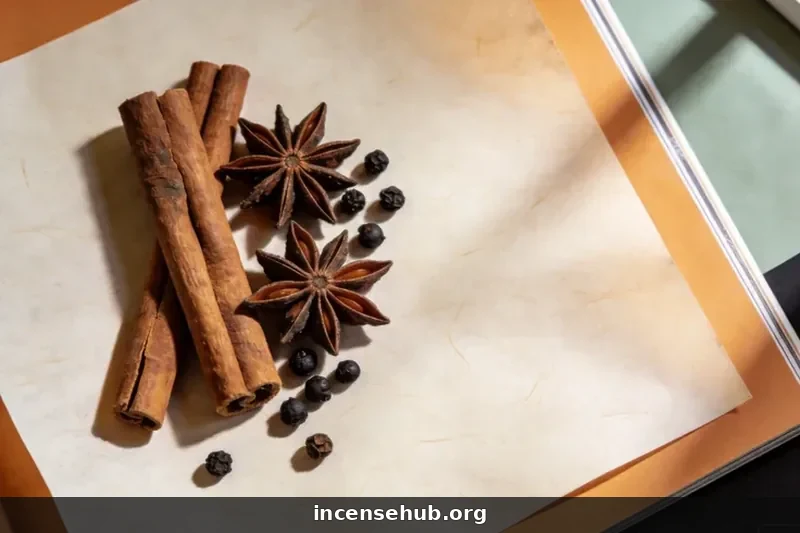
Direct answer: 砂仁 (shārén) is a dried aromatic fruit of the ginger family, sold under the botanical name Amomum villosum and, in newer databases, Wurfbainia villosa. Its seeds hold a warm, camphor-like, faintly bitter spice, and Chinese incense practice uses that spice as an accent inside a blended 合香 (héxiāng, “blended incense”) rather than as a fuel burned alone.
Key facts
| Item | Detail |
|---|---|
| Chinese name | 砂仁 (shārén) |
| Botanical name | Amomum villosum; synonym Wurfbainia villosa in recent databases |
| Family | Zingiberaceae (ginger family) |
| Material class | Dried aromatic fruit with aromatic seeds — not a wood, not a resin |
| Aroma family | Warm spice, camphor-like, bitter-herbal |
| Recorded in | 香乘 (Xiang Cheng), including the 南阳公主熏衣香 formula |
| Function in a blend | Accent and lift, used in small proportion |
| Nearest look-alikes | 白豆蔻 (cardamom), 草果 (tsaoko), 高良姜 (galangal) |
What the material actually is
Direct answer: 砂仁 is a fruit, and the spice sits in the seeds inside it. The shell is a rough, spiny husk that protects the seed mass; the seed mass is what carries the aroma.
A dried 砂仁 fruit looks unremarkable — a small, dull brown, slightly wrinkled capsule with a hard, spiky surface that catches on cloth. Break one open and the structure explains the trade: a thin husk, then tightly packed, angular brown seeds. The aromatic fraction lives in those seeds, not in the husk, which is why every quality conversation about this material eventually turns into a conversation about how much seed a fruit contains.
That physical fact drives three practical consequences. First, a fruit that looks large can still be a poor buy if the interior is hollow or thinly filled. Second, the husk is not waste to be thrown away carelessly, because it slows the loss of volatiles from the seed during storage. Third, grinding changes the material’s behaviour more than it changes its identity: the powder is the same spice, but it gives up its aroma far faster than an intact fruit.
The material belongs to the same botanical family as ginger, turmeric, and cardamom, and it shares their general architecture — a rhizome below ground, leafy shoots above, and aromatic tissue distributed through the plant. In 砂仁 the aromatic concentration that matters commercially is in the fruit, which is why the harvest is a fruit harvest and not a rhizome harvest.
Why the fruit, not the powder, is the trading unit
Direct answer: Whole fruit is the trading unit because the husk is a slow barrier and the seed fill is visible only before grinding. Once the material becomes powder, a buyer can no longer see fill, husk ratio, or foreign matter.
Think about what a buyer can actually verify at each stage. A whole fruit can be weighed, cut open, squeezed, and smelled. A shelled seed lot can be examined for colour, uniformity, and broken pieces, but the link back to fruit fill is already gone. A powder can only be smelled and felt, and smell is the easiest thing for a seller to influence through storage conditions in the last few weeks before shipping.
This is why the trade in whole fruit survives even though almost every incense workshop eventually wants powder. The whole fruit is a record of what happened upstream. It preserves the evidence.
Editorial judgment: For a small workshop, buying whole fruit and grinding in-house is usually the more informative choice, even at the cost of extra labour. The exception is a supplier with a documented, stable grind and a batch you can compare against the previous one — a relationship that takes time to build, and one that a single sample cannot establish.
There is a second reason the fruit stays intact: the husk moderates moisture exchange. Seeds inside a closed fruit move toward equilibrium with the air slowly, while loose seeds and powder react within hours. In a humid climate that difference is the gap between a material that keeps its bite for a season and one that goes flat before the jar is half empty.
The name problem: four materials that get swapped
Direct answer: 砂仁, 白豆蔻, 草果, and 高良姜 are four different plants with four different aroma profiles. They share a family, sometimes a genus, and a habit of being sold in similar-looking dried form. The species name is the only reliable specification.
The confusion is not a beginner’s problem that disappears with experience. It survives in supplier catalogues, in translated ingredient lists, and in the loose habit of writing “cardamom-like” as if that described a material. A formulator who accepts “Amomum” on a label has accepted a genus, and a genus is not a specification.
| Material | Botanical identity | Part sold | Dominant note | Bitter? | Smoke? | Failure if swapped in |
|---|---|---|---|---|---|---|
| 砂仁 (this page) | Amomum villosum / Wurfbainia villosa | Dried fruit, seed | Warm camphor, spice, bitter tail | Yes, moderate | No | Loses the cool-sharp lift; blend reads flatter |
| 白豆蔻 (cardamom) | Amomum kravanh | Dried fruit, seed | Sweeter, brighter, eucalyptus-leaning | Low | No | Blend turns sweet and top-heavy; the bitter floor disappears |
| 草果 (tsaoko) | Amomum tsao-ko / Lanxangia tsao-ko | Dried fruit | Dark, smoky, resinous | Yes, heavy | Yes | Smoke dominates; the formula reads as kitchen spice, not incense |
| 高良姜 (galangal) | Alpinia species of the ginger family | Rhizome | Sharp, peppery, citrus-tinged heat | Slight | No | Heat arrives without the camphor; texture and burn change |
Read the table down the “bitter” column and the pattern appears. Bitterness is the axis that separates 砂仁 from 白豆蔻, and smoke is the axis that separates 草果 from both. Galangal is a different organ altogether — a rhizome, not a fruit — and its pungency behaves differently on heat because the aromatic tissue is denser and wetter.
A useful counter test: put a single fruit of each on a warm surface and smell them in sequence, from lightest to heaviest. 白豆蔻 opens sweet and airy, 砂仁 follows with a camphor note and a bitter edge, 草果 lands last with smoke. Doing this once fixes the distinction in a way that reading about it does not.
How it smells, and why the bitterness matters
Direct answer: 砂仁 opens camphoraceous and slightly eucalyptus-like, warms into a dry spice mid-section, and finishes bitter and faintly medicinal. The bitterness is the signature, not a defect.
The first impression is cool rather than sweet — closer to a crushed leaf than to a dessert spice. That coolness is what most people mean when they call the material “camphoraceous,” and it is the note that lifts the top of a blend. Under it sits a warm, dry spice body that recalls the ginger family without the heat of ginger itself. The tail is where 砂仁 becomes distinctive: a lingering bitter-herbal film that stays after the sweetness of other spices has gone.
That tail is the reason the material works in small amounts and turns unpleasant in large ones. In a formula, a few percent of 砂仁 can sharpen a heavy woody base and give the smoke a cleaner edge. Push the proportion higher and the bitterness stops reading as structure and starts reading as medicine. The line between the two is narrow, and it is crossed faster in a dry, hot-burning blend than in a slow, low-temperature one.
Editorial judgment: The bitterness is a feature in a 合香 formula and a liability in a solo burn. Judged as a standalone material, 砂仁 loses to almost any wood or resin; judged as an accent, it does work that nothing else in the ginger family does as cleanly.
There is a common expectation worth correcting here. Readers often assume that a “camphoraceous” material will smell like mothballs or like a medicinal balm. 砂仁 does not. Its camphor note is plant-fresh and thin, closer to the smell of a bruised stem than to a crystalline industrial camphor. That difference matters when substituting: a synthetic camphor note will not reproduce the effect, because the effect depends on the bitter-herbal context around the cool top.
Where it grows
Direct answer: Amomum villosum is native to southern China, with Guangdong, Guangxi, and Yunnan as its classic producing regions, and it extends into neighbouring parts of Southeast Asia. It grows as a shade-tolerant understory herb.
The plant prefers filtered light and steady moisture — conditions found under a canopy rather than in an open field. That habitat shapes the material: understory herbs grow slowly, and the aromatic fraction in the fruit reflects a long, shaded season rather than a fast, sun-driven one. Growers in the classic regions work with that rhythm, and the harvest window is short enough that timing affects fill.
Provenance is often used in marketing as a quality claim. Treat it as a starting point and not a verdict. A well-managed plot in a lesser-known district can out-perform a neglected plot in a famous one, and no origin label survives a badly dried fruit. What origin does tell you is the general climate the material dried in, which influences the risk of mould during primary processing.
The Southeast Asian distribution matters for a practical reason: material enters the trade through several borders, and the same species can arrive under different local names. That is another argument for pinning the botanical name and the Chinese drug name rather than relying on a trade nickname.
What it does in a 合香 formula
Direct answer: 砂仁 works as an accent — it adds a cool-sharp top note and a bitter floor to a blend that is otherwise built from woods, resins, and sweeter spices. It is not a base and not a fixative.
Chinese blended incense is often discussed through the 君臣佐使 (jūn chén zuǒ shǐ) frame — chief, minister, assistant, and guide — a way of describing how ingredients relate rather than a fixed recipe rule. In that frame, 砂仁 rarely takes the chief role. It behaves like an assistant with a specific job: modify the surface of the blend and keep the base from reading as heavy or sweet.
What does “modify the surface” mean in practice? A blend of sandalwood and a sweet resin can smell complete but dull, because both materials occupy a similar warm register. A small addition of 砂仁 introduces contrast at the top of the smell — a cool, slightly sharp note that makes the warmth underneath more legible. The same logic applies at the end of the burn, where the bitter tail gives the smoke a defined finish instead of letting it fade into ash.
The material also has a practical role in texture. Ground 砂仁 is a light, dry powder that blends easily and does not add stickiness. In a formula where a resin is pushing the mix toward clumping, a dry spice powder can restore workability. That is a mechanical contribution, not an aromatic one, and it is easy to overlook when a formula is evaluated only by smell.
Editorial judgment: The most common formulation error with 砂仁 is not using too little — it is adding it late in development, after the base is already balanced. Because the material changes the top of the blend, it has to be present while the base is being judged. Adding it at the end makes the whole formula read as unfinished.
Behaviour on heat
Direct answer: 砂仁 gives up its cool top note early and its bitter fraction late. On direct coal the first release is masked by pyrolysis smoke, so the material reads harsher than it is.
The sequence matters. Warm the material gently and the light, volatile fraction leaves first — that is the camphor and eucalyptus impression. Keep heating and the heavier, bitter compounds dominate, while the seed tissue itself begins to char. The char is what turns a clean spice into acrid smoke.
That gives a causal chain worth remembering:
gentle indirect heat → light fraction volatilises first → cool camphor top reads clearly → heavier bitter fraction follows → tail stays defined. Switch to direct coal → surface pyrolises immediately → acrid smoke forms before the spice opens → the camphor note is buried → the material reads harsh and medicinal.
The practical consequence is that 砂仁 belongs on a warmer or in a stick that burns at a moderate rate, not scattered on a live coal. That is a judgment about delivery, not about the material’s quality. The same fruit that smells clean in a spoon can smell like scorched husk on a coal, and a buyer who tests only one way will misjudge the lot.
A second consequence concerns position in a stick. In a extruded incense stick, the ingredients are distributed through the body, so the material’s volatiles have to migrate through the matrix before they reach the flame front. Finer powder releases sooner; coarser powder releases later and more unevenly. Neither is better in the abstract — the right grind depends on how long the stick is meant to burn and how much top note the formula needs at first light.
Processing, and the grind-freshness problem
Direct answer: 砂仁 is harvested as fruit, dried, then either kept whole, shelled, cracked, or ground. The processing step that matters most for incense is the last one, because grinding starts a clock.
Drying is the first control point. Fruit dried too fast can case-harden, leaving moisture trapped in the seed mass; fruit dried too slowly in humid air is exposed to mould. Both faults are visible later: case-hardened fruit feels light for its size and smells dull when cut, while mould shows as a musty note that no amount of later cleaning removes.
Shelling is a choice, not an improvement. Shelled seed is easier to inspect and easier to grind uniformly, but it loses the husk’s protection and starts losing aroma sooner. Whole fruit stores better; seed and powder are more convenient. The trade-off is shelf life against handling.
Grinding is where the material changes character fastest:
whole fruit → intact seed cells → volatiles retained behind cell walls → grinding ruptures the cells → surface area multiplies → volatiles escape and oxidise → powder goes flat within a shorter window than the fruit would.
That chain is why a workshop that grinds its own material should grind in small batches matched to production, and why a supplier’s “freshly ground” claim is worth more than a particle-size claim. Freshness cannot be seen in a powder. It can only be smelled, and only against a reference.
An editorial screening scale
Direct answer: There is no published grading standard for 砂仁 that a buyer can cite, so the workable approach is a screening scale built from visible fill, husk condition, aroma, and cleanliness.
The scale below is an editorial tool, not an industry standard. Its purpose is to make a rejection decision defensible and repeatable, not to create a grade that a supplier must accept.
| Screen | Pass | Borderline | Reject |
|---|---|---|---|
| Fruit fill | Heavy for its size, solid when pressed, seeds fill the cavity | Some light fruit in the lot | Hollow or papery fruit common |
| Husk | Intact, dry, uniform colour, no splitting | Minor splits, some discolouration | Cracked, damp, or mould-flagged |
| Aroma when cut | Cool camphor, warm spice, clean bitter tail | Aroma present but thin | Musty, dusty, or no discernible top note |
| Foreign matter | None visible; no sand or stem fragments | Trace stem | Sand, grit, or insect damage |
| Moisture feel | Dry, free-running, no clumping when squeezed | Slight softness | Damp, sticky, or warm to the touch |
| Intended use | Accent in a blended formula | Acceptable in a heavy base | Reject for any aromatic use |
The order of the screens matters. Fill and husk come first because they are the cheapest to check and the hardest to fake at scale. Aroma comes second, because a clean-smelling lot with poor fill is still a poor buy — you are paying for husk. Cleanliness comes last only because it is usually obvious.
One screen is deliberately missing: fruit size. Large fruit is often presented as premium, and the assumption is wrong often enough to be misleading. Size can reflect variety, irrigation, or simply which grade the seller set aside, and none of those predicts aroma. Fill per fruit predicts aroma yield far better than diameter does. That is the single most useful correction a new buyer can make.
Forms, and what each is for
Direct answer: The market offers four states of the same fruit: intact, shelled, cracked, and milled. Each state trades shelf life for convenience, and the milled state gives up the most.
| Form | Aroma retention | Dosing accuracy | Behaviour in a stick | Best use |
|---|---|---|---|---|
| Whole fruit | Highest | Low — you must grind to dose | Not used directly | Long storage, incoming inspection |
| Shelled seed | High | Moderate | Grinds unevenly if damp | Short-term storage, small batches |
| Cracked seed | Moderate | Good | Releases early, unevenly | Test blends, coarse incense |
| Fine powder | Lowest | Best | Even dispersion, fast release | Production sticks and cones |
The choice is a trade between control and convenience. A workshop that makes one product repeatedly can justify keeping whole fruit and grinding to a fixed schedule. A workshop that develops new formulas constantly will prefer powder, because it needs to change proportions quickly — and will accept the faster aroma loss as the cost of iteration.
There is a middle path worth mentioning: grind a batch coarse, store it in a sealed jar away from light, and grind the final fine fraction only for the run in progress. The coarse material loses aroma more slowly, and the final grind is fresh when it matters. This is a workflow judgment, not a rule from any text.
A bench test for a new lot
Direct answer: Test a new lot three ways — intact fruit, freshly cut fruit, and a pinch warmed on an indirect heater — because each reveals a different fault.
Start with the intact fruit. Weigh a handful in the hand and judge density rather than size: a well-filled fruit feels heavier than its dimensions suggest. Press one between thumb and forefinger; a husk that gives way easily usually hides a thin seed mass. Look for splits, damp patches, and any sign of insect entry, which shows as a small, clean hole rather than a tear.
Then cut one open. The interior should be packed, the seeds dark and even, the smell immediate. A hollow centre or a pale, papery seed mass is the clearest single signal of a low-grade lot, and it is visible in seconds. This is also the moment to check the bitter note: it should read clean and herbal, not dusty.
Last, warm a pinch on an indirect heater — a covered warmer or a hot plate, not a live coal. The sequence to listen for is cool camphor first, warm spice second, bitter tail third. If the first note is scorched rather than cool, either the material is over-dried or the heat is too high; repeat at lower temperature before judging the lot.
The three tests answer different questions. Weight answers fill, cutting answers soundness, warming answers aromatic behaviour. A lot can pass one and fail another, which is why a single sniff at the counter is not an inspection.
Substitution: what works and what does not
Direct answer: 白豆蔻 is the closest structural substitute but reads sweeter; 草果 is not a substitute at all because its smoke changes the blend; galangal replaces the heat but not the camphor.
| If you lack 砂仁 | Direction | What changes | Verdict |
|---|---|---|---|
| 白豆蔻 (cardamom) | Reduce the sweet components slightly | Sweeter top, weaker bitter floor | Workable in small amounts |
| 草果 (tsaoko) | Do not substitute one-for-one | Smoke and dark resin dominate | Not a substitute |
| 高良姜 (galangal) | Use a fraction of the amount | Heat without camphor, denser texture | Partial, for warm blends only |
| Nothing | Rebalance the base | Blend loses its cool top and definition | Often the honest choice |
The logic behind the table is structural rather than aromatic. A substitute has to occupy the same slot in the formula — same volatility band, same density of effect, same position between the top and the base. 白豆蔻 sits close enough in volatility to take the slot, but its sweetness pulls the blend in a different direction, so the surrounding formula usually needs adjustment. 草果 sits in a different slot entirely: it is heavier, smokier, and it colours everything around it.
The “nothing” row deserves emphasis. Omitting an accent and rebalancing is often better than substituting something that changes the formula’s identity. A blend without 砂仁 is a different blend, but it can still be a good one. A blend with 草果 standing in for 砂仁 is a blend with a smoke problem.
Reading a supplier’s specification
Direct answer: A useful 砂仁 specification names the species, the plant part, the origin, the processing form, and the storage history. A specification that lists only “Amomum” or “cardamom-like” has not specified anything.
What to ask for, and why each item earns its place:
- Species and authority. Amomum villosum is the name most reference works use; Wurfbainia villosa appears in newer databases. Either is acceptable if the supplier is consistent. A label that says only “Amomum” is a genus, and several genera members are sold under overlapping trade names.
- Plant part. Fruit, seed, or powder. These behave differently in storage and in a blend, and the price per kilo is not comparable across them.
- Origin. Region of production, not just country of export. Re-export obscures the growing region, and the growing region is what shapes drying conditions.
- Processing date. Not the shipping date. A lot ground eight months ago and shipped last week is an old lot.
- Form and grind. “Powder” without a particle description tells you nothing about how it will disperse in a stick.
- Storage statement. Sealed, dark, dry. A supplier who cannot describe storage cannot describe the material’s condition.
- Foreign-matter statement. Sand and stem fragments are the common contaminants; a supplier who screens for them usually knows the material.
None of these items requires a laboratory. They are questions, and the answers are checkable against a sample. What they do require is consistency: the same questions asked of every lot, so that a change in the answers is visible before it reaches a formula.
Editorial judgment: A supplier who answers the species question precisely and the origin question vaguely is more trustworthy than one who answers both fluently without documentation. Precision in one place usually reflects a real supply chain; fluency everywhere usually reflects a sales script.
Storage and decline
Direct answer: 砂仁 declines through volatile loss and moisture uptake. Whole fruit in a sealed, dark, dry container holds longest; powder holds shortest, and no container stops the clock entirely.
The decline is not a single event. It runs as a chain:
powder → large exposed surface → volatiles evaporate and oxidise → aroma flattens → formulator increases the dose to compensate → texture and burn change → the blend drifts without anyone changing the recipe.
That last step is the one that catches workshops. A formula that “stopped working” is often a formula whose material aged, not a formula that was wrong. Keeping a reference sample from each purchase makes the drift visible; without one, the change is invisible until a customer notices.
Moisture is the second route. Dried fruit is hygroscopic, and a jar opened repeatedly in a humid room pulls water in. The visible sign is clumping in powder and a dull, heavy smell in seed. The functional sign is uneven burning, because damp material resists ignition in patches. Silica packs and smaller jars help; the real fix is to buy in quantities that get used.
Light matters less than air and moisture, but it is free to control. Opaque containers cost little and remove a variable. Heat is the one factor a kitchen workshop often ignores — a jar stored above a stove ages faster than the same jar in a cupboard.
The classical record, and what it can and cannot tell us
Direct answer: 砂仁 appears in 香乘 (Xiang Cheng) as an ingredient in blended incense, including the 南阳公主熏衣香 formula. That records use; it does not establish efficacy.
The classical incense literature is a record of practice. It tells us that a material was considered worth including, in what company, and often in what proportion relative to other ingredients. For 砂仁, the record places it inside blended formulas rather than in single-material burning, which matches what the material does well: modify a blend rather than stand alone.
What the record cannot do is carry modern claims. A recipe’s presence in a Ming-era compilation is evidence of tradition, not evidence of physiological effect. This page therefore treats the medicinal standing of 砂仁 as traditional belief — a historical category, not a clinical finding. The same caution applies to any page that cites classical texts as proof of benefit.
A reader can still use the classical record productively. It is a map of combinations: which materials were paired, which were kept apart, and how proportions shifted between formulas. Read that way, 香乘 is a design archive rather than an authority on outcomes.
How firm each claim is
Direct answer: The botanical identity and the classical use are documented; the aromatic description is sensory and repeatable; health effects are not established.
| Claim | Evidence layer | What it does not prove |
|---|---|---|
| 砂仁 is the fruit of Amomum villosum | Botanical reference (Flora of China) | Nothing about quality of a specific lot |
| The name Wurfbainia villosa refers to the same plant | Taxonomic database (GBIF) | Nothing about which name a supplier uses |
| 砂仁 appears in 香乘 formulas | Historical text | Nothing about efficacy or safety |
| The aroma is camphoraceous and bitter | Sensory description | Nothing about chemical composition |
| 砂仁 is used as a 香药 | Traditional category | No clinical claim |
The table is deliberately unglamorous. Its value is that it separates what a reference work can settle from what only a sample can settle. A buyer who confuses the two will over-trust documentation and under-inspect material.
Safety
Any incense, whatever it contains, releases smoke and fine particles when it burns. Ventilate the room, keep the burner on a stable heat-proof surface, and do not leave it unattended near children, pets, or anyone sleeping. Sitting in a closed room with a smouldering stick concentrates exposure, so treat ventilation as part of the practice rather than an afterthought. What follows is reference material on an aromatic substance; it is not medical guidance and asserts nothing about prevention or treatment of illness. Handling and burn-safety basics sit in the safety guide.
FAQ
Is 砂仁 the same as cardamom? No. 砂仁 is Amomum villosum, while the cardamom entry on this site is 白豆蔻, Amomum kravanh. They are related ginger-family fruits with different profiles: 砂仁 is warmer and more bitter, 白豆蔻 is sweeter and brighter. Treating one as a direct stand-in for the other changes the blend more than the substitution suggests.
Can 砂仁 be burned on its own? It can, but it is a poor test of the material. Alone, the fruit reads thin and slightly harsh, because the cool top note has nothing to lift and the bitter tail has nothing to sit against. The material is designed by its chemistry for blending, and judging it solo will make a good lot seem worse than it is.
Why does 砂仁 smell bitter? The bitter note is part of the material’s aromatic profile, not a sign of spoilage. Spoilage smells musty, dusty, or flat; bitterness smells clean and herbal. The distinction matters when inspecting a lot, because a buyer who rejects every bitter sample will reject sound material.
Does grinding change the smell? Yes, and quickly. Grinding ruptures the seed structure and exposes far more surface to air, so the light camphor fraction leaves first and the powder becomes flatter and more bitter over time. Whole fruit holds its character far longer, which is why small-batch grinding is the usual workshop practice.
Why are there two botanical names? Because taxonomy moved. Flora of China records the plant as Amomum villosum, while GBIF lists it under Wurfbainia villosa. Both refer to the same fruit. A supplier may use either name legitimately; what matters is that the name is a species and not a genus.
Is 砂仁 a medicine? It has a recorded place in traditional materia medica as a 香药, an aromatic used in both culinary and medicinal contexts. That standing is historical. This page treats it as traditional belief and makes no medical claim, because no clinical evidence is presented here.
Summary
砂仁 is a small dried fruit with a large job in Chinese blended incense: it supplies a cool camphor top, a warm spice middle, and a bitter floor that gives a formula definition. Its identity is settled botanically — Amomum villosum, also listed as Wurfbainia villosa — but its trade identity is not, because three related materials are routinely confused with it. Buy on species and fruit fill, store whole, grind small, and dose it as an accent. The bitterness that makes it useful in a blend is the same bitterness that makes it disappointing alone, and that tension is the whole character of the material.
Sources
- Amomum villosum in Flora of China — botanical description and accepted name in the Chinese flora.
- Wurfbainia villosa on GBIF — taxonomic record reflecting the newer placement.
The classical reference is 香乘 (Xiang Cheng), which records 砂仁 among the ingredients of blended incense, including the 南阳公主熏衣香 formula. Medicinal standing is treated as traditional belief, not clinical evidence. This is editorial knowledge content, not medical advice.
Related Resources
- cardamom (白豆蔻) — the sweeter, brighter member of the same cluster, and the most common mix-up.
- tsao-ko (草果) — the smoky fruit that is never a like-for-like swap.
- galangal (高良姜) — a rhizome from the same family, sharp rather than camphoraceous.
- how incense is made — where grinding, moisture, and binder choice turn a spice into a stick.
- scent guide — the wider map of aroma families this material sits inside.