
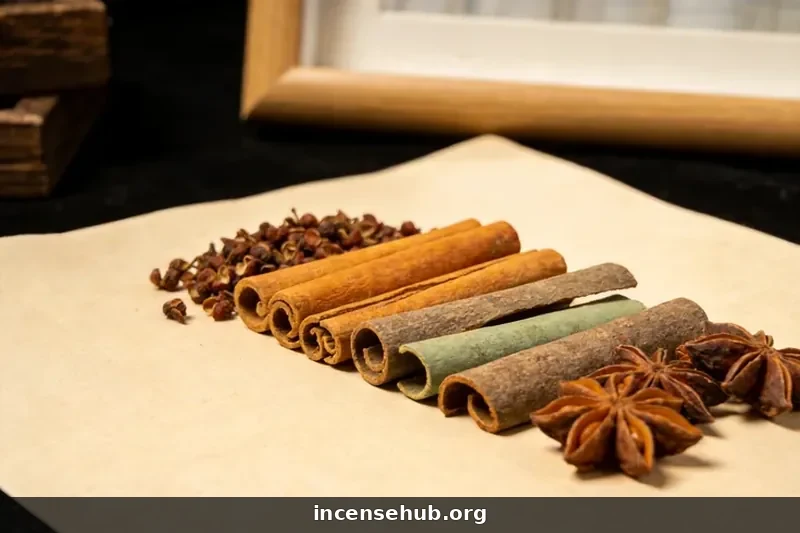
Direct answer: Anise (茴芹, huíqín) is the dried fruit of Pimpinella anisum, a small annual umbellifer native to the eastern Mediterranean and western Asia, and its sweet liquorice smell comes almost entirely from one molecule, trans-anethole. Chinese readers meet it as a modern botanical label rather than an old 香材 name, because the classical 茴香 of the incense manuals is fennel. This page treats it as what it is: a Western spice with a real aromatic use and no classical Chinese incense pedigree.
Key facts
| Chinese name | 茴芹 (huíqín); also 洋茴香 in trade Chinese |
| Species and family | Pimpinella anisum L., Apiaceae (umbellifer) |
| Traded part | The dried fruit — “aniseed” is a fruit, not a seed |
| Scent register | Sweet, liquorice, warm, faintly spicy |
| Principal volatile | trans-anethole, with estragole and anisaldehyde in support |
| Classical Chinese status | None; 茴香 in old texts means fennel, 大茴香 means star anise |
| Chief lookalikes | 小茴香 (fennel) and 八角 (star anise) |
| Forms in trade | Whole fruit, ground powder, steam-distilled oil |
The fruit, not the seed
Direct answer: What the spice trade calls aniseed is a whole dry fruit — a cremocarp that splits into two one-seeded halves. The distinction sounds academic until you are checking a delivery, because the shape and the ridged surface of that fruit are the first thing that separates anise from its two 茴 relatives.
The anise plant is a slender annual, typically knee-high or less, with thread-fine leaves and small white flowers held in compound umbels. It flowers in summer and sets a fruit that ripens unevenly across the umbel, which is one reason growers harvest on a judgment call rather than a fixed date: cut too early and the fruit is thin and pale, wait too long and the earliest umbels shed before the last ones fill.
The fruit itself is small, ovoid to pear-shaped, longitudinally ridged, grey-green when fresh and drifting toward brown with age. At the top sits a tiny stylopodium — the remnant of the flower’s styles — that gives the fruit a slightly crowned look under a hand lens. Each fruit is a pair of mericarps joined along a flat face; in a sack you will find both whole pairs and separated halves, and that ratio is itself a handling clue.
A true seed would be a single kernel inside a fruit wall. Anise keeps its aroma in oil ducts (vittae) running through that wall, so the volatile load sits in the outer layer rather than deep in a kernel. Crush a fruit between thumbnails and the oil is released at once from the surface structures. That anatomy drives almost everything practical about the material: how it dries, how it stores, how it grinds, and how fast it goes flat.
Botanically the species sits in Pimpinella, a large umbellifer genus, and it shares a family with fennel, coriander, cumin, dill, and carrot. Family membership explains the shared building blocks — umbels, ribbed fruits, aromatic ducts — but not the shared smell. The liquorice note is a chemical coincidence, and it is the subject of the next two sections.
One sound, three plants
Direct answer: 茴 is a name element attached to a smell, not to a botany. 小茴香 is fennel, 大茴香 and 八角 are star anise, and 茴芹 is anise — three plants from two families that converged on anethole. A formula or a label that says only 茴香 has not told you which plant it means.
The confusion is old and structural. Chinese aromatic vocabulary groups materials by what they do in the nose, and anethole does one thing very well: it reads as sweet liquorice. So a fennel fruit, a star-shaped tree fruit, and a Mediterranean seed all attracted the same descriptive word, and the qualifiers 小 (small) and 大 (large) were pressed into service to keep them apart.
| Written name | Plant | Family | What the buyer receives |
|---|---|---|---|
| 小茴香 | Foeniculum vulgare | Apiaceae | Ridged, curved half-fruit, larger than anise |
| 大茴香 / 八角 | Illicium verum | Schisandraceae | Woody eight-pointed star, one seed per point |
| 茴芹 / 洋茴香 | Pimpinella anisum | Apiaceae | Small tear-shaped fruit, this page |
| 孜然 | Cuminum cyminum | Apiaceae | Long, narrow, bristly fruit, entirely different smell |
The naming trap has a practical consequence that runs through the whole page. When a Ming or Qing formula writes 茴香, the material in the apothecary’s jar was fennel, because fennel was the common Chinese crop. Star anise entered wider trade later and carries its own name, 八角, taken from its shape. Anise, a Mediterranean plant, had no place in that older vocabulary at all; 茴芹 is a modern coinage built to give an imported spice a Chinese botanical handle.
That is why a spec sheet matters more than a name. If a supplier quotes “anise” for a Chinese-origin order, the binomial on the paperwork should read Pimpinella anisum. If it reads Foeniculum vulgare, you are buying fennel with a translated label, and the two behave differently enough in a blend that the substitution will be audible.
There is a second layer to the trap. In English, “anise” and “aniseed” are used loosely for the spice, while “star anise” is a different material entirely; in Chinese export documents, “fennel” and “anise” are sometimes swapped because the translator worked from 茴香. The species name is the only field that survives translation intact, so it is the field to insist on.
Scent chemistry: one molecule, three registers
Direct answer: trans-Anethole supplies the sweet liquorice core, but the edges of the smell come from the supporting cast — estragole, anisaldehyde, and in fennel’s case fenchone. Anise reads cleaner than fennel because its supporting cast is quieter, not because its anethole is better.
Anethole is a phenylpropene: a benzene ring with a propenyl tail and a methoxy group, and that shape is what the olfactory system reads as sweet liquorice. The same molecule appears in fennel, star anise, and (in the related form estragole) in basil and tarragon. Chemistry does not care which plant made it.
What differs is the ratio. Anise carries a high anethole share with relatively little of the green, camphoraceous, or resinous company that fennel and star anise bring. Fennel’s bitter chemotypes hold fenchone, which reads camphor-like and slightly bitter; star anise brings resinous woodiness from its fruit wall. Anise’s minor constituents — estragole, anisaldehyde, some monoterpenes — sit further back, so the liquorice arrives with less furniture around it.
| Compound | Where it turns up | What it contributes |
|---|---|---|
| trans-Anethole | Anise, fennel, star anise | The sweet liquorice core |
| Estragole | Basil, tarragon, some fennel | A sharper, greener anise edge |
| Anisaldehyde | Anise, fennel, some flowers | A sweet, floral, hawthorn-like softness |
| Fenchone | Bitter fennel, absinthe herbs | Camphoraceous bitterness |
| Limonene | Citrus peel, many umbellifers | A fresh terpenic lift |
This table is the reason “anise smells like fennel” is only half true. Put the two fruits side by side and the difference is not intensity but silhouette: anise is a clean bell of sweetness, fennel is the same bell with a green haze and a bitter tail. A formulator choosing between them is choosing that silhouette, not choosing a strength grade.
Anethole’s physical behaviour also explains its role in a burn. It is a volatile that leaves plant tissue as a vapour well before the cellulose around it chars, so in a burning stick the sweetness travels on the smoke rather than being created by combustion. That makes anise a top-and-heart material by physics, not by convention: it arrives early, fills a room easily, and fades before the woody base has finished.
The catch is that a volatile which leaves easily also leaves during storage. Anethole migrates out of the fruit into any headspace it can reach, which is why an opened bag of anise smells wonderful for a week and then begins to taste of the bag. Airtight, cool, dark storage is not fussiness; it is the only thing standing between the material and its own volatility.
Telling them apart at the bench
Direct answer: Shape settles the question faster than smell. Anise is a small, ridged, tear-shaped fruit; fennel is a larger curved half-fruit with a flat inner face; star anise is a woody star you could not mistake for either. Smell confirms, but smell alone has already been primed by expectation.
The examination takes a minute and needs no equipment beyond a hand lens and a white sheet of paper.
| Feature | Anise | Fennel | Star anise |
|---|---|---|---|
| Overall form | Small ovoid to pear-shaped fruit | Elongated, slightly curved half-fruit | Eight-pointed woody star |
| Relative size | Smallest of the three | Roughly twice anise’s length | Centimetre-scale, much larger |
| Surface | Fine longitudinal ridges, slightly rough | Five prominent ridges, smoother | Smooth, glossy, hard |
| Inner face | Flat commissure where halves joined | Flat and pale, often visible | None; a follicle wall instead |
| Colour | Grey-green to brownish | Pale green to yellow-brown | Red-brown to dark brown |
| Crush test | Immediate sweet liquorice, clean | Sweet with a green, hay-like edge | Sharp liquorice with resinous wood |
| Texture | Light, papery, crushes easily | Firmer, more fibrous | Hard, requires force |
Two assessment notes follow from the table. First, colour is the weakest column: age darkens all three, and a dark fruit is not automatically old, since anise browns naturally as it dries. Second, the crush test measures volatile content, not species. A stale anise fruit and a stale fennel fruit can both read faint; the shape has to do the identifying.
The sensory order matters too. Smell a strong anise sample first and the next sample will read weaker than it is, because anethole fatigues the nose quickly. Professionals in the flavour trade work from the mildest sample toward the strongest, and they re-ground a fresh pinch for each assessment rather than sniffing a jar that has been open all morning.
Where anise comes from and how it moves in trade
Direct answer: Anise is a Mediterranean and West Asian crop, grown today across southern Europe, the eastern Mediterranean, Central Asia, and parts of India and China as an introduced crop. It reaches China as an imported spice under a modern botanical name, not as a material with a classical pedigree.
The plant’s native range runs through the eastern Mediterranean into western Asia, and cultivation spread with kitchen use: Spain, Turkey, Egypt, Syria, India, and later the Americas all grow it. Flora of China records the species as a cultivated introduction, described as a strongly aromatic annual of modest height — the profile of a crop plant, not a wild Chinese herb.
Trade follows the kitchen. Anise is bought by flavour houses, distillers, bakers, and spice packers, and the incense trade is a small side channel that draws from the same supply. That has two effects on a buyer. The first is availability: anise is a commodity spice, so it is rarely scarce and never precious. The second is grading: the quality language you will hear is a flavour-industry language — volatile oil content, cleanliness, colour, foreign matter — not an incense-industry language about burn behaviour.
| Channel | What it buys | What it grades on |
|---|---|---|
| Flavour and beverage | Bulk fruit and distilled oil | Volatile oil, aroma profile, freedom from mould |
| Bakery and confectionery | Whole and ground fruit | Colour, particle size, shelf life |
| Herbal and supplement trade | Fruit, extracts | Identity, marker compounds, documentation |
| Incense and fragrance craft | Small lots of whole fruit or powder | Aroma on crushing, dryness, cleanliness |
A craft buyer sits at the bottom of that table and inherits the standards of the channels above. That is not a disadvantage: it means the material is well documented, and a supplier who cannot produce a species name and a harvest year for a commodity spice is telling you something about their operation.
Origin claims deserve scepticism in a different way than for luxury materials. Anise from one Mediterranean country and another differs less than, say, agarwood from two forests, because the crop is grown from seed on an annual cycle and the chemistry is fairly stable across regions. Regional origin is a logistics fact here, not a quality promise. What varies more is harvest year and drying care.
What anise does in a burn
Direct answer: In a burning stick anise behaves as a volatile top note: its anethole distils ahead of the char front, fills the air early, and is largely gone by the time the base materials dominate. It adds lift and sweetness, not depth, and it punishes over-dosing with a cloying, slightly sharp edge.
The physics runs in a short chain. Heat reaches the fruit → the oil ducts warm → anethole and its companions vaporise → the vapour rides the smoke column → the nose reads sweetness within the first minute. The cellulose behind the vapour front is still heating, which is why the sweetness precedes any burnt note. By the time the ember has moved on, most of the anise has already left.
That chain explains three behaviours that otherwise look like faults.
- A stick that smells weak cold can smell strong burning. Cold sniffing under-reads a material whose volatiles only fully release with heat, so a modest cold nose is not proof of a weak load.
- A stick that smells strong cold can smell thin burning. The opposite failure: oil that has migrated to the surface during storage flashes off in the first moments and leaves nothing behind.
- Anise disappears from the room before the stick ends. The material has no fixative power of its own; the sweetness is a wave, not a floor.
Grinding changes the timing. A coarse powder releases slowly and unevenly, giving a lumpy scent with sweet patches; a fine powder releases fast and can read sharp at the front of the burn. The practical target is a powder that is even enough to distribute through the mix without becoming a dust that coats everything and flashes early.
Moisture is the other lever. Damp fruit carries water that must be driven off before the aromatic is released, and the same moisture invites mould. A musty, cellar-like note on opening is not a character; it is a defect that will sit under the sweetness for the whole burn and cannot be blended away.
Oil load has a mechanical consequence as well. Anise is volatile-rich for a seed spice, and volatile-rich powders plasticise binders. Push the anise share up and the stick can soften, draw poorly, and burn unevenly — a formulation failure that shows up as a physical defect rather than an aroma one. The correction is not more binder but less anise, or a coarser grind that releases its oil more slowly.
Grading: what a buyer can actually check
Direct answer: There is no universal anise grade, so a buyer works with a small set of observable criteria: fruit integrity, colour consistency, crush aroma, dryness, foreign matter, and the smell of the sack rather than the sample. The order matters, because a clean-looking sample can hide a stale lot.
| Check | What good looks like | What it rules out |
|---|---|---|
| Fruit integrity | Mostly whole paired fruits, few broken halves | Rough handling, excessive screening |
| Colour | Even grey-green to light brown, no dark patches | Uneven drying, storage heat |
| Crush aroma | Immediate, clean, sweet liquorice | Flat or woody material |
| Dryness | Dry to the touch, no clumping, no warmth in the sack | High moisture, mould risk |
| Foreign matter | No stems, soil, or other umbellifer fruit | Poor cleaning, adulteration |
| Sack smell | Sweet and clean on opening | Mustiness, pest activity, old stock |
These are working grades, not an official standard, and they are editorial judgments about what a small buyer can verify without a laboratory. Their value is that they can be applied at delivery, before money changes hands, with nothing but hands and a nose.
The one check that needs discipline is the sack smell. A supplier will present a hand-filled sample that has been kept dry and clean; the sack itself tells you what the rest of the lot has been through. Open the bag, stand back, and smell the headspace before you put your hand in. Mustiness, a sour dairy note, or a papery staleness in the headspace will be in the material too.
The crush test deserves its own caution. It answers a single question — is there volatile left? — and it answers it loudly, which makes it easy to over-read. A fruit can be stale in the sense of oxidized and still crush sweet, because anethole survives longer than the minor constituents that give the smell its freshness. That is why a professional assessment also smells for the edges: a clean anise has a faint floral lift from anisaldehyde; an old one has only the sweet centre and a flat, waxy tail.
Forms, shelf life, and the grinding problem
Direct answer: Anise is sold whole, ground, and as a distilled oil, and the three have different clocks. Whole fruit keeps its aroma for a long time; powder loses it in months; oil is a concentrate with its own handling rules.
| Form | Best use | Behaviour over time |
|---|---|---|
| Whole dried fruit | Reference form, storage, blending by weight | Slow volatile loss through the fruit wall |
| Ground powder | Direct blending, dosing small batches | Fast volatile loss, caking with humidity |
| Steam-distilled oil | Fragrance work, flavour, tincture | Concentrated, oxidation-sensitive, needs airtight dark storage |
The whole fruit is the reference form because its own anatomy protects it. The oil ducts sit within a wall that limits diffusion, so a whole fruit loses aroma far more slowly than a crushed one. This is why the standard advice — buy whole, grind small — is not romanticism about freshness but a direct consequence of where the volatile lives.
Grinding is a one-way door. Once the wall is broken, surface area multiplies and every aromatic molecule is closer to the air. A ground anise smells more intense for a few days and then falls away faster than the whole fruit ever would. For a workshop that uses anise as an accent, the sensible pattern is to keep whole fruit and grind a working quantity, not to buy powder by the kilo because it is convenient.
Storage follows the same logic. Whole fruit wants an airtight container, a cool dark place, and a label with the harvest year; powder wants smaller containers and a shorter rotation. The refrigerator is a poor home for either unless the container is truly sealed, because condensation on removal adds moisture at every opening.
The distilled oil is a different material with a different risk profile. It is a concentrate, so a little goes a long way and over-dosing is easy; it is also prone to oxidation, which turns a clean sweet note waxy and slightly sharp. Oil belongs in small amber glass, filled high, kept cool, and used within its own clock rather than the fruit’s.
Oil, tincture, powder: three ways to carry the note
Direct answer: The same fruit can enter a blend as powder, as a distilled oil, or as an alcohol tincture, and each carrier changes when the sweetness arrives and how long it lasts. Powder is the incense default; oil is the dose-efficient option; tincture is the most controllable and the least traditional.
Powder is the form the incense workshop actually uses. Ground fruit goes into the mix by weight, releases its volatile as the stick heats, and leaves a small residue of fruit wall that burns with the rest of the botanical charge. Its advantage is that the whole aromatic profile travels together — anethole plus the minor constituents that give the note its edges — and its disadvantage is the fast fade once ground.
Distilled oil strips the profile down to the volatile fraction. The anethole arrives concentrated and clean, the waxy, papery, fruity edges are reduced, and a small weight does the work of a much larger weight of powder. That efficiency is also the risk: an over-dosed oil reads sharp and slightly chemical, and it can slick the surface of a stick so that the binder no longer grips. Oil is best treated as a modifier applied at the end of mixing, not as a bulk aromatic.
Tincture — fruit steeped in high-proof alcohol, then filtered — is the form a perfumer reaches for and an incense maker rarely does. It carries both volatile and semi-volatile material, so the note has more body than the oil and more clarity than the powder, and it can be dosed by drops into a blend. The cost is time and the need to let the alcohol flash off before the material goes near a binder.
| Carrier | Arrival in the burn | Dose efficiency | Best use |
|---|---|---|---|
| Powder | Early, with the full profile | Low | Standard incense blends |
| Distilled oil | Very early, clean and narrow | High | Accent correction, fragrance work |
| Tincture | Early, with more body | Medium | Experimental and perfumery work |
The choice is not about which is stronger. A blend built on powder has a different architecture from one built on oil, because the powder contributes burnable mass and the oil contributes only aroma. Replacing one with the other by weight is a formulation error even when the numbers look equivalent on paper.
Pairing logic: where the sweet register fits
Direct answer: Anise pairs upward with citrus and floral notes, sideways with other sweet spices, and downward with resins and woods only in small doses. Its usefulness is as a brightener at the top of a blend, and its failure mode is a sweet film that flattens everything under it.
The reason is structural. Anise occupies the same olfactory territory as citrus peel and light florals — high, bright, sweet — and it reinforces them without competing. With woods and resins, it sits above a much heavier material and can either lift it or coat it, depending on dose. A trace of anise over sandalwood reads as a warm sweetness in the smoke; too much reads as a sweet fog with no wood left.
| Partner family | Effect at low dose | Effect at high dose |
|---|---|---|
| Citrus peel | Brightens and extends the top | Becomes a sweet-sour clash |
| Light florals | Rounds the sweetness, adds warmth | Flattens the floral detail |
| Other sweet spices | Builds a coherent sweet core | Cloys; the blend loses structure |
| Resins | Lifts a heavy base | Coats the resin, hides its character |
| Woods | Adds a warm finish | Turns the smoke sweet and thin |
This is why anise is often described as a “rounding” material. Rounding is a real function, but it is a function of proportion: the same material that rounds at a trace level blurs at a heavy one. The practical discipline is to add anise last, in small increments, and to stop while the base material is still recognisable.
There is a cultural dimension to pairing that a formulator should not ignore. In Western flavour work anise sits comfortably with vanilla, citrus, and warm bakery spices because those combinations are familiar from the kitchen. In a Chinese incense context those same pairings read as modern crossover, not as tradition, and a blend marketed as classical should be built on fennel or star anise instead. The nose does not care about the label; the reader might.
Format matters: stick, cone, coil, loose
Direct answer: Format changes anise more than dose does. A stick meters the volatile through a binder and a moving ember; a cone burns hotter at the core and loses the top note faster; a coil stretches the same charge over a long, low smoulder; loose powder over a coal releases everything at once.
The mechanism is the same in every case — heat drives the volatile out of the fruit wall and into the smoke — but the rate differs. Anything that raises the temperature at the aromatic layer, or shortens the path from powder to air, pushes anise forward and shortens its life.
| Format | How the anise note reads | What to adjust |
|---|---|---|
| Hand-rolled stick | Sweet top note in the first third, then a tail | Grind coarser if the opening is sharp |
| Extruded stick | Denser, slower release, longer sweetness | Reduce dose; dense cores over-read anise |
| Cone | Hot core, fast flash, brief sweetness | Use less; pair with a resin to hold the room |
| Coil | Long, even, low-intensity sweetness | Accept a quieter note; do not over-dose to compensate |
| Loose powder on a coal | Immediate, dramatic, very short | Treat as a ritual gesture, not a room scent |
A stick is a metering device. The binder regulates how fast heat reaches the aromatic particles, and the draw regulates how much air passes through the coal. A loosely rolled stick with a coarse grind delivers anise in pulses — sweet, then thin, then sweet again — while a dense extruded stick delivers a steadier but slower release. Neither is better; they suit different rooms.
A cone concentrates heat. The burning surface is small relative to the mass, so the core stays hot and the aromatic layer ahead of it is heated harder than in a stick. Anise in a cone reads bright and brief, and the same charge that works in a stick can feel thin by the end of a cone.
A coil trades intensity for duration. The ember creeps along a thin section, so the aromatic is warmed gently over a long period. Anise in a coil is a background sweetness rather than a statement, and the format rewards restraint: a coil dosed for a stick will smell cloying for the first hour and empty for the rest.
Loose powder is the least forgiving. Dropped on a coal, the whole charge is heated at once and the volatile leaves in a single wave. That can be exactly right for a short ritual, and exactly wrong for a room. The format decision should come before the dose decision, because the same weight of anise behaves like three different materials across these four formats.
The honest boundary: anise in Chinese practice
Direct answer: Anise has no classical Chinese incense record. 茴芹 is a modern name for an imported spice, and the incense manuals that mention 茴香 mean fennel. That does not make anise worthless in a modern blend; it makes it a crossover material, and calling it classical would be a fabrication.
The evidence for this boundary is naming, not opinion. The 本草 and 香乘 literature was written around materials that had Chinese names with histories; anise’s Chinese name is a botanical coinage built on the 茴 root, and it appears in modern reference works rather than in Ming formulas. A page that presented anise as an ancient 香材 would be borrowing authority it has not earned.
What follows is a distinction worth holding. Traditional status is a property of the documentary record. Aromatic usefulness is a property of the material in the nose. Anise scores low on the first and reasonably well on the second, and those two facts do not contradict each other.
In modern Chinese-language practice, anise turns up as a sweet accent in crossover compositions — blends that borrow the Western liquorice register rather than extending the classical 合香 system. That is a legitimate use, and it is honest as long as nobody relabels it. The classical liquorice register belongs to fennel and star anise, and a formulator who wants that register in a historically grounded formula should reach for them, not for this seed.
There is a further point about provenance that buyers routinely miss. A modern Chinese label reading 茴芹 does not mean the material was grown in China, and a Chinese supplier quoting “anise” does not mean the material has a Chinese tradition. The name is a translation layer. The plant is Mediterranean either way.
When anise is the right call — and when it is not
Direct answer: Anise earns its place when a blend needs a clean, sweet, liquorice top note with no green or resinous baggage. It is the wrong choice when the target is the classical Chinese 茴香 register, when the blend needs a base-note liquorice, or when the formula has to survive a long burn without a top-note collapse.
| Situation | Better choice | Why |
|---|---|---|
| Clean sweet top note in a modern blend | Anise | Quiet supporting cast, pure liquorice silhouette |
| Classical Chinese 茴香 register | Fennel (小茴香) | The material the manuals actually name |
| Sharp, resinous liquorice body | Star anise (八角) | Woody fruit wall carries the note deeper |
| Bulk sweetness at low cost | Fennel or star anise | Anise is a small, relatively costly fruit |
| Green, hay-like herbal sweetness | Fennel | Fenchone and green notes supply the haze |
| Long-burning stick with a stable heart | Neither alone | All three are top-and-heart volatiles |
The table is a register map, not a ranking. Each row asks what job the liquorice note has to do, and the answer changes the material. A formulator who keeps only one 茴 material in stock is not simplifying; they are accepting that two of the three jobs will be done badly.
Substitution has a mechanical side as well. Anise and fennel are close in particle behaviour and can be swapped in small proportions without wrecking a stick, though the scent changes register. Star anise cannot be swapped by weight: it is a woody fruit that grinds differently, holds its note longer, and brings resinous weight that anise does not have. Treating the three as interchangeable by weight is the single most common formulation error in this family.
For blends where the liquorice note is a supporting player rather than the point, anise is often the least risky choice because it interferes least. Its sweetness sits on top of woody and resinous bases without muddying them, and it lifts dull heart notes. That is a modest, useful role — and it is the role the material can actually fill.
Three failures that look like bad anise
Direct answer: Most disappointing anise is not a weak crop; it is one of three handling failures — spent fruit that has already been distilled, cross-contamination in a shared mill, or moisture damage. Each has a distinct tell, and each is cheaper to catch at delivery than to blend around.
Spent fruit. Anise is distilled for its oil, and the exhausted fruit has to go somewhere. Re-dried, it can look intact: the ridges are there, the colour is plausible, the sack smells faintly sweet. The tell is in the crush. A spent fruit collapses into a flat, papery, wet-cardboard smell with no sweetness behind it, because the ducts that held the volatile are empty. A second tell is weight — spent fruit feels lighter in the hand than fresh fruit of the same size, and it crushes to a duller powder.
The mechanism is simple and worth remembering: distillation removes the oil → the oil ducts collapse → the fruit wall loses its aromatic payload but keeps its shape → the visual check passes while the sensory check fails. This is why appearance-led buying is risky with anise in a way it is not with, say, a resin.
Shared-mill contamination. Fennel and anise are often processed on the same equipment, and a mill that runs both will carry fennel dust into an anise lot. The tell is a green, hay-like edge under the sweetness — the fennel signature — and it shows up most clearly in the first seconds after crushing, before the anethole dominates. For a blend where anise is meant to be the clean note, that edge is a defect even at low levels.
Moisture damage. Fruit that has taken on water develops a musty, cellar-like note, sometimes with a visible grey bloom. The scent does not sit on top of the sweetness; it wraps it, and it survives blending because mould metabolites are not volatile in the same way as anethole. No amount of additional anise fixes a musty lot; the only remedy is rejection.
| Failure | Tell at the bench | What it means |
|---|---|---|
| Spent fruit | Flat, papery crush; light weight | Oil already removed |
| Fennel carry-over | Green, hay-like edge | Shared equipment, poor cleaning |
| Moisture damage | Musty, cellar note; grey bloom | Mould risk, not recoverable |
Claims, evidence, and what the record supports
Direct answer: The documented facts are narrow and solid: botanical identity, family placement, the anethole chemistry, and a long Western culinary and flavouring use. Everything beyond that — medical benefit, classical Chinese status, ritual pedigree — is either unsupported here or belongs to a different plant.
The layers separate cleanly.
- Botanical identity. Pimpinella anisum L., Apiaceae, an annual umbellifer with a ridged cremocarp. Established and checkable against Flora of China and GBIF.
- Chemistry. trans-Anethole is the dominant aroma compound, with estragole and anisaldehyde as supporting constituents. Established flavour chemistry, not a health claim.
- Western use. A long culinary and beverage record — liqueurs, baked goods, confectionery. Historically documented.
- Chinese incense status. No classical record. 茴芹 is a modern label; the classical 茴香 is fennel.
- Health claims. None made here, and none implied by the material’s culinary history.
That last line is worth stating plainly rather than burying. Anise has a food history and a folk-medicine history in several cultures, and a reader can find both in older books. This page is about aromatic material, and it does not translate either history into a therapeutic claim. Culinary use is not evidence of medical benefit, and a pleasant smell is not a treatment.
What the record does support is a set of practical judgments: which of the three 茴 materials a text means, how to tell the fruits apart, how the volatile behaves in a burn, and how to store the material so it still smells like itself next year. Those are the claims this page is willing to defend.
Safety
Direct answer: The safety issue with anise in incense is combustion, not the spice. Burning any plant material produces smoke and fine particulate matter, and a well-ventilated space is the basic control. Anise oil is a concentrate and should be handled as one.
Incense smoke is a mixture of gases and particles, and the particles are small enough to travel deep into a room. Burn less, burn in ventilated space, and do not treat a fragrant room as evidence of clean air. The safety guide sets out the general case; the anise-specific points are simpler.
- Smoke and particulates. The material adds fragrance, not safety. A sweet smell does not reduce the smoke load.
- Oil handling. Steam-distilled anise oil is concentrated and volatile; keep it off skin and away from flame, and store it sealed.
- Sensitisation. Some people react to strong aromatic volatiles with headache or nasal irritation; a first trial in a small space is sensible.
- Pets and small rooms. Animals and children are more vulnerable to smoke exposure than healthy adults; ventilate and keep burn times short.
- No ingestion guidance. This page is not a herbal or dietary reference, and nothing here should be read as dosing advice.
FAQ
Is anise the same as fennel? No. Anise is Pimpinella anisum and fennel is Foeniculum vulgare; they are different species in the same family. Their fruits differ in size and shape, and their smells differ at the edges — anise is a clean liquorice bell, fennel has a green, hay-like haze and often a bitter tail. They share anethole, which is why the confusion persists.
Why does Chinese 茴香 not mean anise? Because the word predates the import. 茴香 in classical Chinese texts refers to fennel, the common Chinese umbellifer; 大茴香 and 八角 refer to star anise. Anise arrived as a Western spice and received the modern label 茴芹, built on the same 茴 root to signal the shared smell.
Can I use anise where a classical formula calls for 茴香? Only as a deliberate modern substitution, never as a reconstruction. The formula’s 茴香 was fennel, and swapping in anise changes the register from green-sweet to clean-sweet. In a small accent dose the difference is subtle; in a leading role it is not.
Why does ground anise go flat so quickly? Grinding breaks the fruit wall and multiplies the surface exposed to air, so the volatile leaves faster. Whole fruit keeps its aroma far longer because the oil ducts are still enclosed. Buy whole, grind a working quantity, and keep it sealed.
Does anise smell stronger cold or burning? Both, for different reasons. A fresh, coarsely ground sample smells strong cold because crushing releases oil at the surface; in a burn the volatile distils ahead of the char and fills the room early. A stick that smells strong cold and thin hot usually has surface oil that flashed off in storage.
Is anise used in Chinese incense at all? As a modern crossover accent, yes; as a classical material, no. The distinction is documentary rather than sensory. A blend can use anise well, but its Chinese name is modern and the classical 茴 register belongs to fennel and star anise.
Summary
Anise (茴芹) is the dried fruit of Pimpinella anisum, an annual umbellifer from the Mediterranean and western Asia, and its clean liquorice sweetness is an anethole effect shared with two unrelated plants. The Chinese name is a modern botanical label, not a classical 香材 name; 茴香 in old formulas means fennel, and 大茴香 means star anise. In a blend it works as a top-and-heart accent with little fixative power, best bought whole, stored sealed, and dosed modestly. Its value to a reader is less as an incense material than as the clearest case in the 茴 family of a name that records a smell rather than a species.
Evidence & Sources
Botanical identity
What the record shows: Pimpinella anisum in Flora of China describes the species as a cultivated introduction with an aromatic annual habit; Pimpinella anisum on GBIF confirms the accepted name and places it in Apiaceae. Status: checkable in two independent taxonomic databases.
Traditional and culinary use
What the record shows: a long Western kitchen and beverage history — liqueurs, baked goods, confectionery — alongside a modern Chinese botanical label (茴芹) that is distinct from the classical 茴香 (fennel). Status: documented for Western culinary use; the Chinese incense record does not contain this plant.
Authenticity and disambiguation
What the record shows: fruit morphology and volatile chemistry separate 茴芹 (Pimpinella anisum) from 小茴香 (Foeniculum vulgare) and 八角 (Illicium verum). Status: practical screening supported by established botany.
Safety
What the record shows: burning plant material produces smoke and fine particles; ventilation is the basic control. Status: established, and general to incense rather than specific to anise.
Evidence status
| Question | What the record supports |
|---|---|
| Which plant is this? | Settled: Pimpinella anisum, Apiaceae |
| What makes the smell? | Settled: anethole, with minor supporting volatiles |
| Is there a Western use history? | Yes, culinary and beverage use is well recorded |
| Is there a classical Chinese incense role? | No; 茴香 in old texts is fennel |
| Are health benefits claimed here? | No claims are made in either direction |
Sources
These two taxonomic records anchor the botanical identification. The material’s culinary history is treated as documented context, not as evidence of any therapeutic effect, and the page asserts no classical Chinese incense role for 茴芹.
Related Resources
- Fennel (小茴香) — the classical Chinese 茴香, and the material a historical formula actually means.
- Star anise (八角) — the woody, resinous member of the 茴 cluster.
- Incense material comparison matrix — where anise sits against the wider ingredient set.
- Incense substitution cross-reference — how to swap 茴 materials without wrecking a register.
- Scent guide — the vocabulary for describing sweet, warm, and liquorice notes.
- Safety guide — ventilation, smoke, and exposure basics for any burn.
Editorial note: this page is knowledge content about aromatic materials, not medical advice. Working grades and formulation judgments are the author’s, offered as reasoning rather than as standards.