
Direct answer: Sweet wormwood (青蒿, qīnghāo) is Artemisia annua, an annual herb of the daisy family with finely cut leaves and a fresh, camphoraceous, faintly sweet smell. It belongs to the Chinese materia medica and to the sachet tradition, and it is a different plant from the perennial mugwort (艾草, Artemisia argyi) that most buyers confuse it with. The same species is the plant from which artemisinin is extracted, a fact that belongs to medicine and not to the incense burner.
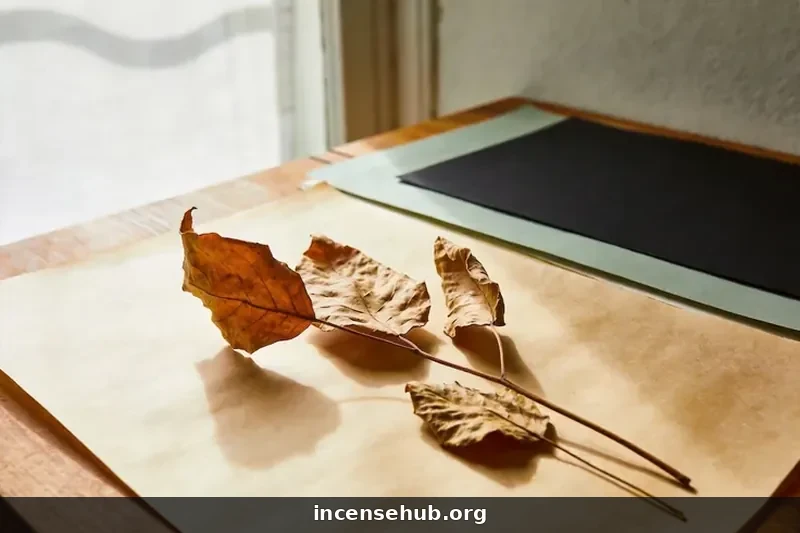
Key takeaways
Direct answer: Five things decide what a lot of 青蒿 is: the species, the plant part, the harvest stage, the drying method, and the storage history. Species comes first, because two of the most common substitutes are different plants with different chemistry.
| Question | Short answer |
|---|---|
| Chinese name | 青蒿 (qīnghāo); classical aliases 草蒿, 香蒿 |
| Botanical identity | Artemisia annua L., Asteraceae; an annual |
| Part traded | The aerial herb — leaf and soft stem, dried |
| Scent register | Green, camphoraceous, fresh, faintly sweet |
| Classical status | Materia medica (《本草纲目》草之四) and aromatic herb |
| Common substitute | Mugwort (艾草, A. argyi), a perennial |
| Modern association | Source plant of artemisinin — a drug, not an incense claim |
| Behaviour in fire | Burns fast and hot; the fresh top note does not survive |
The order matters. A buyer who settles the species has removed most of the risk from the purchase. A buyer who settles only the aroma has settled nothing, because the camphoraceous note is a genus character that several Artemisia species share.
What the plant is
Direct answer: Artemisia annua is an erect annual herb, strongly aromatic, with grooved stems and leaves divided into fine, feathery segments. It flowers in small, nodding heads rather than showy blooms, and it completes its whole cycle — seed to seed — inside one season.
The plant grows upright from a taproot, with stems that are noticeably ribbed and often tinged with purple when young. The leaves are the material of value: deeply divided, almost fern-like, dark green above and paler beneath, covered with the glandular hairs that hold the essential oil. Brush a hand across a growing plant and the oil is released at once — a sharp, green, camphoraceous smell that is the genus signature.
Flowering is unremarkable to look at and important to the trade. The heads are tiny, greenish, and nod in loose panicles at the stem tips. They are wind-pollinated and do not need to be showy, because the plant does not pay insects to visit. What matters commercially is that the plant’s chemistry shifts as it moves from leaf growth into flowering, and the leaf fraction declines as stem and flower take a larger share of the biomass. A crop cut at the wrong moment is still 青蒿, but it is a thinner, woodier material.
The annual habit is the single most useful field clue, and it is also the most misused one. 青蒿 germinates, grows, flowers, sets seed, and dies within a year. Mugwort (A. argyi) is a perennial that returns from the same root system for years and builds dense, long-fibred leaves. That difference in lifecycle produces a difference in material: the annual gives a light, quick, green herb; the perennial gives a heavier, more persistent leaf. Confusing the two is the central error this page exists to prevent.
The name: colour, class, and three aliases
Direct answer: 青蒿 combines 青 (“green”) with 蒿, the character for the artemisia class of herbs. Two old aliases, 草蒿 (“grass artemisia”) and 香蒿 (“fragrant artemisia”), are listed in the Bencao Gangmu, which also notes that northerners call the plant 青蒿.
The character 蒿 is a category marker rather than a species name. It gathers a group of aromatic Asteraceae herbs that share a bitter-green, camphoraceous character — the same way 柏 gathers the cypresses and 松 the pines. That is why 青蒿, 艾草, 茵陈, and 龙蒿 can all sit under one written register while describing four different plants with four different uses. A name built from a class character tells a reader what family of material to expect. It does not tell a buyer which species is in the sack.
青 (“green”) describes the state of the herb — the fresh, green leaf, and by extension the cool, green character of its aroma. It is not a flavour note and not a sweetness marker. The herb is green in the way that a young leaf is green: bright, slightly bitter, and quick to fade when dried badly.
The Bencao Gangmu entry, in the herb section 草之四, gives the plant its own heading and records the regional naming with the line “北人呼為青蒿” — northerners call it 青蒿. The entry also lists 草蒿 and 香蒿 as aliases, and it sits apart from the entry for 艾, the mugwort. That separation in a 16th-century text is worth noticing: the confusion between the two herbs is not a modern problem created by translation. It is old enough to have needed fixing in the classical literature.
The English name adds a layer the Chinese does not have. “Sweet wormwood” is a comparative label: the plant is less aggressively bitter than wormwood proper (A. absinthium), the species that gives absinthe its reputation. The “sweet” is a relative judgement about mildness, not a report of sugar. Readers who expect a sweet herb on the basis of the English name are reading the wrong word.
Five Artemisias, five different materials
Direct answer: 青蒿, 艾草, 茵陈, 龙蒿, and 苦艾 are five Artemisia species sitting in one genus and one bitter-green aromatic register, yet differing in lifecycle, leaf, scent, and use. Only one of them is Artemisia annua.
| Material | Species | Lifecycle | Leaf and habit | Scent | Usual role |
|---|---|---|---|---|---|
| 青蒿 (sweet wormwood) | A. annua | Annual | Finely divided, feathery | Green, camphor, faintly sweet | Materia medica; sachet herb |
| 艾草 (mugwort) | A. argyi, A. vulgaris | Perennial | Broad, lobed, white beneath | Bitter-green, heavy camphor | Moxibustion; 艾 incense |
| 茵陈 (yin chen) | A. capillaris | Perennial | Fine, soft, young shoots harvested | Fresh, slightly bitter | Spring materia medica |
| 龙蒿 (tarragon) | A. dracunculus | Perennial | Narrow, lance-shaped | Anise, sweet-green | Culinary herb |
| 苦艾 (wormwood) | A. absinthium | Perennial | Silvery, deeply lobed | Very bitter, thujone-heavy | Absinthe; bitter tonics |
The table is a filter, not a taxonomy lesson. Its practical use is to show how many different purchases can arrive under the single English word “wormwood”. A supplier shipping “wormwood” may be shipping any row. A supplier shipping “青蒿” is naming a specific plant, and the invoice should repeat that name in Latin.
The lifecycle column is the fastest field check. An annual crop has thin, soft stems and no woody crown; a perennial has a woody base and denser fibre. That difference shows in the hand before it shows in the smell. It is a clue, not proof — a young perennial can look soft, and a drought-stressed annual can look woody — so the identification should rest on leaf shape and, at volume, on a named species rather than on habit alone.
The 茵陈 row deserves its own caution. A. capillaris is harvested as young spring growth, and the material is soft, fine, and pale — visually closer to 青蒿 than mugwort is. The two are different species with different classical entries, and a lot that looks like “fine green artemisia” can be either. That is the kind of ambiguity that a Latin name on the paperwork resolves and a photograph never will.
Why “sweet” is a comparison, not a sugar
Direct answer: The “sweet” in sweet wormwood is a relative term. The herb smells and tastes milder than bitter wormwood, and that mildness is what the name records; there is no meaningful sugar content behind it.
This is a small correction with a large practical consequence. A reader who expects sweetness will over-dose the herb in a blend, because the note that reads “sweet” in the English name is actually a soft, green, balsamic impression sitting on top of a bitter base. Push the dose and the bitterness arrives first, and the blend turns medicinal rather than sweet.
The comparison is real, though. A. absinthium is aggressively bitter, with a thujone-heavy chemistry that made it the base of absinthe and a long list of bitter tonics. A. annua is gentler: the camphor is softer, the green note is cleaner, and the bitterness sits further back. A name that distinguishes the two is doing useful work, even if it chose a misleading word.
For a formulator, the useful translation is “mild-bitter green herb”, not “sweet herb”. That framing predicts how the material behaves: a fresh top note, a bitter middle, and an aroma that fades faster than a resin. It also predicts the pairing logic — 青蒿 lifts a heavy blend rather than sweetening it, and it needs a sweet or resinous partner to round the bitter edge.
The scent: camphor, cineole, and a green top
Direct answer: 青蒿 smells green and camphoraceous because its oil is built from small, volatile molecules — camphor, 1,8-cineole, artemisia ketone, and sesquiterpenes such as germacrene D. Those molecules evaporate quickly, which is why the herb reads as a top note.
Camphor is the molecule most people recognise without knowing its name: a penetrating, cooling, slightly medicinal smell that clears the nose. 1,8-Cineole, the main component of eucalyptus oil, adds a similar cool freshness with a softer, more herbal edge. Artemisia ketone contributes the characteristic green, slightly fatty note that distinguishes A. annua oil from other members of the genus. The sesquiterpenes — germacrene D and caryophyllene among them — are heavier, slower molecules that give the oil a faint woody-green depth.
The balance of those fractions explains the sensory experience. The monoterpenes dominate the first impression and leave quickly. The sesquiterpenes linger and give the dried herb its faint persistence in a sachet. Nothing in the oil is a fixative, so the aroma has no anchor: it rises fast and falls away, and a sachet that smelled strong in June smells like hay by autumn.
That is also why the herb reads “medicinal” to some noses and “fresh” to others. Camphor and cineole trigger a cooling sensation that is easy to read as medicine, especially for anyone who grew up with mentholated ointments and cough drops. The association is cultural and sensory, not pharmacological. Smelling like a pharmacy shelf is not the same as acting like one, and this page keeps the two apart.
One season, one harvest
Direct answer: Because 青蒿 is an annual, each crop is a single generation grown from seed, harvested once, and replaced the following season. That makes harvest timing and the leaf-to-stem ratio the two decisions that shape the lot.
An annual puts its energy into rapid growth, flowering, and seed. It does not build a woody crown, and it does not store reserves for a second year. The grower’s calendar is therefore compressed: prepare, sow, grow, cut, dry, and clear the field. There is no second cut from the same root, and no aged material held back from a previous season unless the buyer stores it.
Timing the cut is the commercial skill. Cut too early and the plant has not built enough biomass; cut too late and the stems have thickened and the heads have opened, diluting the leaf fraction that carries both the aroma and the chemistry the plant is famous for. The window is a matter of weeks, and it shifts with latitude, altitude, and weather. A lot’s harvest date is therefore real information, not paperwork.
The leaf-to-stem ratio is the second lever. Stems are fibre and water; they contribute bulk, a duller colour, and a slower, smokier burn. Leaf is where the oil glands sit. A lot that looks green and leafy is not automatically better — colour can be preserved badly — but a lot that is mostly pale stem will smell thin and burn harshly. The ratio is visible in the hand and should be part of any sample assessment.
Drying follows the harvest, and it decides how much of the green note survives. Slow shade drying preserves chlorophyll and the lighter volatiles; fast, hot drying drives off the top notes and fixes a duller, hay-like character. Sun drying bleaches the leaf and pushes the aroma toward the dry, dusty end. None of these methods is wrong in the abstract, but they produce different materials, and a buyer who does not ask which one was used is buying an unknown.
Drying, storage, and the loss of the green note
Direct answer: 青蒿 is a light, volatile herb, and its quality declines from the moment it is cut. Moisture, light, heat, and air each accelerate the loss, and the decline cannot be reversed by any later step.
The chemistry of decline is straightforward. Moisture left in the herb supports enzyme activity and microbial growth; the result is a musty, hay-like, sometimes sour smell that no blending hides. Light and oxygen break down chlorophyll, which turns the leaf from green to yellow-grey and takes the fresh note with it. Heat drives off the monoterpenes that carry the top note. Each pathway runs faster in a warm, damp, open sack than in a cool, dry, sealed one.
The chain is worth stating plainly, because it explains why storage is a quality decision rather than housekeeping:
cut herb with residual moisture → enzymes and mould remain active → chlorophyll breaks down and microbial growth begins → the green top note is replaced by hay, dust, and mustiness → the lot can still be sold as 青蒿, but it can no longer do the job 青蒿 is bought for.
Good storage is unglamorous: dry the herb until stems snap rather than bend, keep it whole for as long as possible, store in a dark, dry, closed container away from heat, and open the container as rarely as the work allows. Whole herb keeps better than cut herb because there is less exposed surface. Powder keeps worst of all, because every particle is an open door.
There is an editorial point buried in this. Freshness is not a marketing adjective for a herb like this; it is the material’s functional core. A two-year-old lot and a two-month-old lot can carry the same label, the same colour photograph, and the same price, and behave like different materials. The harvest date is the only field that separates them, which is why it belongs in the specification.
Forms and what each one is for
Direct answer: 青蒿 is traded as whole dried herb, cut herb, powder, and — in specialist trade — a distilled oil. The whole and cut forms suit sachets and blending; the powder suits incense and quick extraction; the oil is a concentrate with a different risk profile.
| Form | What it is | Aroma behaviour | Sensible use | Caveat |
|---|---|---|---|---|
| Whole dried herb | Leaf and soft stem, uncut | Slow release, long keeping | Sachets, display, storage | Bulky; stems dilute the leaf |
| Cut herb | Chopped leaf and stem | Faster release, shorter life | Blending, sachet refills | More surface, faster fade |
| Powder | Milled leaf | Strong initial lift, quick decline | Incense blends, extraction | Dust; loses the top note fast |
| Distilled oil | Steam-distilled concentrate | Intense, immediate, volatile | Perfumery, dilution trials | Far stronger than the herb; dose with care |
| Fresh herb | Growing or recently cut | Brightest green note | Seasonal, local use | Moisture; will not store |
The jump from herb to oil is a jump in kind, not degree. A distilled oil concentrates the volatile fraction and leaves behind the chlorophyll, the fibre, and most of the bitter principles. It smells like a sharper, cleaner version of the herb, and it behaves like a solvent-strength material: a drop perfumes a room, and a spoonful is a spill. Treating the oil as if it were “strong herb” is the most common way to over-dose a blend.
The powder is the form most likely to disappoint. It releases a strong smell when the jar is opened, which reads as quality, and then loses that smell within weeks because every particle is exposed to air. A maker who buys powder in bulk and uses it slowly is buying a declining asset. Buy the amount that will be used in a season, or buy whole herb and mill small batches.
Quality: a working decision table
Direct answer: Species, harvest stage, leaf share, colour, aroma, moisture, and storage history are the checks that predict performance. Size and packaging are the checks that predict nothing.
| Check | What good looks like | What failure looks like |
|---|---|---|
| Species | Artemisia annua named on the lot | “Wormwood” or “artemisia” with no species |
| Harvest | Date or season recorded | No date; “current crop” as the only claim |
| Leaf share | Green leaf dominant, stems thin | Pale, thick stems; leaf in fragments |
| Colour | Deep green to grey-green, even | Yellow, brown, or bleached patches |
| Aroma | Fresh, green, camphoraceous, clean | Hay, dust, mustiness, sourness |
| Moisture | Stems snap; no clumping | Stems bend; herb feels cool and damp |
| Cleanliness | No soil, grit, or foreign matter | Sand at the bottom of the bag |
| Storage history | Cool, dark, dry, sealed | Warm warehouse, open sack, sunlight |
Colour is the check that buyers trust most and understand least. A vivid green lot may have been dried fast and hot to preserve appearance while losing the volatiles that carry the smell; a duller, grey-green lot may be older but better dried. Colour is evidence about handling, not a verdict on quality. The nose and the harvest date together tell a more reliable story than the photograph.
The species check is the one that cannot be skipped. 青蒿, 艾草, and 茵陈 can all arrive as “fine green artemisia”, and the differences between them are the differences between a light sachet herb, a moxibustion material, and a spring tonic herb. A Latin name on the paperwork, repeated on the invoice, is the cheapest quality control available. It costs nothing and prevents the most expensive mistake in this category.
A five-minute check in the hand
Direct answer: Four tests — snap, rub, look, and smell — separate a fresh, correctly dried lot from a stale one without any equipment. They do not identify the species, and they are not a substitute for a Latin name on the paperwork.
Snap a stem. A well-dried stem breaks with a crisp crack. A stem that bends, or that feels cool and leathery, is holding moisture, and moisture is the condition under which mould and off-notes develop.
Rub a leaf between the fingers. The oil glands rupture and release the green, camphoraceous note. A fresh lot gives a sharp, clean smell that lingers on the skin for a minute. A stale lot gives hay, dust, or a faint sourness, and the difference is usually obvious at the first rub.
Look at the colour and the mix. Even grey-green to deep green leaf, with thin stems, is what a leaf crop should look like. Yellow or brown patches, a high proportion of pale stem, or a dusty residue at the bottom of the bag all point to handling problems — bleached drying, late cutting, or rough transport.
Smell the empty bag. The bottom of a sack collects fines and the oldest, driest material. A musty or sour note there is a warning about the whole lot, because it is the part that has been in contact with moisture longest.
The limits of the method deserve a sentence. These tests measure freshness and handling; they cannot separate A. annua from A. capillaris, and they say nothing about the volatile oil content beyond what the nose can judge. A lot that passes all four still needs its species confirmed. A lot that fails any of them does not need a laboratory to be rejected.
The artemisinin boundary
Direct answer: Artemisia annua is the plant from which artemisinin is obtained, and artemisinin is the basis of the most important modern malaria therapy. The drug is an extracted, purified, precisely dosed pharmaceutical; the dried herb is not, and burning it delivers no treatment.
The chemistry is elegant. Artemisinin is a sesquiterpene lactone with an endoperoxide bridge — a peroxide group built into a ring — and that bridge is what makes the molecule active against the malaria parasite. The compound accumulates in the plant’s glandular trichomes, at a low and variable fraction of the dried leaf. Growing the plant well is not the same as producing the drug; the drug is the product of extraction, purification, and formulation.
The history is worth recording because it explains the plant’s fame. Chinese pharmacological work in the 1970s isolated the compound from 青蒿 and established its antimalarial activity, work later recognised by the 2015 Nobel Prize in Physiology or Medicine. That research turned a classical herb into a modern medicine. It did not turn the herb into the medicine.
The chain makes the distinction concrete:
plant material → solvent extraction of the leaf → purification of artemisinin → formulation into a fixed dose → combination therapy under medical supervision.
Every arrow is a step that a bundle of dried herb has not been through. The herb contains the molecule, at a variable and unmeasured level, alongside waxes, chlorophyll, and everything else in the leaf. The drug contains a measured dose of one compound. Between those two facts sits the whole of pharmaceutical manufacturing, and no amount of tradition closes the gap.
The practical consequences are three. First, no incense or sachet claim can borrow from the drug’s reputation; a smell is not a therapy. Second, the loose herb or a home-made tea is not a substitute for treatment, and public-health guidance has warned against using it that way, because the dose is uncontrolled and sub-therapeutic exposure carries risks of treatment failure and resistance [need-source]. Third, a buyer should not pay a premium for “high artemisinin” herb in an aromatic context, because the aromatic value comes from the volatile oil, not from the medicinal compound.
That last point is the commercial crux. The plant’s two chemistries — the volatile oil that smells, and the sesquiterpene lactone that treats — are different fractions serving different markets. An incense buyer is buying the first. Paying for the second is paying for a laboratory story that the burner cannot use.
Sachet versus smoulder
Direct answer: 青蒿 performs best in a sachet, where the volatiles evaporate at room temperature, and worst as a solo incense, where the leaf burns too fast and the fresh note is destroyed. The same herb gives two different experiences depending on how the aroma is released.
| Question | Sachet (cold diffusion) | Incense (combustion) |
|---|---|---|
| What releases the aroma | Evaporation at room temperature | Heat-driven vaporisation and burning |
| Which fraction arrives | Monoterpenes first, then heavier notes | Volatiles flash off, then char and smoke |
| Character | Fresh, green, camphoraceous | Sharp, acrid, smoky, faintly herbal |
| Duration | Weeks, declining steadily | Minutes, front-loaded |
| Best role | Linen, drawers, seasonal sachets | A small accent in a bound blend |
| Main failure | Fades unnoticed | Burns hot and harsh |
The sachet is the older and better fit. A cloth bag of dried herb releases aroma passively, and the release is gentle enough that the green note reads as clean rather than sharp. In the Chinese sachet tradition, 青蒿 sits with other aromatic herbs as a fresh, cooling element — a green note among warmer, heavier materials. The tradition is a practical one: the herbs were chosen for what they did in a small closed space, not for how they burned.
Combustion is a different exchange. Heat drives the monoterpenes off in the first moments, so the opening of a burn is the closest the material gets to its sachet character. After that, the leaf burns and the plume turns acrid. A loose pile of dried herb burns hot and fast because the leaf is thin, dry, and full of air; the front races through it, and the smoke carries the products of incomplete combustion rather than the aroma of the plant.
What follows from this is a design rule. If the goal is the fresh green note, use the herb cold — in a sachet, a drawer, a pillow, or a potpourri. If the goal is smoke, use a small amount of the herb as an accent inside a structure that burns slowly, and accept that the note will be transformed rather than preserved. Expecting a burned herb to smell like the sachet is the aromatic equivalent of expecting toast to taste like bread.
Using 青蒿 in a blend
Direct answer: In a blend, 青蒿 is an assistant rather than a chief: a green, camphoraceous lift at low dose, paired with sweeter resins or warmer woods. It is a 佐 or 使 material in 君臣佐使 terms, not a base.
The pairing logic follows from the chemistry. A camphoraceous top note cuts through sweetness and lifts a heavy blend, so 青蒿 works beside benzoin, sandalwood, and soft floral notes — materials that give it something to lift. It also sits well with other green herbs, though the combination quickly becomes a generic “herbal” smell if more than one green note is used at strength.
Dose is where the material punishes enthusiasm. The dried herb smells strong in the hand, so a maker’s instinct is to use a little; in the burner the note is brief, so the next instinct is to use more. More herb means a hotter, faster, more acrid burn, which buries the note it was meant to lift. The way out is the same as with any volatile herb: keep the dose modest, give the note a structure to sit on, and judge the result in the plume rather than in the mixing bowl.
The 君臣佐使 frame is useful here as a vocabulary rather than a rule. A chief (君) material defines the blend; a minister (臣) supports it; an assistant (佐) modifies it; a guide (使) carries it. 青蒿 is an assistant: it modifies the top of a blend, brightening and cooling it. Calling it a chief would be a category error, and pricing it as one would be a commercial one.
Sourcing questions that change the answer
Direct answer: Four questions separate a usable lot from an unknown one: which species, which plant part, when it was cut, and how it was dried and stored. A supplier who answers all four is selling a specification; one who answers none is selling a photograph.
Ask for the Latin name first. Artemisia annua is the only answer that identifies this material, and a supplier who cannot give it is either uncertain or selling something else. Ask what part is in the bag: leaf, leaf-and-stem, or stem-heavy. Ask for the harvest date or season, and compare it with the drying method. Ask how the herb was dried and how it has been stored since. None of these questions requires a laboratory, and all of them change what the material will do.
There are questions that do not help. “Is it wild?” tells a buyer nothing about species or freshness, and wild harvest is not automatically better for an annual weed that grows readily in cultivation. “Is it organic?” is a certification question, not a quality question, and a lot can be certified and stale. “Is it high quality?” invites an adjective in place of a fact.
The most useful sourcing habit is a retained sample. Keep a sealed portion of each lot, labelled with the date and the supplier, and compare the next delivery against it. Over a year, that collection becomes a reference library: the buyer learns what good 青蒿 smells like in their own warehouse, under their own storage, rather than relying on a description. It is a small discipline with a large payoff, and it is the same discipline that separates a purchasing department from a series of one-off purchases.
Traditional use and the evidence boundary
Direct answer: The plant’s identity, its classical citation, and the chemistry of artemisinin all have documentation behind them. The medicinal uses of the herb do not have clinical evidence behind them, and its aromatic value rests on practice.
| Layer | Status | What it means here |
|---|---|---|
| Botanical identity | Established | Artemisia annua, Asteraceae, annual |
| Classical record | Documented | 青蒿 in 《本草纲目》草之四, recorded under 草蒿 and 香蒿 |
| Distinction from 艾草 | Established | Different species, different lifecycle, different use |
| Medicinal efficacy of the herb | Traditional, not established | Recorded use is not clinical evidence |
| Artemisinin as a drug | Established | Extracted, purified, dosed; not the same as the herb |
| Aromatic value | Practice-based | Judged by nose and behaviour, not by assay |
The table is deliberately short. Most of the claims made for 青蒿 in commercial writing collapse two rows: they take the established drug and use it to support a claim about the herb, or they take a traditional record and present it as a finding. Keeping the rows apart is the whole discipline.
Safety
Direct answer: Burning 青蒿 produces smoke and particulate matter like any incense, and the herb should not be treated as a medicine. Ventilate the space, keep the burn short, and keep smoke away from children, pets, and anyone with sensitive airways.
Smoke is the first consideration. Incense combustion generates fine particles and carbon monoxide, and a small closed room concentrates both. Burn in a ventilated space, sit away from the plume rather than over it, use short sessions, and keep the burner on a stable, non-combustible surface. Loose dried herb burns fast and can throw sparks, so a fire-safe holder matters more with leaf than with a stick.
The herb itself is not a food and not a medicine. 青蒿 has a long record in the materia medica, and that record is not a licence to self-treat. The artemisinin story in particular invites a dangerous inference: because the plant contains an antimalarial compound, a tea or a capsule of the leaf is assumed to be a treatment. It is not. The dose is unknown, the compound is not extracted or stabilised, and relying on the herb instead of proper medical care can cost a life [need-source].
Handling is a smaller concern but a real one. Milling dried herb raises dust, and a workshop that mills in quantity should use extraction, a mask, and ventilation. The dust is a mechanical irritant rather than a chemical hazard, but it is unpleasant and avoidable. People who react to pollen or to strong aromatic dust should stay out of the milling room.
No claim on this page is medical advice, and none should be read as a recommendation to consume, inhale, or apply the herb for a health purpose. Anyone with a medical question should ask a clinician, and anyone taking a medicine should assume that an unstudied herb can interact with it until told otherwise.
FAQ
Direct answer: These five questions cover identity, the mugwort confusion, the camphor note, incense use, and the artemisinin boundary.
What is sweet wormwood (青蒿)? Artemisia annua — an annual herb in the daisy family, with finely divided leaves and a fresh, camphoraceous, faintly sweet aroma. It belongs to the classical Chinese materia medica and to the sachet tradition, and it is the plant from which the antimalarial drug artemisinin is obtained. It is not the same plant as mugwort.
Is 青蒿 the same as 艾草? No. 青蒿 is Artemisia annua, an annual that grows from seed, flowers, and dies within one season; 艾草 is Artemisia argyi (or A. vulgaris), a perennial that returns from the same root system for years, and the material of moxibustion. The two share a genus and a camphoraceous smell, and the classical literature already treats them as separate entries. A supplier who uses the names interchangeably has not identified the material.
Why does 青蒿 smell of camphor? Because its essential oil contains camphor, 1,8-cineole, and artemisia ketone, small volatile molecules with a cooling, penetrating character. The green note comes from the same oil, and the faint sweetness is a soft balsamic impression rather than sugar. The smell is a genus signature, not a species proof.
Can 青蒿 be burned as incense? It can, but it is not at its best that way. The dried leaf burns fast and hot, the fresh top note flashes off early, and the plume turns acrid. It works as a small green accent in a bound blend; it does not work as a base or a solo material.
Does burning 青蒿 deliver artemisinin? No. Artemisinin is an extracted, purified pharmaceutical, and its endoperoxide structure is not stable under combustion. Burning the herb produces smoke, not a measured dose of a drug. Treating the smoke as a therapy would be both ineffective and unsafe.
Summary
青蒿 names Artemisia annua, an annual herb of the daisy family with feathery leaves, a green camphoraceous scent, and a documented place in the Chinese materia medica. Its name marks it as a green member of the 蒿 class, the Bencao Gangmu gives it its own heading under 草蒿 and 香蒿, and the classical literature already separates it from 艾. The plant’s modern fame comes from artemisinin, a compound extracted and purified into a malaria drug — a fact that belongs to medicine and says nothing about the value of the dried herb in a sachet or a blend.
For a buyer, the useful knowledge is narrower and more practical. Species first, because three or four Artemisia herbs can arrive under one English word. Harvest and drying second, because the green note is volatile and unforgiving. Form third, because whole herb, powder, and oil are different materials with different dose logic. The herb is an assistant in a blend, a pleasure in a sachet, and a poor solo incense. Held inside those limits, it is a clean, bright, honest material. Pushed beyond them, it becomes a bitter, acrid smoke or a medical claim that the plant cannot support.
Sources
- Artemisia annua in Flora of China — the botanical treatment behind the habit, leaf, and flower description used here.
- Artemisia annua on GBIF — taxonomic backbone and distribution records for the species.
- 本草纲目 草之四 on Wikisource — the 草之四 section recording 青蒿 alongside the names 草蒿 and 香蒿.
Botanical statements follow the Flora of China and GBIF treatments. The artemisinin history, the oil chemistry, and the trade observations are editorial summaries of documented science and workshop practice. Classical material is cited as historical record; medicinal uses are traditional, not clinical evidence, and nothing here is medical advice.
Related Resources
- Mugwort (艾草) — the perennial relative most often mistaken for 青蒿.
- Tarragon (龙蒿) — the anise-scented culinary Artemisia.
- Agastache (藿香) — a fresh, aromatic herb that shares the sachet register.
- Schizonepeta (荆芥) — another light, green herb used in cooling blends.
- Chrysanthemum — a floral note with a similar seasonal, cooling character.
- The scent guide — where green and camphoraceous notes sit among the aroma families.
- Incense material comparison matrix — how herbs, woods, and resins differ as materials.
- Safety guide — ventilation, smoke exposure, and household precautions.