
Direct answer: Bamboo leaves (竹叶, zhúyè) are the narrow, green leaves of bamboo (Phyllostachys and related genera, family Poaceae). They carry a mild, fresh, grassy-green scent and enter Chinese tradition chiefly as a tea and a fragrant, cooling leaf rather than as a prominent incense material. They must be kept distinct from the herb 淡竹叶 (Lophatherum gracile).
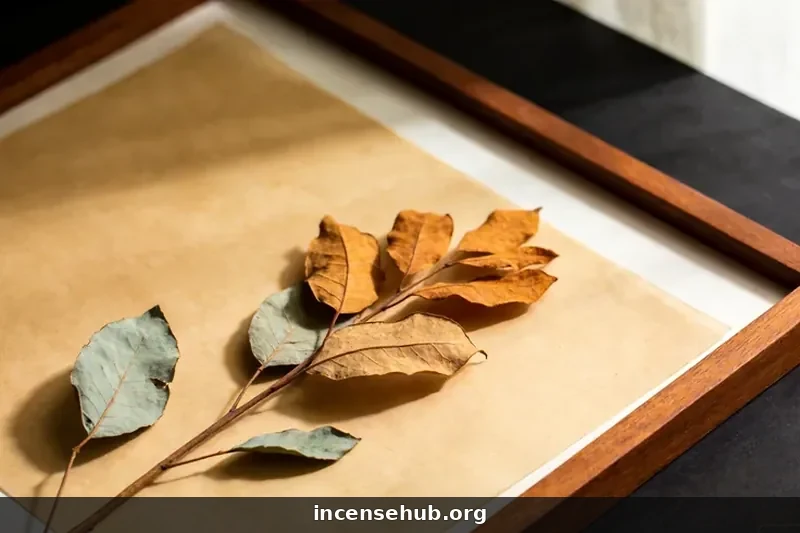
Key facts
| Chinese | 竹叶 (zhúyè); bamboo = 竹 (zhú) |
| Botanical source | Phyllostachys and related bamboo genera (Poaceae) — the leaves |
| What it is | The green leaves of bamboo, distinct from its stem and shoot |
| Aroma | Green, fresh, grassy, slightly sweet |
| Traditional role | Tea and fragrant leaf; not a lead incense material |
Aroma profile
Direct answer: Bamboo leaves have a mild, clean, grassy-green scent with a faint sweetness — closer to fresh-cut foliage or a green tea leaf than to any strong aromatic. It is a quiet note, useful as a subtle green accent in sachets and blends, but it does not carry the intensity of the resinous or floral materials that anchor a classical formula.
竹叶 has a mild, clean, grassy-green scent with a faint sweetness — closer to fresh-cut foliage or a green tea leaf than to any strong aromatic. It is a quiet note, useful as a subtle green accent in sachets and blends, but it does not carry the intensity of the resinous or floral materials that anchor a classical incense formula.
The register is a green, tea-like freshness — the scent of a fresh leaf rather than a flower, a wood, or a resin. This is what makes 竹叶 a quiet supporting note: it lends a clean green lift without competing with the heavier materials that carry a formula.
A botanical note (read this)
Direct answer: bamboo leaves (竹叶) and 淡竹叶 (Lophatherum gracile) sound alike but are different plants. 竹叶 is the leaf of bamboo (Phyllostachys and related genera); 淡竹叶 is a small grass-like herb that merely resembles young bamboo, with its own separate materia-medica entry.
竹叶 and 淡竹叶 sound alike but are different plants:
- bamboo leaves (竹叶) — the leaves of bamboo, Phyllostachys and related genera. This entry.
- 淡竹叶 — Lophatherum gracile, a small grass-like herb that merely resembles young bamboo; its own, separate materia-medica item.
The Bencao Gangmu (本草纲目) records bamboo under 竹 (木之五), noting the leaves among its parts, while 淡竹叶 appears elsewhere as a distinct herb. This page describes 竹叶 = bamboo leaves.
Botanical source and origin
Direct answer: Bamboos (Phyllostachys and allies, family Poaceae) are fast-growing woody grasses with many species across China and East Asia. The leaf is one part of a plant used more famously for its culm (stem) and edible shoot. Flora of China records the genus, and species such as black bamboo (Phyllostachys nigra) and moso (P. edulis) are widespread.
Bamboos (Phyllostachys and allies, family Poaceae) are fast-growing woody grasses, with many species across China and East Asia. The genus Phyllostachys is recorded in Flora of China; species such as Phyllostachys nigra (black bamboo) and P. edulis (moso) are widespread. The leaf is one part of a plant used more famously for its culm (stem) and edible shoot. See Phyllostachys in Flora of China and Phyllostachys nigra on GBIF.
One category point is worth stating plainly: bamboo is a grass (Poaceae), not a tree. Its leaf is therefore a grass leaf — a fact that places 竹叶 in a very different botanical category from the tree leaves (桑叶 mulberry, 侧柏叶 platycladus) with which it is often grouped in the green-leaf register.
Chinese name and terminology
Direct answer: 竹叶 (zhúyè) is a literal “bamboo leaf” name, but it is not unique: it must be distinguished from 淡竹叶 (Lophatherum gracile), a look-alike herb with a similar name. The Bencao Gangmu records bamboo under 竹 (木之五), noting the leaves among its parts.
The name 竹叶 is literal — “bamboo leaf” — but the naming landscape is not clean. The near-identical 淡竹叶 (“pale bamboo leaf”) names a different, grass-like herb (Lophatherum gracile) that only resembles young bamboo. The Bencao Gangmu (本草纲目) records bamboo under 竹 (木之五), noting the leaves among its parts, while 淡竹叶 appears elsewhere as a distinct herb. For the reader, the terminology rule is to confirm which “竹叶” is meant — the bamboo leaf or the look-alike herb — because they are different plants with different materia-medica entries.
Why is it used in tradition?
Direct answer: Bamboo leaves enter Chinese tradition chiefly as a fragrant, cooling tea (竹叶茶) and as a subtle green accent in sachets, not as a lead incense material. Their role is a quiet, fresh, tea-like green note, secondary to the resins and woods that anchor classical formulas.
竹叶’s traditional role is in tea and fragrant leaf contexts: bamboo-leaf tea (竹叶茶) is a traditional fragrant, cooling drink, and the fresh-leaf scent informs its use in the sachet (香囊) and tea contexts. In incense, bamboo leaf is not a lead 香材; its role is a mild green accent, secondary to the resins and woods. This is a quiet material — its value is a fresh green lift, not a defining scent.
How is it processed?
Direct answer: Bamboo leaves are used fresh or dried. Drying concentrates the mild green character for tea and sachet use; there is no distillation or refinement step for the leaf itself. The dried leaf is the tea and sachet form.
Bamboo leaves are used fresh or dried. For tea, the leaves are steeped; for sachets and blends, the dried leaf is the relevant form. Drying concentrates the mild grassy-green character. There is no distillation or refinement step for the leaf itself — the material is a leaf, used much as one would use a tea leaf.
What determines quality?
Direct answer: Bamboo leaf quality turns on cleanliness and freshness — clean, well-dried leaves with the mild, fresh, grassy-green character — and on correct identification, since 竹叶 must be distinguished from the look-alike herb 淡竹叶.
The practical checks are identification (confirming bamboo leaf rather than the look-alike 淡竹叶) and cleanliness/freshness (clean, well-dried leaves carrying the mild, fresh, grassy-green, slightly sweet character). Because bamboo leaf is a quiet accent rather than a lead material, the reader’s concern is a correctly identified, clean leaf rather than a strong fragrance.
Common forms
Direct answer: Bamboo leaves are traded fresh and dried. The dried leaf is the tea, sachet, and blend form; the fresh leaf is used where the green character is wanted immediately. There is no oil or powder of consequence for this material.
| Form | Typical use |
|---|---|
| Fresh leaf | Immediate green note; cooking wrapper |
| Dried leaf | Tea (竹叶茶), sachet, subtle blend accent |
The dried leaf is the reference form for tea and sachet use; the material is a quiet accent, not a lead aromatic.
In Chinese tradition
- Tea: bamboo-leaf tea (竹叶茶) is a traditional fragrant, cooling drink, and the fresh-leaf scent informs its use in the sachet (香囊) and tea contexts.
- Materia medica: 竹叶 appears in traditional Chinese materia medica. This is traditional materia-medica language, not modern clinical evidence.
- Incense: bamboo leaf is not a lead 香材; its role is a mild green accent, secondary to the resins and woods.
Traditional use vs modern evidence
Direct answer: The tea and materia-medica records for 竹叶 are traditional, not established clinical fact, and no medical claims are made. The documented, non-medical facts are the botanical identity (Poaceae), the distinction from 淡竹叶, and the quiet green-leaf role.
- Traditional Use — 竹叶 as a fragrant, cooling tea (竹叶茶) and as a subtle green accent in sachets.
- Historical Record — the Bencao Gangmu (本草纲目), 木之五, records 竹, noting the leaves among its parts (“竹類甚多…葉最勝”), while 淡竹叶 appears as a distinct herb.
- Scientific Evidence — the botanical identity (Phyllostachys and related bamboo genera, Poaceae) is established, and the 竹叶/淡竹叶 distinction is documented. No clinical or medical efficacy claims are presented.
The tea and materia-medica records are traditional, not established clinical fact, and we make no medical claims. The documented, non-medical facts are botanical identity, the Poaceae placement, and the distinction from 淡竹叶.
Quality notes
Practical points:
- 竹叶 is the leaf of bamboo (Phyllostachys spp.); expect a mild, fresh, grassy-green, slightly sweet scent.
- Distinguish it from 淡竹叶 (Lophatherum gracile) — a different, grass-like herb with a similar name.
- It is a quiet green note, not a lead incense material; treat it as an accent, not a base.
Summary
Bamboo leaves (竹叶) are the green leaves of bamboo (Phyllostachys and related genera, Poaceae), carrying a mild, fresh, grassy-green, slightly sweet scent. They enter Chinese tradition chiefly as a fragrant, cooling tea and a subtle sachet accent, not as a lead incense material, and they must be distinguished from the look-alike herb 淡竹叶 (Lophatherum gracile).
FAQ
What is bamboo leaves (竹叶)? The narrow green leaves of bamboo (Phyllostachys and related genera, family Poaceae), with a mild, fresh, grassy-green, slightly sweet scent. They enter Chinese tradition chiefly as a fragrant tea and a cooling leaf, and as a subtle green accent in sachets, rather than as a prominent incense material.
Is bamboo leaves (竹叶) the same as 淡竹叶? No. 竹叶 is the leaf of bamboo (Phyllostachys spp.); 淡竹叶 is Lophatherum gracile, a small grass-like herb that only resembles young bamboo. The two share a similar name but are different plants with different materia-medica entries.
What does bamboo leaves (竹叶) smell like? Mild, clean, and grassy-green with a faint sweetness — like fresh-cut foliage or a green tea leaf. It is a quiet, subtle note, useful as a gentle green accent, not a strong aromatic base.
Is bamboo leaf a classical incense ingredient? Not a lead one. Bamboo leaf’s traditional role is in tea and as a fragrant leaf, and it can lend a mild green accent to a sachet or blend, but it does not carry the intensity of the resins, woods, and florals that anchor classical incense formulas.
Which bamboo species supply the leaves? Phyllostachys species broadly, including black bamboo (Phyllostachys nigra) and moso bamboo (P. edulis), which are widespread in China. Flora of China records the genus; the leaf is one part of a plant better known for its culm and edible shoot.
Is bamboo a tree or a grass? A grass (family Poaceae), not a tree. Bamboo’s leaf is therefore a grass leaf, which places 竹叶 in a different botanical category from tree leaves like mulberry (桑叶) or platycladus (侧柏叶), even though they share the green-leaf register.
See also: mulberry-leaf (桑叶), platycladus-leaves (侧柏叶), cypress-seed (柏子), and the full scent guide.
Evidence & Sources
Botanical identity
Source: Phyllostachys in Flora of China · Phyllostachys nigra on GBIF. Evidence type: Established.
Traditional Chinese use
Source: the Bencao Gangmu (本草纲目), 木之五, records 竹, noting the leaves among its parts (“竹類甚多…葉最勝”). Evidence type: Historically documented — tea and materia-medica use; medicinal uses are traditional, not modern clinical evidence.
Authenticity / disambiguation
Source: 竹叶 (bamboo leaves, Phyllostachys) vs 淡竹叶 (Lophatherum gracile) — different plants. Evidence type: Practical screening.
Safety
Source: incense combustion produces smoke and particulate matter; burn in a well-ventilated space. Evidence type: Established.
Evidence status
| Layer | Status |
|---|---|
| Botanical identity | Established |
| Traditional use | Historically documented (tea / materia medica) |
| Authenticity test | Practical screening |
| Health claims | Not established |
Sources
Sources: botanical references on Phyllostachys and the Bencao Gangmu (本草纲目) 木之五 record of 竹/竹叶. 竹叶 is documented as the bamboo leaf, distinct from 淡竹叶; medicinal uses are treated as traditional, not established clinical fact. This is editorial knowledge content, not medical advice.