
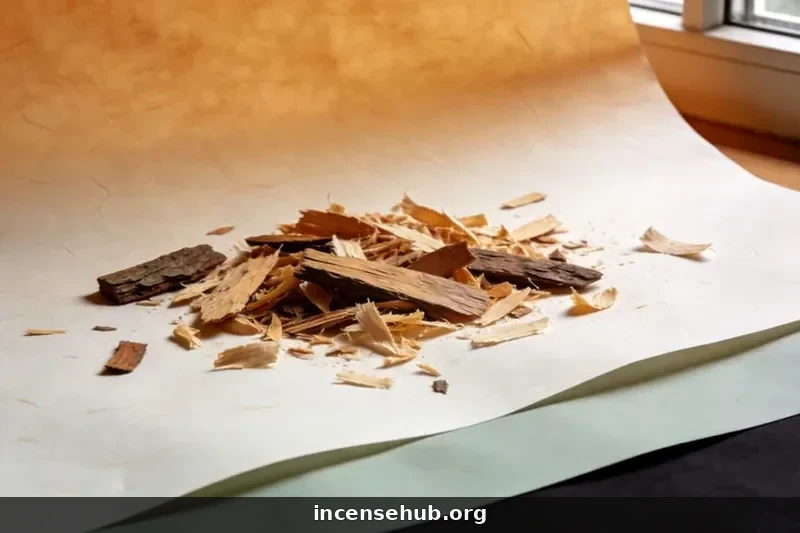
Direct answer: Camphor is two materials from one tree: 樟木 (zhāngmù), the aromatic wood of Cinnamomum camphora, and 樟脑 (zhāngnǎo), the white crystal steam-distilled from that wood. The wood smells cool, resinous and faintly minty; the crystal is the same smell concentrated until it turns sharp. Chinese incense uses it as a small, bright top note, and the English word also covers a synthetic crystal that is chemically close but commercially separate.
Most introductions to camphor start with the smell. This one starts with the ambiguity, because the ambiguity decides what a buyer actually receives. Three different objects answer to the name, they are dosed differently, they keep differently, and one of them is not a plant product at all. Until the form is fixed, every later statement about “camphor” is half true.
The page treats the material as a craft input rather than a curiosity. It sets out what the tree is, how the wood and the crystal diverge, why the crystal leaves a blend early, how to grade what arrives, and where the classical and modern uses part company. The safety note at the end is part of the material’s identity, not a disclaimer bolted on.
Key facts
| Question | Short answer |
|---|---|
| Chinese names | 樟木 (zhāngmù) for the wood; 樟脑 (zhāngnǎo) for the crystal |
| Botanical source | Cinnamomum camphora, family Lauraceae |
| Plant part | Wood, and the crystal distilled from wood |
| Native range | Southern China, Taiwan, Japan, Vietnam |
| Traded forms | Carved wood, chips, shavings, white crystal, synthetic crystal, oil |
| Aroma | Cool, sharp, resinous, faintly minty — “camphoraceous” |
| Physical behaviour | A volatile solid that sublimes at room temperature |
| Role in incense | Top-note accent, used in small amounts |
| Common confusion | Borneol (龙脑), a different crystal from different plants |
| Safety headline | Not for ingestion; strong vapour; smoke needs ventilation |
Three objects under one word
Direct answer: “Camphor” names a molecule, not a single product. 樟木 is timber with the molecule still locked in wood; 樟脑 is the purified crystal; synthetic camphor is the same molecule made in a factory. Each behaves differently in the hand and in a burner.
In a timber yard, camphor is a board. It is pale, soft, easy to carve, and it smells when you cut it. The aroma is held in oil cells distributed through the wood, and it leaves slowly, over years, from an intact surface. A chest made of it keeps a faint scent long after the sawdust is gone.
In a pharmacy or a spice shop, camphor is a white crystalline solid sold by weight. It has been separated from the wood and purified, so its strength no longer depends on the density of a particular plank. This is the form that appears in repellent blocks, in liniments, and in small pinches in a blending bowl.
In a chemical plant, camphor is a manufactured commodity. It is the same compound in the same crystalline form, produced without a tree. The difference is not detectable by looking at a white crystal on a saucer. It shows up in the supply chain, in the trace aroma, and in what the seller is willing to put in writing.
That is the first correction this page makes: a formula calling for “camphor” has specified a molecule and left the material choice open. The maker still has to decide whether the formula wants wood or crystal, and whether natural origin is part of the design.
The three forms also fail differently, which is the quickest way to tell which one a formula is actually asking for.
| Form | What it gives | How it varies | What it asks of the buyer |
|---|---|---|---|
| Wood (樟木) | A slow, diffuse smell held in tissue | Grain, density, age of the cut | Judge the plank, not the powder |
| Natural crystal (樟脑) | A sharp, immediate, concentrated note | Distillation batch, drainage, trace oil | Ask for origin and dryness |
| Synthetic crystal | The same note, cleaner and more abrupt | Purity grade, almost nothing else | Ask what it is, and expect uniformity |
| Camphor oil | A liquid fraction with its own uses | Fraction and camphor content | Do not buy it expecting solid |
A formula that names the wood is asking for slowness. A formula that names the crystal is asking for impact. A formula that names the oil is asking for a liquid, whatever the label implies. Reading the request at that level of detail is what prevents a maker from buying a perfectly good material that does the wrong job.
The tree behind the name
Direct answer: The camphor laurel is an evergreen of the Lauraceae, growing wild through warm southern China, Taiwan, Japan and Vietnam. Oil runs through the whole plant, yet the wood holds the deepest reserve, and that single fact decides which parts of the tree become products.
The camphor laurel is a broad-crowned tree with glossy, leathery leaves and a habit of flushing new growth in a soft red-brown. Crush a leaf and the family resemblance is immediate: the same warm, aromatic sharpness that runs through the Lauraceae, the family that also gives cinnamon, cassia and bay.
The genus Cinnamomum is best known in kitchens for bark. Camphor laurel is the exception in commercial terms. Its bark is not the product; its wood is. The tree is grown and harvested for timber and for the oil locked inside that timber, and the bark is a by-product rather than a spice.
Cinnamomum camphora is planted well beyond its native range as a shade and street tree in warm climates and has naturalised in several countries. That matters for the reader in a small way: not every camphor tree in the world is part of a medicinal or incense supply chain, and a tree in a park is not evidence of a material’s quality.
The botanical anchor is the Flora of China treatment, which records the species within the laurel family and distinguishes it from its relatives. For identity work, that entry and the GBIF record are the two references this page relies on. See Cinnamomum camphora in Flora of China.
Where the material comes from
Direct answer: Natural camphor comes from the wood of the camphor laurel, harvested across southern China, Taiwan, Japan and Vietnam and steam-distilled from chips. Taiwan was for a period the dominant source of natural camphor; synthetic production later took most of the market.
The tree grows in warm, humid country, and the historical production map follows the tree. Fujian, Guangdong, Guangxi, Jiangxi, Zhejiang, Hunan and Taiwan all sit inside the range, and so do parts of southern Japan and northern Vietnam. Material moved from these regions into medicine, insect control and incense for centuries before it was an industrial chemical.
The industrial history is worth knowing because it explains why “natural camphor” is a specialty today rather than a default. In the late nineteenth and early twentieth centuries, Taiwan was the largest single source of natural camphor in world trade, and the industry was organised, taxed and monopolised by the colonial administration of the period. Camphor was a strategic material: it fed celluloid, smokeless powder stabilisers and pharmaceutical manufacture, not only incense.
Synthetic production broke that dependency. Once the molecule could be made in a factory at scale, the agricultural supply chain lost its mass market. Natural camphor survived where the tree was cheap, where the craft wanted the whole material rather than the molecule, or where a buyer specifically asked for tree-derived stock. The rest of the market quietly switched.
For an incense maker, the practical result is a two-tier supply. Natural crystal and natural wood chips are available, often at a premium and often with less consistent grading. Synthetic crystal is cheap, uniform, and rarely labelled as such on a general-purpose listing. A buyer who cares about origin has to ask, because the appearance will not tell them.
The chemistry that explains the behaviour
Direct answer: Camphor is a bicyclic monoterpene ketone, a waxy white solid at room temperature that passes directly into vapour without melting. That single property explains the smell through packaging, the shrinking block, and the way the note leaves a burning stick early.
The molecule belongs to the terpenoids, the large family built from five-carbon units that supplies most of the aromatic vocabulary of resinous plants. In camphor the units close into a rigid bicyclic cage with a ketone group at one corner. The cage is compact and the crystal lattice is weak, which is why the solid is soft, waxy and easily broken.
Volatility is the defining behaviour. Camphor does not wait for flame or hot water to enter the air. At ordinary room temperature its surface releases molecules steadily, so a solid block slowly loses mass and a closed container becomes a scent chamber. This is sublimation: solid to vapour, with no liquid stage in between.
The consequences run through every use on this page:
- A camphor block left open will shrink, and the missing mass has gone into the room.
- The smell passes through paper, card and many plastic films, which is why a sealed bag does not guarantee a sealed aroma.
- The nose detects the compound at very low concentration, so a small quantity in a blend is enough to be noticed.
- The crystal dissolves in alcohol and in fixed oils but not in water, so it can be carried in a tincture and not in a water-based binder.
Mechanism chain — why the solid smells without heat:
- Crystalline camphor sits in an open dish → surface molecules escape into the air at room temperature → the crystal loses mass without ever melting → the surrounding air carries a strong, sharp note → the block shrinks and the room smells of camphor.
None of this is a health claim. It is the physical reason the material behaves the way users describe: insistent, penetrating, and hard to confine.
Why it reads as a top note
Direct answer: In a burning stick, camphor leaves the blend before the heavier materials get going. The result is a cool, sharp opening that fades into the woods and resins behind it. That is a position in the burn, not a measure of quality.
A stick burns from the lit end inward. Heat arrives at the material ahead of the coal and drives off whatever is most volatile first. Camphor is among the most volatile solids in the classical pantry, so it leaves early and in quantity.
Mechanism chain — from crystal to opening note:
- The coal heats the adjacent blend → camphor’s vapour pressure climbs sharply → the crystal fraction leaves the stick within the first minutes → the opening of the burn reads cool, sharp and slightly medicinal → the base woods and resins take over as the heat front advances → the camphor is gone before the middle of the stick.
This is why adding more camphor does not make the note last longer. It makes the opening harsher and pushes the transition to the pleasant middle later. The material has a fixed place in the timeline of a burn, and the only real control is how loud the first minute is.
The same logic explains a common disappointment. A maker smells the raw blend, finds it fresh and bright, and expects the finished stick to smell that way throughout. It will not. The raw blend shows the total aromatic load; the burn shows the sequence in which that load is released.
There is a boundary here worth stating plainly. None of this makes camphor a poor material. It makes it a material with one job, done early. A blend that wants a cool lift at the start is well served. A blend that wants a cool thread through the whole burn needs a different strategy, usually a slower-releasing aromatic or a resin that holds volatiles.
Preparing wood and crystal
Direct answer: The wood is seasoned, sawn and worked; the crystal is recovered by steam-distilling chips and allowing camphor to crystallise from the condensate. Both are preparation routes from the same tree, and neither is complicated. The synthetic route replaces the tree entirely.
Wood preparation is carpentry before it is chemistry. Logs are felled, sawn and air-dried, because green camphor wood moves and cracks as it loses moisture. Once dry, the timber is planed, carved or turned. Every cut exposes fresh oil cells, which is why a workshop that works camphor smells of it for days.
Distillation begins with waste from that process: slabs, edgings, branches, and chips too small for the sawmill. Steam is passed through the packed wood, the volatile fraction is carried out with the steam, and the mixture is condensed. Camphor solidifies from the condensate as a white, slightly greasy mass, which is drained, pressed and dried.
The condensate is not a single substance. A liquid oil fraction accompanies the solid, and the two are separated. The solid is the material this page calls 樟脑; the oil is a separate commercial product with its own grade and its own uses. A maker who buys “camphor oil” expecting crystals has bought the wrong fraction.
Synthetic camphor skips all of this. It is produced in a factory from other chemical feedstocks, crystallised, and sold in the same white form. The industrial process is not a botanical one, and the material has no wood, no chips and no harvest behind it.
The practical difference between the two routes shows up at the edges. Natural crystal carries trace companions from the wood, which soften the sharpness very slightly and make the smell read more “resinous”. Synthetic crystal is the single compound, and it reads cleaner and more abrupt. Whether that difference matters is a judgment about the blend, not a universal rule.
Grading the material
Direct answer: Grade the wood by density, oil content and soundness; grade the crystal by dryness, strength and declared origin. Appearance is the weakest test, because a white crystal can be natural, synthetic or recrystallised from poor stock.
| What you have | What to check | Why it matters | Failure sign |
|---|---|---|---|
| Wood, carved or sawn | Density, straight grain, oil on a fresh cut | Dense heartwood carries more oil and works better | Pale, dry, splintery stock with no smell when cut |
| Chips and shavings | Species, freshness, proportion of bark and dust | Bark and dust add bulk, not aroma | Grey, dusty material with a flat smell |
| Natural crystal | Colour, dryness, strength, origin claim | Residual oil makes the crystal clump and weep | Oily film, yellow tint, weak smell |
| Synthetic crystal | Explicit declaration, batch consistency | The buyer is paying for a molecule, not a harvest | No origin statement at all |
| Camphor oil | Fraction and camphor content | Oil and crystal are different products | Label says “oil” but the buyer expected solid |
Whiteness is the least useful test on that list. Synthetic material is white by default. Natural crystal can be white, translucent or faintly yellow depending on how it was pressed and how long it sat. Recrystallised material from a poor batch can be whiter than the good batch it came from.
The tests that carry information are behavioural. Crush a small piece: it should be brittle, not chewy, and the smell should arrive immediately and stay sharp on the fingers for a while. Press a crystal against paper: a ring of oil means the material was not properly drained. Cut a chip of wood: the fresh surface should smell stronger than the weathered face, because the oil is inside.
For a buyer, the cleanest question is not “is this good camphor” but “what is this camphor for”. A carver wants straight, sound timber. A formulator wants dry, strong crystal in a small quantity. A sachet maker wants a block that will sublime slowly over months. Those are three different specifications, and one supplier rarely serves all three well.
Dosing: the arithmetic of an accent
Direct answer: Camphor is an assistant in the 君臣佐使 framework, not a chief material. Its useful dose is narrow because the note is strong, and the difference between “present” and “dominant” is a small change in weight. Dose it as a seasoning, not as a base.
Classical Chinese blending describes a formula through four roles: 君臣佐使 (jūn chén zuǒ shǐ), chief, minister, assistant and guide. The framework is a way of talking about hierarchy: what leads, what supports, what corrects, and what carries the blend through. It is a design language rather than a recipe, and different readers apply it with different strictness.
Camphor rarely takes the chief role. It is too loud and too short-lived to carry a formula. Its natural place is among the assistants: the material that lifts a heavy blend, sharpens a dull one, or gives the opening a direction. That role explains why the dose is small and why the position in an ingredient list matters.
A formula that names camphor last among ten ingredients is telling the reader something. The list is not always ordered by weight, but the convention often puts the small, potent materials at the end, and camphor belongs there. A formula that puts it near the top is either a repellent, a medicinal preparation, or a blend built around the note.
The narrow dose band has a practical consequence. Doubling an accent does not double its effect; it changes the category of the blend. A lifted formula becomes a medicinal one. The correction is not to add more base material to balance it, because the base cannot mask a note that leaves first. The correction is to cut the camphor.
One process point belongs here. Because the crystal is volatile, it should go into a blend late and be mixed briefly. Long grinding, warm rooms and extended drying all drive it off before the stick is finished. A maker who adds camphor at the start and then dries the sticks for a week has quietly reduced the dose.
Camphor and borneol
Direct answer: Two white crystals, two unrelated plants: 樟脑 comes out of camphor-laurel wood, while 龙脑 is won from Dryobalanops aromatica or from the leaves of Blumea balsamifera. They share a cool, piercing sensation, and that shared adjective is a naming trap rather than a family connection.
| Camphor (樟脑) | Borneol (龙脑) | |
|---|---|---|
| Botanical source | Cinnamomum camphora (Lauraceae) | Dryobalanops aromatica / Blumea balsamifera |
| Plant part | Wood, distilled | Resin or leaf, depending on source |
| Character | Sharp, cool, medicinal, penetrating | Cool, minty, woody, slightly softer |
| Classical standing | Practical and medicinal material | Prestige aromatic in high-status formulas |
| Substitution | Not a drop-in replacement for borneol | Not a drop-in replacement for camphor |
The confusion is linguistic before it is chemical. European naturalists named a whole family of cool, crystalline smells after camphor, and borneol was described by analogy. The adjective travelled; the plants did not. A label that says “camphoraceous” is describing a sensation, not an identity.
The practical difference is temperature. Camphor reads sharp and slightly medicinal, with a hard edge that cuts through resin. Borneol reads cooler and more minty-woody, with a softer landing. Swapping one for the other does not preserve the blend; it changes its temperament, even when the weight is adjusted.
That is the second correction on this page: borneol is not a gentler camphor. It is a different material with a different history and a different place in the formula. Treating the two as interchangeable is the most common mistake in reading a camphoraceous formula, and it is the one a buyer is most likely to make when a seller offers “the same thing, cheaper”.
See borneol, cinnamon, the borneol vs camphor comparison, and the material comparison matrix.
The Chinese record
Direct answer: 樟木 is recorded as a timber, a chest wood and an insect-repellent material; 樟脑 appears in the materia medica for external use. The medicinal entries are traditional belief, and this page repeats them as history rather than as evidence.
The wood has a domestic history that is easier to document than its incense history. 樟木箱, the camphor chest, is a familiar object in southern Chinese households: a dovetailed box for woollens, silks and books, valued because the wood’s aroma discourages insects and because the timber itself is light and workable. The chest is a technology as much as a piece of furniture.
樟脑 enters the materia medica as a cooling, penetrating substance used externally. The classical descriptions are vivid and specific, and they belong to a medical system with its own logic. This page reports them as traditional belief and makes no claim that they describe a modern clinical effect.
In incense manuals, the strong camphoraceous materials sit among the accents. The pattern in the surviving corpus is that 龙脑 (borneol) carries the prestige in high-status formulas, while 樟脑 appears more often in practical, medicinal and repellent settings. That is a reading of the record, not a rule, and a single counter-example would not overturn the page.
The distinction is worth keeping because it explains a modern confusion. A reader who finds “camphor” in a translated formula may be looking at either material, depending on the translator. The Chinese terms are precise; the English word is not.
Three applications, three physics
Direct answer: A chest, a sachet and a burning stick use the same material under three different physical regimes. The chest relies on slow evaporation, the sachet on body-warm evaporation, and the stick on combustion. A material that works in one is not automatically suited to the others.
In a chest, the camphor is a solid block or a piece of wood in a closed volume. Vapour accumulates, the concentration rises, and insects meet an atmosphere they avoid. The block is consumed slowly, and the protection lasts as long as the solid does.
Mechanism chain — the chest:
- A camphor block is placed in a closed chest → vapour accumulates in the still air → the concentration stays high enough to deter insects → the solid sublimes away over months → the block shrinks and the atmosphere weakens → protection ends when the solid is spent.
That chain has a practical corollary. A camphor block that no longer smells is not resting; it is finished. Keeping it in the chest is harmless but pointless. Replacing it is the only way to restore the effect.
A sachet works at lower concentration and at body temperature. The material is enclosed with other aromatics, warmed slightly by the wearer, and smelled at close range. The note must be strong enough to register through cloth and gentle enough not to overwhelm the other ingredients. Camphor in a sachet is a top-note component, not the whole composition.
A burning stick is the most demanding regime. Heat drives the volatile fraction off in seconds, smoke carries the residue, and the nose receives a concentrated burst. The same dose that scents a chest for months is far too much for a stick. That is why the three applications cannot share a single specification.
Workshop handling
Direct answer: Camphor is easy to work and hard to store. It crushes readily, clogs fine sieves, and migrates as vapour into anything porous nearby. Sealed glass, a cool cupboard and a clear label solve most of the problem.
The crystal is soft and brittle. It breaks under a pestle without much effort, and it tends to smear rather than powder when the room is warm. A coarse crush is usually enough for incense; a fine powder is not required and can make the material clump in the binder.
Sieving is the awkward step. Camphor is waxy at room temperature, and a fine mesh loads up quickly. Working in small batches and sieving cold reduces the problem. A maker who forces the material through a warm sieve will lose some of it to the mesh and some to the air.
Storage is the bigger issue. Camphor vapour passes through many films and papers and adsorbs into porous materials. A block stored beside tea, unfinished wood, paper or a mild resin will taint them. The safe habit is a sealed glass jar, a cool dark cupboard, and isolation from anything whose smell matters.
Labels matter more than they usually do, because the material is a white crystalline solid that resembles several others. Borneol, menthol, Epsom salt and sugar all look plausible on a shelf. A jar labelled only “white crystal” is an accident waiting to happen, particularly in a household with children.
Mechanism chain — cross-taint:
- Camphor sublimes inside a cupboard → vapour fills the confined space → porous neighbours adsorb the vapour → the tea, paper or resin takes on a camphor note → the contamination persists after the camphor is removed.
How camphor fails in storage
Direct answer: Camphor does not rot, sour or turn rancid. It leaves, it fuses into lumps, or it borrows the smell of whatever sits beside it. Two of those are physical losses and one is contamination, and only the last is avoidable after the fact.
The first failure is quiet. A sealed jar is never sealed against its own vapour: every opening exchanges the headspace, and the crystal at the surface keeps refilling it. Mass drops, the pieces get smaller, and a smaller piece gives up its remaining load faster than a large one. A jar of coarse crystal therefore holds its character longer than the same weight of powder, which is why a workshop that crushes everything in advance pays for the convenience twice.
The second failure is moisture. Camphor dissolves only sparingly in water, but a damp storeroom softens the outer surface of the crystal, and soft surfaces fuse where they touch. What comes out of the jar is a lump rather than a scoop of separate grains, and a lump doses unevenly: the top of the spoon is not the weight of the bottom. The blend that follows drifts stick to stick, and the fault gets blamed on the formula.
Mechanism chain — humid storage to uneven sticks:
- A jar is opened in a humid room → the crystal surface takes up a little water → touching crystals fuse at the contact points → the lump breaks unevenly when scooped → one batch of sticks carries more camphor than the next → the first burns sharp and medicinal, the second flat.
The third failure is borrowed smell, and the mechanism is the cross-taint chain above. What matters here is that the damage runs one way. A resin that has picked up camphor cannot be aired back to its old character in any reasonable time, because the camphor has gone into the material rather than sitting on its surface.
The habit that prevents all three is unglamorous: buy to the season rather than to the discount, keep the crystal in glass with a tight lid, keep that glass out of the damp and away from anything porous, and crush what you need rather than what you own.
What goes wrong
Direct answer: Most camphor problems are dosing problems or volatility problems, not quality problems. The blend reads medicinal, the opening is harsh, the middle is flat, or the note vanishes in storage. Each symptom points to a specific correction.
| Symptom | Likely cause | Correction |
|---|---|---|
| Blend smells medicinal rather than lifted | Camphor or borneol dosed above the accent level | Cut the camphor; do not add more base to mask it |
| Bright first minute, dull remainder | The volatile fraction left early, as it always does | Accept the top-note role, or add a resin that holds volatiles |
| Crystals visible on the finished stick | Coarse particles or uneven mixing | Crush finer, mix longer, add the crystal later |
| Note fades between batches | Source changed, natural to synthetic or the reverse | Fix the source and keep a reference sample |
| Camphor smell in unrelated stock | Vapour migration in storage | Isolate in sealed glass, away from porous goods |
| Headache in a small room | Concentration and poor ventilation | Burn less, ventilate more; this is not a formula fault |
The first row is the one that catches makers most often. Camphor is added to lift a blend, the blend still feels heavy, and the instinct is to add more. The extra camphor does not lift the base; it announces itself. The base was the problem, and the camphor was the wrong tool for it.
The second row is not a fault at all, and treating it as one leads to over-correction. A camphor top note is supposed to leave. A blend designed around a long, even scent curve should use camphor sparingly or not at all, and should build its continuity from materials that release slowly.
Substitution
Direct answer: There is no exact substitute for camphor, because the note is a single compound with a distinctive shape. There are stand-ins that preserve part of the effect, and the choice depends on which part of the effect the formula needs. The judgments below are editorial.
| Stand-in | Preserves | Loses | Choose when |
|---|---|---|---|
| Borneol (龙脑) | The cool crystalline lift | The sharp medicinal edge; adds minty-wood | The formula wants a softer coolness and allows a different material |
| Eucalyptus leaf | Freshness and a cooling top note | The crystalline intensity; adds green-herbal | A lighter, more botanical opening is wanted |
| Peppermint | Coolness | The camphoraceous character; adds sweetness | A culinary-adjacent blend can accept a mint note |
| Less camphor | Identity and balance | Intensity | Always the first option to test |
The last row is not a joke. Reducing the dose is the only substitution that keeps the material and changes nothing else, and it solves more problems than any swap. A blend that needs a different aromatic usually needs a different formula, not a different crystal.
Eucalyptus and peppermint are included as practical stand-ins because their coolness comes from different compounds with different curves. Eucalyptus leaf carries 1,8-cineole, which reads fresh and slightly camphoraceous; peppermint carries menthol, which reads sweeter and more obviously minty. Neither is classical, and a traditional formula that names camphor is not improved by pretending they are.
Buying: a short decision table
Direct answer: The label tells you less than the form does. Decide first whether you need wood, crystal or oil, then ask for the origin and the grade. A seller who cannot answer both questions is selling a category, not a material.
| What the listing says | What you probably have | What to ask |
|---|---|---|
| 樟木, 樟木片, camphor wood | Timber or chips | Species, part of the tree, moisture, oil on a fresh cut |
| 樟脑, camphor crystal | Crystal, origin unstated | Natural or synthetic; distillation source; dryness |
| Natural camphor | Tree-derived crystal | Which country, which part of the tree, how pressed |
| Camphor oil | Liquid fraction | Fraction name and camphor content; not a substitute for crystal |
| Synthetic camphor | Factory product | Purity and intended use; no origin claim applies |
| 龙脑, borneol | A different material | Botanical source; do not accept it as “camphor” |
Two questions do most of the work. The first is “which form”, because wood, crystal and oil are not interchangeable. The second is “natural or synthetic”, because the answer changes the supply chain and the trace aroma, and because a listing that avoids the question usually has a reason.
A third question is worth asking for wood: “which part of the tree”. Heartwood is denser and carries more oil than sapwood, and a mixed lot behaves inconsistently in the workshop. The answer will not always be precise, but the hesitation is informative.
Reading an origin claim
Direct answer: A natural-origin claim is a documentary claim, not a sensory one. It should name the species, the region and the route, and it should survive the question “how would you know”. The table separates what a typical label phrase can carry from what it cannot.
| Phrase on the listing | What it can establish | What it leaves open |
|---|---|---|
| “Natural camphor” | The seller asserts tree-derived stock | Which tree, which region, which route |
| “From Cinnamomum camphora” | A species is named | Whether the batch in the box is that species |
| “Steam-distilled” | A recovery route is described | Purity, dryness, age, storage history |
| “100% pure” | A purity assertion about the compound | Origin: the molecule is identical either way |
| “Pharmaceutical grade” | A specification the seller claims to meet | Suitability for burning, or for inhaling smoke |
| No origin statement | Nothing | Everything |
The pattern to notice is that “pure” and “natural” answer different questions and are often printed as though they answered the same one. Purity is a statement about what else is in the crystal. Origin is a statement about where the carbon came from. A synthetic batch can be extremely pure; a natural batch can be poorly drained and still full of its own oil.
What a buyer can usefully request is a batch-specific statement rather than a category word. Ask which species, which part of the tree, which country, and whether the material was distilled or synthesised. A supplier who answers three of the four has told you more than a page of adjectives. A supplier who answers none has told you where the price came from.
There is a limit worth naming. No document proves that the crystal in your hand matches the certificate, because a certificate describes a batch and a jar contains a scoop. The paperwork shifts the question from “is this natural” to “will this supplier stand behind a claim”, and the second question is the one a repeat buyer is really asking.
Safety
Direct answer: Camphor is a strong aromatic with a real concentration risk. The crystal is not for ingestion, concentrated vapour should not be breathed in a closed space, and any incense produces smoke and fine particles that need ventilation.
The safety profile has two separate parts, and mixing them up produces bad advice. The first is the material itself: concentrated camphor is a potent substance, it is not a food, and it should be kept away from children and pets. The second is the smoke: any burning aromatic produces particulate matter, and the correct response is ventilation and sensible quantities rather than a claim that one material burns “cleanly”.
The concentration point deserves emphasis because it is easy to lose. A camphor block in a chest is a slow, low-level exposure in a ventilated room. A handful of crystal heated in a small closed room is a different event. The material is the same; the dose and the volume are not.
This page makes no medical claims, and nothing here is medical advice. Traditional external uses are reported as historical practice, not as recommendations. If a household member is pregnant, asthmatic, or sensitive to strong smells, the sensible course is to keep concentrated camphor out of the living space. A sachet is a lower-exposure application than a burner, which does not make it a risk-free one: keep the crystal off the skin and the sachet out of reach of children and pets. See our safety guide.
What the nose cannot tell you
Direct answer: Smell is a good detector and a poor witness. It confirms that camphor is present; it cannot date the material, separate natural from synthetic, or predict how a stick will burn. Treating a strong jar smell as a quality certificate is the most common buying mistake with this material.
Three things defeat the nose. The first is temperature: a cold room suppresses volatiles, so good crystal can smell muted in winter and loud in summer, and a comparison made across seasons is not a comparison. Warm the piece in the hand before judging it.
The second is surface area. A freshly broken face releases far more vapour than a weathered one, which is why a block that smells tired outside can smell sharp where it is cut. The test is a break, not a sniff.
The third is the nose’s own adaptation. Camphor is a strong stimulus and the receptors stop reporting it within a minute or two, so a second evaluation is always weaker than the first and says nothing about the material. Step into clean air, wait, come back.
What follows from this is a division of labour. Use the nose to confirm identity and catch contamination, use the break and the paper test to judge condition, and use a burn to judge the only thing that finally matters to an incense maker: how the note sits in the timeline of a stick. None of the three replaces another, and the last cannot be done in a shop.
The editorial judgment behind that division is simple. A material is bought for a job, and the job is a burn, a chest or a sachet. Judge it in the application it will serve, and accept that some questions a buyer wants answered — origin, for one — are settled by paperwork rather than by the senses.
FAQ
Is camphor the same as camphor wood? No. 樟木 is the aromatic wood, used for carving, chests and chips; 樟脑 is the white crystal distilled from that wood. They come from the same tree but are different commercial materials with different strengths, doses and uses.
What is the difference between camphor and borneol? They are separate materials with separate sources. 樟脑 is the distillate of Cinnamomum camphora wood; 龙脑 is obtained from Dryobalanops aromatica or Blumea balsamifera. The resemblance is sensory — both read cool and piercing — and it is no licence to swap one for the other in a formula.
Does camphor make incense last longer? No. It is one of the most volatile materials in the blend, so it leaves early. A camphor note is an opening, not a fixative. A blend that needs longevity should look to resins and slower-releasing woods.
Does camphor go bad, and why did my block shrink without melting? It does not spoil like food; it sublimes, passing from solid to vapour at room temperature, so the missing mass has entered the air. Age shows as size, not as rot. A block that has stopped shrinking and stopped smelling has been spent, and a jar of fine powder fades sooner than a solid piece of the same weight.
Is natural camphor better than synthetic, and how would I know? “Better” is not established. They are the same compound, with different supply chains and slightly different trace aromas. Natural material carries the wood’s minor companions; synthetic material is the single compound. Appearance will not tell you which is which, so the answer has to come from the supplier’s paperwork.
Summary
Camphor is a tree and a molecule at the same time. Cinnamomum camphora, the camphor laurel, supplies 樟木, an aromatic timber, and 樟脑, the white crystal distilled from its wood. The crystal is volatile, sublimes without heat, and leaves a blend early, which is why it works as a top-note accent and fails as a base. The English word also covers a synthetic crystal and is routinely confused with borneol, a different material from different plants. Grade by behaviour and declared origin rather than by whiteness, dose it as an assistant rather than a chief, store it sealed and isolated, and treat the medicinal record as traditional belief rather than evidence.
Sources
The botanical identity rests on the Flora of China entry for Cinnamomum camphora, which places the species in the Lauraceae and separates it from its relatives: Cinnamomum camphora in Flora of China. The taxonomic record is corroborated by the GBIF backbone entry: Cinnamomum camphora on GBIF.
The historical and technical statements are drawn from the standard account of the camphor trade and from the material’s established physical chemistry: a bicyclic monoterpene ketone, solid at room temperature, volatile, and only sparingly soluble in water. The medicinal entries are reported as traditional materia-medica language, not as clinical findings. No clinical or efficacy claim is made anywhere on this page, and no dosage for internal use is given or implied.
Related Resources
- Borneol (龙脑) — the other camphoraceous crystal, from a different plant and a different tradition.
- Cinnamon (桂皮) — the same genus, grown for bark rather than wood.
- Eucalyptus — a cooling leaf aromatic built on a different compound.
- Borneol vs camphor — the comparison in full, with the naming history.
- Material comparison matrix — where camphor sits against the rest of the pantry.
- Scent guide — the vocabulary of cool, sharp and camphoraceous notes.
- Incense storage and longevity — why volatile materials need sealed storage.
- Safety guide — smoke, ventilation and household precautions.