
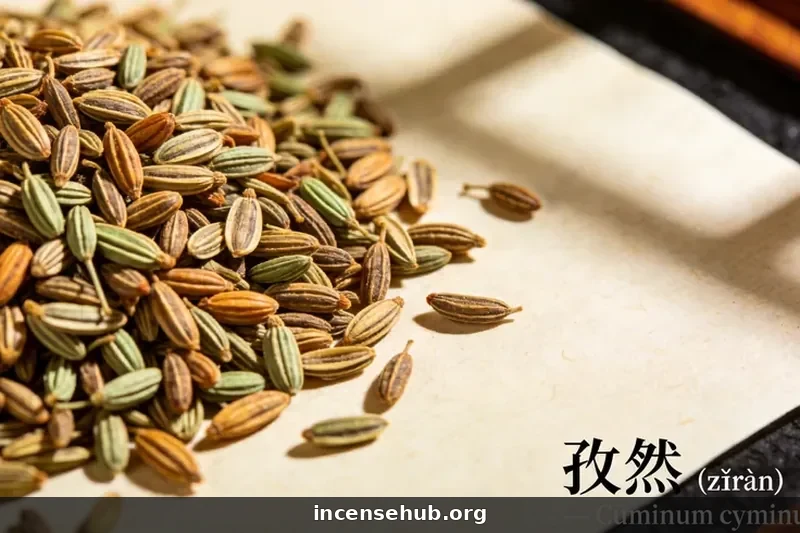
Direct answer: Cumin, written 孜然 in Chinese, is the dried fruit of Cuminum cyminum, an annual umbellifer grown from the eastern Mediterranean across western and southern Asia. A warm, earthy, faintly bitter scent built on cuminaldehyde defines it, and its Chinese name is a phonetic borrowing that documents a Central Asian trade route rather than a classical incense pedigree.
Key facts
Direct answer: Cumin is a culinary seed spice with a savory, penetrating aroma. No entry for 孜然 appears in the Ming incense manual Xiangcheng (香乘) or in the Bencao Gangmu (本草纲目), and the plant is not treated as native to China.
| Item | Detail |
|---|---|
| Chinese name | 孜然 (zīrán), a phonetic loanword from Central or West Asia |
| Botanical source | Cuminum cyminum L., family Apiaceae |
| Plant habit | Slender annual herb, a few tens of centimetres tall, with finely divided leaves and small umbels |
| Part traded | The whole dried fruit (a pair of mericarps, each a few millimetres long) |
| Aroma family | Warm spice, earthy, savory, slightly bitter, faintly musky |
| Principal odorant | Cuminaldehyde, supported by terpenes and related aldehydes |
| Chinese textual status | Absent from 香乘 and 本草纲目 under 孜然; not a Flora of China native |
| Documented Chinese use | Culinary, concentrated in Xinjiang and the northwest |
| Incense status | No classical 合香 (hé xiāng, blended-incense) role; a modern register choice only |
| Main confusion | Fennel, caraway, black cumin (Nigella), and generic “cumin powder” blends |
The plant behind the spice
Direct answer: Cuminum cyminum is an annual umbellifer: a thin branched stem, thread-like leaves, small white or pinkish flowers in compound umbels, and a dry fruit that splits into two ribbed halves. The “seed” of commerce is that fruit, not a true seed.
The plant is unremarkable in the field and unmistakable in the hand. It grows as a slender annual, usually less than knee height, with leaves cut into fine threads — a shape that reduces water loss in the dry, sunny places where the species does well. The flowers are small and white to pink, carried in the flat-topped umbels typical of the carrot family. What follows is a dry schizocarp: a fruit that matures as a pair and separates at harvest into two single-seeded halves, each with longitudinal ridges and, beneath the surface, the oil canals that hold the aromatic volatiles.
That botanical detail explains a practical fact. The aroma is not in a resin or a bark; it sits in tiny oil channels inside a thin fruit wall. Anything that breaches the wall — grinding, crushing, rough handling, damp storage — releases those oils and starts the clock on their loss. A whole cumin “seed” is therefore a small sealed package, and a spoon of cumin powder is the same package opened and left open.
Wild and feral populations now blur together across the Middle East, South Asia and Central Asia, where the plant has been grown for so long that its original range — the eastern Mediterranean into southwestern Asia — is partly reconstructed rather than observed. Flora of China does not list it as a native species. That absence is consistent with the historical picture: the plant reached China as a crop and a trade good, not as part of the native flora.
The name is the provenance record
Direct answer: The word 孜然 does not describe the plant; it imitates a foreign one. It transcribes a Central or West Asian term for cumin — compare Persian zire and Arabic kammūn — and that borrowed form is stronger evidence of the spice’s route into China than any later claim of antiquity.
Chinese plant names usually describe something. 小茴香 (“small fennel-fragrance”) names a scent and a resemblance; 八角 (“eight-cornered”) names a shape; 花椒 (“flower pepper”) names a plant and a taste. 孜然 does neither. It carries no Chinese morpheme that a speaker would recognise as “warm”, “seed” or “spice”. It is a transcription, and transcriptions enter a language when the thing arrives from outside with its name attached.
The same pattern appears elsewhere in the aromatic lexicon. Asafoetida is 阿魏, long pepper is 荜茇, and both are loanwords for materials that came in through trade. The name travels with the commodity; the plant does not need to be native for the word to stick. Cumin’s corridor was the overland road through Central Asia. The word’s concentration in northwestern speech also marks where the spice took hold in daily cooking.
This is where the page takes a deliberate editorial position. A “西域” (Western Regions) ingredient is often given a decorative Chinese antiquity in marketing copy: an invented Han-dynasty palace, an invented imperial formula, an invented line of classical praise. Cumin does not need any of that, and the invention would be detectable. The loanword is a cleaner and more interesting fact. It says: this spice came from outside, was adopted for food, and was never absorbed into the classical incense canon. That is a complete story. It does not become a better story when a lost 香乘 entry is conjured for it.
One caution about textual absence. “Not recorded in 香乘 or 本草纲目 under 孜然” is not the same claim as “no Chinese person ever burned cumin before 1900”. Absence from a manual records what the manual’s compilers recognised and valued; it does not survey every kitchen, temple and household. The defensible statement is narrower and still useful: cumin has no classical Chinese incense record, no named role in the 合香 tradition, and no textual authority that a seller can honestly cite. Where a modern blend uses it, that is a modern choice.
Aroma: the savory outlier of the carrot family
Direct answer: Cumin reads warm, earthy, savory and slightly bitter, with a musky-penetrating edge and almost no sweetness. That profile places it apart from fennel, anise and coriander seed, which occupy the sweet, licorice or citrus side of the same botanical family.
The first impression is heat without chili: a dry warmth that sits at the back of the nose. Behind it is earth — not the cool earth of iris or vetiver, but a kitchen earth, close to toasted bread crust and roasted root vegetables. A faint bitterness arrives at the end, and with it a musky, almost animalic persistence that explains why cumin is either loved or rejected outright. There is no honeyed bridge, no floral lift, no anise sweetness. The material is savory from start to finish.
Cuminaldehyde does most of this work. It is a small aromatic aldehyde with a sharp, green-cumin character in isolation, and in the whole fruit it is moderated by terpenes, alcohols and the oily load of the fruit wall. The result is a scent that behaves like a concentration: a little reads as a lot. In a blend, cumin can be present at a fraction of the total and still announce itself as the theme. That is a dosing fact before it is an aesthetic one.
The contrast with its relatives is genuine, not a matter of degree. Fennel and anise carry anethole, which reads sweet and licorice-like; coriander seed carries linalool and related alcohols, which read bright, floral-citrus and woody. Cumin carries cuminaldehyde, which reads savory and dry. To fold the Apiaceae seed spices into one flavour family is to erase a genuine sensory divide. The family relationship is botanical; the aroma relationship is not.
There is a second contrast worth naming, because it explains most failed blends. Cumin does not support; it argues. Fennel can sit under a floral accord and soften it. Coriander seed can lift a citrus top note. Cumin enters a blend and changes its subject, pulling the composition toward food, smoke and warmth. Used deliberately, that is a powerful effect. Used as a “spice accent” in a delicate floral formula, it reads as a mistake — not because the material is poor, but because its register overpowers the structure around it.
Aroma mechanism: why a small dose travels so far
Direct answer: Cumin’s impact comes from a low odour threshold, a high-boiling aromatic load and a fruit wall that releases oil slowly when intact and all at once when crushed. Those three properties, not “strength” in a vague sense, explain its behaviour in a blend.
The chain runs like this:
intact fruit wall → oil canals sealed → volatiles released only on crushing or heating → a slow, controlled release in the censer; grind the fruit → cell walls rupture → surface area rises sharply → oxidation and evaporation begin immediately → the powder loses its top note within weeks and turns dusty.
A second chain explains the roasting effect:
raw fruit → moist, green, slightly bitter volatiles → dry heat drives off water and part of the light terpene fraction → surface carbohydrates and proteins brown → toasted, nutty, deeper aroma forms → too much heat → pyrolysis of the outer tissue → acrid, burnt, harsh note that no amount of blending repairs.
A third chain explains the dominance in a mixture:
cuminaldehyde has a low odour threshold → a small mass produces a large perceptual signal → the note sits high in the blend’s hierarchy → other soft materials are masked → the formula reads as “cumin plus background” → the fix is dilution or a competing sweet-resin register, not more of the other ingredients.
These chains are ordinary physical chemistry and sensory behaviour, not trade secrets. They are also the reason the practical advice on this page is repetitive: buy whole, grind small, roast gently, dose low. Every one of those rules follows from the same few properties.
Identification: what is actually in the jar
Direct answer: Whole cumin is a small, straight, ridged, brownish fruit with a warm earthy smell when crushed. Powder should smell of the same material, not of flour or stale spice. The common lookalikes are caraway, fennel and black cumin, and each has a different botanical source.
| Feature | Cumin (孜然) | Caraway (葛缕子) | Fennel (小茴香) | Black cumin (黑种草) |
|---|---|---|---|---|
| Species | Cuminum cyminum | Carum carvi | Foeniculum vulgare | Nigella sativa |
| Family | Apiaceae | Apiaceae | Apiaceae | Ranunculaceae |
| Fruit shape | Straight, slender, long ridges | Curved, crescent-like, narrower | Plump, greenish-yellow, prominent ribs | Angular, rough, teardrop-shaped |
| Crush smell | Warm, earthy, savory-bitter | Sweeter, peppery, faint anise | Sweet licorice-anise | Peppery, oregano-like, not sweet |
| Typical giveaway | The savory, almost smoky dry-down | The curve of the fruit | The anise sweetness | The hard angular black seed |
The table matters because “cumin” is used loosely in several trades. Black cumin in English usually means Nigella sativa, a buttercup-family plant with a peppery, thyme-like seed — not a cumin at all. Caraway is the closest visual relative and the most plausible accidental mix-up in a bulk bin: the fruits are both small and brown, and the difference is clearest in the hand, where caraway curves and cumin stays straight. Fennel is easy to separate by sweetness once crushed, though the whole fruits can look similar to an unpractised eye.
For ground material, identification is harder and the honest answer is that smell plus provenance is all most buyers have. A powder that smells of raw flour, or that has a flat, papery note with no bitter edge, is either old, diluted, or both. A powder that smells sharply of cumin but feels gritty and tastes starchy is a blend. These are screening observations, not laboratory proof. Where the purchase matters, the only decisive controls are the supplier’s declared species, a lot-level certificate of analysis, and a retained sample against which later deliveries can be compared.
Grades and forms: what the market actually sells
Direct answer: Whole dried fruit, ground powder and roasted material are the three commercial forms of cumin. They are presentations of the same fruit rather than steps on a formal quality ladder, and what separates them is shelf life, dosing control and aroma intensity.
| Form | What it is | Keeps well because | Main risk | Sensible use |
|---|---|---|---|---|
| Whole fruit | Dried, cleaned mericarps | The fruit wall protects the oil canals | Dust, foreign matter, mixing with caraway | The reference form for checks and for grinding to order |
| Ground powder | Milled whole fruit | Nothing; surface area is now large | Loss of top note, starch or spent-seed dilution | Blending where a uniform powder is required, used fresh |
| Roasted whole | Fruit heated before sale or use | The roast note is stable, the raw edge is reduced | Scorching, uneven heat, bitterness | Preparations where a toasted, deeper register is wanted |
| Roasted ground | Milled after roasting | Convenience only | Both of the above at once | Short-shelf-life blends, small batches |
There is no publicly standardised grading ladder for cumin comparable to, say, vanilla or saffron grades. Sellers use descriptions such as “bold”, “sun-dried”, “hand-cleaned” or an origin name, and those words carry commercial meaning without carrying a specification. For a buyer, the useful move is to translate the description into a question: bold according to what measure, cleaned to what foreign-matter limit, dried to what moisture level. A supplier who cannot answer in measures is describing a feeling.
Origin claims deserve the same treatment. Cumin from a named region may genuinely differ in size, oil content and drying practice, because climate and handling differ. That does not make the origin name a guarantee. The same region produces good and poor lots, and a good lot from an unnamed region can outperform a poor lot from a famous one. The material in the jar is the evidence; the label is a hypothesis about it.
Processing, from field to powder
Direct answer: Cumin is harvested when the fruits ripen, then threshed, cleaned and dried. Roasting is an optional thermal step that deepens the aroma; grinding is a size-reduction step that shortens shelf life. None of these steps creates the aroma — they release, concentrate or degrade what the fruit already holds.
The harvest window matters more than most descriptions admit. The fruits ripen unevenly on the umbel, and leaving the crop too long invites shattering — the ripe mericarps drop before collection. Cutting early avoids loss but leaves pale, under-filled fruit with weaker oil. The trade-off is familiar from every seed crop: yield and oil quality peak at slightly different moments, and the grower chooses where on that curve to cut.
After cutting, the crop is dried and threshed. Threshing separates the fruit from stems and umbel fragments; winnowing and screening remove dust, stones and light chaff. Cleaning is where a lot’s visual grade is largely set, and it is also where careless handling shows: a dirty lot can be re-cleaned, but a lot that has been stored damp cannot be restored. Damp storage invites mould, and mouldy cumin smells musty and feels clumped — a defect that no roasting hides.
Roasting is a controlled burn of the surface, not a cook-through. The aim is to drive off moisture, volatilise part of the sharp green fraction and brown the outer tissue enough to build a toasted note. The margin is narrow. Under-roast and the raw, green, slightly bitter edge remains; over-roast and the fruit turns acrid, with a burnt note that dominates everything it touches. Commercial roasted cumin is often sold as a distinct product for exactly this reason: the roast is a specification, and a buyer should ask whether “roasted” means a light toast or a dark one.
Grinding is the last and most damaging step. A mill ruptures the fruit walls and exposes the oil to air, light and heat. The powder’s aroma is brightest in the first days and declines steadily after that. This is why the same fruit can be sold as a vivid, potent powder and as a flat, dusty one with no change in the label: the difference is time since milling, not species or origin.
Storage and failure modes
Direct answer: Cumin fails in four predictable ways: it loses its top note through oxidation, it goes musty through moisture, it scorches in the roast, and it is diluted in ground form. Whole fruit in a sealed, dark, cool container is the simplest defence against the first three.
| Failure | What you notice | Cause | What it means for use |
|---|---|---|---|
| Flat, dusty powder | No lift on opening; smells “brown” rather than warm | Oxidation and evaporation after milling | Increase dose and you add bitterness, not aroma; replace the stock |
| Musty, clumped fruit | Damp, cellar-like smell; fruit sticks together | Moisture uptake and mould | Discard; heat does not make mouldy spice safe or pleasant |
| Acrid, burnt note | Sharp, harsh, lingering bitterness | Over-roasting or scorching during cooking | The note spreads through the blend; use a fresh batch |
| Starchy, gritty powder | Powdery mouthfeel, weak aroma, pale colour | Dilution with flour, starch or spent seed | Not a dosing problem; the material is not what it claims |
| Overpowering blend | Everything tastes of cumin | Low odour threshold plus careless dosing | Reformulate; dilution is easier than masking |
The storage rule follows from the chemistry. Heat speeds volatilisation, light accelerates oxidation, oxygen is the reactant, and moisture enables both mould and slow chemical change. A sealed opaque jar in a cool cupboard addresses all four. The refrigerator is not automatically better: repeated opening causes condensation, and condensation is moisture. If a large stock is kept cold, it should be split into small, sealed portions and brought to room temperature before opening.
There is a useful test that costs nothing. Crush a few fruits between finger and thumb and smell immediately. Good cumin releases a warm, earthy, slightly bitter cloud that lingers on the skin. Old cumin releases a faint, papery smell that vanishes in seconds. The test is comparative, so it works best against a sample known to be fresh. It will not tell you the species, the origin or the oil percentage. It will tell you whether the jar in front of you still has the material’s defining feature.
Cumin in modern fragrance: a register, not a tradition
Direct answer: Cumin appears in modern perfumery and aromatic blending as a warm, savory, food-adjacent note, often used to give a “skin”, “grilled” or “spice-market” effect. That is a modern aesthetic choice. It is not a classical Chinese incense role, and no classical text can be cited for it.
The perfume world’s cumin is a specific effect rather than a spice-jar smell. In small doses it adds a dry, human warmth — the quality perfumers sometimes call “skin” — and a savory depth under florals. In larger doses it becomes the smell of a spice market or a grill, which is either the point or a disaster depending on the brief. The material is also used in savoury flavour work, where its job is unambiguous.
For incense, the honest framing is narrower. Cumin can be burned alone, and it will produce a warm, sharp, food-like smoke. It can sit in a modern blend as a top or middle accent. No classical Chinese temple role exists for it, and no classical text can be cited in support. The distinction is not pedantry. A reader who buys “classical cumin incense” on the strength of a decorative story is buying a story, and the material inside the box may be anything.
The practical question is whether the register suits the composition. Cumin pairs well with resins that can carry its weight — labdanum, benzoin, certain woods — and badly with delicate florals, where its musky edge reads as contamination. It also interacts with smoke: burned cumin’s acrid fraction can dominate a censer blend even when the raw material smelled balanced. Testing the actual burn, not just the raw scent, is the only way to know.
Cumin against fennel and coriander seed
Direct answer: Cumin, fennel and coriander seed all belong to the carrot family, yet each pulls a formula in a different direction. The first is savory, earthy and bitter; the second sweet with anise; the third bright, citrusy and woody. None substitutes for another in a serious composition.
| Cumin (孜然) | Fennel (小茴香) | Coriander seed (芫荽籽) | |
|---|---|---|---|
| Species | Cuminum cyminum | Foeniculum vulgare | Coriandrum sativum |
| Dominant impression | Warm, earthy, savory-bitter | Sweet, licorice, anise | Bright citrus, floral-woody |
| Key odorant group | Cuminaldehyde | Anethole | Linalool and related alcohols |
| Behaviour in a blend | Dominates; pulls toward food and smoke | Softens; sweetens; supports florals | Lifts; bridges citrus and wood |
| Classical Chinese status | No classical incense record | Classical 茴香 | Culinary and materia medica |
| Common failure | Overdose; scorched roast | Cloying sweetness in excess | Confusing seed with leaf |
The three share a family and a fruit form, and that is where the similarity ends. Fennel and coriander seed can be swapped in some culinary contexts without ruin; cumin cannot replace either in an aromatic formula without changing the composition’s subject. The same logic runs in reverse: fennel cannot do cumin’s savory work, and coriander seed cannot supply cumin’s musky weight.
For readers working through the site, the useful cross-references are fennel, coriander-seed, dill and fenugreek. The broader comparison of aromatic materials sits in the material comparison matrix, and the sensory vocabulary used here is set out in the scent guide.
Decision guide: when cumin earns its place
Direct answer: Use cumin when the composition needs a warm, savory, food-adjacent anchor and can tolerate a dominant note. Avoid it when the brief is floral, sweet, classical Chinese or delicate. The decision is about register, not about quality.
| Situation | Cumin fits? | Reasoning |
|---|---|---|
| A modern savory or “smoke and spice” blend | Yes, at low dose | The musky-earthy note supplies the warmth the brief asks for |
| A floral or sweet accord | No | The savory edge reads as contamination and masks top notes |
| A classical 合香 reconstruction | No | There is no classical record to reconstruct from |
| A culinary spice blend | Yes | This is the material’s documented strength |
| A solo burn for fragrance | Sometimes | It works as an experience, not as a refined incense |
| A blend that already contains fennel or anise | With care | The sweet and savory directions can fight; dose cumin below the sweet note |
The boundary is easiest to state as a question: is the target a kitchen warmth or a temple calm? Cumin delivers the first and undermines the second. That does not make it a lesser material. It makes it a material with a narrow, legible role, which is more useful to a formulator than a vague reputation for “warmth”.
A second boundary concerns provenance claims. A seller may say “traditional Western-Regions incense” and mean only that cumin comes from the west. The phrase is not a textual citation. Ask which text, which passage, which dynasty. If the answer is a region rather than a source, the claim is geography dressed as history.
Safety and handling
Direct answer: Cumin is a food spice, and burning any plant material produces smoke and particulate matter. Burn in a ventilated space, avoid inhaling concentrated smoke, and keep burning material away from children, pets and anything flammable.
The safety issues here are ordinary combustion issues, not a special hazard attached to cumin. Smoke from any organic material contains fine particles and a mixture of combustion products; a small room with a smouldering censer concentrates them. Ventilation, a heat-resistant holder and a sensible distance from the face are the basics.
Culinary cumin is generally recognised as a food ingredient, and this page makes no medical claim about it. People with known sensitivities should treat the smoke as they would any aromatic smoke and avoid it. The page’s subject is aroma, botany and trade, not therapy.
Cooking heat and censer heat are not the same test
Direct answer: A spice that smells balanced in a hot pan can turn harsh in a censer, because cooking heats the material inside a moist food matrix while a censer heats it dry in air. The difference is pyrolysis, not preference.
In a kitchen, cumin usually meets heat in one of two ways: briefly in oil, or longer in a wet dish. Both settings moderate the temperature at the surface of the fruit. Oil conducts heat efficiently but the spice is stirred and often removed from the pan; water-based cooking caps the temperature near boiling until the water is gone. The aromatic volatiles come off gradually, mixed with steam and food aromas, and the bitter fraction stays largely bound in the tissue.
A censer has none of those moderators. The fruit sits in air, the temperature at the coal or heater is far above boiling, and the material pyrolyses. Cellulose and other structural polymers break down into smoke, and the same cuminaldehyde load that read as warm in the pan now arrives alongside acrid combustion products. This is why the burn test is not a formality. It is a different chemical regime from the smell test, and it can reverse a judgement made on raw material.
The practical consequences are simple. If cumin is to be burned, dose it well below the level suggested by its raw scent, and test the actual burn in the actual holder. If it is to be used in a blend, add it to the dry mix in small increments and smell the mix, not the component. If the target is cooking, ignore the censer advice entirely: the two uses are not transferable, and a rule derived from one will mislead in the other.
There is a broader point here about how aromatic materials are judged. A raw-material review describes the material; it cannot predict the smoke. Burn behaviour depends on particle size, moisture, airflow, the heater, the holder and the surrounding blend. Anyone who claims a wood or spice “burns clean” without specifying those conditions is describing an impression, not a property.
A simple bench routine catches most of these variables before they reach a customer. Weigh a small, fixed quantity, burn it on the intended heater, and note the time to first smoke, the density of the plume and the smell at one minute and at five. Repeat with the same quantity on a different heater. If the two runs disagree sharply, the material is not the variable — the setup is. That result is useful, because it prevents a batch being rejected for a fault in the test.
Summary
What sits in a jar of 孜然 is the split dried fruit of Cuminum cyminum, an annual umbellifer with a Mediterranean-to-Central-Asian range and a long history as a crop. Cuminaldehyde gives the material its warm, earthy, bitter-savory signature, and that signature separates it sharply from the sweet anise of fennel and the citrus-wood of coriander seed. China knows the spice mainly as a northwestern kitchen staple, and knows it under a borrowed name. No classical incense manual names it. Read the material as a culinary aromatic with a trade-route biography, and its behaviour in a censer becomes predictable: strong at low dose, food-adjacent by nature, and outside the classical canon.
FAQ
Does cumin belong to the classical Chinese incense canon? No. No entry under 孜然 appears in the Ming Xiangcheng (香乘) or the Bencao Gangmu (本草纲目), and Flora of China does not treat Cuminum cyminum as a native. Its documented Chinese life is in food, above all in Xinjiang and the northwest. A contemporary blend may include it, yet that inclusion is a modern decision, not an inherited practice.
What does cumin smell like, exactly? Warm and dry first, then earthy, then faintly bitter, with a musky-penetrating edge that lingers on the skin. It is not sweet and not floral. Crushing the whole fruit gives the clearest reading: the initial cloud is warm and slightly green, and the dry-down is earthy and savory.
Is black cumin the same spice? No. “Black cumin” usually means Nigella sativa, a plant in the buttercup family (Ranunculaceae) with hard, angular black seeds and a peppery, oregano-like aroma. It is not an Apiaceae plant and not a Cuminum species. The shared English name is a naming trap, not a botanical relationship.
Why does ground cumin lose its smell so quickly? Grinding ruptures the fruit walls and exposes the oil to air and light. The light, bright fraction evaporates first, and oxidation changes the rest. The powder is still “cumin” by label, but the top note that made it recognisable is gone. Whole fruit, ground just before use, avoids most of the loss.
Can cumin be used in perfume? Yes, as a modern accent. Perfumers use it in small doses for a dry, warm, skin-like or spice-market effect, often under florals or in leather and amber accords. The dose is usually far below what a culinary recipe would use, because the material’s odour threshold is low and its musky edge becomes dominant quickly.
How should I store cumin? Whole fruit in a sealed, opaque container in a cool, dry cupboard. Heat, light, oxygen and moisture are the four enemies, and the container addresses all four. Avoid keeping a large jar in the refrigerator door, where repeated opening causes condensation. Ground cumin should be bought in small quantities and used within the period its aroma survives, not the period printed on the packet.
Sources
- Cuminum cyminum on GBIF — taxonomic record for the species; the backbone for the botanical statements on this page.
The classical Chinese textual point is recorded as an absence: 孜然 is not named in the Xiangcheng (香乘) or the Bencao Gangmu (本草纲目), and the loanword status of the name is the page’s primary evidence for its trade origin. No medical or clinical claim is made. The page is editorial reference material and is not medical advice.
Related Resources
- Fennel (小茴香) — the sweet, anise-like Apiaceae counterpoint to cumin’s savory register.
- Coriander seed (芫荽籽) — the citrus-floral member of the same family, and a frequent blending partner.
- Dill — another umbellifer with a green, herbal profile.
- Fenugreek — a seed spice with a different bitterness and a strong culinary identity.
- Incense material comparison matrix — the site’s cross-material reference for substitution decisions.
- Scent guide — the vocabulary used here for warmth, earthiness and tenacity.