
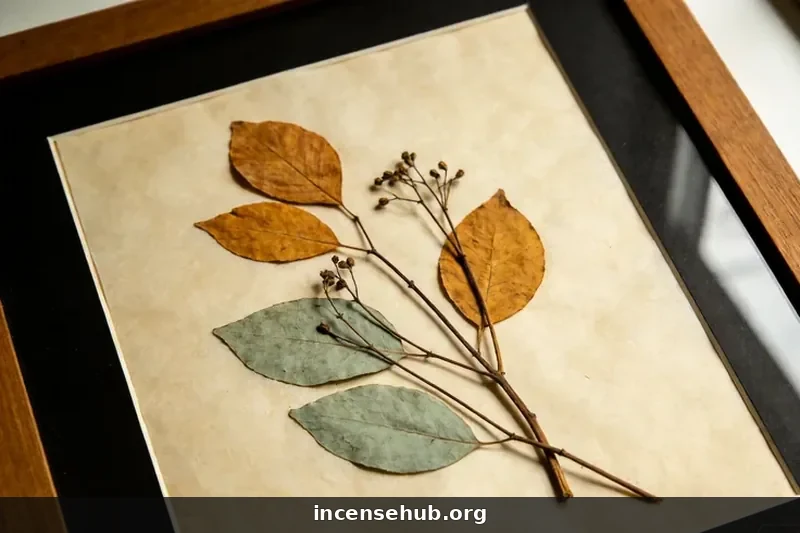
Direct answer: 香薷 (xiāngrú) is the dried leaf-and-flower top of Elsholtzia ciliata, an annual mint of East and Southeast Asia. Green and mint-like at the start, it turns spicy, faintly sweet, and cool. The classical tradition treats it as a 芳草 aromatic and the Ming 香乘 lists it; in a blend it lifts the opening, never the base.
Key facts
| What | Reading |
|---|---|
| Material | Aromatic leaf and flower top, dried |
| Identity | Elsholtzia ciliata, Lamiaceae |
| Aliases | 香柔, 香茸, 蜜蜂草 |
| Nose | Green, mint, spice, sweet trace, cool |
| Record | 芳草 herb; 香乘 aromatic; materia medica |
| Function | Lift at top or middle; no base |
| Test | Species name plus fresh aroma |
What the Name 香薷 Names
Direct answer: The Chinese name is a description before it is a label: it says the plant smells good and feels soft, and the old aliases repeat that judgment.
The Bencao Gangmu supplies the etymology. Its 草之三 section notes that 薷 was once written 葇, then explains: 其氣香,其葉柔,故以名之 — fragrant smell, soft leaf. The entry also lists 香柔, 香茸, and 蜜蜂草. The first two restate the same pair of impressions; the third, “honeybee herb,” adds the sweet-green note.
Li Shizhen’s editorial choice is the tell. He took the entry out of the vegetable section and placed it in 芳草. Classification is argument: a potherb is defined by the plate, while a fragrant herb is defined by its volatile character and its place in scent. The move asserts which identity comes first. It also explains why the plant can sit in both a kitchen and an incense vocabulary without belonging entirely to either.
At the bench, the names behave as expectation markers. “香薷” is the standard trade label. “香柔” or “蜜蜂草” signals an older name, not a different grade. None of them names a species, and none predicts a lot’s freshness. They describe what the tradition thought the plant should smell like; the binomial says which plant it is.
The Plant Behind the Name
Direct answer: Elsholtzia ciliata is a soft, erect annual of the mint family, and its botanical description is unusually concrete: height, leaf dimensions, flower size, and season are all on record.
The botanical entry is precise about size and season. A mature plant stands 30–50 cm. Its leaves run 3–9 cm long and 1–4 cm wide, ovate to elliptic-lanceolate, serrated, and pointed. Purple flowers, each corolla about 4.5 mm, crowd into spikes of 2–7 cm. The nutlets are yellow-brown. Bloom begins in July and continues through October; fruit can persist into January.
Those details do more than fill a description. Height and leaf size tell a gatherer what the plant looks like in a mixed stand. The flower spike is the part that signals the harvest window, since the useful material includes the flowering top. The season tells a buyer when a lot should have been taken, which is a check on a seller’s claim of freshness.
The genus holds more than one species. E. ciliata is the common one; E. splendens is also gathered for aromatic oil. A genus label is broader than a species label, and the gap matters: “Elsholtzia” identifies a group, while “E. ciliata” identifies the plant most lots are expected to contain.
The plant’s softness is not incidental either. It is an annual herb with little woody tissue, which is why the material dries quickly, crumbles easily, and loses its scent faster than a wood or resin. The botany and the handling instructions are the same fact seen from two angles.
A Life Cycle of One Season
Direct answer: The annual habit explains the herb’s brightness and its short shelf life better than any marketing claim about quality.
A tree or a resinous heartwood accumulates aromatic compounds slowly and holds them for years. A soft annual does the opposite: it grows, flowers, sets seed, and dies within a season. Its aromatic investment is in light, mobile leaf oils rather than dense, stable resin. That allocation is why the dried herb smells vivid and immediate, and why it does not improve with age.
The sequence from field to bench follows the plant’s structure: one season of growth → oils concentrated in leaf and flower tissue → harvest of the aerial parts → drying removes water but also begins the loss of volatiles → storage continues that loss at a slower rate. The herb is at its most expressive shortly after a good drying, and it declines from there. A buyer who treats it like a wood, expecting a vintage to improve, has the model backwards.
This is also why the material is a top note by nature rather than by convention. Light oils leave early when warmed. The green flash at the opening is the chemistry of a leaf, not a stylistic choice by the blender. A formula can support that flash or waste it, but it cannot turn the herb into a base.
The Range and What It Means for Supply
Direct answer: The species covers a huge stretch of East and Southeast Asia, which makes it available and variable at the same time.
Qinghai and Xinjiang are the only Chinese provinces that Flora of China leaves out. Elsewhere the plant appears from sea level up to 3,400 m, on disturbed ground: hills, waste lots, sunny terraces, riverbanks, forest edges. Its Asian range extends through Cambodia, India, Japan, Laos, Malaysia, Mongolia, Myanmar, Russia, Thailand, and Vietnam; Europe and North America host introduced populations.
Two commercial facts follow. The first is that this is not a scarce material. It is widely gathered, it regenerates from seed, and it has no rarity tier that would justify a premium. The second is that a plant with that range cannot produce one uniform note. Altitude, sun, soil, rainfall, and the weather during drying all shape the volatile profile, so two genuine lots can differ noticeably.
A buyer’s response should be procedural rather than romantic. Name the species, smell the lot, keep a sample of a good batch, and accept that the next batch will drift. A supplier who can name the gathering region and the season is giving useful information. A supplier who offers only “premium” or “wild” is giving a mood, not a specification.
Scent: Mint, Spice, and a Cool Edge
Direct answer: The first impression is green and mint-adjacent, then a spice note and a faint sweetness, with a cool lift that recalls camphor without being camphor.
The mint comparison is useful but imperfect. Peppermint is sharply cooling and simple; 香薷 is cooler at the edges and warmer in the body, with an herbal weight that mint lacks. Perilla is the closer relative in texture: both have a green, slightly spicy presence, but perilla turns toward anise and shiso while elsholtzia stays green. The herb occupies the space between them without being a weaker version of either.
“Camphor-adjacent” is a sensory phrase, and the boundary matters. It points to the cool, penetrating lift shared by camphor, borneol, and several mint-family oils. It does not mean the herb contains camphor, and it does not make the herb a substitute for camphor or borneol. Those are distinct materials with their own intensity and handling. Elsholtzia borrows the cool register, not the identity.
Temperature changes the reading. Cold, the dried leaf smells grassy and a little flat; warmed, the mint and spice rise; overheated, the green turns hay-like and then acrid. That is why a cold sniff is a poor test and a warm one is a good test. The herb is telling you what it will do in a burn, and it only speaks when the volatiles are moving.
Three Greens That Share a Register
Direct answer: 香薷, 藿香, and 紫苏 are different genera with overlapping green notes, and a fourth, mint, is the sharp reference point they are often measured against.
| Herb | Species | What the nose finds | Where confusion starts |
|---|---|---|---|
| 香薷 | Elsholtzia ciliata | Mint, herb, spice, sweet trace | Reduced to “mint-family herb” |
| 藿香 | Agastache rugosa | Mint with an anise roundness | Sometimes traded under other names |
| 紫苏 | Perilla frutescens | Anise, shiso, green | Treated as kitchen herb only |
| 薄荷 | Mentha species | Sharp, simple coolness | Used as a universal green |
The table is a disambiguation aid, not a league table. All four are Lamiaceae and all four can lift a blend, but they are not interchangeable. Replace elsholtzia with agastache and the opening gains an anise softness. Replace it with mint and the blend becomes colder and less complex. Replace it with perilla and a shiso edge appears. Each swap changes the design, which is why “a green herb” is not a usable specification.
The family relationship is the trap. A label reading “mint-family aromatic” has named a botanical neighborhood. A label reading “fragrant herb” has named a category. Only the species names the material. The companion entries for agastache, perilla, and mint make the same point for their own plants.
A quieter confusion is worth naming: the assumption that a culinary herb is the same material in an incense context. Perilla in a kitchen and perilla in a blend may be the same species, but the cut, grade, and freshness are different. The name travels; the specification does not.
Where It Sits in a Formula
Direct answer: In a 合香 blend, elsholtzia is an assistant or guide material — a green lift at the top or middle, never the chief that defines the scent.
The mechanism is a volatility sort. Its oils are light → they release early when the blend is warmed → the opening reads green, fresh, and slightly spicy → as those fractions spend, the heavier woods and resins become audible → the blend settles into its middle and base. That is what “top note” means in practice: a structural position determined by chemistry, not a rank of importance.
In the 君臣佐使 framework, the chief carries the main character, the minister supports it, the assistant rounds or corrects, and the guide harmonizes and directs. Elsholtzia fits the assistant or guide seat. Give it the chief’s seat and the blend turns green and thin, because a leaf lacks the density to sustain a base. The role is real work, but it is supporting work.
Dose is the other half. A small amount opens the blend; too much turns it medicinal and crowds the woods it was meant to lift. No fixed number belongs here, because the right dose depends on the formula and on the lot’s strength. The judgment is sensory: add, warm, smell, and stop when the green sits over the blend rather than in front of it.
The wider architecture is set out in the blending system. Read against that structure, the herb’s position is easier to see than in isolation.
Drying, and the Fight Against Loss
Direct answer: Processing for 香薷 is drying, not tapping or distilling, and the quality question is how much of the volatile note survives it.
The sequence from harvest to shelf is a controlled loss: aerial parts are gathered → moisture is reduced gently, away from harsh heat → the tissue stabilizes and enzymatic change slows → some volatile oil is retained, some escapes → the remainder is what the buyer later warms and smells. Every stage can go wrong in the same direction. Sun-drying on hot ground, fast mechanical heat, or a damp store all push the light fractions out and leave a hay-like residue.
Whole herb holds its note longer than cut or powdered material because less surface is exposed. Grinding is a preparation for use, not a storage strategy. A buyer who orders powder for a blend that will run for months has shortened the herb’s life before the first burn. That is a handling decision, not a grade difference.
The contrast with other incense materials is sharp. Resins are tapped and hardened; woods are aged; both are graded by density, resin content, or oil. Elsholtzia has none of those structures. It is a dried leaf, and its technology is preservation rather than transformation. The broader sequence is described in how incense is made.
Judging a Lot: Freshness Over Grade
Direct answer: No official grade ladder exists for 香薷. The working specification is a named species plus a fresh aroma, and the decisive test is gentle warmth.
| Check | A sound lot | A tired lot |
|---|---|---|
| Cold smell | Green, minty, lightly spicy | Dusty, hay-like, closed |
| Warmed smell | Mint and spice with a sweet edge | Flat, musty, or acrid |
| Leaf | Whole, crisp, clean | Brittle, shattered, dusty |
| Stem fraction | Low | High — stems carry little oil |
| Color | Green to grey-green | Brown or unevenly faded |
| Storage history | Sealed, cool, dark | Warm shelf, open bag |
The table is a set of observations, not a certificate. A lot can look right and still be flat, which is why the nose decides. Warm a pinch in the palm or over a gentle heat source, wait a few seconds, and smell. Mint, herb, spice, and a sweet trace mean the material is alive. Hay means the volatile fraction is gone, and no blending skill will bring it back.
Species clarity is the other half. A bag labeled 香薷 that holds agastache or a generic mint may smell green and pleasant, but it is not the material the formula calls for. The remedy is a species name on the lot, not a higher price. Price is a weak signal for a common herb; a premium label on an annual usually describes the packaging.
This page takes an editorial position here: buy 香薷 as a freshness specification, not as a static grade. “Premium,” “grade A,” and “selected” are tier words. The variable that decides quality is time and storage, and no tier name captures either.
Whole, Cut, or Powdered
Direct answer: The herb reaches buyers in three physical states, and the right one follows the method and the storage window rather than a hierarchy of quality.
| Form | Where it fits | What it costs |
|---|---|---|
| Whole dried herb | Stock; grinding as needed | Bulky, slow to release |
| Cut herb | General blending | More surface, faster fade |
| Powder | Batches used quickly | Fastest release, shortest life |
Whole, cut, and ground are the same leaf at different particle sizes. Particle size controls how fast the volatiles escape: coarse material gives a slower, more gradual read; fine powder gives an immediate green lift and then declines. Neither is inherently better. The form should match the method and the time between purchase and use.
For small-scale blending, cut herb is the practical middle. It measures easily, disperses evenly, and keeps longer than powder. Whole herb suits a buyer who wants to hold stock and grind small amounts. Powder suits a blend that will be consumed within a short window, or a format where uniform dispersion matters more than longevity.
Classical practice uses the dried herb, not a distilled oil or a resin. That distinction matters in a modern market that sells oils and extracts under the same plant name. An essential oil is a different material with a different intensity and safety profile; it is not a stronger version of the dried herb in a blend. This page is about the dried aerial herb.
Following the Note Through a Burn
Direct answer: Elsholtzia behaves as a classic top note — a quick green opening that is mostly gone by the time the middle arrives — and the format changes only the timing.
The burn is a volatility sort. The lightest molecules leave first → the green, minty, spicy impression dominates the opening → the middle-weight materials come forward as the top spends → the heavy woods and resins remain at the end. A material’s place in that sequence is set by chemistry, not by the blender’s intent. Elsholtzia sits at the front because its oils are light.
Format modifies the speed. Loose powder or a heap on a heater releases fast and gives a short flash. A pressed stick or cone slows the release through binder and density, stretching the note but also muddying it. A coarse cut on a warm plate reads slower and cleaner than powder, though still front-loaded.
That is why “how much” and “in what form” are separate questions. A bright opening calls for a small amount of cut herb near the top of the formula. A green that persists into the middle cannot be achieved by adding more of the same material; something heavier must carry the impression forward, or the green must be reintroduced at a later stage. Chemistry sets the ceiling, and format decides how quickly it is reached.
What the Texts Say, and What They Do Not
Direct answer: The species, its family placement, the name entry, and the 香乘 listing can all be checked. The medicinal applications belong to tradition, not to established clinical evidence.
The distinction separates what a reader can verify from what a reader is asked to accept. Elsholtzia ciliata is recorded by Flora of China and GBIF. The name and its etymology appear in the Bencao Gangmu. The aromatic listing appears in the Ming 香乘. Those are botanical and historical facts with sources. What the herb was used for in traditional practice is a different kind of statement: recorded tradition, properly labeled traditional belief, not proof of effect.
The same line applies to scent language. “Minty, herbal, spicy, slightly sweet” is a sensory description, not a chemical assay. “Camphor-adjacent” is a comparison, not a claim that the plant contains camphor. A reader who wants chemistry can consult volatile-oil studies of the genus; a reader who wants a medical recommendation will not find one here.
Safety belongs in the same register. Burning any plant material produces smoke and fine particles, and those are not harmless. Ventilation, quantity, and duration all matter. The aromatic use of 香薷 is a scent practice, not a therapeutic protocol, and the traditional framing should not be read as a modern clinical claim.
A Buyer’s Five Checks
Direct answer: Five questions cover most of the risk: which species, how it smells warm, what condition the leaf is in, which form suits the method, and how the lot has been stored.
- Which species? A binomial — Elsholtzia ciliata or a named relative. A family name is a neighborhood, not an address.
- How does it smell warm? Green, minty, spicy, sweet. Hay, dust, or acrid notes are grounds to walk away.
- What condition is the leaf in? Whole and crisp beats shattered and dusty. Stem-heavy lots carry less oil.
- Which form? Whole for stock, cut for blending, powder only for a batch headed for quick use.
- How was it stored? A recent pack date plus sealed, cool, dark storage outperforms any grade word.
The list is short on purpose. A longer one invites the belief that paperwork can replace the nose. The herb is cheap enough that a trial ounce is the cheapest insurance: warm it, smell it, then decide on a larger lot.
For a blender working across lots, keep a sealed sample of a good batch. It gives the nose a fixed point and turns “this smells right” into a comparison.
Naming, Substitution, and the Label
Direct answer: The main sourcing risk is naming rather than adulteration: several mint-family greens share the register, and a label that stops at the family has not identified the material.
A label narrows in steps. “Aromatic herb” names a category. “Mint-family herb” names a family. “香薷” names a Chinese drug name that may cover one species or several. Only “Elsholtzia ciliata” names the plant. Each step reduces ambiguity, and each step is a place where a seller can stop and leave the buyer with less than they think.
Substitution follows from the same gap. A blender who cannot get elsholtzia may reach for agastache, perilla, or mint. Each produces a different result: agastache adds anise roundness, perilla a shiso edge, mint a sharp simplicity. None is a failure, but none is a drop-in replacement. The swap should be recorded in the formula rather than hidden under the same name.
The confusion can look like sophistication. A label crowded with Chinese aliases may seem more authentic than a bare binomial, yet the aliases are historical synonyms, not guarantees of identity. The species name is the least poetic part of the label and the most useful.
An Editorial View: Why Freshness Outranks Origin
Direct answer: For this herb, freshness matters more than origin, and a buyer who applies agarwood or sandalwood logic will misjudge the material.
My view, labeled as editorial: the supply chain works against the note. The crop is gathered, dried, and moved through general herb channels; every month in a warm warehouse costs volatile oil; and the buyer at the end has no instrument except the nose. In that setting, origin stories and rarity language are distractions. The useful questions are how recently the herb was dried, how it has been stored, and whether the species is named.
The contrast with premium woods is sharp. Agarwood and sandalwood carry origin premiums because their aromatic deposits are dense, stable, and slow to form. A region can produce a recognizably different material, and age can improve it. A soft annual mint has none of those properties. Its note peaks near drying and declines from there. Paying extra for “wild” or “rare” 香薷 is paying for a story the plant cannot support.
The practical rule is to buy small, buy recent, and buy by aroma. A cheap lot that still smells green beats an expensive lot that smells like hay. That is not a compromise on quality; it is the correct definition of quality for a perishable leaf.
The Three-Minute Test
Direct answer: The whole judgment takes about three minutes — look, rub, warm, smell — and the storage rule is cool, dark, dry, and sealed.
Start with the eyes. Whole leaves, a green-to-grey-green color, and a low stem fraction suggest careful drying and recent packing. Brittle, shattered leaves and a dusty bag suggest handling loss. Brown, uniform color suggests age or heat. None of these is decisive, but each narrows the field before the nose works.
Then the hands. Rub a leaf between the fingers. A fresh, well-dried herb releases a little oil and leaves a green, spicy trace; a spent herb feels papery and gives almost nothing. The rub also warms the tissue slightly and starts the release.
Then the nose, with gentle heat. Warm a pinch in the palm, over a radiator, or on a warm plate — never over a flame. The note should rise as mint, herb, spice, and a faint sweetness. Hay or dust means stop. Sharp acrid notes suggest the sample was overheated during drying.
Storage follows the same chemistry. Heat, light, and moving air accelerate oxidation, so the container should be airtight, opaque or kept in the dark, and stored cool. Buy only what will be used within a season or two. No published shelf life exists for dried 香薷, which is itself a reason to treat it as perishable. A jar at the back of a warm shelf is a slow way of discarding the herb.
Drift Between Lots, and How to Record It
Direct answer: A wild-gathered annual from a wide range will not deliver a uniform note, and the buyer’s job is to manage drift rather than reject it.
The plant grows from sea level to 3,400 m across a dozen countries, on sites that differ in sun, soil, rainfall, and drying weather. Its volatile profile responds to all of it. A cool, high-site lot and a warm lowland lot can both be genuine E. ciliata and still smell different: one greener and sharper, the other rounder and sweeter. Neither is wrong.
The chain is simple: site and season shape the plant’s oil profile → harvest brings that profile into the drying shed → drying conditions decide how much survives → the lot that reaches the buyer is a snapshot of one place and one year. Because the plant is gathered rather than bred to a standard, the snapshot changes.
The practical response is a lot record. Note the species, supplier, pack date, form, cold and warmed aroma, the dose used in a test, and the result. Keep a sealed sample. The record turns memory into evidence and makes the next purchase a comparison. Without it, drift still happens, but no one can see it; the blend simply becomes less itself with each resupply.
Region is not a guarantee of quality here, but it is a clue about the kind of variation to expect. A supplier who can name the gathering area and season is offering information that predicts something. A supplier who offers only a grade word is offering nothing.
Layering Greens Without Mud
Direct answer: Several green materials in one blend can produce a muddy, indeterminate green, so the discipline is to let one lead and keep the others at a distance.
The problem is overlap. Elsholtzia, agastache, perilla, and mint all occupy the fresh-herbal register. Stacking them does not add four distinct notes; it adds four similar ones that blur. The nose cannot separate them when they arrive together at the same intensity.
The fix is structural. Give one green the lead and assign the others a different job — a lift at the very top, a touch in the middle, a contrast against a sweet material — so they are separated by time or function rather than piled into the same opening. If two greens must sit close, make one clearly subordinate, a small fraction that rounds the lead rather than competing with it.
A simple test is to smell the blend and name the green. If the answer is “green” rather than “minty-spicy 香薷 with a hint of anise,” the layers have merged and the design has lost information. The target is not maximum green; it is a green with a shape.
Sustainability and the Trade Route
Direct answer: 香薷 is a widespread, fast-growing annual, so the sustainability question is local and modest rather than a species-level crisis.
The plant colonizes disturbed ground across a huge range, from sea level to 3,400 m. An annual that regenerates from seed within a season does not carry the extraction pressure of an old-growth wood or a slow-growing resin tree. The stewardship concern, where it exists, is local: a particular gathering area can be over-harvested if demand concentrates there.
Trade routing adds a different risk. The herb moves through general herb and materia-medica channels rather than a dedicated incense supply chain, so lots are identified by a Chinese drug name and a grade word rather than by species and harvest date. That routing keeps the material cheap and available; it also means the buyer’s own checks carry most of the quality assurance.
The honest summary is that this is a low-risk material with a low-cost supply chain, and the buyer’s attention belongs on freshness rather than scarcity. A seller who frames a common annual as a rare harvest is describing a market position, not a botanical fact.
The Wider Mint Family
Direct answer: Elsholtzia belongs to the same botanical family as basil, thyme, oregano, rosemary, sage, lavender, and the mints, and that family resemblance explains both why its scent feels familiar and why it cannot be replaced by a kitchen herb.
Lamiaceae is a large family with a shared chemical toolkit: aromatic leaves, glandular hairs, and volatile oils built mainly from terpenoid compounds. The family’s members express that toolkit in different balances. Basil leans sweet and clove-like; thyme is dry and phenolic; rosemary is resinous and pine-adjacent; lavender is floral; peppermint is sharp and cooling. Elsholtzia’s balance is greener and more spicy than most, with a sweetness that keeps it from reading medicinal.
That shared toolkit is why a cook can recognize the herb’s family at once. The leaf, the glandular texture, the quick aromatic release when rubbed — all are familiar. The recognition is useful, but it can mislead. A familiar family does not make a drop-in substitute. Basil in a blend would add a sweet, clove-like note; thyme would add a dry, savory one; rosemary would add a resinous, piney weight. None of them is elsholtzia.
The practical value of the comparison is calibration. If a blend needs a green, mint-adjacent lift with a spice edge and a short life, elsholtzia is the material. If it needs a durable herbal base, another family member or a different material altogether is the better choice. Knowing the family helps a blender describe what is missing; it does not license a swap.
Green Notes in Other Traditions
Direct answer: The green register is not unique to Chinese incense, and placing elsholtzia beside patchouli, vetiver, galbanum, oakmoss, and clary sage shows what kind of green it is — fresh, brief, and top-weighted.
Western perfumery uses “green” for a wide band of materials. Galbanum is sharp and sappy, almost bitter. Oakmoss is forest-floor and persistent. Patchouli is earthy and heavy, more base than top. Vetiver is dry, rooty, and long. Clary sage is herbal and softly floral. Each occupies a different part of the register, and each behaves differently in a burn or a blend.
Elsholtzia sits at the fresh, brief end of that band. Its green is leafy rather than sappy, mint-adjacent rather than bitter, and short-lived rather than persistent. That profile makes it a brightener for a blend that has become dense or dark, not a foundation. A perfumer would call it a top note with high diffusion and low tenacity; an incense maker can simply say it opens the room and then steps back.
The comparison also clarifies what the herb is not. It is not a moss, not a resin, not a root. It has no fixative power and no aged depth. Those absences are not defects; they are the shape of the material. A blender who wants a green that lasts has to look elsewhere or build the persistence from other materials.
A Note on the Genus Name
Direct answer: The Latin binomial is an identification tool, not an aroma description: Elsholtzia names the genus, and ciliata points to a physical feature of the leaf.
The genus commemorates Johann Sigismund Elsholtz, a seventeenth-century Prussian physician and botanist whose name was Latinized in the botanical convention of the period. The species epithet ciliata refers to the fine marginal hairs — cilia — on the leaves. Neither part of the name says anything about scent, grade, or origin. The name answers “which plant,” and the nose answers “which lot.”
That division of labor is worth keeping straight in a purchase. A correct binomial on a bag is a starting point, not a quality claim. It tells you the seller is naming a species rather than a category. It does not tell you when the herb was dried, how it was stored, or whether the volatile note survived. Those questions belong to the sample, not the label.
Dried Herb or Essential Oil?
Direct answer: The dried herb and the distilled oil are different materials with different strengths, storage lives, and safety profiles, and the classical incense use is the herb.
| Dried aerial herb | Essential oil | |
|---|---|---|
| What it is | Leaf and flowering top | Concentrated distillate |
| Dose | A pinch, by eye | Drops, by measure |
| Release | Gradual, short-lived | Immediate, intense |
| Storage | Sealed, cool, use within seasons | Sealed, dark, longer-lived |
| Role in a blend | Direct aromatic material | Scenting agent, not a burned classical form |
| Handling | Low risk as a dried plant | Concentrated; needs dilution and care |
A distilled oil is not a stronger version of the leaf. Distillation concentrates a fraction of the plant’s volatiles and leaves others behind, so the oil’s profile differs from the herb’s. It also behaves differently: a drop on a surface is far more intense than a pinch of leaf, and the intensity is easy to misjudge. For incense work, the dried herb is the traditional material and the one this page describes.
The oil has legitimate uses in perfumery and scenting, where a measured dilution is normal practice. Those uses sit outside the classical incense method, and they should not be treated as interchangeable with it. A buyer who wants the herb’s green, leafy opening should buy the herb, not a bottle that promises the same plant in concentrated form.
How a Lot Fails
Direct answer: Most disappointing 香薷 fails in one of four ways: heat damage during drying, oxidation in storage, moisture and mold, or a lot that was mostly stem and dust.
Heat damage is the fastest failure. Drying too close to a strong heat source drives off the light fractions and leaves a hay-like, sometimes acrid smell. The leaf may still look green, which is why appearance alone is unreliable. The warmed aroma is the tell.
Oxidation is slower and quieter. Sealed or not, the oils react with oxygen over time; the green note fades, the spice flattens, and the herb begins to smell like old tea. A lot that was vivid a year ago can be papery now without any visible change.
Moisture is the dangerous one. Damp herb can grow mold, and mold is not a note to blend around. A musty, cellar-like smell, clumping, or visible fuzz means discard, not salvage. Storage in a sealed container with a desiccant, away from a damp wall, prevents most of it.
The fourth failure is dilution by stem and dust. Stems carry little oil, and dust is mostly broken leaf that has already lost its volatiles. A lot with a high stem fraction and a dusty bag is not fraudulent; it is simply lower grade in a material that has no official grades. Sieving and hand-sorting can improve it, but the oil that left cannot be restored.
What the Scent Pyramid Gets Wrong
Direct answer: The top-middle-base pyramid is a teaching model, not a law of nature, and a single herb rarely respects the boundaries it draws.
Perfumery uses the pyramid to explain how a composition unfolds: bright volatile materials at the top, rounded heart notes in the middle, heavy persistent materials at the base. The model is useful for conversation and misleading as a description. Real materials sit on a continuum of evaporation rates, and many straddle two layers. A citrus oil is top-weighted but can carry sweetness into the heart; a resin is base-weighted but may open with a sharp note.
Elsholtzia is a case in point. Its minty-green opening is unmistakably top, yet the spice and faint sweetness give it a middle-note body that a pure top material lacks. In a warm burn, the green flashes first and the spicy-sweet trace lingers briefly behind it. Calling the herb “a top note” is shorthand for that behavior, not a claim that it disappears in seconds.
Heat changes the timeline. A perfume on skin warms slowly and unevenly; incense in a censer is a continuous, controlled heat source. The pyramid becomes a schedule rather than a stack: what arrives first, what arrives next, what remains. That is why a blend can smell balanced on paper and collapse in the burner, or seem simple at the start and deepen halfway through.
The practical lesson is to judge a blend across its whole burn, not from the first minute. A top note that vanishes is doing its job if the middle that follows is coherent. A top note that hangs around too long is usually a sign that something heavier was used to prop it up.
Questions to Put to a Supplier
Direct answer: Five questions separate a described lot from a known one, and none of them requires the supplier to use technical language.
Ask what species the lot is. A reply of “Elsholtzia ciliata” is an identification; a reply of “mint-family herb” is a category. Ask when it was dried. A season and a year are useful; “recent” is not. Ask how it was dried. Shade or low heat preserves the green note; fast high heat explains a hay smell. Ask how it has been stored. A sealed, cool, dark history is the difference between a live lot and a tired one.
The fifth question is the sample. A small bag sent before a bulk order answers more than any description: the nose can check the species, the freshness, and the stem fraction in a few minutes. A supplier who resists a sample is telling you something about their confidence in the lot.
None of these questions is adversarial. A good supplier answers them easily because the answers are part of their own quality control. A vague answer is not proof of a bad lot, but it shifts the burden of verification onto the buyer, and that is worth knowing before money changes hands.
One more question is worth asking: whether the lot is a single harvest or a blend of leftovers. A blended lot can smell fine and still vary from bag to bag, because the proportions shift. A single-harvest lot is easier to document and easier to compare against a reference sample. Neither is automatically better, but the answer tells a buyer what kind of consistency to expect.
Three Misreadings Worth Correcting
Direct answer: A top note is not a minor ingredient, a common herb is not a poor one, and a camphor-like lift does not mean the plant contains camphor.
The first misreading confuses position with importance. A top note is the part of a composition that greets the nose; without it, a blend can feel closed or heavy. The role is structural, and a material that performs it well is doing work the base cannot do. Status in a formula is not a measure of value.
The second confuses availability with quality. A widely gathered annual can be excellent when it is fresh and correctly named, and a scarce material can be poor when it is stale. Rarity is a supply fact, not a sensory one. For this herb, the useful hierarchy runs freshness first, identity second, and price a distant third.
The third confuses resemblance with composition. “Camphor-adjacent” describes a cool, penetrating quality the nose recognizes; it does not assert a chemical ingredient. Camphor and borneol are separate materials with their own intensity. A taster who expects their punch will misread the herb’s gentler green lift.
FAQ
Q: What plant is 香薷?
It is the dried above-ground herb of Elsholtzia ciliata, an annual in the mint family. The flora account puts the plant at 30–50 cm, with leaves 3–9 cm by 1–4 cm, purple corollas near 4.5 mm in spikes 2–7 cm, and bloom from July to October. Its range covers much of East and Southeast Asia, and classical sources treat it as a fragrant herb.
Q: What does elsholtzia smell like?
Green and mint-adjacent at first, then spicy and faintly sweet, with a cool lift often called camphor-like. It is softer and warmer than peppermint and less anise-leaning than perilla. In a blend it reads as a clean green top note that freshens the opening rather than leading the scent. The impression is strongest when the herb is gently warmed.
Q: Is elsholtzia the same as agastache, perilla, or mint?
No. They are all Lamiaceae, but they are different genera with different notes. 香薷 is minty-spicy with a sweet trace; 藿香 is minty-anise; 紫苏 leans anise and shiso; 薄荷 is sharply cooling. The overlap in the green register is exactly why a species name, not a family name, belongs on the label.
Q: Does 香薷 appear in the classical incense record?
The record has two layers. The Bencao Gangmu, in 草之三, enters 香薷 with the aliases 香柔, 香茸, and 蜜蜂草, and gives the etymology “fragrant smell, soft leaves.” The Ming 香乘 lists it among aromatics. Neither source makes it a base material; the documented role is aromatic.
Q: Is a higher price a sign of better 香薷?
Price is a poor guide here. The herb is common and widely gathered, and no official grading ladder exists. What a high price often buys is packaging, a scarcity story, or a particular sales channel, not a better volatile profile. Judge by a named species, a recent pack date, and the smell of a warmed pinch.
Summary
A soft annual leaf, bought for freshness rather than prestige. Its green, mint-and-spice opening belongs at the top of a blend, where it lifts heavier material and then recedes. The classical record supports the aromatic role; it does not support a medical one. Buy by species and by nose, store it cool and sealed, and expect each lot to differ.
Sources
Notes: botanical facts from Flora of China and GBIF; name, classification, and aromatic listing from the Bencao Gangmu and the Xiangcheng. Aromatic use is documented; medicinal use is traditional, not clinical evidence. Incense smoke carries fine particles — ventilate. Editorial reference, not medical advice.
Related Resources
- Agastache Rugosa — minty-anise green.
- Perilla — anise-leaning relative.
- Mint — the cool reference.
- How Incense Is Made — production context.
- Scent Guide — aroma-family map.