
Key facts
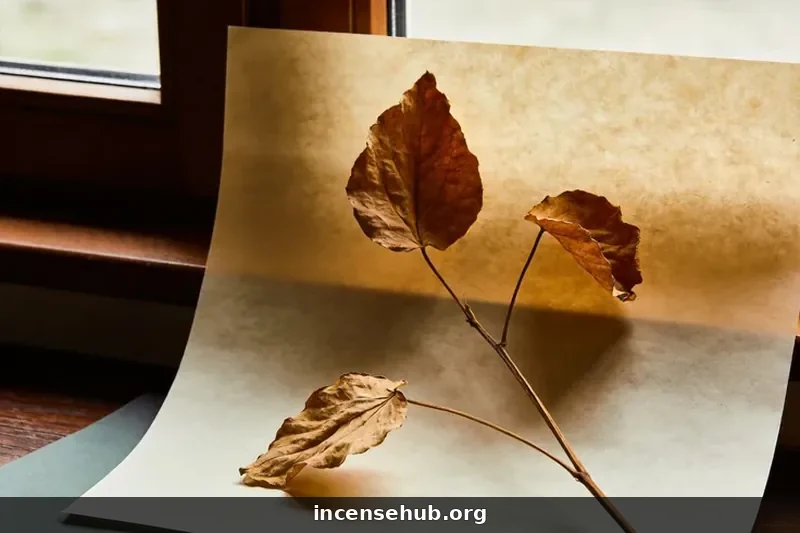
Direct answer: Eupatorium is the dried aerial herb of Eupatorium fortunei, a daisy-family perennial whose Chinese name 佩兰 (pèilán) means “worn orchid” and whose traditional role was scenting sachets and garments rather than burning as a heavy incense.
| Chinese | 佩兰 (pèilán), literally “worn orchid” |
| Botanical source | Eupatorium fortunei (Asteraceae, tribe Eupatorieae) — the aerial herb |
| Material type | A dried fragrant herb, not a wood, resin, or seed |
| Aroma register | Herbal, green, softly sweet, freshly cut-leaf |
| Traditional role | Sachet and clothing scent (佩 / 香囊 xiāngnáng), materia medica |
What eupatorium is
Direct answer: Eupatorium (佩兰, pèilán) is the whole above-ground herb — leaves plus stems — of Eupatorium fortunei, gathered and dried. It belongs to the daisy family, not to the orchid family its Chinese name suggests, and it functions in fragrance as a light, leafy, fresh “green” accent.
A working definition hinges on three separate ideas that people often collapse into one. First, the material is the aerial part of the plant: what gets harvested and dried is the stem-and-leaf mass, never a root, trunk, resin, or seed. Second, the family is Asteraceae — the sunflower-and-daisy clan — which places the herb among leafy aromatics rather than among the woods and gums that dominate incense trade catalogues. Third, the name 佩兰 is a cultural label, not a taxonomic one, and it points to a wearing-and-scenting practice that predates any modern perfumery vocabulary.
The plant reads as a green aromatic in the classical Chinese roster of scented herbs (香草). It shares that bracket with mugwort (艾) and agastache (藿香), two other leafy herbs that lift and brighten a formula. A reader who expects a floral, woody, or resinous character will miss what eupatorium actually does: it supplies a clean, freshly cut-grass note that freshens whatever surrounds it.
Botanical identity
Direct answer: Eupatorium fortunei is a herbaceous perennial recorded by Flora of China at 40–100 cm in height, with procumbent reddish-brown rhizomes, erect green to reddish-purple stems, and median leaves split into three segments; its small capitula cluster in apical compound corymbs.
Flora of China gives the precise scaffold for identifying the living plant. The height range runs 40–100 cm. The rhizomes creep (procumbent) and are reddish-brown; the stems stand erect and vary green to reddish-purple. The median stem leaves are the diagnostic trait: they are 3-sect or 3-partite, with a large terminal lobe measuring 5–10 × 1.5–2.5 cm and margins that are coarsely or irregularly toothed. The tiny flower heads, or capitula, crowd into numerous compound corymbs at the shoot tips. See Eupatorium fortunei in Flora of China and Eupatorium fortunei on GBIF.
The Asteraceae placement carries practical weight. The daisy family is chemically varied, but Eupatorium fortunei sits inside tribe Eupatorieae, a lineage of aromatic herbs whose members are prized for leafy fragrance rather than for wood or resin. That tribal identity is one reason the material behaves as a green note: it is a herb in structure and in scent, and its value is the fresh leafy character that heavier incense ingredients cannot supply.
Chinese name and terminology
Direct answer: 佩兰 (pèilán) means “worn orchid” — 佩 (pèi, “to wear at the belt”) joined to 兰 (lán, “orchid”) — and it records a sachet-and-clothing practice, while the 兰 itself is a title of fragrance that does not imply botanical kinship with true orchids.
The two characters unpack cleanly. 佩 means “to wear” or “to carry at the waist,” and 兰 means “orchid.” Read together they describe an herb that people wore, which matches the historical use: the dried herb was packed into sachets and tied into clothing so its fragrance could diffuse against the body. Chinese fragrance culture applied 兰 broadly, bestowing the character on many sweet-smelling plants regardless of family, the way English once used “balsam” or “balm” loosely. Two naming cautions follow from that looseness:
- 佩兰 is not an orchid. The 兰 in the name is honorific, and the plant is an Asteraceae herb.
- 佩兰 is not 泽兰. 泽兰 is the same-genus Eupatorium japonicum, a separate aromatic species, and in classical materia medica the name 泽兰 often attached instead to the mint-family Lycopus lucidus. See eupatorium-japonicum (泽兰).
The naming trap, spelled out
Direct answer: The character 兰 (“orchid”) names many fragrant plants that are not orchids, so a label reading only “兰” or “泽兰” identifies a naming convention rather than a material; the scientific name Eupatorium fortunei is what actually pins the species down.
The 兰 trap is a recurring feature of Chinese aromatic nomenclature, and eupatorium sits at its center. One table lays the problem open:
| Name | Species | Family | Scent character |
|---|---|---|---|
| 佩兰 | Eupatorium fortunei | Asteraceae | Fresh, leafy, softly sweet |
| 泽兰 | Eupatorium japonicum | Asteraceae | Fresh, herbaceous, lightly aromatic |
| 泽兰 (classical materia medica) | Lycopus lucidus | Lamiaceae | A different, mint-family plant |
Two Eupatorium species share the 兰 word with each other, and the classical 泽兰 name attaches to a third plant in an entirely different family. A trader’s tag that says only “兰” or “泽兰” has narrowed nothing down; it has only invoked a convention. Pinning the binomial — Eupatorium fortunei — is the fix that resolves the whole tangle.
Where it grows and how it is supplied
Direct answer: Eupatorium fortunei is native to China, Japan, and Korea, favoring moist, open or semi-shaded ground; it enters trade through wild collection and small-scale cultivation within the herb and materia-medica supply chain rather than through a dedicated aromatic plantation industry.
The plant’s geography is temperate East Asia. It grows in damp, open, and semi-shaded situations across China, Japan, and Korea. That distribution places it firmly outside the tropical wood-and-resin economy that supplies sandalwood and agarwood; eupatorium moves instead through the everyday herb trade, alongside leafy materia-medica staples. A concrete consequence follows: lots are usually identified by their Chinese materia-medica name, not by any “incense grade,” and the herb rarely headlines a catalogue as a standalone aromatic.
For a sourcing buyer the takeaway is that eupatorium is a secondary ingredient whose availability rides on broader herb markets. Supply is diffuse, seasonally tied to the harvest, and split between wildcrafted and farm-grown material. The species is not a rare or costly item, so adulteration pressure is low — a point developed later — but correct identification still matters because the 兰/泽兰 confusion persists in the trade.
Aroma profile
Direct answer: Eupatorium smells fresh, leafy, and herbaceous, with a gentle sweetness and a clean lift — a “green” note nearer to a crushed aromatic leaf than to a flower or wood, and one that diffuses readily without burning.
The scent sits in the “green” register. Where mugwort reads camphoraceous and bitter, and agastache reads minty with a sweet-anise edge, eupatorium reads clean, mild, and softly sweet. It brightens a blend rather than dominating it, and in traditional use it scented sachets and clothes instead of burning as a lead note.
That mildness has a mechanical explanation worth naming. Light, volatile scent compounds with modest molecular weight escape the leaf surface at ordinary room temperature, which is exactly the property a sachet needs: light volatile molecules → ready room-temperature diffusion → a scent that releases without combustion → but rapid depletion of the same volatiles → a note that freshens rather than anchors. The same behaviour explains both the herb’s traditional job and its modest role in burned incense.
Why it is used in incense
Direct answer: Eupatorium enters incense as a light, fresh “green” accent that lifts spice- and wood-forward blends, and — more centrally in Chinese tradition — as a sachet and clothing fragrance whose job is to freshen a formula rather than to carry it.
The herb occupies a real but modest niche in Chinese fragrance practice. Two uses stand out:
- Incense (香): as a fresh leafy accent it lifts heavier spice and wood blends with a clean green brightness — a supporting note, never a base.
- Sachet and clothing scent (佩 / 香囊): the defining traditional role and the origin of the name. The herb was worn and packed into sachets to scent garments, a non-burning aromatic use.
Because the scent is light, eupatorium is nearly always blended rather than burned alone. Singled out, it offers a faint green note that is easily lost against a stronger base; dosed as a top accent inside a blend, it earns its place.
Comparison: eupatorium vs agastache, mugwort, and artemisia
Direct answer: Eupatorium, agastache, and mugwort are three leafy “green” aromatics that are often confused, but they differ by family and character: eupatorium is softly sweet and Asteraceae; agastache (Agastache rugosa, 藿香) is minty-anise and Lamiaceae; mugwort (Artemisia spp., 艾) is camphoraceous-bitter and Asteraceae.
A buyer who lumps these three together will blend the wrong note into a formula. The differences are cleanly separable:
| Herb | Botanical source | Family | Aroma register |
|---|---|---|---|
| Eupatorium (佩兰) | Eupatorium fortunei | Asteraceae | Softly sweet, clean, leafy |
| Agastache (藿香) | Agastache rugosa | Lamiaceae | Minty, sweet-anise, aromatic |
| Mugwort (艾) | Artemisia argyi / A. vulgaris | Asteraceae | Camphoraceous, bitter, dry |
| Wormwood (苦艾) | Artemisia absinthium | Asteraceae | Strongly bitter, herbaceous, green |
The table shows the pattern: the “green herb” family is wide, and each member leans a different direction. Eupatorium is the gentlest of the set; agastache brings a mint-anise sweetness; mugwort and wormwood lean dry and bitter. Choosing among them is a question of what kind of green the formula needs — a soft lift, a minty brightness, or a dry bitter edge — and no single green herb substitutes for another without shifting that character. See the substitution cross-reference for the general disambiguation logic.
Chemistry of the green note
Direct answer: The “green” smell of leafy aromatic herbs is carried by small, volatile molecules — short-chain aldehydes and alcohols plus terpenes — whose low molecular weight lets them diffuse at room temperature and also makes them quick to fade, which is the chemical basis of eupatorium’s light, fresh accent.
The green register in perfumery has a recognizable chemistry. Freshly cut grass and crushed leaves release a cluster of small volatile compounds — short-chain unsaturated aldehydes and alcohols such as cis-3-hexenol (“leaf alcohol”) and hexanal, alongside monoterpenes and sesquiterpenes that round out the herbal body. These molecules are small enough to evaporate freely, which produces the immediate, airy freshness of a bruised leaf. [need-source]
The same molecular smallness is a two-edged property. Light molecules diffuse readily, so the note appears instantly and needs no flame to be perceived — the sachet mechanism again. But light molecules also dissipate quickly, so the note thins out fast once the source is exhausted. A formulator reading this sees the practical rule: small, volatile molecules → fast top-note release and rapid fade → use eupatorium as a brightener dosed early in the evaporation curve, never as a fixative. That is the chemistry behind the herb’s supporting role.
How it is processed
Direct answer: Eupatorium is processed by harvesting the aerial herb and drying it whole or cut; there is no distillation or extraction in herb form, and for incense blending it is then milled to powder, with particle size and moisture set by the formula.
The essential step is harvest-and-dry. The above-ground stems and leaves are cut and dried to a stable, storable state. From there the material branches by end use: whole or cut herb for sachets and traditional practice, or milled powder for incense blending. For powder, the same variables that govern any leafy herb apply: particle size and moisture shape how the material packs, combusts, and releases aroma, and the correct target depends on the binder, the other ingredients, and the production line. The grinding and forming mechanics sit within the wider how incense is made process, and leafy-herb powder behaviour is covered in incense powder & resin.
One nuance matters to a blender: drying is where the fresh “green” top note is partly lost and partly fixed. Over-drying can strip the volatile lift, while under-drying invites mould and mustiness in storage. A conscientious supplier dries the herb to a stable equilibrium moisture without baking away the very compounds that make it useful.
Storage and shelf life
Direct answer: Dried eupatorium is hygroscopic and light-sensitive; it should be stored cool, dry, and away from light in sealed containers, because its value sits in volatile top notes that heat, humidity, and oxygen steadily erode.
Leafy aromatics behave differently from resins and woods in storage. The herb is hygroscopic — it absorbs ambient moisture — and its aromatic payload is a set of volatile compounds that oxidize and evaporate over time. The practical storage rules follow directly:
- Dry and sealed — keep the material below a low equilibrium moisture to block mould, and seal it against moisture re-entry.
- Cool and dark — heat accelerates volatile loss and oxidation, and light bleaches the green colour that signals freshness.
- Smaller lots, faster turnover — because the top note fades, buyers are better served buying modest quantities frequently than a large lot that sits for years.
The shelf-life lesson is the mirror image of the incense lesson: the very volatility that makes the note fresh also makes it short-lived. A stale lot — browned, flat, musty — has already surrendered its lift, and no amount of blending will restore it.
Sourcing strategy and supply chain
Direct answer: Eupatorium is a low-cost, diffuse, herb-trade commodity, so the sourcing task is less about price and more about locking in a clean, correctly identified, fresh lot from a supplier who can name the species and the harvest season.
Because the material is inexpensive, the sourcing problem inverts the usual one. Nobody is cutting eupatorium with a costly substitute; the risks are instead identity and freshness. A sensible sourcing strategy has three parts:
- Pin the species. Require Eupatorium fortunei on the label, and reject lots described only as “兰” or “泽兰.”
- Pin the harvest. Ask for the harvest year or season; a current-season lot is fresher than one of unknown vintage.
- Pin the condition. Specify clean, green, intact herb with low stem and soil content, and request a sample before committing to volume.
The supply chain itself is short: wild collectors or small growers sell to regional herb wholesalers, who sort and re-sell to incense and materia-medica buyers. Traceability is typically thin — a lot may pass through several hands without a written chain of custody — which is why the buyer’s own inspection, not paperwork, is the real quality gate.
Economics of the herb
Direct answer: Eupatorium is a low-value, high-volume herb whose economics are dominated by harvest labour and drying, not rarity; its price is flat and its cost advantage comes from buying fresh, correctly identified material rather than chasing grade.
The economics are unglamorous and predictable. Eupatorium is abundant across East Asia, wildcrafted or cheaply cultivated, so scarcity pricing does not apply the way it does to agarwood or sandalwood. The cost of a lot is mostly labour — cutting, gathering, drying, and milling — plus freight. Prices are correspondingly flat, and the price spread between a good lot and a mediocre one is small.
The commercial implication is counterintuitive for a buyer trained on rare aromatics: paying a premium for “aged” or “special-grade” eupatorium is usually pointless, because the herb has no meaningful age ladder and no scarce high grade. Value comes from buying a fresh, clean, correctly identified lot at a fair commodity price and turning it over quickly, not from hunting a premium tier that does not really exist in this material.
Quality-control checklist
Direct answer: Dried eupatorium should be clean, green, and freshly herbaceous when crushed, with low stem, soil, and foreign-material content; for powder, particle-size distribution and moisture must be checked against the specific formula.
The practical quality checks, arranged as a working checklist rather than a narrative:
| Check | What to look for | Why it matters |
|---|---|---|
| Identity | Eupatorium fortunei named; no 泽兰 or “兰”-only label | Blocks the 兰/泽兰 mix-up |
| Colour | Clean green, not browned or faded | Green signals retained volatiles |
| Aroma | Fresh, leafy, softly sweet when rubbed | Staleness reads as flat or musty |
| Cleanliness | Low stem, soil, and foreign herb content | Debris dilutes the aromatic payload |
| Powder | Even particle-size distribution, correct moisture | Governs packing, burn, and scent release |
There is no standardized numerical grading for this herb, which is itself informative: it is a light, everyday aromatic judged by eye and nose, not by a certified ladder. A buyer who treats the checklist as a routine screen — identity, colour, aroma, cleanliness, powder — will catch nearly every defective lot before it reaches the blend.
Sensory-evaluation method
Direct answer: A workable sensory protocol for eupatorium is to rub a small portion between the palms, note the immediate top note and its tenacity, then compare a fresh reference against the candidate lot for colour, leaf texture, and the presence of any musty off-note.
Sensory evaluation of a leafy herb does not need a laboratory. A repeatable, low-tech method:
- Rub test — crush a pinch between the palms for a few seconds and smell immediately; the fresh “green” lift should appear at once.
- Tenacity check — smell again after a minute or two; a flat or fast-fading note signals an aged lot.
- Visual pass — compare colour and leaf texture against a known-fresh reference; browning, brittleness, or dustiness counts against the lot.
- Off-note screen — any musty, sour, or stale odour is disqualifying, because it indicates moisture damage or spoilage.
An organoleptic panel can formalize this with a simple scoring sheet — freshness, greenness, sweetness, and absence of off-notes — but a single careful buyer using the rub-and-sniff method already captures most of the signal that matters.
Buying decision framework
Direct answer: The buying decision for eupatorium reduces to four questions in order — is it the right species, is it fresh, is it clean, and does it fit the formula’s dose — with price a distant last because the material is cheap and the real losses are identity and staleness.
A compact decision sequence for a sourcing buyer:
- Species first. Confirm Eupatorium fortunei; if the seller cannot distinguish 佩兰 from 泽兰, walk away.
- Freshness second. Green colour and a lively rub-test aroma are the whole margin; a stale lot is worth little regardless of price.
- Cleanliness third. Reject lots with excess stem, soil, or foreign herb material.
- Dose last. Confirm the powder spec (particle size, moisture) matches the formula’s binder and burn behaviour.
The framework’s logic is that eupatorium is a supporting note, so its contribution is character, not intensity. A buyer who spends effort chasing a premium grade is optimizing the wrong variable; a buyer who nails identity and freshness gets the full value of a very inexpensive ingredient.
Adulteration and misidentification
Direct answer: Eupatorium is not a heavily faked aromatic the way agarwood is; its risk is naming — confusion with the same-genus 泽兰 and with the classical materia-medica 泽兰, which is a different, mint-family plant — and the scientific name on the label resolves both.
The herb’s low value spares it from the sophisticated adulteration that plagues expensive resins and woods. Its actual risk is a naming and identification matter: 佩兰 (Eupatorium fortunei) must be kept apart from 泽兰 (Eupatorium japonicum), and both must be kept apart from the classical materia-medica 泽兰, which modern botanists place as Lycopus lucidus, a Lamiaceae herb. Specifying the binomial — Eupatorium fortunei — is the practical fix, and it costs nothing.
A secondary, softer risk is freshness fraud: an old, browned lot sold as if it were current-season. This is not identity fraud in the taxonomic sense, but it is the same kind of quiet misrepresentation, and it is caught by the colour-and-rub screen rather than by any label.
Safety
Direct answer: Incense combustion produces smoke and particulate matter; burn in a well-ventilated space, avoid inhaling concentrated smoke, and keep the material away from children and pets.
This page is editorial knowledge content, not medical advice. The herb’s traditional uses are described as cultural and aromatic practice, and no clinical or therapeutic claim is made here. See the safety guide for the full combustion-safety framework.
What a buyer should verify
Direct answer: A buyer should confirm the species (Eupatorium fortunei, not the same-genus 泽兰 or the mint-family 泽兰) and then judge freshness by colour and aroma — clean, green, and freshly herbaceous when rubbed — because freshness is the entire margin on a light accent herb.
The verification list, in order of priority:
- Identity — Eupatorium fortunei (佩兰), not Eupatorium japonicum (泽兰) or the mint-family Lycopus lucidus.
- Freshness — clean green material with a lively scent when rubbed; a browned, flat herb has lost its lift.
- Condition — free of excess stem, soil, and foreign material.
- Role — a light green accent for blends and sachets, not a base or lead note.
Common mistakes
- Assuming 佩兰 is an orchid. The 兰 character is a fragrance title, not a family; 佩兰 is an Asteraceae herb.
- Confusing 佩兰 with 泽兰. They are distinct Eupatorium species, and the classical 泽兰 is a different mint-family plant.
- Burning it as a lead note. Eupatorium is a light green accent, easily lost alone.
- Ignoring freshness. A browned, stale herb has already surrendered its fresh, leafy lift.
- Paying for a “premium grade.” This herb has no meaningful age ladder or scarce high grade; value is freshness plus correct identity, not a premium tier.
What the author would flag
Direct answer: The misconception worth correcting is that a “兰”-named herb is an orchid — it is not, and treating the 兰 character as a family name misleads a buyer before any purchase is made.
Two editorial judgments stand out.
First, the name overpromises a family. 佩兰 sounds like an orchid, but it is Eupatorium fortunei, an Asteraceae herb. The myth to correct is that the 兰 character implies an orchid; in Chinese fragrant-herb culture, 兰 is a title of honour applied to many non-orchid plants. A buyer who hears “orchid” and expects a floral note will be misled at the very first step.
Second, the boundary is species, not register. 佩兰 and 泽兰 both read as fresh green herbs, but they are different species — and the classical 泽兰 is yet another, mint-family plant. Unless the binomial is pinned down, “泽兰” names a convention, not a material, and no amount of sensory skill fixes an unidentified lot.
The author’s view, not a verified fact.
Eupatorium beyond China: fujibakama
Direct answer: In Japan the same plant, Eupatorium fortunei, is known as 藤袴 (fujibakama, “wisteria trousers”), one of the Seven Flowers of Autumn (秋の七草 aki no nanakusa), where it is celebrated as a fragrant seasonal flower rather than as an incense ingredient.
The herb’s cultural reach extends past China. Japanese tradition counts 藤袴 (fujibakama) among the Seven Flowers of Autumn — 秋の七草 (aki no nanakusa) — a set of wildflowers tied to the classical poetic calendar. The name 藤袴 literally means “wisteria trousers,” a fanciful image for the pale, fringed flower clusters. In this context the plant is admired for its fragrance and its autumnal bloom, and it carries the same species identity, Eupatorium fortunei, that the Chinese 佩兰 records under a different name.
The parallel is instructive for a buyer. The same species travels under distinct names — 佩兰 in Chinese, 藤袴 in Japanese — and neither name, on its own, tells you the plant is a daisy-family herb. A sourcing label that leans on a local vernacular rather than the binomial repeats the naming trap across a language border, which is one more reason the scientific name stays the anchor.
The 香草 tradition in classical poetry
Direct answer: Eupatorium belongs to the 香草 (“fragrant herb”) tradition of classical Chinese poetry, a symbolic language in which scented plants stood for virtue and refinement — a cultural framing that explains why the herb was worn and celebrated, not merely burned.
The 香草 tradition runs deep in Chinese letters. In the Chu Ci (楚辞) anthology, and especially in the long poem 离骚 (Li Sao, traditionally attributed to Qu Yuan, 屈原), fragrant herbs function as a moral vocabulary: wearing and gathering scented plants signaled virtue, and the plants themselves became shorthand for refinement. Eupatorium, as one of the scented herbs (香草) of this register, inherited that symbolic weight — its association with purity and grace is part of why it was worn close to the body.
This is a cultural fact, not a botanical or medical one, and it matters for how the material is marketed and understood. The romantic, poetic aura around 佩兰 is real and documented, but it describes a literary and ritual tradition; it says nothing about the herb’s chemistry or any therapeutic property. A buyer who reads the poetry as a quality signal has confused a symbol with a substance.
Place in the classical fragrance hierarchy (君臣佐使)
Direct answer: In the classical hierarchy of 君臣佐使 — sovereign, minister, assistant, and guide — eupatorium occupies the assistant or guide tier, a light accent that supports heavier base notes rather than leading a formula.
Chinese fragrance and formula theory organizes ingredients into roles borrowed from the 君臣佐使 hierarchy: the 君 (sovereign) sets the central character, the 臣 (minister) supports it, the 佐 (assistant) adds nuance or moderates, and the 使 (guide) harmonizes and directs the blend. Under that frame, eupatorium is plainly a 佐 or 使 — a light, green accent that brightens a wood or spice base without claiming the lead.
The assignment follows from the herb’s chemistry. Its scent is volatile, mild, and quick to fade, the profile of a supporting note rather than a sovereign one. Framing it in the 君臣佐使 language helps a blender dose it correctly: a sovereign carries the blend and can be generous; an assistant is added for a specific effect and must be restrained or it will be lost. Eupatorium’s value is precisely in that modest, well-placed role.
Aroma-family placement
Direct answer: Eupatorium sits in the “green / herbal” family of the aroma wheel, the leafy-fresh quadrant that also holds cut-grass, crushed-leaf, and aromatic-herb notes, distinct from the woody, resinous, floral, and citrus families.
Placing the herb on a standard aroma wheel clarifies what it is and is not. The “green / herbal” family gathers the fresh, leafy, cut-grass and aromatic-herb scents — the register where eupatorium lives. It does not belong to the woody family (sandalwood, agarwood), the resinous family (frankincense, myrrh), the floral family, or the citrus family, even though it carries a faint sweetness that can read as nearly floral.
That family placement is a useful shorthand for blending. A formula short on brightness benefits from a green-family accent; a formula already heavy with green herbs gains little from another. Knowing the family lets a blender reason about the whole palette — what the blend has too much of, what it lacks — rather than about a single ingredient in isolation. It also explains why eupatorium and mugwort, both green-family herbs, are compared so often and yet are not interchangeable.
Harvest timing and seasonal quality
Direct answer: The aromatic quality of eupatorium tracks the growing season: the herb is at its most fragrant when the aerial parts are in active growth and before heavy flowering, because the volatile “green” compounds peak in young, photosynthetically active tissue.
Like most leafy aromatics, eupatorium’s scent is not constant through the year. The volatile green compounds concentrate in young, actively growing tissue, so a harvest taken during vigorous vegetative growth — before the plant puts its energy into flowers and seeds — tends to yield the freshest, most aromatic material. Once flowering is advanced, the leaf oils can thin and the character can shift.
The timing point is practical for a buyer who can ask about it. A lot labeled with its harvest season gives more information than one of unknown vintage, and a current-season cut is the safer bet for a fresh green note. The rule connects back to the chemistry: young photosynthetically active tissue → peak volatile “green” compounds → a harvest timed to vegetative growth captures the freshest note → a later, flowered harvest trades some of that lift away. [need-source]
Sustainably harvesting a wild herb
Direct answer: Because eupatorium is partly wildcrafted, sustainable harvesting means leaving enough of each population to regenerate — cutting aerial parts without uprooting, spreading collection across sites, and rotating harvest areas between seasons.
Wild collection carries a responsibility that plantation farming does not. The plant is a perennial, and careless gathering that pulls up the rhizomes destroys the population it depends on. Sustainable practice cuts only the aerial herb, leaves the roots and a portion of the stand intact, spreads pressure across multiple sites, and rests each patch between seasons so it can recover.
For a buyer, sustainability is partly a sourcing preference and partly a supply-security matter: a region that over-harvests today produces less tomorrow. Asking a supplier how their material is collected — wildcrafted or cultivated, and under what restraint — is a legitimate part of due diligence, even for an inexpensive herb, because the long-term availability of a cheap ingredient depends on the health of the wild stands it comes from.
A blender’s dosage notes
Direct answer: Eupatorium is dosed as a light accent, and the right amount depends on the formula’s base and the other top notes; because its scent is faint and easily masked, it is usually added in small, test-driven increments rather than at any fixed percentage.
There is no universal percentage for eupatorium, and any figure offered as one would be misleading. The correct dose depends on what the blend already contains: a heavy agarwood or spice base can absorb more green accent than a light floral formula, and a formula that already includes mugwort or agastache may not need eupatorium at all. The practical method is to add in small increments, evaluate the scent before and after combustion, and stop when the green lift appears without the herb’s own character becoming obvious.
The logic mirrors the 君臣佐使 role: an assistant is dosed to a purpose, not to a recipe. A blender who treats eupatorium as a brightener — something added until the formula feels fresher — will get more from it than one who chases a number. That is the difference between using a supporting herb well and wasting it.
The genus Eupatorium and its North American relatives
Direct answer: Eupatorium is a large, mostly temperate genus whose members are often aromatic; outside Asia, familiar relatives include boneset (Eupatorium perfoliatum) and the Joe-Pye weeds (now often placed in Eutrochium), which share the leafy, herbaceous profile but are distinct species.
The genus Eupatorium ranges widely across the temperate Northern Hemisphere. In North America the name attaches to boneset (Eupatorium perfoliatum), a tall herb of wet meadows, and to the Joe-Pye weeds, a group of tall pink-flowered perennials now usually placed in the related genus Eutrochium. These are distant cousins of Eupatorium fortunei, sharing the daisy-family structure and a broadly herbaceous, aromatic character but differing in species and in regional use.
The genus-level perspective is useful chiefly as a reminder of scale: “eupatorium” is a genus, not a single plant, and species identity is what a buyer actually needs. A label that says only “eupatorium” without a species is no more precise than a label that says only “兰.” The binomial Eupatorium fortunei is what turns a generic genus name into a specific, sourceable material.
The green note in Western perfumery
Direct answer: The “green” smell that eupatorium supplies has a named Western counterpart: galbanum, violet leaf, and fresh-cut grass accords, which perfumers use for the same leafy brightness and which share the short-lived, airy volatility that defines the green family.
Western perfumery has its own vocabulary for the register eupatorium inhabits. Galbanum, a resinous green gum from Ferula species, gives the dry, leafy-green top note of classic chypre and fougère perfumes. Violet leaf absolute delivers a fresh, cucumber-green, slightly metallic green. A “fresh-cut grass” accord, built around compounds like cis-3-hexenol and its esters, recreates the smell of a mown lawn. All three live in the same green family that eupatorium occupies by nature, and all three are used the same way: as a brief, bright top note.
The cross-cultural parallel is useful for a blender who thinks only in Chinese terms. The green note is not a Chinese specialty; it is a universal perfume register with shared mechanics. Whatever the tradition calls it — 佩兰, galbanum, violet leaf, cut grass — the behaviour is identical: low molecular weight volatiles → fast top-note release → immediate freshness → rapid fade → a brightening role, never a fixative. Recognizing the register lets a blender borrow technique across traditions.
Pairing eupatorium with base notes
Direct answer: Eupatorium’s light green lift pairs naturally with heavy, sweet, or camphoraceous bases — sandalwood (檀香), agarwood (沉香), borneol (冰片), camphor (樟脑), and patchouli (广藿香) — where it acts as a counterweight that stops the base from reading heavy or flat.
A supporting note earns its place by contrast with what sits beneath it. The classic bases of Chinese incense each benefit differently from a green lift:
| Base | Chinese | Character | What eupatorium adds |
|---|---|---|---|
| Sandalwood | 檀香 (tánxiāng) | Creamy, sweet, woody | A leafy freshness that cuts the creaminess |
| Agarwood | 沉香 (chénxiāng) | Deep, resinous, complex | A light green counterpoint to the resin depth |
| Borneol | 冰片 (bīngpiàn) | Cool, camphoraceous, sharp | A softer green that rounds the sharpness |
| Camphor | 樟脑 (zhāngnǎo) | Strong, medicinal-cool | A mild herbaceous cushion against the intensity |
| Patchouli | 广藿香 (guǎnghuòxiāng) | Earthy, dark, musty-sweet | A clean lift that offsets the earthiness |
The pattern is consistent: a light green accent improves a heavy base by adding contrast, and it fails when the base is already light or green. The pairing rule is therefore a contrast rule — dose eupatorium where the blend is heaviest, not where it is already bright.
Reading a certificate of analysis for a leafy herb
Direct answer: A useful certificate of analysis (CoA) for a leafy herb lists moisture content, ash content, foreign-matter percentage, particle-size specification, and the lot number, and a buyer should treat the botanical-identity line and the moisture line as the two that matter most.
Leafy herbs rarely come with the elaborate documentation that expensive resins do, but a competent CoA still answers a handful of questions. The lines worth reading:
- Botanical identity — the species stated as Eupatorium fortunei, the single most important line given the 兰/泽兰 trap.
- Moisture content — a low, stable figure that indicates the herb will store without mould.
- Ash content — a rough screen for soil contamination; elevated ash suggests dirt or excess stem.
- Foreign matter — the percentage of non-target material, which should be near zero.
- Particle size — for powder, the mesh or micron specification that governs burn behaviour.
- Lot number / batch code — the traceability hook that ties the paperwork to the physical lot.
A buyer who checks identity and moisture first, then ash and foreign matter, has covered the practical risk surface. The other lines matter less for a cheap green herb, but they cost little to request and signal a supplier who actually controls their material.
Milling and particle-size engineering
Direct answer: For incense blending, eupatorium is milled to a target particle size that balances even combustion against dust; too fine a grind smothers the burn and blows as dust, while too coarse a grind packs unevenly and releases scent inconsistently.
Powder behaviour is a small engineering problem. A leafy herb milled too finely turns to a flour-like dust that can smother combustion, clog a binder, and fly off the production line. Milled too coarsely, the same herb packs unevenly in a stick or cone, burns patchily, and releases its scent at an uneven rate. The target is a middle grind, and the exact mesh or micron size depends on the formula’s binder and forming method — the same dependency that runs through the incense powder & resin guidance.
A practical screening step is a simple sieve test: shake the powder through a few standard mesh screens and check the distribution. A well-milled lot shows a narrow, consistent fraction rather than a broad scatter of fines and chunks. Because the green note is volatile, finer grinding also exposes more surface area and accelerates aroma loss, so the milling step and the storage step pull in opposite directions — grind fine enough to burn well, but no finer than the formula needs.
A short glossary of green-note terms
Direct answer: The green register has a small technical vocabulary worth learning, because “green” in practice splits into several distinct sub-characters — leafy, grassy, herbal, and galbanum-green — each with a different aromatic feel.
The word “green” is too coarse to be useful on its own. A short glossary of the terms a blender will meet:
- Leafy — the smell of a crushed broad leaf, soft and slightly sweet; the closest match to eupatorium.
- Grassy — the sharper, hay-like smell of a mown lawn, more aldehydic than leafy.
- Herbal — a dry, aromatic, kitchen-herb smell, closer to mugwort or thyme than to eupatorium.
- Galbanum-green — a dry, resinous, slightly bitter green, the classic chypre top note.
- Violet-leaf — a cool, cucumber-fresh, faintly metallic green.
- Cut-grass accord — a synthetic reconstruction of fresh-cut grass built on cis-3-hexenol.
Placing eupatorium on this ladder: it is leafy first, herbal second, and only faintly grassy. That placement is what distinguishes it from mugwort, which leans dry-herbal, and from a galbanum or violet-leaf note, which a Chinese blender would rarely reach for but which occupy the same register. Naming the sub-character is the first step to dosing it well.
Eupatorium across the supply chain
Direct answer: Eupatorium moves through a short, low-margin supply chain — wild collectors or herb farmers (药农) sell to regional brokers (中间商), who sell to wholesalers (批发商) and onward to incense and materia-medica buyers — with thin traceability and seasonally driven availability.
The chain is unglamorous but worth understanding. Wild collectors or smallholder herb farmers (药农) cut and dry the aerial herb in season. They sell to regional brokers (中间商), who consolidate lots, sort roughly by cleanliness and colour, and pass them to wholesalers (批发商). From the wholesaler the material reaches incense manufacturers, materia-medica dispensaries, and export buyers, often without a written chain of custody.
The structure explains the material’s economics and its risks at once. Low margins mean nobody has an incentive to falsify a cheap herb — the adulteration pressure is near zero — but thin traceability means nobody documents the harvest season or the species either. That is why the buyer’s own inspection, not paperwork, is the working quality gate for this ingredient.
Regional provenance and its limits
Direct answer: Unlike agarwood or chenpi, eupatorium has no celebrated single origin; quality is judged by freshness and cleanliness rather than by a named district, and any claim of a “premium” regional grade should be treated with skepticism.
Some aromatics carry a famous place name — chenpi has Xinhui, agarwood has its regional reputations. Eupatorium has none of that. It grows across a wide temperate range, and no single district has established a benchmark reputation for its herb. Quality is a function of harvest timing, drying care, and storage, not of geography, so a label that invokes a “premium” or “famous” origin is marketing without a documented basis. [need-source]
The practical consequence: a buyer should not pay a regional premium for eupatorium, because the regional signal does not exist in the way it does for aged peel. Spend the attention on identity, freshness, and cleanliness instead — the three variables that actually move quality in this material.
Where eupatorium fails: limits of the material
Direct answer: Eupatorium’s limits are the flip side of its lightness — it cannot anchor a formula, it fades quickly in storage and on the burn, and it brings almost no tenacity or fixation, which is why it is always a supporting note and never a base.
Every material has a ceiling, and eupatorium’s is low. It cannot carry a blend the way sandalwood or agarwood can; its scent lacks the weight and persistence that a base note needs. It fades quickly, both in the jar and on the charcoal or in the stick, so it contributes brightness only in the opening moments of a burn. It has no fixative power, and it will not extend the life of other notes the way a resin or a heavy wood might.
Knowing the ceiling is as useful as knowing the strengths. A buyer or blender who expects eupatorium to lead a fragrance, persist through a long burn, or anchor a formula will be disappointed; one who doses it as a brief green accent gets exactly what the material can give. The honest framing — a light, fresh supporting herb with no staying power — is the accurate one, and it protects a blender from overpaying for an ingredient whose value is character, not endurance.
Field identification: telling the species apart
Direct answer: In the field, Eupatorium fortunei is recognized by its three-part stem leaves, its cluster of small flower heads in flat-topped corymbs, and the creeping reddish rhizome — features a collector uses to separate it from lookalike Asteraceae herbs before any drying begins.
Identification happens before the material reaches a buyer, and the field marks are what a knowledgeable collector checks. The capitulum (flower head) is the Asteraceae signature — a tight cluster of tiny florets wrapped in an involucre of bracts called phyllaries. The fruit is an achene, typically crowned by a pappus of bristles that catches the wind. The stems carry nodes and internodes, with leaves attached by a short petiole to a serrate lamina. The rhizome, reddish and procumbent, is what spreads the perennial underground.
None of these terms appear on a sales label, but they are the vocabulary a supplier uses to confirm identity before the herb is cut. For a buyer, the practical point is narrower: a seller who can describe the three-part leaves and the reddish rhizome has actually handled the plant, while one who cannot is passing along a name. The morphology is the unspoken part of the identity guarantee.
The plant’s life cycle and propagation
Direct answer: Eupatorium fortunei is a rhizomatous perennial that overwinters through underground stems, resprouts from the crown each spring, and is propagated by rhizome division or seed — a life cycle that makes it a renewable crop when harvested above ground only.
The plant’s biology explains its supply. As a perennial it does not need re-sowing each year; the rhizome overwinters below ground and sends up fresh shoots in spring. Propagation runs two ways: seed germination for establishing new stands, and rhizome division — splitting the underground stem — for multiplying an existing patch. Because the crown and rhizome persist, a stand harvested for its aerial herb will regrow, provided the roots are left intact.
This is the botanical basis of the sustainability rule stated earlier. A harvester who pulls the rhizome kills the plant; one who cuts the aerial herb and leaves the underground stem gets a renewable crop year after year. The life cycle and the harvesting ethics are the same fact seen from two directions, and both point the same way: cut above, leave below.
A cost-per-kilo reality check
Direct answer: Eupatorium is a low-cost commodity herb whose wholesale price is dominated by harvest labour, drying, and freight; a buyer should treat any large markup or “premium grade” claim as a red flag rather than a quality signal.
The cost structure of a leafy herb is simple and honest. The wholesale price per kilogram reflects three inputs: the labour of cutting and gathering, the energy and time of drying, and the freight to move a light, bulky material. There is no scarcity, no aging ladder, and no expensive extraction to justify a premium. A seller who marks eupatorium up steeply, or invents a “top grade,” is adding margin, not value.
For a blender the corollary is that this ingredient should be bought as a bulk commodity — fresh, clean, and correctly named, at a fair flat price — and turned over quickly. Spending scarce attention on price-shopping a cheap herb is misplaced; the real savings come from buying a lot that is actually Eupatorium fortunei and actually fresh, because a wrong or stale lot is worth close to nothing no matter how little it cost.
Testing authenticity without a laboratory
Direct answer: A buyer without laboratory access can still screen eupatorium with four low-tech checks — a visual colour pass, a rub-and-sniff test, an ash-residue look after burning a pinch, and a hand-lens scan for foreign matter — enough to catch the common defects.
Lab confirmation is rare for a cheap herb, so the working screen is organoleptic and observational. Four checks cover most of the risk:
- Visual colour pass — green, not browned, faded, or grey; colour is a rough proxy for retained volatiles.
- Rub-and-sniff test — crush a pinch and smell at once; a live green lift signals freshness, a flat or musty note signals age or spoilage.
- Ash-residue look — burn a small pinch and examine the residue; heavy grit or excessive ash suggests soil or stem contamination.
- Hand-lens scan — spread a sample and scan for foreign herb material, insects, or mould under magnification.
None of these replaces a botanical voucher or a certificate of analysis, but together they catch the defects that matter most for a light green herb: staleness, dirt, and the wrong plant. A buyer who runs all four before committing to volume has done more due diligence than most of the supply chain does.
Eupatorium outside incense: other uses
Direct answer: Beyond fragrance, eupatorium appears in traditional materia medica and, in the Japanese poetic calendar, as a seasonal flower; these are cultural and traditional uses, not modern clinical evidence, and this page makes no medical claim about any of them.
The herb’s non-incense roles are cultural and historical. In traditional Chinese materia medica, 佩兰 is recorded as an aromatic herb, described in the classical language of that tradition. In Japan, the same plant appears as 藤袴, one of the autumn flowers of the poetic calendar. Neither context carries modern clinical weight, and this page deliberately declines to translate traditional medicinal language into a health claim.
The line drawn here is a fixed policy: cultural and aromatic use is documented and worth describing; therapeutic effect is not established and is not asserted. A reader interested in the traditional materia-medica record should consult that literature directly, keeping in mind that its language is classical and its claims unverified by modern standards. [need-source]
Drying methods compared
Direct answer: The way eupatorium is dried shapes its final aroma: gentle shade-drying preserves the delicate green top note, aggressive sun- or kiln-drying volatilizes more of it but speeds throughput, and a slow dry that traps humidity invites mould.
Drying is not a single step but a choice among methods with different trade-offs. Shade-drying, in which the cut herb hangs or spreads under cover with moving air, is slow but gentle and retains the most volatile top note. Sun-drying is faster and cheap, but the radiant heat and ultraviolet degrade the green compounds. Kiln-drying with warm forced air is fastest and most controllable, but an over-hot kiln strips the very note the material is sold for. A batch dried too quickly can also case-harden — a dry outer crust sealing in internal moisture — which later breeds mould bloom in storage.
The practical takeaway: a buyer can partly read the drying method in the material itself. Bright green, supple, fragrant herb usually saw careful shade-drying; browned, brittle, flat-smelling herb often saw too much sun or heat. Drying care is invisible on a label but legible in the sample.
How the note behaves on a hot ember
Direct answer: On a burning surface, eupatorium’s light volatiles flash off in the opening moments as the ember’s heat reaches them, leaving little for the middle and base of the burn — which is why the herb brightens the start of a stick and contributes almost nothing later.
Combustion is a temperature gradient. The smoldering tip of an incense stick holds an ember whose heat vaporizes ingredients in sequence, lightest first. Eupatorium’s small volatile molecules are among the first to volatilize, so the green note appears at ignition and is spent while the heavier woods and resins are still warming up. After the opening, the herb contributes ash and a faint herbal char, not fragrance.
For a formulator this is a timing fact, not a defect. A stick built to open bright — green on the inhale, woody on the drydown — uses eupatorium exactly where it belongs: at the front of the evaporation curve. Expecting it to persist is expecting the physics to bend, and the physics will not cooperate.
A descriptor bank for the green note
Direct answer: The green register can be described with a wider palette than “fresh” alone: dewy, snappy, crushed-stem, hayloft, green-bean, cucumber-skin, petitgrain-like, faintly coumarinic, ozonic, and violet-leaf all name distinguishable shadings a blender can train on.
A working descriptor bank helps a buyer articulate what a specific lot actually smells like. For a leafy green note the useful terms include:
- Dewy — moist, cool, morning-fresh.
- Snappy — bright and immediate, with a slight aldehydic edge.
- Crushed-stem — the sappy, green smell of a broken stalk.
- Hayloft — dry, warm, faintly sweet, like sunned hay.
- Green-bean — vegetal and slightly earthy.
- Cucumber-skin — cool and watery-green.
- Petitgrain-like — citrus-wood with a leafy underside.
- Coumarinic — a soft, sweet, hay-and-tonka undercurrent.
- Ozonic — an airy, fresh, almost rain-cleaned lift.
- Violet-leaf — cool, faintly metallic, cucumber-adjacent.
Naming the sub-shading is the difference between “this smells green” and “this lot leans dewy-crushed-stem, not hayloft” — and that precision is what lets a blender pick between two otherwise identical lots.
Questions to put to a supplier
Direct answer: A short interrogation — what species, what harvest season, how dried, and what moisture — separates a supplier who controls the herb from one who only resells a name, and the answers cost nothing to obtain.
Before committing to a lot, a buyer should pose a tight set of questions and watch the replies:
- What species, exactly? The answer must be Eupatorium fortunei; any hedging toward “兰” or “泽兰” is disqualifying.
- When was it harvested? A current-season answer signals freshness; a blank signals an aged or unverified lot.
- How was it dried? Shade-dried, sun-dried, or kiln-dried — the answer should be confident and specific.
- What is the moisture content? A low, stable figure indicates storage stability.
- Can you supply a sample? A supplier who refuses a sample is refusing the standard due-diligence step.
The questions are cheap, but the pattern of answers is diagnostic. A supplier who answers all five precisely controls their material; one who deflects is reselling, and reselling is where the 兰/泽兰 mix-up and the stale-lot problem live.
FAQ
Q: What is 佩兰 (pèilán)?
A classical Chinese fragrant herb — the dried aerial part of Eupatorium fortunei, a daisy-family plant native to East Asia. The name literally means “worn orchid” (佩 “wear,” 兰 “orchid”), recording its traditional role: the fragrant herb was worn in sachets and used to scent clothing. It is a fresh, leafy, softly sweet aromatic, not an orchid and not a wood or resin.
Q: Is eupatorium (佩兰) an orchid?
No. The 兰 (“orchid”) in the name is a title of fragrance, not a family label. 佩兰 is Eupatorium fortunei, an herb of the Asteraceae (daisy) family, in a Chinese tradition that applies 兰 to many sweet-smelling plants beyond true orchids. It is also distinct from 泽兰 (Eupatorium japonicum), a separate aromatic herb.
Q: What does eupatorium smell like?
Fresh, leafy, and herbaceous, with a gentle sweetness and a clean lift — a “green” scent nearer to a crushed aromatic leaf than to a flower or wood. It reads as softly sweet rather than bitter, and it scents sachets and garments more than it burns as a dominant note; in a blend it works as a light, fresh accent.
Q: How was eupatorium traditionally used?
Primarily as a fragrance — worn in sachets and used to scent clothing, which is exactly what the name 佩兰 (“worn orchid”) records. It belongs to the classical roster of scented herbs celebrated in Chinese poetry and ritual. It also appears in traditional materia medica, but this page treats any medicinal use as traditional, not established clinical fact.
Q: What part of the plant is used?
The above-ground herb — the leaves and stems — harvested and dried. The aromatic character comes from the whole aerial herb rather than a root, wood, or seed. The dried material should be clean and green, with a fresh scent when rubbed, and is usually blended rather than burned alone.
Q: Why does eupatorium suit sachets more than long-burning incense?
Its scent compounds are light and volatile enough to diffuse at room temperature, which is what a sachet needs — a fragrance that releases without burning. The same volatility means the note fades quickly, so eupatorium brightens a blend or scents clothing rather than carrying a long burn. The name 佩兰 (“worn orchid”) records that non-burning, wearable role.
Q: How should I store dried eupatorium?
Cool, dry, dark, and sealed. The herb is hygroscopic and its value sits in volatile top notes, so humidity, heat, oxygen, and light all work against it. Buy modest quantities and turn them over quickly, because a large lot that sits for years will brown, flatten, and lose the fresh leafy lift that makes the material worth using.
See also: mugwort, agastache-rugosa, eupatorium-japonicum (泽兰), and the full scent guide.
Sources
Direct answer: Botanical identity rests on Flora of China and GBIF records for Eupatorium fortunei; the 佩兰/泽兰 distinction is a practical screening point, and the aromatic cultural role is historically documented rather than clinical.
The botanical scaffold for this page — height, rhizome, leaf, and inflorescence — comes from the Flora of China treatment and the GBIF occurrence record. The naming distinction between 佩兰 (Eupatorium fortunei) and 泽兰 (Eupatorium japonicum, plus the classical mint-family 泽兰 Lycopus lucidus) is presented as practical disambiguation, not as a botanical novelty. The sachet-and-clothing role and the 香草 cultural tradition are documented aromatic and cultural practice.
Sources: botanical references on Eupatorium fortunei and the 佩兰/泽兰 distinction. Eupatorium is recorded as a fragrant herb worn in sachets and used to scent clothing; medicinal uses are treated as traditional, not established clinical fact. This is editorial knowledge content, not medical advice.
Related Resources
Direct answer: The closest companions are the other leafy “green” herbs — mugwort and agastache — plus the same-genus 泽兰 page for disambiguation, the substitution cross-reference for general mix-up logic, and the powder and making guides for practical blending.
- mugwort — the bitter-camphoraceous green herb eupatorium is often measured against.
- agastache-rugosa — the minty, sweet-anise green herb of the same broad bracket.
- eupatorium-japonicum (泽兰) — the same-genus species that the 兰/泽兰 naming trap most often confuses.
- substitution cross-reference — the general logic for separating one-name, several-plants mix-ups.
- incense powder & resin — how leafy-herb powder behaves in a blend.
- how incense is made — the forming and grinding mechanics around any powdered herb.
- scent guide — the wider aromatic vocabulary this green note sits inside.
Summary
Direct answer: Eupatorium (佩兰, “worn orchid”) is the dried aerial herb of Eupatorium fortunei, an Asteraceae perennial Flora of China records at 40–100 cm with three-part stem leaves and corymbs of small heads, valued in Chinese tradition as a sachet-and-clothing fragrance and secondarily as a fresh green incense accent.
The material’s whole story compresses to a few lines. Botanically it is Eupatorium fortunei, a daisy-family herb of tribe Eupatorieae, whose aromatic part is the stem-and-leaf mass. Its name 佩兰 — “worn orchid” — records a wearing-and-scenting practice, not a taxonomic fact, and the 兰 character is the source of the herb’s one real identification hazard: it must be kept apart from the same-genus 泽兰 (Eupatorium japonicum) and from the mint-family 泽兰 (Lycopus lucidus). Chemically it is a light green note carried by small volatile molecules, which makes it perfect for sachets and quick to fade in a burn. In incense it is a fresh supporting accent, never a base; in trade, correct identification, clean green condition, and freshness outweigh any premium a label might claim. See the scent guide for where this note sits among the wider aromatic palette.