
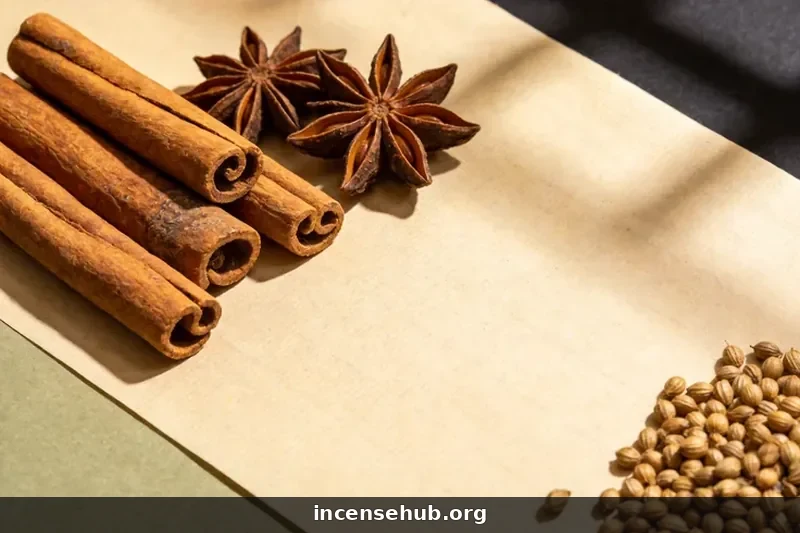
Direct answer: Long pepper (荜茇, bìbá) is the dried, immature fruit spike of Piper longum, a climbing vine of the pepper family (Piperaceae) native to South and Southeast Asia. It is a warm, pungent spice with a sweet, lingering heat, used in Chinese incense as a warm spice accent in some 合香 contexts. Long pepper was historically the more important of the peppers in Asia, predating black pepper.
Key facts
| Chinese | 荜茇 (bìbá), also 荜拔 |
| Botanical source | Piper longum (family Piperaceae) — the dried fruit spike |
| What it is | A dried spice fruit, not a wood or resin |
| Aroma | Pungent, spicy, warm, sweet |
| Traditional role | Culinary spice, materia medica, warm incense accent |
Aroma profile
Direct answer: Long pepper is pungent and warm, with a sweet, lingering heat that is often described as hotter but more rounded than black pepper — a penetrating, almost resinous warmth. It is a spice accent rather than a base note, adding a warm, piquant depth to blends.
Long pepper is pungent and warm, with a sweet, lingering heat that is often described as hotter but more rounded than black pepper — a penetrating, almost resinous warmth. It is a spice accent rather than a base note: it adds a warm, piquant depth to blends. In the pepper family it is closely related to black pepper (Piper nigrum) and cubeb (Piper cubeba).
The register is worth stating against black pepper: long pepper’s heat is often felt as hotter, sweeter, and more rounded — a penetrating warmth with a slight resinous undertone — rather than black pepper’s cleaner, sharper pungency. This is the sensory difference that once gave long pepper its prominence, and it still shapes how the spice reads in a blend.
Botanical source and origin
Direct answer: Piper longum is a climbing vine native to South and Southeast Asia — India, the Himalayan foothills, and parts of Southeast Asia — now cultivated across the tropics. The part used is the dried, immature fruit spike: a slender, catkin-like structure of tiny fused fruits, distinct from the round berries of black pepper.
Piper longum is a climbing vine native to South and Southeast Asia — India, the Himalayan foothills, and parts of Southeast Asia — now cultivated across the tropics. The part used is the dried, immature fruit spike: a slender, catkin-like structure of tiny fused fruits, distinct from the round berries of black pepper. The name 荜茇 records an ancient Indian origin (cf. Sanskrit pippalī). See Piper longum in Flora of China and Piper longum on GBIF.
A naming caution: 荜茇 (long pepper, Piper longum) is distinct from black pepper (Piper nigrum) and cubeb (荜澄茄, Piper cubeba) — three different pepper-family spices. Long pepper is the slender, catkin-like fruit spike, not the round berry.
Chinese name and terminology
Direct answer: 荜茇 (bìbá), also written 荜拔, is the Chinese name for Piper longum, recording an ancient Indian origin (Sanskrit pippalī). It belongs to the pepper-family name cluster alongside black pepper (胡椒) and cubeb (荜澄茄) — three different spices that share the pepper register but not the species.
The name 荜茇 (also 荜拔) is a phonetic rendering of the ancient Indian name for the spice (cf. Sanskrit pippalī), recording the material’s South Asian origin in the same way 阿魏 records asafoetida’s Central Asian origin. It sits in the pepper-family name cluster: black pepper (胡椒), cubeb (荜澄茄), and long pepper (荜茇) are three distinct Piper species, and the names — though they share the pepper register — identify different fruit forms and different spices. For the reader, the name alone does not separate them; the species does.
Why is it used in incense?
Direct answer: Long pepper appears as a warm spice accent in some 合香 blends, alongside other spices, rather than as a classical defining material. Its role is a warm, piquant depth — a pungent lift that supports the aromatic core without leading it.
Long pepper’s incense role is a warm spice accent: it appears in some blended incense (合香) contexts alongside other spices, contributing a warm, piquant depth rather than serving as a defining material. Its pungency is used as a supporting note — a warm lift beneath the resins and woods — rather than as a lead fragrance. This is consistent with its culinary identity as a spice, and it places long pepper in the spice-accent layer of a formula rather than the aromatic core.
How is it processed?
Direct answer: Long pepper is produced by harvesting the immature fruit spikes and drying them. The dried, slender spike is the traded form, used whole or ground. Drying concentrates the warm, pungent, sweet character.
The immature fruit spikes are harvested and dried, producing the slender, catkin-like dried form that is the traded material. Drying concentrates the warm, pungent, sweet character. The dried spike is used whole or ground, much like black pepper — the processing is a drying step, not an extraction, and the material needs no refinement beyond it.
What determines quality?
Direct answer: Long pepper quality turns on density and pungency — whole spikes should be dark, dense, and strongly pungent-aromatic, with the slender spike form being normal rather than a defect. The sweet, lingering heat should be present in full.
The practical checks are density (dark, dense spikes rather than light or hollow ones) and pungency (a strong, sweet, lingering heat). The slender, catkin-like spike form is normal — it is not a defect, but the defining morphology that distinguishes long pepper from the round berry of black pepper. Correct identification is the first check, since 荜茇, 胡椒, and 荜澄茄 are three different spices.
Common forms
Direct answer: Long pepper is traded as the whole dried fruit spike and as a ground powder. The whole spike is the reference form, and its slender catkin shape is the visual signature that separates it from black pepper’s round berries.
| Form | Typical use |
|---|---|
| Whole dried spike | Culinary spice; the reference form |
| Ground powder | Blending and dosing |
The whole spike is the reference form; the powder is a convenience form for blending.
In Chinese tradition
- Culinary spice: long pepper is a warm, pungent spice used in cooking and spice blends.
- Materia medica: 荜茇 is recorded in traditional Chinese medicine (本草綱目, 草部) as a warming aromatic. This is traditional materia-medica language, not modern clinical evidence.
- Incense context: long pepper appears as a warm spice accent in some 合香 blends, alongside other spices, rather than as a classical defining material.
Traditional use vs modern evidence
Direct answer: The culinary role of long pepper is well documented. Medicinal uses are traditional, not established clinical fact, and no medical claims are made. The documented, non-medical facts are the botanical identity, the pepper-family placement, and the warm, pungent aromatic use.
- Traditional Use — 荜茇 as a warm, pungent culinary spice and a warm incense accent in some 合香 blends.
- Historical Record — 荜茇 recorded as a warming aromatic in the 本草綱目 草部; the name records an ancient Indian origin (Sanskrit pippalī).
- Scientific Evidence — the botanical identity (Piper longum, Piperaceae) is established. No clinical or medical efficacy claims are presented.
The culinary role is well documented. Medicinal uses are traditional, not established clinical fact, and we make no medical claims. The documented, non-medical facts are botanical identity, the pepper-family placement, and the warm, pungent aromatic use.
Quality notes
Practical points:
- Whole long pepper should be dark, dense, and strongly pungent-aromatic; the slender spike form is normal, not a defect.
- Distinguish long pepper (荜茇) from black pepper and cubeb — three different pepper-family spices.
- In incense, long pepper is a warm spice accent, usually blended, not burned alone.
The pepper family: long pepper vs black pepper vs cubeb
Direct answer: Long pepper, black pepper, and cubeb are three different pepper-family (Piper) spices with different fruit forms and characters. Long pepper (Piper longum) is a slender fruit spike, hotter and sweeter; black pepper (Piper nigrum) is a round berry; cubeb (Piper cubeba) is a stalked berry with a cooling-pungent edge. Only the species separates them.
| Long pepper (荜茇) | Black pepper (胡椒) | Cubeb (荜澄茄) | |
|---|---|---|---|
| Botanical source | Piper longum | Piper nigrum | Piper cubeba |
| Fruit form | Slender catkin spike | Round berry | Stalked berry |
| Character | Hotter, sweeter, rounded | Sharp, clean pungency | Pungent with cooling edge |
The three share the pepper register but are distinct species with distinct fruit forms and characters. See pepper, cubeb, and the material comparison matrix.
Summary
Long pepper (荜茇) is the dried, immature fruit spike of Piper longum, a climbing pepper-family vine native to South and Southeast Asia. It is a warm, pungent spice with a sweet, lingering heat, used as a culinary spice, a materia-medica warming aromatic, and a warm accent in some 合香 blends. Historically it predated black pepper in importance, and its slender spike form separates it from black pepper’s round berry and cubeb’s stalked berry.
FAQ
What is long pepper? The dried, immature fruit spike of Piper longum, a climbing vine of the pepper family (Piperaceae) native to South and Southeast Asia. It is a warm, pungent spice with a sweet, lingering heat, formed of a slender catkin of tiny fused fruits rather than the round berries of black pepper. It was historically the more important of the peppers in many Asian traditions.
How does long pepper differ from black pepper? They are different pepper-family species. Long pepper is Piper longum — a slender, catkin-like fruit spike with a hotter, sweeter, more rounded heat; black pepper is Piper nigrum — a round berry. Long pepper historically predated black pepper in many Asian and Mediterranean traditions, and it remains common in Indian and Chinese cuisine and spice blends.
What does long pepper smell like? Pungent and warm, with a sweet, lingering heat that is often described as hotter but more rounded than black pepper — a penetrating, almost resinous warmth. In incense it acts as a warm, piquant spice accent that deepens a blend rather than serving as a base note.
What is long pepper (荜茇) in Chinese tradition? long pepper (荜茇) is a warm, pungent culinary spice and a recorded materia-medica warming aromatic, listed in the 本草綱目 草部. It is also used as a warm spice accent in some blended incense (合香) contexts alongside other spices. Its name records an ancient Indian origin, related to the Sanskrit pippalī.
Where does long pepper come from? From Piper longum, a climbing vine native to South and Southeast Asia — India, the Himalayan foothills, and parts of Southeast Asia — now cultivated across the tropics. The dried, immature fruit spike is the part used, and the spice has been traded for centuries, predating black pepper in many traditions.
How does long pepper differ from cubeb? They are different Piper species. Long pepper (Piper longum) is a slender fruit spike with a hot, sweet heat; cubeb (Piper cubeba) is a stalked berry with a pungent, cooling edge. Both belong to the pepper family alongside black pepper, but they are distinct spices with distinct forms and characters.
See also: cubeb, clove, pepper, sichuan pepper and the full scent guide.
Evidence & Sources
Botanical identity
Source: Piper longum in Flora of China · Piper longum on GBIF. Evidence type: Established.
Traditional Chinese use
Source: 荜茇 as a culinary spice and materia-medica warming aromatic, recorded in the 本草綱目 草部. Evidence type: Historically documented — culinary use; medicinal uses are traditional, not modern clinical evidence.
Authenticity / disambiguation
Source: long pepper (荜茇) vs black pepper (Piper nigrum) vs cubeb (Piper cubeba) — three pepper-family spices. Evidence type: Practical screening.
Safety
Source: incense combustion produces smoke and particulate matter; burn in a well-ventilated space. Evidence type: Established.
Evidence status
| Layer | Status |
|---|---|
| Botanical identity | Established |
| Traditional use | Historically documented (culinary) |
| Authenticity test | Practical screening |
| Health claims | Not established |
Sources
Sources: botanical references on Piper longum and the long-pepper-vs-black-pepper distinction. Long pepper is recorded as a culinary spice; medicinal uses are treated as traditional, not established clinical fact. This is editorial knowledge content, not medical advice.