
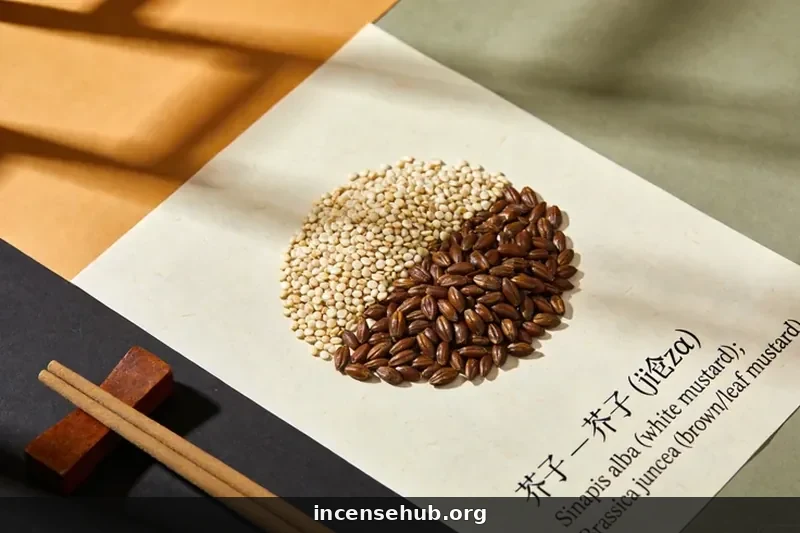
Direct answer: Mustard seed (芥子, jièzǐ) is the pungent seed of mustards in the cabbage family (Brassicaceae): white mustard (Sinapis alba) and brown or leaf mustard (Brassica juncea). It is a sharp, spicy culinary seed whose heat is released only when the ground seed meets water. The Bencao Gangmu records 芥 in its vegetable section, noting the white mustard seed (白芥子) is “甚辛美” — very pungent and fine.
Key facts
| Chinese | 芥子 (jièzǐ); 白芥子 = white mustard seed |
| Botanical source | Sinapis alba (white mustard); Brassica juncea (brown/leaf mustard), Brassicaceae — the seed |
| What it is | A pungent culinary spice seed |
| Aroma | Pungent, sharp, spicy, green |
| Traditional role | Culinary spice (香药); 芥子 in materia medica |
Aroma profile
Direct answer: Mustard seed is pungent and sharp, with a hot, green, horseradish-like bite that appears only when the crushed seed is moistened — dry, the seed is almost scentless. The heat is a chemical defense released on wetting, not a lingering spice warmth like pepper or cinnamon.
Mustard seed is pungent and sharp, with a hot, green, horseradish-like bite that appears only when the crushed seed is moistened — dry, the seed is almost scentless. The heat is a chemical defense (the enzyme myrosinase acting on glucosinolates), not a lingering spice warmth like pepper or cinnamon. It is a food aroma first, and its role in aromatics is as a sharp, corrective seasoning rather than a lead fragrance.
This is a genuinely unusual trait among the spice seeds: most spices — pepper, cinnamon, clove — release a stored, pre-formed aroma when crushed or heated. Mustard’s heat does not exist until the crushed seed meets water. The dry seed is nearly inert, and the “pungency” is a reaction that the moisture unlocks. This chemical fact is the key to understanding both how mustard works in the kitchen and why it behaves differently from every other spice seed on this site.
Botanical source and origin
Direct answer: Mustard covers several cabbage-family (Brassicaceae) plants. The two most relevant to 芥子 are white mustard (Sinapis alba), native to the Mediterranean and West Asia, and brown or leaf mustard (Brassica juncea), long cultivated across Asia for both its pungent seed and its leafy vegetable form (芥菜). The seed is the material of value.
Mustard covers several cabbage-family plants. The two most relevant to 芥子 are white mustard (Sinapis alba), native to the Mediterranean and West Asia, and brown or leaf mustard (Brassica juncea), long cultivated across Asia for both its pungent seed and its leafy vegetable form (芥菜). The seed is the material of value; it is ground, sometimes after roasting, and mixed with liquid to develop its heat. Flora of China records Brassica juncea as a cultivated and sometimes naturalized herb — annual, with the pungent seeds that give mustard its character.
The white-vs-brown distinction is practical, not pedantic: white mustard (Sinapis alba) yields the milder, paler, classic table mustard; brown/leaf mustard (Brassica juncea) is the hotter seed behind many Asian mustards and the leafy vegetable 芥菜. Both carry the 芥 name, and both feed the 芥子 material, but their heat, color, and culinary roles differ.
Chinese name and terminology
Direct answer: 芥子 (jièzǐ) means “mustard seed” — 芥 for the mustard plant, 子 for “seed.” The white seed is distinguished as 白芥子 (“white mustard seed”). The term is classical, appearing in the Bencao Gangmu vegetable section, and belongs to the culinary and materia-medica vocabulary rather than the incense 香材 canon.
The name 芥子 is transparent: 芥 (mustard) + 子 (seed). The white variety is distinguished as 白芥子 (“white mustard seed”), the form the Bencao Gangmu specifically calls out as “甚辛美” (very pungent and fine). The term is genuinely classical — it sits in the materia medica (本草) vegetable section, not in the incense compendium 香乘 — which is an important placement: 芥子 belongs to the food-and-medicine layer of the Chinese record, not to the burned-incense 香材 canon. A reader or reader should read 芥子 as a culinary aromatic seasoning (香药), not as a 合香 incense ingredient.
Why is it used in seasoning and aromatics?
Direct answer: Mustard seed is a sharp, hot culinary seasoning — an aromatic spice (香药) — whose heat develops only on wetting the crushed seed. It is not a classical Chinese incense ingredient; its aromatic value is as a hot, corrective food note, and it does not belong to the burned-incense 合香 tradition.
Mustard’s role is culinary, not incense. It is a sharp, hot seasoning — a 香药 — used to add a pungent, green, horseradish-like bite, and its heat is released only when the ground seed meets water. This makes it a corrective food note rather than a lead fragrance: it sharpens and cuts richness, and its value is entirely in the wet-activated pungency. There is no classical 合香 or 香乘 role for mustard seed, and we do not retrofit one — its genuine story is the culinary and materia-medica record.
How is it processed?
Direct answer: Mustard seed is harvested and dried, then ground — sometimes after roasting — and mixed with liquid to develop its heat. The wetting step is essential: the enzyme myrosinase acts on glucosinolates only in the presence of water, releasing the sharp, hot bite. Dry, the seed is almost scentless.
The seed is harvested and dried, then ground (sometimes after roasting, which mellows and deepens the flavor) and mixed with liquid to develop its heat. The wetting step is the essential one: the enzyme myrosinase acts on the glucosinolates only in the presence of water, releasing the sharp, hot, horseradish-like bite. Dry, whole mustard seed is nearly scentless — a fact that surprises anyone who knows mustard only as the prepared paste. The processing is thus a reaction trigger, not a simple drying: the material’s signature heat does not exist until moisture is introduced.
What determines quality?
Direct answer: Mustard quality turns on the seed’s pungency potential and freshness. Good seed, when freshly ground and moistened, releases a strong, sharp, clean heat — not a stale or musty note. Because the heat is wet-activated, the “quality test” is really a fresh-grind-and-wet test.
The practical checks are: pungency potential (a strong, sharp, clean heat when freshly ground and moistened — not a stale or weak bite) and freshness (dry, sound seed rather than old or musty material). Because the heat is wet-activated, the quality test is inherently a fresh-grind-and-wet test: you cannot judge a mustard seed by sniffing it dry, because the seed is almost scentless until ground and moistened. This is a distinctive quality-checking quirk among the spice seeds.
Common forms
Direct answer: Mustard is traded as whole seed, as ground powder, and as prepared mustard paste. The whole seed is nearly scentless; the powder and paste carry the wet-activated heat. White mustard yields the milder classic paste; brown mustard the hotter Asian types.
| Form | Typical use |
|---|---|
| Whole seed | Pickling, tempering; near-scentless until crushed and wet |
| Ground powder | Table mustard base; heat develops on wetting |
| Prepared paste | The finished condiment, heat already developed |
The whole seed, powder, and paste are stages of the same material — the seed nearly inert, the powder a latent heat, the paste the finished pungency.
In Chinese tradition
- Culinary spice (香药): mustard seed is a sharp seasoning; the Bencao Gangmu (本草纲目) records 芥 among the cultivated vegetables, with the white seed (白芥子) noted as “甚辛美” (very pungent and fine).
- Materia medica: 芥子 appears in traditional Chinese medicine. This is traditional materia-medica language, not modern clinical evidence.
Traditional use vs modern evidence
Direct answer: The culinary use of mustard seed is unambiguous and well documented, and its wet-activated pungency is established chemistry (myrosinase + glucosinolates). Medicinal uses are traditional, not established clinical fact, and no medical claim is made.
- Traditional Use — mustard seed as a sharp culinary seasoning (香药); 白芥子 noted in the Bencao Gangmu as “甚辛美.”
- Historical Record — 芥 recorded in the Bencao Gangmu vegetable section (菜之一) among the cultivated vegetables, with the white seed distinguished as 白芥子.
- Scientific Evidence — the botanical identity (Sinapis alba, Brassica juncea, Brassicaceae) is established, and the wet-activated pungency (myrosinase acting on glucosinolates) is established chemistry. No clinical or medical efficacy claims are presented.
The culinary use is unambiguous and well documented. Medicinal uses are traditional, not established clinical fact, and we make no medical claims. The documented, non-medical facts are botanical identity, the Brassicaceae placement, and the culinary-spice record — plus the distinctive wet-activated chemistry that separates mustard from every other spice seed.
Quality notes
Practical points:
- 芥子 is mustard seed — white mustard (Sinapis alba) or brown/leaf mustard (Brassica juncea); expect a sharp, hot, green bite released only when the ground seed is moistened.
- Dry mustard seed is nearly scentless; the pungency develops on wetting or grinding with liquid.
- It is a culinary spice and 香药, not a burned incense material and not a classical 香乘 ingredient.
- Judge quality by the fresh-grind-and-wet test, not by sniffing the dry seed.
Mustard vs pepper: the wet-activated heat
Direct answer: Mustard and pepper are both “hot,” but by different mechanisms. Pepper’s pungency is a pre-formed, oil-soluble bite (piperine) released on crushing; mustard’s heat is wet-activated — the enzyme myrosinase acts on glucosinolates only in water. One is a stored heat, the other a triggered reaction.
| Mustard seed (芥子) | Pepper (胡椒) | |
|---|---|---|
| Botanical source | Sinapis alba / Brassica juncea (Brassicaceae) | Piper nigrum (Piperaceae) |
| Heat mechanism | Wet-activated (myrosinase + glucosinolates) | Pre-formed (piperine) |
| Dry state | Nearly scentless | Aromatic even dry |
| Character | Sharp, green, horseradish-like | Hot, pungent, woody |
The contrast is instructive: pepper’s heat is stored and released by crushing; mustard’s heat is a reaction that water must trigger. See pepper, cinnamon, and the material comparison matrix.
Summary
Mustard seed (芥子) is the pungent seed of cabbages in the Brassicaceae family — chiefly white mustard (Sinapis alba) and brown/leaf mustard (Brassica juncea). Its heat is wet-activated: the enzyme myrosinase acts on glucosinolates only in water, so the dry seed is nearly scentless and the sharp, green, horseradish-like bite appears only on grinding and moistening. It is a culinary 香药 recorded in the Bencao Gangmu vegetable section, with the white seed (白芥子) noted as “甚辛美,” and it is not a classical Chinese incense material.
FAQ
What is mustard seed (芥子)? The pungent seed of mustards in the cabbage family (Brassicaceae) — chiefly white mustard (Sinapis alba) and brown or leaf mustard (Brassica juncea). It is a sharp, spicy culinary seed whose heat is released only when the crushed seed meets water, and it is used as a seasoning 香药 rather than a burned incense material.
Why does dry mustard seed have little smell? Because its pungency is a chemical defense, not a stored aroma. The enzyme myrosinase reacts with glucosinolates only when the crushed seed is moistened, producing the sharp, hot, horseradish-like bite. Dry, whole seed is nearly scentless; wetting or grinding with liquid unlocks the heat.
Does mustard seed (芥子) appear in the Bencao Gangmu? Yes. The Bencao Gangmu (本草纲目), vegetable section (菜之一), records 芥 among the cultivated vegetables, describing several kinds, and notes the white mustard seed (白芥子) as “甚辛美” — very pungent and fine. The culinary use is the documented role, while medicinal uses are traditional, not established clinical fact.
What is the difference between white and brown mustard? White mustard (Sinapis alba) has a milder, more evenly pungent seed and is the source of the classic pale table mustard; brown or leaf mustard (Brassica juncea) is hotter and is the seed behind many Asian mustards and the leafy vegetable 芥菜. Both contribute to the name 芥子, and they differ in heat, color, and culinary use.
Is mustard a classical incense ingredient? Not in the burned-incense tradition. Mustard’s role is culinary — a sharp seasoning 香药 — rather than a material of blended incense (合香) or the 香乘 canon. Its aromatic value is as a hot, corrective food note, not a lead fragrance.
How do I judge mustard seed quality? By the fresh-grind-and-wet test, not by sniffing the dry seed. Good mustard seed, when freshly ground and moistened, releases a strong, sharp, clean heat; old or stale seed gives a weak or musty bite. Because the pungency is wet-activated, the dry seed is nearly scentless and cannot be judged by smell alone.
See also: pepper, cinnamon, dried ginger, and the full scent guide.
Evidence & Sources
Botanical identity
Source: Brassica juncea in Flora of China · Sinapis alba on GBIF · Brassica juncea on GBIF. Evidence type: Established.
Traditional Chinese use
Source: the Bencao Gangmu (本草纲目), 菜之一, records 芥 with the white seed (白芥子) noted as “甚辛美”. Evidence type: Historically documented — culinary spice; medicinal uses are traditional, not modern clinical evidence.
Authenticity / disambiguation
Source: 芥子 (white mustard Sinapis alba vs brown/leaf mustard Brassica juncea). Evidence type: Practical screening.
Safety
Source: incense combustion produces smoke and particulate matter; burn in a well-ventilated space. Evidence type: Established.
Evidence status
| Layer | Status |
|---|---|
| Botanical identity | Established |
| Traditional use | Historically documented (culinary) |
| Authenticity test | Practical screening |
| Health claims | Not established |
Sources
- Brassica juncea in Flora of China
- Sinapis alba on GBIF
- Brassica juncea on GBIF
- 本草纲目 菜之一 on Wikisource
Sources: botanical references on Sinapis alba and Brassica juncea and the Bencao Gangmu (本草纲目) 菜之一 record of 芥. 芥子 is documented as a culinary spice; medicinal uses are treated as traditional, not established clinical fact. This is editorial knowledge content, not medical advice.