
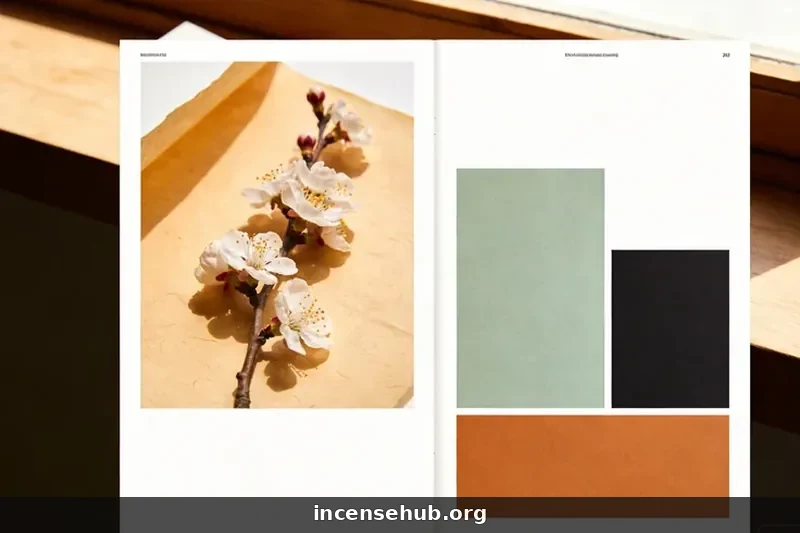
Definition: Read guìhuā, 桂花 is a dried blossom: the autumn flower of Osmanthus fragrans, a tree in the olive family long grown across East Asia. Its scent is apricot and honey, and it has flavoured tea, sweets, and censers for centuries.
Key facts
| Chinese name | 桂花 (guìhuā) |
| Botanical source | Osmanthus fragrans, olive family (Oleaceae) |
| Material type | Dried flower — not a wood, resin, or root |
| Scent family | Fruity-floral: apricot, peach, honey, soft tea |
| Commercial forms | Whole dried flower, sugar or syrup, absolute |
| Main quality axis | Colour variant, freshness, cleanliness, scent strength |
| Origin of supply | Cultivated across southern China, Taiwan, Japan, the Himalaya fringe |
Direct answer: Osmanthus is a flower, and that single fact governs everything about how it is bought and burned. It has no resin to smoulder and no heartwood to age; its value sits in a thin petal that loses its perfume quickly if it is handled badly.
A flower rather than a wood
Direct answer: The part of Osmanthus fragrans used in fragrance is the small, four-lobed flower, picked in clusters and dried whole. The tree’s wood is not aromatic in any useful way, so osmanthus never behaves like agarwood or sandalwood on a burner.
Osmanthus fragrans belongs to Oleaceae, the olive family. English catalogues sometimes call it “sweet olive” or “fragrant tea olive,” both of which describe the plant rather than the product. It grows as an evergreen shrub or a small tree, and it is planted as much for ornament and shade as for its flowers. The bloom is tiny — a few millimetres across — and appears in dense clusters along the branches. In most varieties the flowering window is short and sharply seasonal, which is why fresh osmanthus is a treat and dried osmanthus is the normal commercial material.
That botanical placement matters for anyone blending incense. A resin like agarwood is a defence secretion, rich in heavy molecules that release slowly under heat. A heartwood like sandalwood is dense and oil-bearing throughout its fibre. A petal is neither. It is soft tissue with a thin wall, a high surface-to-volume ratio, and a volatile load that begins escaping the moment the flower is picked. You cannot treat flower material like wood chips and expect the same curve of release.
The practical consequence: osmanthus is a top-and-heart accent, not a foundation. It contributes lift, sweetness, and a fruity turn, then steps back. When a formula needs weight or a long tail, that work has to come from somewhere else.
Two records anchor the identity question. The Flora of China entry for the genus describes its structure and its place in Oleaceae; the GBIF record for the species confirms the accepted name and range. Neither says anything about scent quality. Both settle what plant a trade label is pointing at.
Reading the scent: apricot, honey, and the fruity turn
Direct answer: Osmanthus smells sweet and fruity-floral, with ripe apricot or peach at the front, honey and nectar in the middle, and a faint soft-tea note underneath. It is one of the few flowers whose natural scent reads as fruit rather than as petals.
Most floral absolutes sit somewhere on a spectrum from green to powdery to narcotic. Osmanthus sits off to the side, in a register that perfume writers usually reserve for fruit: stewed apricot, peach skin, a spoonful of honey stirred into weak black tea. That is not a metaphor imposed by marketing. It is the first thing most people say on smelling the flower, and it is why osmanthus appears in fragrances that want a soft, edible warmth without going sugary.
The mechanism behind that impression is a small group of molecules rather than one single compound. Ionone-type materials — the family that gives violets their powdery-woody character and contributes to the smell of some stone fruit — are part of the picture, which is exactly why reconstructed “osmanthus” accords so often lean on them. The flower’s own volatiles are a mixture: fruity lactonic facets, honeyed notes, a green edge that keeps the sweetness from collapsing into syrup, and a mild tea-like base. Good material keeps all of those in proportion. Poor material flattens into one note, usually the honey.
There is a useful distinction between fresh flower, dried flower, and absolute, because the three do not smell the same:
- Fresh bloom is the brightest and most complex, with a green sap edge that disappears on drying. It is a seasonal experience, not a shelf product.
- Dried flower is softer, more honeyed, and slightly hay-like. The apricot survives; the green top does not.
- Absolute is concentrated and dense, closer to jam than to a garden. A little goes a long way, and it can turn cloying faster than the flower does.
For blending, the dried flower and the absolute are different tools. The flower brings texture and a gentle, slightly dusty sweetness; the absolute brings intensity and a fruity core that can dominate if dosed carelessly.
How osmanthus sits against other materials
A cross-map is more useful than a list of adjectives, because it shows what each material is doing in a blend rather than what it smells like in isolation.
| Material | Dominant facet | Kind of sweetness | Position in a blend | Job it does |
|---|---|---|---|---|
| Osmanthus | Fruity-floral, apricot-honey | Light, nectar-like | Top to heart | Lifts and brightens |
| Jasmine | White floral, slightly indolic | Heavy, narcotic | Heart | Adds body and depth |
| Rose | Rosy, honeyed, faintly green | Round, waxy | Heart | Bridges floral and wood |
| Sandalwood | Creamy, soft, buttery | Gentle, woody | Base | Anchors and smooths |
| Agarwood | Resinous, balsamic, complex | Deep, dark | Base | Adds gravity and movement |
Read down the “position” column and the logic appears. Osmanthus and jasmine can both be called “sweet florals,” yet they occupy different slots: jasmine fills the middle of a composition, osmanthus decorates its opening. Put osmanthus where jasmine belongs and the blend goes thin. Put jasmine where osmanthus belongs and the opening turns heavy before the woods arrive.
金桂, 银桂, 丹桂, 四季桂: what the colour names promise
Direct answer: Chinese trade names divide Osmanthus fragrans by flower colour: 金桂 (gold) is the most fragrant and the reference grade, 银桂 (silver) is paler and lighter, 丹桂 (red-orange) is showier but weaker in scent, and 四季桂 (four-seasons) blooms repeatedly with a milder aroma.
The four names are old horticultural categories, not laboratory grades. They describe the colour of the corolla and, loosely, the strength of the scent that tends to come with it.
| Name | Flower colour | Scent strength | Bloom habit | Typical use |
|---|---|---|---|---|
| 金桂 (gold) | Deep yellow to golden | Strongest, richest | Main autumn flush | Fragrance reference, tea, premium blends |
| 银桂 (silver) | Creamy white to pale yellow | Moderate, cleaner | Main autumn flush | Tea, lighter floral work |
| 丹桂 (red) | Orange to red-orange | Weaker, flatter | Main autumn flush | Ornament, visual appeal |
| 四季桂 (four-seasons) | Pale, small | Mild | Repeated flushes through the year | Garden plant, everyday tea |
Two things follow, and they pull in opposite directions.
The first is that variant is a real specification. A formulator who builds a formula around 金桂 and then receives 丹桂 has not received the same material at a lower grade; they have received a different material with a different scent ceiling. If the flower is a headline note, that difference will be audible in the finished stick.
The second is that the label is not a certificate. 金桂 is a cultivar group, and within it there is good and bad material. A fresh, clean, well-dried 银桂 can outperform a stale 金桂 that was picked late, dried slowly, and stored in a warm room. This is the point where a buyer’s nose matters more than the character on the bag. The colour name tells you what to expect; it does not tell you what you got.
For a collector or a curious reader, the useful habit is to treat the variant name as a prior, not a verdict. Smell before you commit, and judge the flower in front of you.
One character, three plants: the 桂 problem
Direct answer: Three plants, one character. 桂花 is osmanthus, 月桂叶 is bay leaf (Laurus nobilis), and 桂皮 is cinnamon bark (Cinnamomum cassia). When a classical text writes 月桂, read osmanthus — taking it as the Mediterranean laurel is a translator’s error.
This is the single most common source of confusion around osmanthus, and it is a language problem rather than a botanical one. Three unrelated plants carry the same syllable in their Chinese names.
| Written form | Plant | Family | Part used | What it smells like |
|---|---|---|---|---|
| 桂花 | Osmanthus fragrans | Oleaceae | Flower | Apricot, honey, soft tea |
| 月桂叶 | Laurus nobilis | Lauraceae | Leaf | Herbal, camphoraceous bay |
| 桂皮 | Cinnamomum cassia | Lauraceae | Bark | Warm, sweet spice |
| 月桂 (classical texts) | Usually osmanthus | — | Flower | As 桂花 |
The classical trap is 月桂. In older Chinese writing the phrase generally points to the osmanthus, the tree of the moon, not to the Mediterranean laurel that English readers call bay. So a line that mentions 月桂子 — literally “moon laurel seed” — is describing osmanthus fruit, not bay berries. Translators who render it as “laurel” send the reader to the wrong plant, and from there to the wrong aroma and the wrong safety profile.
A second layer of the trap is that 桂皮 is a bark and 桂花 is a flower, yet both appear in food contexts. Osmanthus sugar and cassia-bark braises belong to different culinary traditions, and a recipe that says 桂 alone can mean either depending on region and era.
For anyone buying material, the fix is simple: insist on the full name. 桂花 is the flower. 月桂叶 is bay. 桂皮 is cassia bark. Each has its own entry here — see bay leaf and cinnamon — and the three should never be substituted for one another in an incense formula.
From tree to trade: how the flower becomes an incense material
Direct answer: Osmanthus is picked at bloom, dried whole for tea and incense, or preserved in sugar and syrup. For perfumery, the flowers are solvent-extracted to a concrete and then washed to an absolute, a costly route because the petals yield so little.
The supply chain is short but unforgiving.
Harvest. The flowers are picked in clusters when the flush is at its peak. The window is narrow — a few days of full scent before the flowers darken and drop. Picking is done by hand because the blooms are too small and too delicate for mechanised harvesting. This is labour-intensive, seasonal work, and it sets the rhythm of the whole trade.
Drying. The flowers are dried whole, gently, until the moisture is low enough to store. This is the step where quality is won or lost:
fresh bloom, high moisture → slow or uneven drying → enzymatic browning and fermentation → hay-like, flat, slightly sour aroma → a batch that smells of the field rather than the flower.
Fast, even drying preserves the apricot-honey core. Heat that is too aggressive drives off the most volatile top notes and leaves a cooked, jammy residue. There is no single correct method; there is only the rule that the gap between picking and stabilising the flower should be short.
Sugar and syrup. Packing fresh blooms in sugar, or steeping them in syrup, produces 桂花糖 and 桂花酱 — the sweet base of many Chinese desserts. This is a preservation method as much as a flavouring one: the sugar locks in the aroma and the moisture, and the result keeps far longer than the dried flower.
Extraction. For perfumery, the flowers go through solvent extraction to a concrete, which is then washed with alcohol to produce an absolute. The yield is low because each flower carries so little oil, which is the root of the price:
tiny petals, low oil content → a large mass of flowers per gram of extract → high unit cost → strong incentive to stretch or reconstruct the note.
That last arrow is the commercial reality behind every cheap “osmanthus” product on the market. It is not a moral failing of the trade; it is what happens when a beautiful material is expensive and a convincing imitation is not.
Seasonality adds a second layer. The bloom arrives once a year for most cultivars and lasts days, so the year’s supply is decided in a short window. A wet or windy spell during that window can strip the flowers before picking; a hot, dry spell can shorten the flush. Growers cannot simply make more next month. The result is a material whose annual character varies more than a wood or a resin, which is why experienced buyers ask which year a lot came from and why a supplier’s stock can change noticeably between seasons without any change in specification.
That variability is not a defect to be engineered away. It is the nature of a flower crop, and it is one reason osmanthus sits in the accent slot rather than the foundation of a formula. A material whose aroma shifts year to year is hard to build a signature scent on, and easy to use as a seasonal colour.
Four commercial forms and what each is good for
Direct answer: Osmanthus reaches buyers as whole dried flowers, sugar or syrup, concrete and absolute, and reconstructed fragrance accords. The dried flower is the incense material; the absolute is a perfumery material; the accord is a label question.
| Form | What it is | Scent fidelity | Relative cost | Best use | Common failure |
|---|---|---|---|---|---|
| Dried whole flower | Petals dried intact | Good; softer than fresh | Low to moderate | Tea, incense accents, garnish | Stale, dusty, stem-heavy |
| Sugar / syrup (桂花糖) | Flowers preserved in sugar | Good, rounded | Moderate | Desserts, drinks | Over-sweet, flower content unclear |
| Concrete / absolute | Solvent extract | High intensity, jammy | High | Fine fragrance, premium sticks | Adulteration, dilution |
| Reconstructed accord | Aroma chemicals built to resemble osmanthus | Variable; can be excellent | Low | Mass-market incense, candles | Sold as “natural,” dosed too high |
The form determines the behaviour, and this is where a lot of buyer disappointment originates.
A dried flower is a solid that burns. It contributes a dusty, petal-like sweetness and a certain amount of smoke of its own. An absolute is a liquid that has to be carried — on a stick, in a paste, in a wax. It contributes intensity without the petal texture, and it can make a blend smell perfumed rather than botanical if the dose is too high. A reconstructed accord is a design, and its quality depends entirely on how well it was built and how honestly it is described.
There is no ranking here. Each form is correct for a different job. Flower powder belongs in a censer, absolute belongs in a perfume bottle, and an accord belongs on a label that says so. The mistake is assuming the single word “osmanthus” tells you which of the three you have.
Tea grade and incense grade are not the same standard
Direct answer: Tea grade rewards a clean, whole, mild flower that infuses sweetly in water. Incense grade rewards aroma intensity and a clean burn. The two overlap on cleanliness, but they optimise for different things, and a top tea flower is not automatically the best censer material.
This distinction is easy to miss because the same dried petals can go into either channel. A tea buyer wants a flower that gives up its scent gently in hot water without turning bitter or cloudy. That pushes the selection toward whole, pale, delicately dried petals with low dust and no scorched edges. An incense buyer wants the aromatic load to survive heat and to burn without an acrid tail. That pushes toward material with a strong, intact volatile fraction and away from anything that was dried too hard or stored too long.
The points of agreement are real. Both channels want flowers free of mould, soil, and leaf fragments. Both want a short gap between picking and stabilising. Both suffer from the same storage faults. Where they diverge is in what “best” means:
| Criterion | Tea grade | Incense grade |
|---|---|---|
| Appearance | Whole, unbroken, pale | Colour consistent, not dust-heavy |
| Aroma in the packet | Delicate, fresh | Strong, close to the flower |
| Behaviour under heat | Gentle infusion, no bitterness | Clean burn, no scorched-plant tail |
| Dust and fragments | Undesirable | Tolerable in small amounts |
| Age | Best within one season | Declines, but slower than tea grade |
The practical consequence for a buyer is that a “premium tea osmanthus” claim says very little about how the material will behave in a stick. It may be excellent — clean, fresh, well handled — or it may be a mild cultivar selected for infusion and too quiet for burning. Neither outcome is a scandal. The label is simply answering a different question.
For anyone blending at home, the test is straightforward. Put a small pinch on a warm surface — a heated tile, a mica sheet over a low burner — and smell what comes off. A flower with a strong, clean apricot lift is worth keeping for incense. One that only smells sweet when it is steeped in water belongs in the teapot.
A vocabulary for judging a sample
Direct answer: Judge osmanthus on five facets — fruit, honey, green edge, tea base, and dust. The first two should lead, the green edge should be faint, the tea base should be clean, and dust should be absent.
Adjectives are slippery, and “sweet” covers everything from fresh nectar to the smell of a forgotten cupboard. Breaking the impression into facets makes a sample easier to compare against another sample, and it makes a buyer’s note to a supplier more useful than “smells good.”
Fruit. The apricot-peach facet is the signature. In good material it is bright and recognisable, and it survives drying. In poor material it is thin or absent, and the flower reads generically sweet. Fruit that tips into overripe or fermented is a drying fault, not a virtue.
Honey. The middle of the scent. Honey is warm and rounded, and a little goes a long way. When honey dominates, the flower loses its lift and starts to smell like syrup; that is a common outcome for material dried slowly at low heat.
Green edge. A faint sappy freshness, most present in the fresh bloom and mostly gone after drying. A trace is pleasant — it keeps the sweetness from cloying. A strong green or leafy note suggests flower material mixed with leaf, or a lot that was picked immature.
Tea base. The soft, dry, faintly tannic note underneath. It is what makes osmanthus read as “Chinese” rather than as a generic fruit syrup, and it is the part that lingers longest on a warm plate.
Dust. Not a facet so much as a fault. Old flowers, shaken bags, and poorly cleaned lots carry a papery dustiness that sits on top of everything else. Once it is there, no amount of blending hides it.
Written down as a note, a good sample reads something like: bright apricot, medium honey, faint green, clean tea base, no dust. A weak one reads: sweet, flat, papery. The vocabulary is not a substitute for experience, but it turns an impression into something you can compare, argue about, and reorder against.
How osmanthus behaves in a burning blend
Direct answer: In a burning stick, osmanthus releases its volatiles early and fades, because petal material is light and low in resin. It works as a bright opening accent over a creamy or resinous base, and it turns harsh if dosed too heavily.
Three mechanisms explain most of what a maker observes.
The release curve. Heat travels through a stick from the lit end. The lightest molecules — the fruity, green, honeyed top of the flower — vaporise first, at relatively low temperature. The heavier, waxier, less volatile fraction stays behind and reads as a faint dry, tea-like note.
petal volatiles, low molecular weight → vaporise at low temperature → released in the first third of the stick → the fruity signature peaks early → the dry-down carries only the base materials.
This is why an osmanthus-forward stick can smell wonderful for two minutes and then seem to forget the flower entirely. The flower did its work at the start. That is not a defect; it is the nature of a top note.
The cellulose problem. A petal is plant tissue, not resin. Above a certain share in the mix, the burning cellulose and the smoke it produces begin to dominate the aromatic contribution.
high petal load → more burning plant tissue per puff → sharp, scorched, leafy smoke → the delicate apricot note is buried → the stick reads “burnt pot-pourri” rather than osmanthus.
The fix is not more flower. It is a smaller dose, better distributed, over a base that can carry it.
The fixative question. A top note needs something to slow it down and give it a floor. Creamy woods do this well because their own volatiles are heavy and slow, and they blend with the honeyed facet rather than fighting it.
osmanthus + creamy base → the base’s heavy molecules hold the aromatic mix → the fruity note is released more gradually → the opening lasts longer and the transition is smoother.
Sandalwood is the obvious partner. Agarwood works too, though its resinous, sometimes bitter depth can overpower a delicate flower if the ratio is wrong. Vetiver is a third option when a drier, earthier floor is wanted.
Dose, in practice. Floral absolutes and flower powders are usually a small fraction of a stick, not the bulk. This is editorial judgment rather than a fixed rule, because the right number depends on the base, the binder, and the intended intensity. What can be said with confidence is that the curve is not linear: doubling the flower does not double the perceived sweetness, and past a point it starts to add harshness instead.
Where osmanthus sits in a 合香 formula
Direct answer: In the classical 君臣佐使 (jūn chén zuǒ shǐ — chief, minister, assistant, guide) reading of a blend, osmanthus is an assistant or guide, never the chief. It modifies the way the main material is perceived rather than supplying the composition’s spine.
The framework is a way of talking about rank inside a formula. The chief (君) sets the character; the minister (臣) supports and extends it; the assistant (佐) corrects, softens, or balances; the guide (使) carries the blend and harmonises the parts. The labels are traditional craft language, not a laboratory schema, and different eras used them loosely. Still, they are useful because they force a formulator to say what a material is for.
Applied to osmanthus, the ranking is fairly clear:
| Role | What it does | Is osmanthus a fit? |
|---|---|---|
| 君 Chief | Defines the scent of the stick | No — too light, too short-lived |
| 臣 Minister | Reinforces the chief’s character | Sometimes — in a floral-led blend |
| 佐 Assistant | Softens, sweetens, corrects | Yes — its natural role |
| 使 Guide | Carries and harmonises the mixture | Occasionally — the fruity top can round a seam |
The reasoning is structural. A chief material has to survive the whole burn and define the dry-down; osmanthus is gone too early for that job. An assistant, by contrast, is judged by what it changes in the materials around it, and that is exactly where a fruity-floral note earns its place. A small amount can make a resinous blend feel less austere, or stop a sandalwood-heavy stick from reading flat and monotonous.
This also explains a common disappointment. A buyer encounters a beautiful osmanthus note in a temple or a shop, buys “osmanthus incense,” and finds a stick that smells of almost nothing after the first minute. The stick was probably built correctly: the flower was an assistant doing an assistant’s job. Expecting it to behave like a chief is a category error, not a manufacturing fault. If you want osmanthus to dominate, you need a different product — a dipped stick or a cone built around the absolute — and even then the note will fade before the base does.
The 合香 lens has one more practical use. It gives a buyer a question to ask: what is the osmanthus doing here? If the answer is “it is the main note,” the material should be dosed and priced accordingly. If the answer is “it lifts the opening,” a small, clean flower lot is entirely sufficient, and paying for a premium absolute in that slot is money spent on something the burn will not reveal.
Pairing logic: what osmanthus lifts, and what it fights
Direct answer: Osmanthus pairs best with creamy or resinous woods — sandalwood, agarwood, vetiver — and with other florals such as jasmine and rose. It clashes with strongly camphoraceous or smoky materials that flatten its fruit.
The pairing rule is a matter of weight and temperature, not of tradition alone.
Works well:
- Sandalwood. Creamy, soft, sweet. The honeyed facet of osmanthus lands inside the wood’s own sweetness, so the two read as one material rather than two.
- Agarwood. Resinous and complex. Osmanthus brightens the opening and keeps the resin from feeling heavy. This is the classic pairing for a reason: the flower gives lift, the wood gives gravity.
- Jasmine and rose. Floral layering. Osmanthus supplies the fruit, jasmine supplies the narcotic body, rose supplies the waxy bridge. The jasmine and rose entries cover those two materials in their own right.
- Vetiver. Earthy and dry. Osmanthus softens the root’s roughness and adds a sweet top that vetiver otherwise lacks.
Works poorly:
- Strong camphor or eucalyptus notes. The cooling, medicinal sharpness cuts through the apricot and leaves a soapy impression.
- Heavy smoke or tar notes. Osmanthus is delicate; a dominant smoky material will erase it.
- Very sweet resins in large amounts. Benzoin and labdanum can push the blend from honeyed to cloying, and the flower’s freshness is lost.
A useful discipline is to smell the proposed pair on a test strip before committing a batch. Two materials that sound complementary on paper can cancel each other when the ratios are wrong, and floral top notes are the easiest thing in a formula to lose.
The cultural record: mid-autumn, tea, and the moon tree
Direct answer: Chinese fragrance and food writing records osmanthus from at least the Tang period, and the flower became inseparable from 中秋, the Mid-Autumn Festival. It flavours tea, cakes, and wine, and it grows in legend as the tree beside the lunar palace.
The flower’s cultural weight comes from its timing. It blooms as the autumn moon festival approaches, and the association stuck. 中秋, the Mid-Autumn Festival, is a family holiday built around the full moon, mooncakes, and reunion; osmanthus is the scent of that season in much of southern China. Osmanthus-flavoured mooncakes and osmanthus wine are part of the standard repertoire.
Tea is where most Chinese readers first meet the flower. 桂花茶 can mean petals scattered through green or oolong leaf, or a pure infusion with nothing else in the cup. Either way the liquor is soft, floral, and faintly fruity, and it forgives water that is a little too hot — a rare virtue among flower teas. The kitchen takes the same profile further: 桂花糕, a translucent steamed cake, and 桂花酒, a sweet wine, both depend on the flower’s honeyed top to carry them.
The moon association runs deeper than the festival. Chinese legend places a cassia or osmanthus tree on the moon, tended by the figure Wu Gang, who is condemned to chop at it forever while it heals. The idiom 蟾宫折桂 — “plucking the cassia in the toad palace” — became a metaphor for success in the imperial examinations. None of this is botanical evidence, and none of it should be read as a health claim. It is the reason the flower carries so much meaning, and the reason a Chinese reader recognises 桂花 instantly in a way that “osmanthus” does not convey in English.
There is a toponymic trace too: the city name 桂林 reads literally as “forest of osmanthus,” a reminder of how deeply the tree is woven into the southern landscape. For a reader approaching Chinese incense, this cultural layer is part of the material’s identity, not decoration around it.
Buying osmanthus: a verification sequence
Direct answer: Confirm the form first, then the colour variant, then freshness and cleanliness. Smell the material before you buy a quantity, and treat any absolute as a purity question rather than a variety question.
The order matters, because each answer changes what the next question should be.
Step 1 — What form is it? Dried flower, sugar-preserved flower, concrete, absolute, or a finished accord. If the seller cannot answer this plainly, the rest of the conversation is noise.
Step 2 — Which variant? 金桂, 银桂, 丹桂, or 四季桂. The name sets an expectation of scent strength. It does not guarantee it.
Step 3 — How fresh? Dried flowers fade. Ask for the harvest season and smell the material. Fresh osmanthus is bright and apricot-forward; old material is dusty, flat, and vaguely hay-like.
Step 4 — How clean? Look for stems, leaf fragments, grit, and any sign of mould. A flower lot that was dried on the ground will carry soil and debris, and no amount of blending will remove the resulting off-note.
Step 5 — For an absolute, what is the purity claim? Genuine osmanthus absolute is expensive and its price reflects a low yield. If the price is far below the market for the claimed material, the likely explanation is dilution or a reconstructed accord.
| What the seller says | What to check | What would change the decision |
|---|---|---|
| “Gold osmanthus, premium” | Flower colour, scent strength, harvest date | Pale, weak-smelling material contradicts the claim |
| “Pure osmanthus absolute” | Price plausibility, supplier documentation, scent | A jammy but thin profile suggests an accord |
| “Wild-picked” | Origin and harvest story | Osmanthus is overwhelmingly cultivated; the claim adds little |
| “Food grade” | Handling and storage | Food grade says nothing about smoke safety |
| “Fresh crop” | Smell and appearance | Dust and faded colour mean it is not fresh |
The last row deserves emphasis. Food grade is not a statement about inhalation. A flower that is safe to eat can still produce smoke and particulate matter when burned, and the two risks are measured differently. That distinction is a recurring theme on this site, and it applies to every botanical in the incense cabinet.
Storage and handling
Direct answer: Keep dried osmanthus airtight, dark, and cool, away from strong odours. The flowers are hygroscopic and will pick up moisture and foreign smells, and both are irreversible.
Dried petals behave like a sponge. They equilibrate with the humidity of the room, and once moisture is in, the risk of mould and off-fermentation rises. A jar with a good seal, kept in a dark cupboard, is enough for most quantities.
Three habits make a difference:
- Do not store near spices or incense oils. The flower will absorb neighbouring volatiles, and a cardamom-scented osmanthus is a ruined batch.
- Bring the jar to room temperature before opening. Opening a cold jar in a warm room draws condensation onto the petals.
- Buy in quantities you will use within a season. Dried flowers are not a long-term investment; they are a seasonal ingredient, and their perfume declines steadily.
The absolute is a different storage problem. It is an oil-soluble extract, sensitive to light and oxygen, and it should be kept in a small, full, dark bottle. Oxidation turns the fruity top stale and the honeyed middle waxy. A half-empty bottle left on a shelf for a year is a waste of an expensive material.
Label every lot you open. The harvest season, the variant, the form, and the supplier belong on the jar, not in your memory. Osmanthus fades quietly, and a batch that impressed you in October can be a disappointment by the following autumn; a dated label is what lets you tell a change in the material from a change in your own nose. It also makes reordering possible, which matters more than any single purchase.
What the evidence supports
Direct answer: The botanical identity, the traditional culinary and fragrance use, and the colour-variant trade names are well documented. Claims that burning osmanthus treats a medical condition are not established, and this page makes none.
| Layer | Status | Note |
|---|---|---|
| Botanical identity | Established | Osmanthus fragrans, Oleaceae |
| Traditional use | Historically documented | Tea, confectionery, fragrance, at least Tang-era |
| Colour variants | Trade terminology | 金桂 / 银桂 / 丹桂 / 四季桂 |
| Aroma description | Descriptive | Apricot, honey, soft tea |
| Health claims | Not established | No clinical claims are made here |
| Smoke safety | Established risk | Combustion produces particulate matter |
The distinction between “documented use” and “proven effect” is not pedantry. A flower can have a thousand years of culinary history and still have no evidence base for treating illness. Traditional use is worth recording because it explains why the material matters culturally and how it is handled in practice. It is not a substitute for clinical evidence, and this page does not present it as one.
Safety
Osmanthus is a food-safe flower with a long culinary record, but that fact does not transfer to its smoke. Burning any plant material produces smoke, fine particulate matter, and carbon monoxide, and the aromatic compounds that make incense pleasant are not the only things in the plume.
Always burn where air moves freely. Avoid inhaling concentrated smoke directly. Keep burning incense away from children, pets, and anyone with respiratory sensitivity. If you are testing a new material, start with a small amount and note the response. The site’s safety guide sets out the general framework.
One misconception worth correcting: “natural” and “food-safe” are not synonyms for “safe to inhale.” The route of exposure is different, the dose is different, and the chemistry of combustion is different from the chemistry of digestion.
FAQ
Is osmanthus a flower, a wood, or a resin? It is a flower, and neither of the other two. What the trade sells is the bloom of Osmanthus fragrans, an evergreen tree in the olive family, not the timber. Gardeners know the plant as sweet olive or fragrant tea olive, but the fragrant material is the small golden petal. That matters in practice: flower material burns and releases its scent quickly, while a wood or resin releases slowly and can anchor a blend.
What does osmanthus actually smell like? Ripe apricot or peach at the front, honey and nectar in the middle, and a faint soft-tea note underneath. It is a fruity-floral rather than a green or powdery floral, which is why it reads as edible and why it pairs so naturally with creamy woods. Dried flowers are softer and more honeyed than fresh ones; the absolute is denser and jammier than either.
Is 金桂 always better than 银桂? No. 金桂 is the most strongly scented variant and the usual reference grade, but variant is only one axis of quality. A fresh, clean, well-dried 银桂 can beat a stale 金桂 that was picked late or stored badly. Treat the colour name as an expectation, then judge the material in front of you by smell and condition.
Is osmanthus the same as bay leaf? They are different plants, despite the shared character. Osmanthus (桂花) is Osmanthus fragrans in the olive family; bay leaf (月桂叶) is Laurus nobilis in the laurel family. In classical texts 月桂 usually means osmanthus rather than bay, which is exactly how the confusion survives. The two are unrelated and are not interchangeable in a formula. The bay leaf entry covers that plant separately.
Can I burn dried osmanthus flowers on their own? You can, but the result is underwhelming. Petals are light, low in resin, and burn rather than smoulder, so the scent flashes off quickly and the smoke turns leafy. Osmanthus works far better as an accent — a small proportion over a creamy or resinous base that can hold the fruity top and carry the burn.
Sources
The botanical identity of this material rests on two reference records, both of which are stable and citable:
- Flora of China — Osmanthus treatment: the taxonomic description of the genus and its placement in Oleaceae.
- GBIF — Osmanthus fragrans: the global biodiversity record, useful for confirming the accepted scientific name and distribution.
The cultural and trade material on this page — the Tang-era record, the Mid-Autumn association, the four colour variants, the 桂 naming confusion — is editorial synthesis of standard Chinese horticultural and culinary reference knowledge. It is presented as documented tradition and trade terminology, not as clinical evidence.
Related resources
- Jasmine — the other great sweet floral of Chinese incense, heavier and more narcotic.
- Rose — the waxy, honeyed bridge between florals and woods.
- Bay leaf — the plant that shares the 桂 character and causes the classical mistranslation.
- Cinnamon — 桂皮, the bark that completes the three-way name tangle.
- Orchid — another delicate floral used as an accent rather than a base.
- Silk tree flower — a soft floral from a very different botanical family.
- Scent guide — how the major incense materials relate by family and weight.
Summary
桂花 is a tiny golden petal from Osmanthus fragrans, the olive-family tree that scents southern China each autumn. Its scent is fruity-floral — apricot, peach, honey, soft tea — and it functions in incense as a bright opening accent rather than a base. The colour variants 金桂, 银桂, 丹桂, and 四季桂 describe real differences in scent strength, but the name is a prior, not a guarantee. The 桂 character it shares with bay leaf and cinnamon cassia is the main naming trap, and classical 月桂 usually means osmanthus. Buy by form and freshness, store airtight and dark, and remember that a food-safe flower does not produce harmless smoke.