
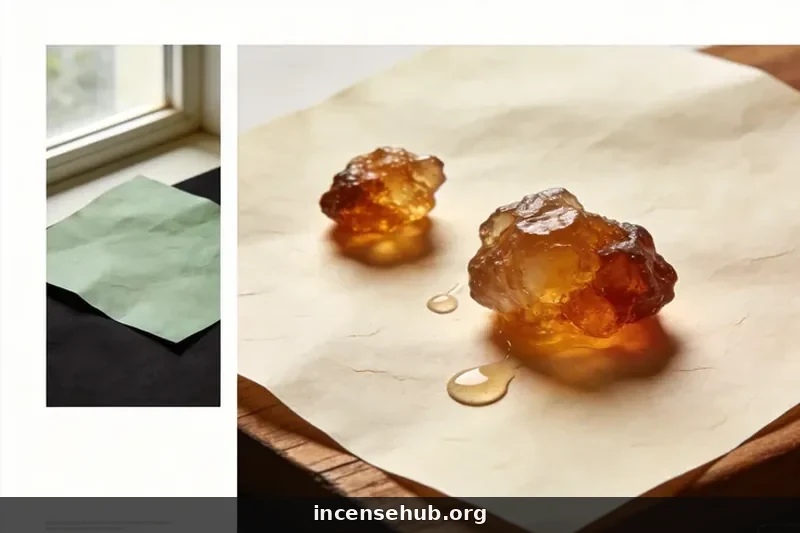
Direct answer: Storax (苏合香, sūhéxiāng) is an aromatic balsam obtained from the wounded inner bark of Liquidambar orientalis, the Oriental sweetgum of southwestern Asia Minor. In classical Chinese incense it was a prized imported resin, kept distinct from the native Chinese sweetgum (枫香, Liquidambar formosana) and from benzoin (安息香, Styrax spp.), with a sweet, balsamic warmth that reads faintly of cinnamon.
Key facts
| Chinese | 苏合香 (sūhéxiāng) |
| Botanical source | Liquidambar orientalis (Oriental sweetgum) — the balsam, not the wood |
| Family | Altingiaceae (formerly placed in Hamamelidaceae) |
| What it is | An aromatic balsam exuded from wounded inner bark |
| Aroma | Sweet, balsamic, resinous, warm, faintly cinnamon-like |
| Classical role | Imported incense resin; materia medica entry |
| Main confusion | Benzoin (Styrax spp.) and the native 枫香 (L. formosana) |
| Grade logic | Resin-rich and oily is aromatic; dry and woody is residue |
Key Takeaways
- Storax is a balsam from a sweetgum, not a wood, not a gum in the culinary sense, and not a benzoin.
- The English words storax and styrax point at different plants: one is Liquidambar, the other is the genus that yields benzoin.
- Classical Chinese sources treat 苏合香 as an import, and the name itself records that origin.
- The oldest quality rule in the literature — only the oily fraction is aromatic — is still the most useful test.
- Its role in a blend is softening and fixing, which is a different job from adding a top note.
The Short Version: A Resin With a Nationality
Direct answer: Storax is one of the few classical Chinese incense materials whose identity is inseparable from trade. It was not gathered in China; it arrived, and the names used for it preserve the route.
Most materials in the Chinese incense cabinet are named for what they are: 檀香 for sandalwood, 沉香 for agarwood, 柏子 for cypress seed. 苏合香 is named for where it came from — 苏合国, a name associated with Sogdiana in Central Asian trade geography. The plant is a sweetgum of Asia Minor. The material is a balsam, tapped from bark. The scent is sweet and balsamic with a cinnamon edge.
Three facts follow from that, and each one matters to a reader:
- It was expensive because it traveled. An imported resin in a market of domestic aromatics carries status, and status shapes how texts describe it.
- Its identity was recorded by traders as much as by botanists. Loanwords, Sanskrit transcriptions, and place names sit alongside the physical description.
- Its substitutes were available locally. The native 枫香 produces a related resin from a related tree, which is exactly the situation that produces centuries of confusion.
The page below takes those three facts seriously. It treats storax as a material with a botany, a trade history, a chemistry, and a set of practical tests — and it keeps the medical language of the sources at arm’s length, because traditional use is not the same thing as clinical evidence.
Name, Misname, and the Styrax Trap
Direct answer: The single most common error on this subject is reading “storax” and “styrax” as the same word. Storax comes from Liquidambar; the genus Styrax is the source of benzoin. They are different plants in different families with different scents.
The trap is built into European languages. The medieval Latin storax and the botanical genus Styrax look like variants of one term, and older commercial writing used “styrax” for both materials depending on the country and the century. A reader who searches for “styrax resin” will find pages about benzoin, pages about storax, and pages that confidently mix them.
The clean separation:
| Material | Botanical source | Family | Aroma direction | Chinese name |
|---|---|---|---|---|
| Storax | Liquidambar orientalis | Altingiaceae | Sweet, balsamic, cinnamon | 苏合香 |
| Chinese sweetgum resin | Liquidambar formosana | Altingiaceae | Lighter balsamic, greener | 枫香 |
| Benzoin | Styrax spp. (e.g. S. benzoin) | Styracaceae | Sweet, vanilla, almond | 安息香 |
| American storax | Liquidambar styraciflua | Altingiaceae | Balsamic, less cinnamon | — (no classical name) |
Two further notes keep the table honest. First, “American storax” is a real commercial material from the American sweetgum, and it is not the classical 苏合香. Second, in perfumery the word “styrax” is sometimes used as a trade name for storax absolute, which adds another layer to the confusion. The botanical name is the only stable identifier; trade names drift by market and by decade.
A practical rule: if a supplier says “styrax” without a Latin binomial, ask which genus. The answer tells you whether you are buying a cinnamon-sweet balsam or a vanilla-sweet one, and the two are not interchangeable in a formula.
Why the Chinese name is a loanword
Direct answer: 苏合香 does not parse as Chinese botanical description. It is a transcription, and the classical texts say so.
The Song-dynasty Xiangpu (香譜) traces the name to 苏合国 and records a Sanskrit form, 咄鲁瑟剑 (duruṣka), glossed as storax. That double record — a place name and a foreign word — is the signature of an imported commodity. Compare 枫香, which is transparently Chinese: 枫 the maple-like tree, 香 aromatic. One name describes a plant; the other describes a supply route.
This matters for identification because loanwords attract lookalikes. Once a name is detached from a plant, any sweet balsam from the right direction of travel can be sold under it. The classical literature fought that problem with physical description — density, color, ash, oiliness — rather than with etymology. That is a more modern instinct than it looks.
Where It Comes From: Asia Minor and the Sogdian Road
Direct answer: Liquidambar orientalis is native to southwestern Asia Minor, in the region of modern southwestern Turkey. The balsam is harvested from the bark, and the classical Chinese record places the trade origin much further east, in Sogdiana.
The tree is a sweetgum, a genus familiar to anyone who has seen the star-shaped leaves and spiky seed balls of Liquidambar styraciflua in North America. The Oriental species is smaller in range and confined to a warm, humid corner of the eastern Mediterranean basin. Its bark, when wounded, exudes a balsam that collects as a sticky, opaque mass and hardens on exposure.
The Chinese texts knew the material long before they knew the plant. 苏合国, associated with Sogdiana, was a trading polity in Central Asia, and the route from Asia Minor to China passed through several hands before a scholar in the capital ever saw the resin. That distance explains two features of the classical record: the emphasis on rarity and price, and the reliance on traders’ descriptions for origin.
There is a lesson here for anyone reading old material descriptions. Origin claims in premodern texts are trade claims, not botanical ones. “From 苏合国” means “entered the market through Sogdian intermediaries,” not “harvested in Sogdiana.” The plant’s actual range is Asia Minor. Both statements can be true at once, and the difference between them is the difference between a supply chain and a herbarium.
The same pattern appears with frankincense and myrrh, which were associated with named Arabian and African routes rather than with the specific hillsides where the trees grew. Aromatic materials travel well — they are light, valuable, and durable — so their trade geography is often much wider than their botany.
What the Balsam Is, Chemically
Direct answer: Storax is a resinous balsam whose characteristic sweetness comes from cinnamyl esters, with a small vanillin fraction that readers often describe as vanilla. It is not a single compound, and its behavior in a blend follows from that mixture.
The main aromatic constituents reported for storax include cinnamyl cinnamate (sometimes called styracin), cinnamyl alcohol, cinnamaldehyde, ethyl cinnamate, and vanillin, alongside resin acids and triterpenoid material. The exact profile varies with the tree, the harvest, and the method used to clean the balsam, which is one reason two samples can smell related without smelling identical.
For a reader, the useful consequences are these:
- The cinnamon note is chemistry, not added spice. Cinnamyl compounds produce the warm, spicy-sweet impression. A storax that smells strongly of cinnamon candy is not necessarily better; it may simply be a fraction richer in cinnamaldehyde.
- The vanilla note is a minor fraction doing a lot of work. Vanillin is present at low levels, and it is part of why storax reads as “sweet” rather than “resinous” alone.
- The resin acids carry the fixative behavior. They are heavy, slow to volatilize, and they hold lighter aromatic molecules in the blend. That is the physical basis of the “fixer” role described below.
- The balsam is not water-soluble in any useful sense. It is a resinous material; cleaning and separation rely on heat, straining, and sometimes solvent extraction rather than on washing.
Mechanism: resin-rich balsam → a mixture of volatile cinnamyl compounds and heavy resin acids → gentle heat releases the volatile fraction first → the sweetness blooms → the heavy fraction remains and continues to release slowly → the dry-down stays sweet instead of turning ashy.
That chain is why storax behaves differently depending on how it is heated. On a warm charcoal, the volatiles come off in a soft wave. If the coal is too hot, the same compounds can scorch and turn sharp, which is a defect of application rather than of material.
Aroma: Sweet, Balsamic, and Faintly Cinnamon
Direct answer: Storax smells sweet and balsamic with a warm cinnamon edge and a faint vanilla undertone. It is a softener rather than a projector, and its most useful property in a blend is that it makes other materials feel rounder.
The word “balsamic” needs unpacking, because it is used loosely in fragrance writing. Here it means the smell of a resin that is sweet rather than sharp — closer to a warm syrup than to a pine pitch. Storax sits firmly in that register. It has little of the citrus lift of frankincense, little of the church-like smoke of myrrh, and none of the camphoraceous bite of borneol.
In a burn, the profile moves through three phases:
- Opening. The first warmth releases the lighter cinnamyl fraction. The impression is sweet, slightly spicy, and soft.
- Middle. The resin acids take over and the scent becomes rounder and heavier, with the vanilla facet more visible.
- Dry-down. A persistent sweet-balsamic residue, which is the reason the material is valued as a fixative.
The intensity curve is gentle. Storax does not announce itself the way a citrus top note does; it modifies the blend around it. A reader smelling a stick that contains storax may notice that the whole composition feels smoother before noticing the storax itself. That is the intended effect, and it is also why an overdose is easy to miss: the blend does not become “more storax,” it becomes sweeter and heavier everywhere.
A boundary worth stating: sweet does not mean weak. Storax can dominate a dry-down if it is used at a high proportion, and the result is a cloying, syrupy finish that is hard to correct after the sticks are made. The material is forgiving in small amounts and stubborn in large ones.
The Oily-Grade Rule
Direct answer: Classical sources specify that only the oily, resinous fraction of storax is genuinely aromatic, and record that producers extracted the fragrant balsam first and sold the spent woody residue separately. That is a supply-chain warning from a thousand years ago, and it still describes the main quality problem.
The relevant classical observations are compact:
- 药中只用有膏油者极芳烈 — in medicine, only the storax with ointment-like oil is extremely fragrant.
- 大秦国人采得苏合香先煎其汁以为香膏乃卖其滓 — the people of Daqin, having collected storax, first boiled out its juice to make a fragrant paste, and then sold the dregs.
- 烧之灰白者好 — the grade that burns to a white ash is considered good.
- 重如石 — heavy as stone, a description of density.
Read together, these lines describe a material graded by resin content, not by origin or by appearance alone. The aromatic value sits in the oily fraction. The residue left after extraction is still storax in a loose sense — it is the same plant, the same bark, the same process — but it has lost the part that smells. Selling it as storax is the ancient version of selling spent material under a premium name.
An editorial grading scheme
No standardized commercial ladder for storax is asserted here. The table below is an editorial reading aid built from the classical criteria and from ordinary resin handling; it is not a trade standard, and no supplier is claimed to use these labels.
| Grade (editorial) | Appearance | Aroma at room temperature | Behavior on charcoal | Typical use |
|---|---|---|---|---|
| Resin-rich balsam | Soft, opaque, grey-brown to amber; sticky when warmed | Sweet, balsamic, cinnamon; clearly scented cold | Melts, bubbles gently, white-grey ash | Blending as a softener and fixer |
| Semi-hard balsam | Firmer, darker, less tacky | Sweet but quieter; needs warmth to open | Melts slowly, more smoke | Blending at higher proportion, or tincture |
| Dry woody residue | Crumbly, fibrous, dull | Faint, woody, slightly sour | Chars rather than melts; grey ash | Not the aromatic grade |
| Adulterated mass | Uniform, often too shiny; grit or foreign fiber | Sharp or flat; alcohol-like edge | Spits, blackens, leaves hard residue | Reject or investigate |
The bottom row deserves a note. Adulteration in resins usually takes one of three forms: adding a cheaper resin with a similar color, adding inert material to increase weight, or selling the spent residue with a little fresh balsam mixed back in. The first is the hardest to detect by eye and the easiest to detect by burn, because a foreign resin usually changes the ash and the smoke. The second shows up as grit or as a residue that does not melt. The third shows up as a material that smells acceptable in the jar and thin on the coal.
Mechanism: spent residue → most volatile cinnamyl compounds already removed → what remains is heavy and resin-poor → on heat it chars instead of melting → acrid smoke and a grey, gritty ash → the blend smells burnt at the finish rather than sweet.
That is the mechanism behind the classical preference, and it explains why the white-ash criterion was useful. Ash is a crude readout of what was in the material and what happened to it.
Tapping, Separation, and the Residue Trade
Direct answer: Storax is obtained by wounding the inner bark and collecting the balsam that exudes. The aromatic fraction is then separated from woody debris, and the quality of the finished material depends heavily on how cleanly that separation was done.
The sequence is a resin-tapping one, not a harvest:
- Wounding. The bark is cut or scored to reach the inner layers, and the tree responds by exuding balsam.
- Collection. The exudate is gathered as a sticky mass, often with bark fragments and grit included.
- Cleaning. Heat and straining separate the fragrant balsam from the woody residue and foreign matter.
- Grading. The cleaned material is sorted by consistency and scent, and the residue is a separate stream.
The classical line about boiling out the juice and selling the dregs describes steps three and four with unusual clarity. It also implies an economic fact that modern buyers should recognize: the residue has always had a market. It is not waste in the strict sense. It can be sold as a lower grade, blended into cheap products, or used where color and weight matter more than scent.
For a reader, the practical question is not “was this tapped?” but “what happened between tapping and packing?” A balsam that was cleaned carefully and packed without heat damage smells different from one that was boiled hard to maximize yield. Heat drives off the lightest fraction, and the lightest fraction is where the cinnamon sparkle lives.
The wider handling of resins in incense is covered in incense powder and resin, which is the right next read if you are working with storax in a formula rather than assessing a sample.
What Good Storax Looks, Feels, and Burns Like
Direct answer: Good storax is a soft-to-firm balsam with a visible resin sheen, a sweet scent at room temperature, and a clean melt on charcoal. The tests are simple, and they are more informative than a certificate for a material at this scale.
Look. Fresh, resin-rich storax is opaque and grey-brown to amber. It may look dull rather than glossy; extreme shine is more often a sign of added gum or of surface treatment than of quality. Look for uniform color and the absence of fibrous streaks.
Feel. Warm a small piece between the fingers. It should soften and become tacky. A material that stays hard and crumbly at body temperature is either old, resin-poor, or not storax. A material that turns liquid immediately is likely cut with a softer resin or an oil.
Smell. At room temperature, a resin-rich sample is clearly sweet and balsamic. Warm it gently — a hand-warm spoon is enough — and the cinnamon facet should open. If the scent only appears when the material is nearly burning, the volatile fraction is low.
Burn. On a piece of charcoal, a small sample should melt, bubble gently, and release sweet smoke. The ash should be pale and light. Black, hard residue, spitting, or a sharp acrid note points to adulteration or to a residue-grade material.
The limits of these tests: they cannot tell Liquidambar orientalis from L. formosana with certainty, and they cannot quantify resin content. They can separate a resin-rich balsam from a spent residue, which is the distinction that matters most in commerce. Where species identity is critical, the reference standards are botanical: Liquidambar orientalis on GBIF and Liquidambar formosana on GBIF.
Storax in the 君臣佐使 Frame
Direct answer: In the classical blending vocabulary of 君臣佐使 (chief–minister–assistant–guide), storax rarely takes the chief role. It works as an assistant that softens the chief material and as a guide that holds the composition together.
The 君臣佐使 framework is a way of describing hierarchy in a formula: a chief material sets the character, ministers support it, assistants moderate or extend it, and guides carry the blend. It is a traditional organizing idea, not a laboratory model, and it is most useful as a set of questions rather than a set of rules.
Read through that frame, storax has two jobs:
- Assistant (佐). It rounds off sharp edges. A blend with a bright frankincense top and a dry sandalwood base can feel disjointed; storax bridges the two by adding a sweet, resinous middle.
- Guide (使). It slows the release of lighter molecules, which extends the dry-down. This is the fixative role, and it is the one that shows up most clearly when storax is omitted from a formula that previously contained it.
An editorial caution: the 君臣佐使 vocabulary can make a formula sound more systematic than it is. The framework describes relationships, not quantities. Two makers can both say “storax as assistant” and use it at very different percentages, with very different results. The useful discipline is to state the role and the proportion, and to test the proportion at the burn rather than on paper.
How much is enough
There is no universal percentage, and any page that gives one should be read with suspicion. What can be said is directional:
- At a low proportion, storax reads as roundness. The blend feels smoother and the finish lasts longer.
- At a middle proportion, it reads as a distinct sweet-balsamic note and starts to shape the dry-down.
- At a high proportion, it dominates and can turn the finish syrupy.
The practical method is a ladder: make three small batches at increasing storax load, burn them side by side, and note where the sweetness stops supporting and starts leading. That test costs a few sticks and settles a question that no description can.
Pairing and Substitution
Direct answer: Storax pairs best with materials that need softening — frankincense, myrrh, sandalwood, agarwood — and substitutes only partially with benzoin, 枫香, labdanum, or Peru balsam. Each substitute changes the direction of the sweetness, not just its amount.
| Need in the blend | Storax | Benzoin | 枫香 | Labdanum | Peru balsam |
|---|---|---|---|---|---|
| Sweet-balsamic middle | Best fit | Sweeter, more vanilla | Lighter, greener | Deeper, leathery | Very sweet, cinnamon-heavy |
| Fixative effect | Strong | Strong | Moderate | Strong | Moderate |
| Cinnamon facet | Present, soft | Absent | Absent | Absent | Present, stronger |
| Classical Chinese context | 苏合香 | 安息香 | 枫香 | Not classical Chinese | Not classical Chinese |
| Risk in overdose | Cloying | Powdery, flat | Thin, hay-like | Heavy, sticky | Sticky, sharp |
The table is a decision aid, not a claim of equivalence. Benzoin is the closest substitute in function — it is also a resinous fixative with a sweet character — but it moves the blend toward vanilla and away from cinnamon. 枫香 is the closest substitute in botany and the furthest in scent: a related tree, a lighter resin, a different classical identity. Labdanum and Peru balsam are not substitutes at all in the classical sense; they are alternative ways of achieving sweetness and fixation in a modern formula.
A reader’s rule: substitute by function first and by scent second. If the function is fixation, several materials will do. If the scent is the point — a classical recipe that names 苏合香 — substitution changes the recipe, and the honest move is to say so rather than to rename the result.
Handling and Storage
Direct answer: Storax is a soft resin that responds to heat and air. Store it cool, sealed, and away from light, and expect the surface to darken before the interior does.
Practical handling notes:
- Cool and sealed. Warm storage softens the balsam and encourages it to spread into packaging. A cool cupboard is better than a shelf above a stove.
- A barrier matters. Resins can migrate through paper. Glass or a lined container is preferable for long storage.
- Surface oxidation is normal. A darker skin on the outside of a stored mass is not necessarily a defect; break it open and smell the interior before judging.
- Avoid repeated warming. Every warm-cool cycle moves volatiles to the surface, where they are lost. Warm only the portion you are about to use.
- Keep it separate. Storax is strongly scented and will transfer to nearby materials, especially powders and papers.
For a maker, the storage question is really a batching question: buy in quantities that will be used within the period the material holds its character, rather than in quantities that require long storage. The material is not fragile in the way a fresh leaf is, but it is not inert either.
Traditional Use, Historical Record, and the Limits of Claim
Direct answer: Storax has a long record in classical Chinese materia medica, including the famous 苏合香丸 formula. That record is historical and traditional. It is not clinical evidence, and this page makes no medical claims.
The layers separate cleanly:
- Traditional use. 苏合香 appears in classical formulas and is described in materia-medica language. This is traditional belief and historical practice, recorded because it explains the material’s status and trade value.
- Historical record. The Song Xiangpu and Ming Xiangcheng record the name, the foreign origin, the Sanskrit transcription, the density description, the white-ash criterion, and the oily-grade rule. These are documentary facts about what was written, not proof of efficacy.
- Botanical and chemical record. The identity of Liquidambar orientalis, its family placement, and the presence of cinnamyl esters and vanillin are established botanical and phytochemical facts.
- Clinical evidence. No claim is made here that storax treats, cures, or prevents any condition. The page takes no position on medicinal use beyond noting that the tradition exists.
The boundary that matters: describing a tradition accurately is not the same as endorsing it. A reader interested in the medical history should read it as history — what people believed, recorded, and traded — rather than as a protocol. Anyone considering a medicinal use should consult a qualified practitioner, and should not rely on an incense reference for guidance.
Safety
Direct answer: The safety issues for storax are the ordinary ones for a resin burned on charcoal, plus a sensitization caution for people who react to cinnamon-family materials.
- Smoke and particulate matter. Any incense combustion produces smoke and fine particles. Burn in a well-ventilated space, avoid inhaling concentrated smoke, and keep the burner away from children and pets. The site’s safety guide covers the general case.
- Skin contact. Resinous balsams can irritate sensitive skin. Handle the neat material with care, and avoid repeated contact if you know you react to cinnamyl compounds, which are the same family responsible for cinnamon sensitivity.
- Do not ingest. This page describes an aromatic material for incense. It is not a food ingredient and not a medicine.
- Heat and fire. Charcoal burners reach high temperatures. Use a heat-proof holder, keep the burner stable, and never leave it unattended.
- Sensitization is cumulative. A reaction that does not appear on first contact can appear after repeated exposure. If you handle resins regularly, gloves are a sensible default.
No claim is made that storax smoke is safe to inhale, and no claim is made that it is unusually hazardous. It is a combustible aromatic material, and it should be treated like one.
Reading a Supplier’s Claim
Direct answer: Four words do most of the selling in this material — pure, Turkish, oily, and wild — and each one means less than it appears to. The useful move is to translate each claim into a question about evidence.
“Pure.” Pure relative to what? A balsam is a mixture by nature, so purity can only mean “no added material.” That is a legitimate claim, and it is testable by burn and by smell, but it says nothing about resin content. A pure sample of spent residue is still pure.
“Turkish.” The tree’s native range is southwestern Asia Minor, so Turkish origin is plausible and common. Origin is not grade. A Turkish balsam can be resin-poor, and a well-cleaned balsam from a neighboring region can be excellent. Treat origin as a provenance note, not a quality score.
“Oily grade.” This is the most meaningful of the four, because it points at the quality criterion the classical texts actually used. Ask how the oiliness was assessed — by appearance, by feel, by resin-content testing, or by the supplier’s own description. The word is only as good as the method behind it.
“Wild.” Wildcrafted material comes from trees in their natural range rather than from a plantation. That is a harvest-source claim, not a sustainability certification, and the two are often conflated in marketing. A reader who cares about the conservation question should ask for the specific scheme and the certificate number rather than the adjective.
Balsam, absolute, oil: three different products
| Form | What it is | Behavior in a blend | What to ask |
|---|---|---|---|
| Balsam / resin | The cleaned exudate | Melts, softens, fixes; carries the full scent | Resin content; cleaning method |
| Absolute | Solvent-extracted concentrate | Stronger, darker, more soluble; different dose | Solvent used; yield ratio |
| Essential oil | Distillate of the balsam | Lighter, more top-note, less fixative | Distillation method; what was separated off |
The distinction matters because a formula written for balsam will not behave the same with an absolute at the same weight. The absolute is more concentrated, so the same number gives a much stronger effect; the essential oil has lost much of the heavy fraction that made the balsam a fixative. Substituting one form for another without adjusting the dose is a common way to produce a blend that smells wrong in a way nobody can identify.
FAQ
Is storax the same as benzoin? No, and the naming overlap is the usual cause of the mistake. Storax (苏合香) is the balsam of Liquidambar orientalis, a sweetgum in the Altingiaceae. Benzoin (安息香) comes from trees in the genus Styrax, family Styracaceae. The English words look alike, the plants are unrelated, and the scents differ: storax is sweet-balsamic with a cinnamon edge, benzoin is sweet-vanilla with an almond note. See the benzoin entry for the other side of the comparison.
What is the difference between storax (苏合香) and sweetgum (枫香)? Both are resins from Liquidambar trees, but from different species and different regions. Storax is L. orientalis, native to southwestern Asia Minor and imported into China; 枫香 is L. formosana, native to China. The classical 苏合香 was specifically the imported material, which is why this site treats them as separate entries rather than as synonyms. The sweetgum page covers the native resin.
What does storax smell like? Sweet, balsamic, and resinous, with a warm cinnamon-like edge and a faint vanilla undertone. It is a softening material rather than a sharp one, and in a blend it tends to make the composition feel rounder before it announces itself. The scent opens with gentle warmth and leaves a persistent sweet-balsamic dry-down.
Where does storax come from? The balsam is tapped from the wounded inner bark of Liquidambar orientalis, native to southwestern Asia Minor, in the region of modern southwestern Turkey. In classical Chinese texts it was an imported material, associated with 苏合国 (Sogdiana) and recorded with the Sanskrit name 咄鲁瑟剑 (duruṣka). The import route, not the botany, explains the name.
Why do classical texts emphasize the oily grade? Because the aromatic compounds sit in the resinous fraction. The classical record says that only the oily material is strongly fragrant, and that producers boiled out the fragrant portion first and sold the spent residue. A dry, woody, low-resin “storax” is therefore not the aromatic grade, even though it may come from the same tree and the same process.
Is storax a wood? No. It is a balsam — a resinous exudate from the bark. The tree is a wood, and the spent bark and woody residue left after extraction are wood-like, but the material sold as storax is a resin. The distinction matters because “wood” implies a solid aromatic heartwood, and storax behaves like a soft resin: it melts, it sticks, and it releases scent with gentle heat.
Can storax be used as a substitute for benzoin in a fixative role? Partly. Both are resinous fixatives with sweet characters, so the functional swap often works. The scent direction changes: storax brings a cinnamon-balsamic warmth, benzoin brings vanilla and almond. In a formula where the fixative is the only job, the swap is reasonable; in a formula where the sweet note is the point, it is a different recipe.
How should storax be stored? Cool, sealed, and away from light, in glass or a lined container. Warm storage softens it and encourages migration into packaging; repeated warming pushes volatiles to the surface where they are lost. A darker surface skin is normal — break the mass and smell the interior before judging the batch.
Sources
- Liquidambar orientalis on GBIF — the botanical reference for the storax tree.
- Liquidambar formosana (枫香) on GBIF — the native Chinese sweetgum, included for the species distinction.
- Classical Chinese materia medica as transmitted in the Song Xiangpu (香譜) and Ming Xiangcheng (香乘): the 苏合国 / 咄鲁瑟剑 (duruṣka) naming record, “heavy as stone,” the white-ash criterion, and the oily-grade passage. These are historical records of traditional description, not modern clinical evidence.
- The storax / 枫香 / benzoin separation is presented as practical screening guidance, based on botanical identity rather than on trade names.
Related Resources
- Sweetgum (枫香) — the native Liquidambar resin, and the nearest botanical relative in the Chinese cabinet.
- Benzoin (安息香) — the Styrax resin behind the English naming confusion.
- Amber — another fossil or semi-fossil resin used for warmth in blends.
- Incense Powder and Resin — how resinous materials are handled in a formula.
- Scent Guide — the broader map of aromatic families this material sits in.
- Incense Blending System — the 君臣佐使 framework in more detail.
Summary
Storax (苏合香) is the balsam of Liquidambar orientalis, the Oriental sweetgum of southwestern Asia Minor. It reached China as an import, and its name preserves the trade route rather than the botany. It is distinct from the native 枫香 (L. formosana) and from benzoin (Styrax spp.), despite the near-collision of “storax” and “styrax” in English. Its aroma is sweet, balsamic, and faintly cinnamon-like; its role in a blend is softening and fixation rather than projection. The classical rule that only the oily fraction is aromatic remains the most practical quality test, and the material’s medicinal history is treated here as tradition, not evidence.