
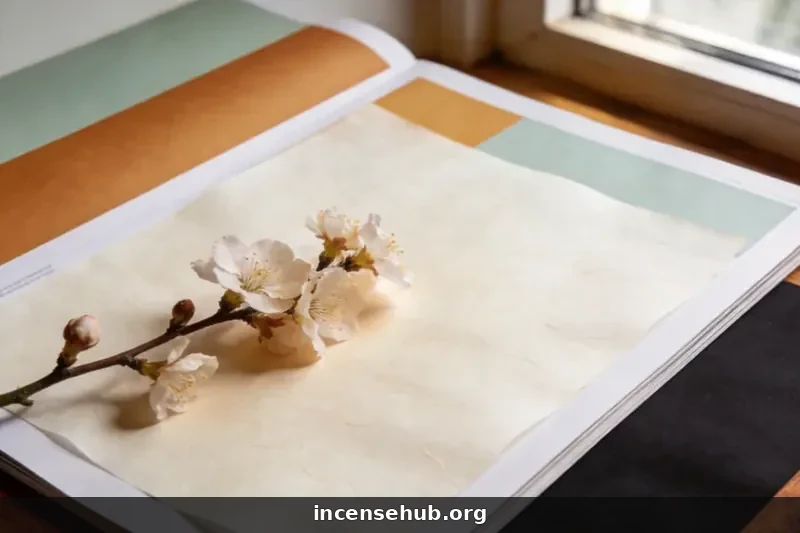
Direct answer: Yulan magnolia (玉兰, yùlán) is the open flower of Magnolia denudata, a deciduous magnolia native to central and eastern China. It is a fresh, green-lemon white floral used as a light top note in scenting and blended incense — and it is a different material from 辛夷, the dried unopened bud of Magnolia biondii.
Key facts
| Chinese name | 玉兰 (yùlán), literally “jade orchid”; also 白玉兰 |
| Botanical source | Magnolia denudata Desr., family Magnoliaceae; Flora of China places it in the segregate genus Yulania as Yulania denudata |
| Plant part | The open flower — not the bud, not the wood, not a resin |
| Aroma register | White floral, fresh, green, with a lemon edge |
| Documented classical role | Garden ornamental and emblem of early spring; no entry in the 香乘 incense compendium |
| Practical use today | Scenting, sachets, and light floral top notes in blends |
| Main confusion | 辛夷 (xīnyí), the dried unopened bud of Magnolia biondii |
The material in brief
Direct answer: 玉兰 is a flower, and that single fact shapes everything about how it is bought, dried, stored and burned.
Most materials in an incense cabinet are structural: woods give body, resins give sweetness and smoke, roots and barks give weight. A flower does none of that. It contributes a surface note — the part of a blend that is noticed first and forgotten first — and it does so with a chemistry that is designed by the plant to disperse into air and disappear. That is not a defect to be corrected. It is the material’s nature, and the whole craft of using 玉兰 consists of accepting it and working with it.
The name helps fix the picture. 玉 means jade, 兰 is the character Chinese gardeners and poets attach to many fragrant plants; together they read as “jade orchid”. The plant is not an orchid, and the name never claimed it was. Chinese horticultural naming often works by resemblance and association rather than by taxonomy: a white, early, elegant flower earns the jade comparison, and 兰 supplies the fragrance connotation. Reading the name as a botanical statement is the first small mistake a new reader makes.
What the name does record accurately is colour and season. The flowers are white — sometimes with a blush of pink at the base of the tepals — and they open before the leaves, on bare grey branches, in the last cold weeks of winter. A tree in full bloom in February reads as a promise that the season has turned. That image, more than any incense formula, is why the flower is famous.
Botanical identity: the tree Flora of China describes
Direct answer: Magnolia denudata is a large deciduous tree — up to 25 m tall, with a trunk to 1 m in diameter — whose fragrant white flowers open before the leaves in February and March.
Flora of China gives a precise portrait, and the details are worth keeping because they explain the material’s limits. The tree can reach 25 m, with a trunk up to a metre across and bark that is deep grey and coarsely fissured. Its leaf blades are obovate to broadly obovate, 10–15 cm long and occasionally to 18 cm. The flowers appear before the leaves, stand erect, measure 10–16 cm across, and carry nine white tepals that are oblong-obovate and usually pinkish at the base. Flowering runs February to March; fruit follows from August to September.
The wild range is a band of central and eastern China: Anhui, Chongqing, northern Guangdong, Guizhou, Hubei, Hunan, Jiangxi, Shaanxi, Yunnan and Zhejiang, in forests at 500–1,000 m. Flora of China notes the tree is grown as an ornamental and for timber, and that it is widely cultivated in temperate parts of the world. Those two lines matter commercially: this is not a rare wild herb gathered by specialists, but a familiar garden and street tree with a very large cultivated population.
Taxonomy adds a layer that trips up catalogue readers. Flora of China treats the plant in the segregate genus Yulania, as Yulania denudata, while GBIF accepts Magnolia denudata. Both names describe the same tree. A supplier listing “Yulania denudata flower” and a reference book listing “Magnolia denudata” are not in conflict; they are using two accepted placements of one species. The practical rule is to check the specific epithet, denudata, rather than the genus initial.
The family context explains the flower’s construction. Magnolias are an ancient lineage, and their blooms are built for beetles rather than for bees: an open, cup-like flower with tough tepals, abundant pollen and a scent that carries across still air. The nine tepals are not a fixed count across the genus — it is what this species shows — and the “petals” are technically undifferentiated tepals, which is why botanists avoid the word petal for them. For a writer or buyer, the useful consequence is that the flower is robust in structure but thin in tissue: a large, fleshy-looking bloom that is, in fact, mostly water and very light dry matter.
Flower versus bud: the distinction that decides everything
Direct answer: 玉兰 is the open flower of Magnolia denudata; 辛夷 is the dried, unopened bud of Magnolia biondii and related species. They differ in species, in plant part, and therefore in aroma, price and classical standing.
This is the page’s central distinction, and it deserves to be stated plainly before any sensory description. An open flower and a closed bud are not two grades of one commodity. They are two plant organs, harvested at different moments, with different chemistry and different behaviour in a blend.
The bud is a compact, scaled structure built to survive winter. Its tissues are dense, its surfaces are waxy and protective, and the aromatic material inside is held in a small volume. That is why a dried bud reads spicy and camphoraceous: the volatiles are concentrated, and the waxy, resinous fractions come along with them. The open flower is the opposite architecture. Its scent is a display, spread over a large, thin surface, and its volatiles are the lightweight, mobile fraction that can travel on air. Dry it and you keep the shape; you do not keep the volume of oil.
| 玉兰 (open flower) | 辛夷 (dried bud) | |
|---|---|---|
| Species | Magnolia denudata | Magnolia biondii and relatives |
| Plant part | Open bloom | Unopened bud |
| Tissue | Thin tepals, high water content | Dense scales, waxy surface |
| Aroma | Fresh, green, lemon-tinged white floral | Spicy, camphoraceous, resinous |
| Behaviour in a blend | Lifts the opening; fades early | Pushes through the middle; can dominate |
| Classical standing | Garden ornamental and spring emblem | A recognised incense and materia-medica material |
The last row is the one buyers underestimate. A material’s classical standing is not a marketing label; it predicts how a formula will treat it. 辛夷 has a documented place in incense and medicine, and formulators have centuries of experience with its dose. 玉兰 has a documented place in gardens and poetry. Using it in incense is a modern, perfectly legitimate choice, but it is an act of adaptation rather than inheritance.
One more wrinkle is worth naming. Commercial 辛夷 is sometimes collected from the buds of related magnolias, including M. denudata, so the species boundary in trade is softer than the botanical boundary. That does not make the flower and the bud interchangeable — the plant part still separates them — but it does mean a label saying “magnolia bud” tells you less than a label naming the species and the part. The distinction matters most precisely where the supply chain is least specific.
Aroma: thin, green, and built to evaporate
Direct answer: 玉兰 smells of cool white petals, cut green stems and a squeeze of lemon peel, with none of the heavy indole that makes jasmine opulent and none of the camphor that makes 辛夷 sharp.
The first impression is freshness rather than sweetness. Think of the air around a cut magnolia branch on a cold morning: a clean, slightly waxy white-floral body, a green sap edge, and a citrus lift that reads more like lemon peel than like lemon juice. The sweetness is there but it is dry, not syrupy. Nothing in the profile is dark, animalic or resinous.
That profile is the direct consequence of the flower’s function. A bloom that must attract a beetle across a few metres of still air produces a volatile bouquet that is light, highly mobile and chemically simple compared with the complex heavy molecules that give jasmine its indole and rose its deep honeyed weight. The scent is a signal, not a store. Once the flower is picked, the signal has no reason to persist, and it does not.
Compared with its own bud, the difference is a change of register rather than a change of family. Both smell “magnolia” in the broad sense; the bud is the same theme played low and with resin, the flower the same theme played high and with air. This is why a formulator who knows 辛夷 should not assume they know 玉兰. The materials rhyme, but they occupy different positions in a composition.
There is a useful test here for anyone judging a sample. A fresh, well-handled flower smells cool and slightly sharp at the edges, with the green note intact. A flower that has spent too long in a warm box smells of hay, stewed tea or dried apple — the green has gone and a brown sweetness has taken its place. That hay note is not a variety characteristic. It is the signature of volatile loss and oxidation, and it is the single most common defect in the material.
From branch to shelf: harvest, drying, and the fate of the note
Direct answer: 玉兰 is a perishable flower, so the note is decided in the first hours after picking: cool handling, fast but gentle drying, and no stacking while wet.
The flower opens over a short window in late winter and early spring. It is thin-tissued, high in water, and prone to browning when bruised. Every step between the branch and the storage jar either preserves the green-floral top or converts it into something flatter.
The mechanism is not complicated. Water leaves the tepal; as the tissue dries, the lightweight volatiles that carry the fresh note leave with it, and oxygen and residual moisture begin converting what remains into heavier, duller compounds. The result is the hay-and-stewed-fruit smell described above. Speed helps retain colour and shape, but heat accelerates the same loss — which is the trap. A fast hot dry gives a pretty flower with a flat smell; a slow cool dry gives a less pretty flower with more of the note, provided the air moves and the material does not sit wet.
Two chains are worth writing out, because they explain most of the failures a buyer will see:
- Warm, still air → tepals stay damp → enzymatic browning and mould at the base → musty, hay-like flower → note lost before storage even begins.
- Direct sun or a hot drying surface → surface temperature climbs → volatile oils evaporate faster than water → flower dries pale and scentless → visual quality high, aromatic quality low.
The practical sequence that follows is: pick in the cool part of the day, keep the flowers shallow and unbruised, dry in moving air away from direct sun, and turn or restack gently and rarely. The exact conditions depend on the room and the weather; there is no universal number to quote, and any supplier who offers one without knowing the batch is guessing.
Judging the dried result is easier than judging the process. A well-dried flower keeps a pale ivory-to-cream colour, holds its shape, feels papery rather than leathery, and still releases a green-floral scent when a tepal is crushed. A badly dried one is brown at the edges, limp or brittle in patches, and smells of hay or dust. The colour check is fast; the crush check is decisive.
The cutting window
Direct answer: The flower is at its aromatic best in the first days after opening, and material picked after the bloom has passed is visibly and olfactorily older.
Timing is the least glamorous variable in the whole chain and one of the most consequential. A magnolia bloom does not open all at once, and it does not stay in condition for long. The window between a tight, half-open flower and a tired, browning one is measured in days, and the scent changes across that window.
A half-open flower is still metabolically active. Its tissues are intact, its surfaces are protected, and the volatile profile is at its most complete. A fully open flower is at peak display but beginning to senesce; the edges are the first to go. A flower past its peak has begun to break down, and the breakdown products — the brown, stewed, hay-like notes — are exactly what a buyer will later smell in a badly handled dried lot. Picking late does not just reduce quality; it starts the defect before drying begins.
The practical consequences are simple to state and hard to guarantee at scale. Harvest in the cool part of the day, when the tissues are turgid and the volatiles are not being driven off by heat. Handle the blooms by the base, not the tepals, because bruising starts the same browning that heat starts. Keep the harvest shallow and move it into drying quickly, because a warm sack is a small composting environment. A supplier who can describe these steps is describing a process; a supplier who cannot is describing a hope.
Grading a lot without a grading standard
Direct answer: There is no published commercial grading ladder for 玉兰, so a buyer grades on plant part, aroma, colour, dryness and cleanliness, in that order.
Absence of an official standard does not mean grading is arbitrary. It means the buyer has to build a defensible order of checks and apply it consistently. The order below puts identity first, because everything after it is wasted effort if the material is the wrong organ or the wrong species.
| Check | What good looks like | What it rules out |
|---|---|---|
| Plant part | Whole open blooms, tepals attached, no bud clusters | 辛夷 substitution or a mixed lot |
| Species claim | M. denudata named; genus synonym understood | Vague “magnolia flower” labels |
| Aroma | Cool green-floral with a lemon edge when crushed | Heat damage, age, oxidation |
| Colour | Ivory to cream, pink blush at the base acceptable | Sun bleaching, scorching, mould staining |
| Dryness | Papery, springs back lightly, no soft centres | Under-drying, which invites mould |
| Cleanliness | No grit, insect frass, leaf litter or dust | Poor handling and storage |
The reasoning behind the order is simple: a beautiful lot of the wrong material is worthless, and a clean, well-coloured lot with no smell is worth very little. Identity and aroma carry most of the value; appearance carries the rest.
One boundary is worth stating, because it is where buyers get talked into bad purchases. A large, intact, snow-white bloom is not automatically a better buy than a smaller, cream-coloured one. Bleaching and over-drying can produce a striking appearance at the cost of the note, and the flower’s value in this context is aromatic. Appearance is a proxy, not the goal. That is an editorial judgment, but it follows directly from what the material is used for.
Using 玉兰 in a blend
Direct answer: Treat 玉兰 as a top note: add it for lift and transparency, dose it modestly, and expect it to recede as the blend burns or ages.
A flower with a light, mobile scent does not behave like a wood or a resin. It sits at the front of the composition, colours the first impression, and then gives way. A formulator who expects it to hold the middle of a blend will over-dose it, and over-dosing produces a thin, soapy floral haze rather than more flower.
The practical moves are these. Use it where a blend needs air — over a sweet resin base, beside a dry wood, or against a green herb — rather than where it must carry weight. Keep the supporting structure simple, because a delicate top note disappears against a busy middle. And accept a short horizon: a blend built around 玉兰 will smell most like itself when fresh.
- Resin-heavy base → 玉兰 on top → brighter opening, same warm drydown. The flower does not sweeten the resin; it makes the first minute feel cooler and more transparent.
- Wood-and-flower pairing → 玉兰 against a dry, non-resinous wood → the green note reads clearly → a clean, spring-like opening that fades into the wood.
- Over-dosing → the floral fraction dominates the top → the blend smells soapy and thin → the flower’s character is lost even though more was used.
There is a further point about application. This is a dried flower, not a distilled oil, and a dried petal does not burn well on its own: it chars, smoulders unevenly, and produces smoke without much scent. The material is at its best as a scenting agent — in sachets, in layered paper, in a sealed box with other materials — or as a minor component in a blend that has a proper combustible base. Anyone expecting a petal to behave like an incense stick will be disappointed, and that is a fact about the material rather than a fault in the material.
| Partner | What 玉兰 adds | What goes wrong |
|---|---|---|
| Dry sandalwood-type wood | A cool, green opening over a steady base | Too much flower reads soapy against a quiet wood |
| Sweet resin (benzoin, labdanum family) | Transparency that keeps the resin from feeling heavy | The flower is swallowed if the resin is dosed high |
| Green herbs (agastache, artemisia) | A spring-garden accord with a lemon edge | The two greens compete and the blend turns sharp |
| Light citrus peel notes | A brighter, cleaner lift | The citrus and the flower blur into one undifferentiated top |
| Warm spice (cassia, clove) | A surprising cool-against-hot contrast | Spice overwhelms the flower unless the flower is refreshed |
The table is a set of hypotheses, not rules, and it is meant to be tested in small batches. What it shows is the pattern: 玉兰 works as a modifier. It changes how the opening of a blend feels, and it does very little to the drydown. Formulas that succeed with it are built around that fact.
Where it sits among white florals
Direct answer: 玉兰 belongs to the cool, transparent end of the white-floral spectrum — closer to a spring garden than to the heavy, honeyed, indolic blossoms of warm climates.
White florals are not one family. The category stretches from clean and airy to dense and almost narcotic, and a material’s position on that line predicts how it will behave in a blend far better than its colour or its name. Placing 玉兰 on the line is a useful exercise, because it prevents the most common formulation error: treating all white flowers as interchangeable.
At the dense end sit jasmine and gardenia, whose scents carry a heavy, creamy, sometimes slightly animalic sweetness. At the middle sit champaca and osmanthus, warm and fruity-floral, with a honeyed or apricot-like weight. At the cool end sit 玉兰 and the lighter spring blossoms: white, green-edged, transparent, and short-lived on the skin or in the air. The distinction is not about strength. A cool floral can be intense while it lasts; what separates the ends is weight and the presence of the heavy, clinging molecules that make a scent feel opaque.
| Material | Climate | Weight | Dominant impression | Behaviour in a blend |
|---|---|---|---|---|
| 玉兰 | Temperate spring | Light | Green-white, lemon edge | Lifts the opening, fades early |
| Jasmine | Warm | Heavy | Creamy, indolic, narcotic | Dominates the heart, persists |
| Gardenia | Warm | Heavy | Buttery, coconut-adjacent white floral | Fills the middle, can turn cloying |
| Champaca | Tropical | Medium-heavy | Fruity, tea-like, honeyed | Colours the heart, needs space |
| Osmanthus | Subtropical | Medium | Apricot, leather, tea | Bridges floral and fruity notes |
The table is editorial — a working map, not a laboratory classification. Its value is diagnostic. If a formula calls for a “white floral top” and the maker reaches for jasmine, the result will be bottom-heavy; if the maker reaches for 玉兰, the result will be airy but brief. Neither is wrong. They answer different briefs.
This is also where the flower’s garden identity and its perfumery identity converge. A spring bloom that appears before the leaves is, by definition, a plant that invests in a short, high-visibility reproductive event. The scent is calibrated to that event: strong enough to be found, light enough to travel, and not built to last for weeks. Reading the horticulture explains the perfumery.
Scenting a room with dried flowers
Direct answer: Dried 玉兰 is best used passively — in sachets, layered paper, or a closed box — where its volatile note can escape slowly into still air.
There is a whole category of fragrant material that is not burned. Dried flowers belong to it, and using them well requires a different set of habits from incense. The goal is not smoke or heat but a slow, low-concentration release of volatiles into a small volume of air.
The simplest method is a sachet: a small cloth or paper bag, filled loosely with dried flowers, placed in a drawer, a cupboard or a linen chest. The scent diffuses through the fabric and accumulates in the enclosed space. A second method is layering: alternate flowers with blotting paper or unscented tissue in a sealed box, let the paper take up the note over days or weeks, then use the paper as a scented liner. A third is direct display in a shallow bowl, which gives the weakest and shortest effect but the most visual pleasure.
The mechanics explain the limits. Passive scenting depends on concentration gradients and air movement: the note leaves the flower, accumulates near the surface, and is carried away by draughts. In a sealed drawer the concentration builds and the effect lasts; in an open room the note is diluted almost immediately and the material is spent faster. Heat speeds the process and shortens its life. Sunlight does the same, and adds colour damage.
- Sealed small volume → volatiles accumulate → noticeable scent for weeks → refresh by crushing a few tepals.
- Open room → constant dilution → faint, short-lived effect → material exhausted without ever being strongly smelled.
- Warm, sunny display → rapid evaporation → strong first day, flat second week → colour bleached as well.
This is why the same material can seem impressive in a drawer and disappointing on a shelf. The difference is the container, not the flower. A buyer who understands the mechanism will stop asking which batch is “strongest” and start asking which use the batch is for.
Ten minutes with a sample
Direct answer: A sample can be assessed in four quick passes — look, crush, smell over time, and check for dust or mould — and the result is more reliable than any certificate for this material.
Beginners tend to smell a sample once and decide. A slightly longer routine gives a much better answer, because dried flowers change as the volatiles reach the nose.
Look. Spread a small amount on white paper. Check for whole blooms, intact tepals, consistent colour, and the absence of dark patches, insect fragments or fine dust. Colour should be ivory to cream, with a pink blush at the base acceptable. Uniform snow-white is a warning, not a virtue, if the smell is flat.
Crush. Take one tepal and roll it between the fingers. The note should arrive within a few seconds: cool, green, floral, with a lemon edge. If nothing arrives, the sample is spent. If a hay or dust note arrives instead, it has been damaged.
Smell over time. Smell the crushed material again after a minute and again after five. A good sample keeps a recognizable floral core while the sharp top fades. A poor sample collapses into a generic dry-plant smell almost at once.
Check the residue. Rub the crushed tepal on the paper. A clean sample leaves little or no oily mark and no gritty feel. Grit suggests soil or poor cleaning; an oily mark suggests the material has been stored warm or contaminated.
The routine is not a substitute for knowing the species and plant part. It is a way of testing whether the material has been handled with care, and for a dried flower that is most of what a buyer can know before a blend is made.
Sourcing questions that actually discriminate
Direct answer: Ask about species, plant part, drying method and harvest year — four questions that a serious supplier can answer immediately and an assembler of generic “dried magnolia flower” cannot.
Most sourcing conversations fail because they ask questions that invite a yes. “Is it good quality?” and “Is it natural?” produce assurances, not information. The four questions below produce answers that can be checked against the material in the box.
Which species, and which plant part? The answer should name Magnolia denudata and the open flower. A reply that says “magnolia flower” without the part is not an answer, because the same phrase covers the bud of a different species. If the supplier offers Yulania denudata, that is the same plant under the Flora of China placement and is fine.
How was it dried? Look for a description of moving air, shade, and shallow layers. A supplier who says “sun-dried” is not necessarily wrong — the material can be sun-dried in cool weather — but the answer should acknowledge the trade-off between speed and volatile loss. A supplier who has never thought about it will say “normally”.
Which harvest? The flower is a spring material, so the crop year is meaningful. Last year’s stock is not defective by definition, but it will be flatter, and the price should reflect that. A supplier who cannot state the year is not tracking the thing the buyer most needs to know.
May I see the crush test? This is the practical one. A small sample crushed between the fingers should release a green-floral note within a few seconds. If the sample smells of hay, dust or nothing, the answer to every earlier question is academic.
None of these questions requires a laboratory. They require a supplier who knows the material, and that is exactly what the buyer is trying to establish.
Storage: the quiet failure mode
Direct answer: 玉兰 fades in storage, and most of the loss comes from three ordinary things: air, light and moisture.
Dried flowers are not stable aromatics. Their volatile fraction is small to begin with, and it is held in an open, porous structure with no resin or oil to slow its escape. Storage is therefore not a housekeeping detail; it is the second half of the drying decision.
The chain runs like this: jar left open or sealed while still warm → moisture redistributes → mould risk at the base of the tepals → musty note that cannot be removed. A second chain runs alongside it: light and repeated temperature swings → volatile fraction oxidises → colour darkens and the green edge turns to hay → the top note flattens. Both are slow, and both are invisible until the jar is opened.
What follows is unglamorous. Store the material dry, cool, dark and sealed, in a jar that is filled as much as practical so that little air remains. Keep it away from strong-smelling neighbours, because a porous dried flower takes on the odours around it. Bring a batch out only when it is needed, and let it come to room temperature inside its closed container so that condensation forms on the glass rather than on the petals. None of this is exotic; all of it is routinely skipped.
Shelf life is finite and shorter than most buyers expect. The material does not spoil in a dramatic way. It simply becomes less itself, and the change is easiest to notice by comparison: keep a small reference sample from the day of purchase and smell it beside the working stock every few months. When the difference is obvious, the stock has moved from aromatic material to decorative dried flower.
The classical record: a garden tree, not a 香乘 material
Direct answer: 玉兰 does not appear in the 香乘 as a canonical incense ingredient. Its documented classical role is ornamental and cultural: a celebrated garden tree and an emblem of early spring.
This is a factual point about the record, and it should be stated without apology in either direction. The 香乘 (Xiang Cheng), the great Ming compendium of incense materials and formulas, does not give 玉兰 a place in the incense canon. What the culture documents instead is the tree in the garden: planted for its early bloom, read as a sign of spring, painted and written about for exactly that reason.
Does that make the flower less interesting? No. It makes it a different kind of material. The incense canon is a record of what was burned, in what combinations, with what expectations. A garden tree belongs to a different record — horticulture, seasonal custom, visual and literary culture — and the two records overlap less than modern marketing implies. A supplier who describes 玉兰 as a “classical 香道 ingredient” is not describing the source record; they are borrowing prestige from a canon the flower never entered.
The honest framing is more useful anyway. 玉兰 is a fresh floral note with a real botanical identity, a real seasonal story, and a real, if modest, place in modern scenting. That is enough. The material does not need a forged pedigree, and buyers who know the difference will trust a page that says so.
What is documented, what is traditional, what is not claimed
Direct answer: Botanical identity and the flower-versus-bud distinction are established; the cultural role is documented as cultural; no medical or therapeutic claim is made here.
The evidence separates cleanly into layers, and keeping them apart is the point of this section.
| Layer | Status | What it covers |
|---|---|---|
| Botanical identity | Established | M. denudata, Magnoliaceae, Yulania placement, morphology and range |
| Classical standing | Documented as cultural | Garden ornamental, spring emblem; absent from the 香乘 canon |
| Aromatic use | Documented modern practice | Fresh white-floral top note in scenting and blends |
| Medicinal claims | Not established | No clinical evidence is presented, and none is implied |
Traditional Chinese writing attaches medicinal reputations to many flowers, and 玉兰 is sometimes discussed in that language. This page does not repeat those claims as fact. A traditional attribution is a historical statement about what people believed and recorded; it is not a finding, and the two should never be blended into one sentence. Where the record is cultural, say cultural. Where it is botanical, say botanical. Readers can tell the difference, and they deserve the chance to.
Safety and handling
Direct answer: The practical risks with 玉兰 are smoke from combustion, mould in poorly dried material, and dust from handling — not the flower itself.
Any incense context involves combustion, and combustion produces smoke and particulate matter. Burn in a well-ventilated space, avoid inhaling concentrated smoke, and keep burning material away from children and pets. Those points apply to every page in this encyclopedia, and they apply here whether the flower is the main note or a minor one.
The material-specific risks are duller but real. Under-dried flowers can carry mould, and mouldy plant material should be discarded rather than salvaged. Handling dry, brittle tepals raises dust, which is unpleasant for anyone with sensitive airways. Dried flowers are also flammable, and a loose pile near a heat source is a fire risk — a simple point that is easy to forget when the material looks decorative.
No medical claim is made for 玉兰, and none should be inferred from the cultural material discussed above. This is editorial knowledge content, not medical advice.
FAQ
Is 玉兰 the same as 辛夷? No. 玉兰 is the open flower of Magnolia denudata. 辛夷 is the dried, unopened bud of Magnolia biondii and related magnolias. They are related plants, but the plant part differs, and so does the aroma: fresh and green-lemon versus spicy and camphoraceous.
Why does my dried 玉兰 smell like hay? Because the delicate volatile fraction has been lost or oxidised. The usual causes are slow drying in still air, heat during drying, or storage in a container that was not airtight. The hay note is a defect, not a characteristic of the species.
Can I burn the petals on their own? Not usefully. A dried petal chars and smoulders without producing much scent. The material works best as a scenting agent, or as a minor note in a blend that has a proper combustible base.
Is 玉兰 an orchid? No. The name means “jade orchid”, but the plant is a magnolia in the family Magnoliaceae. The 兰 in the name is a Chinese naming convention for fragrant plants, not a botanical classification.
Does 玉兰 appear in the 香乘? Not as a canonical incense ingredient. Its documented classical role is as a garden ornamental and a symbol of early spring. Modern incense use is an adaptation, not a continuation of a canon entry.
Where does Magnolia denudata grow wild? In forests at 500–1,000 m across central and eastern China, including Anhui, Chongqing, northern Guangdong, Guizhou, Hubei, Hunan, Jiangxi, Shaanxi, Yunnan and Zhejiang. It is also widely cultivated in temperate regions as an ornamental and timber tree.
Is 玉兰 the same as champaca? No. Champaca (Magnolia champaca, formerly Michelia champaca) is a warm-climate relative in the same family, and its flower is deeper, sweeter and more resinous. 玉兰 is a cool-climate spring flower with a thinner, greener profile. They belong to the same broad family and to very different fragrance families.
How should I store dried 玉兰 flowers? Dry, cool, dark and sealed, in a container filled as far as practical. Keep the stock away from strong-smelling materials, and take out only what will be used. The note fades with air, light and moisture, so the storage decision is really a decision about how much of the original aroma survives.
Summary
玉兰 is the open flower of Magnolia denudata, a large deciduous magnolia of central and eastern China that blooms on bare branches in late winter and early spring. It is a cool, green-edged white floral: a top note by nature, useful for lift and transparency, and unsuited to carrying the weight of a blend. Its nearest confusion is 辛夷, the dried unopened bud of Magnolia biondii, which is a different plant part with a spicy, camphoraceous profile and a genuine place in the incense canon. 玉兰 has no such place; its classical standing is horticultural and seasonal, and saying so plainly is more useful than borrowing prestige it never had.
The buying rule follows from all of this. Identify the plant part first, then judge freshness by the crush test, then store the material as if its aroma were the only thing of value — because for an incense maker, it is.
Related Resources
The neighbouring materials in this encyclopedia are the fastest way to keep the magnolia family straight. Magnolia flower covers 辛夷, the bud that shares the family name and little else in the blending room. Champaca is the other warm-climate white floral worth comparing, and the contrast shows how much a flower’s tissue and climate shape its note. For the broader vocabulary of floral top notes, the scent guide sets out the terms used here.
Evidence status
| Layer | Status |
|---|---|
| Botanical identity | Established |
| Traditional use | Historically documented (cultural) |
| Authenticity check | Practical screening |
| Health claims | Not established |
Sources
- Yulania denudata in Flora of China — morphology, flowering period, range, and the Yulania placement.
- Magnolia denudata on GBIF — the accepted name used alongside the Flora of China treatment.
Sources: botanical references on Magnolia denudata and the Yulania synonymy; the yulan-versus-xinyi distinction rests on the species and plant part named above. 玉兰 is documented here as a garden ornamental and a fresh floral material; no medical claims are made. This is editorial knowledge content, not medical advice.