
Direct answer: 杜松 names Juniperus communis — the juniper of northern heaths and rocky ground, a cypress-family conifer whose wood, needles, and soft dark cones give a dry, piney, resinous scent. Chinese incense knows it as a modern borrowing, not as a classical material.
The material is easy to like and easy to misdescribe. It is abundant, it smells of a northern forest, and it has a long Western life as a flavoring, a bath aromatic, and a room scent. None of that makes it a classical Chinese 香材, and the more interesting question for this page is what a buyer should do with a material that is genuinely useful but has no pedigree to sell.
The answer is a short one. Judge juniper on species, part, and freshness, and let the absence of a classical lineage be stated rather than decorated. That framing runs through the page.
Key facts
Direct answer: 杜松 is Juniperus communis: a cypress-family conifer of the northern cool-temperate zone, harvested for wood, needles, and fleshy cones, with no classical Chinese incense record.
The plant is a shrub or small tree rather than a timber tree, which is why the wood reaches the market as chips rather than logs. Its family placement is the fact most often lost in trade, because the English word “cedar” is used for both cypresses and pines.
The classical record is silent, and that silence is not a defect in the material. It is a boundary on what can honestly be claimed for it, and the rest of the page works inside that boundary.
What the name covers
Direct answer: The species is a shrub or small tree, at home from cool-temperate Europe through Asia to North America, and the structure sold as a berry is a fleshy seed cone rather than a fruit.
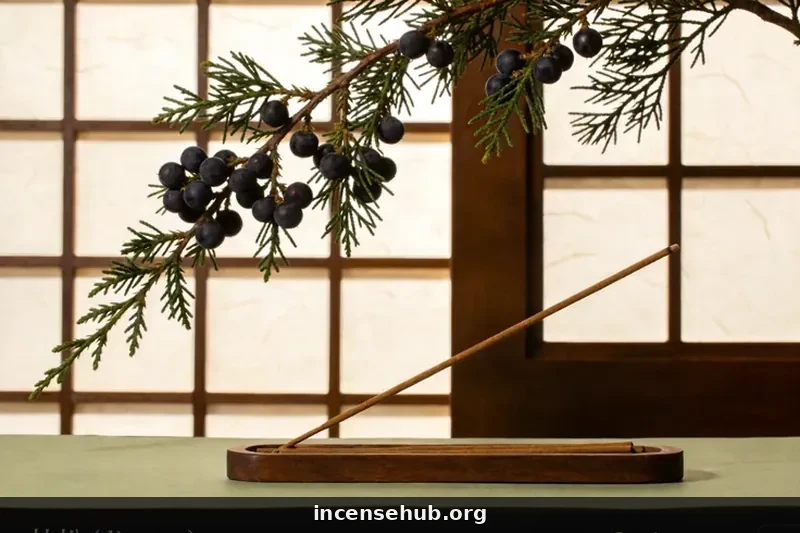
The trade is easier to understand from the cone inward. On a female plant, the scales of the seed cone swell and fuse into a soft, blue-black mass; the seeds sit inside that flesh, which is why the structure yields when pressed instead of splitting like a woody cone. Aromatic tissue lives in the flesh as well as in the wood, so the “berry” is a material in its own right. The plant itself is a shrub or small tree of thin, rocky, open ground, and it endures cold that stops most conifers. Its leaves are sharp needles, and its range runs across the northern hemisphere’s cool and subarctic zones.
The wide range means supply is not concentrated in one country or one forest type, which matters for pricing more than for aroma.
Taxonomic details are held in the GBIF record for Juniperus communis.
The honest absence
Direct answer: Three sources are silent: the Ming incense compendium Xiangcheng has no entry, the Bencao literature does not treat it as an incense ingredient, and Flora of China lists other junipers but not this one.
Each silence belongs to a different literature, and together they make one point. The Xiangcheng is the classical incense compendium, so its silence speaks to the incense canon. The Bencao tradition is the materia-medica literature, so its silence speaks to the medicinal and aromatic register. Flora of China is the modern botanical treatment of Chinese plants, so its silence speaks to native status: the genus is present there through Juniperus formosana, Juniperus chinensis, and Juniperus rigida, but J. communis is not among them.
What an absence can and cannot carry is worth spelling out. It cannot prove that no one in China ever burned the wood, and it says nothing about quality. It can prove that the plant has no documented place in the classical lineage, which is precisely what a history-minded page should record. “We found no record” is a finding; “there was no use” would be a claim the record cannot support.
So the editorial position is plain. If a product or a formula claims an antique 杜松 lineage, the claim needs a source. The material’s real story is Western and modern, and it is a perfectly good story: gin, bath products, room fragrance, wood-based incense, and a long familiarity in European aromatic practice. That is the lineage to describe.
A product page can say plainly that juniper is not part of the classical Chinese incense canon. That phrasing is accurate, checkable, and leaves the material to be judged on aroma; vague language about ancient forests invites a question the seller cannot answer.
Aroma: three parts, one family
Direct answer: The scent is a dry northern conifer — pine and resin over a cool, clean base — with wood supplying warmth, needles an edge of green, and cones a sharper, almost culinary twist.
The overall character is a northern conifer: dry rather than sweet, bright rather than smoky, with a faint camphoraceous quality that reads as cool. Compared with cedarwood it is brighter and drier. Compared with cypress it is less smoky. Those comparisons are the useful ones because they place the material on the shelf a formulator actually uses.
The three parts are not interchangeable, and the differences are structural rather than a matter of grade:
- Wood — dense, resinous, and slow to give up its volatiles. It is the part that behaves like a base note.
- Needles — thin, high in surface area, and quick to release a green, sharp note. They behave like a top note.
- Berries — fleshy cone tissue with a sharper, more culinary profile. They sit between the two and carry the gin association.
A formulator who specifies “juniper” without specifying the part has left the most important decision open. The same species can produce a bright, needle-forward accent or a steady woody base, and the two are not substitutable at the same percentage.
Processing, and why each part wants something different
Direct answer: Each part gets its own handling: wood is seasoned and reduced, needles are air-dried and broken, cones are dried whole or crushed, and the distilled oil is a separate article.
The common step is drying, and the common risk is losing the volatiles that make the material worth buying. The mechanism is straightforward:
- Fresh plant material → moisture still present in the tissue → slow or sealed drying → condensation and oxidation → mould risk or a flat, dull aroma → the lot is stable but the bright conifer note is gone.
Fast, airy drying protects the note. Sealed, damp storage destroys it. That is why the condition of the material at the point of sale tells a buyer more than the harvest date on the label: brittle, clean, strongly aromatic wood and needles have been handled well, and soft, musty, or faint material has not.
Wood preparation adds a second decision. Chips expose end grain and release aroma slowly; powder exposes far more surface and releases it quickly, which changes both the burn and the shelf life. A powder that smells wonderful on the day it is milled can be flat a few months later if it is stored in a jar with air above it. Grinding close to use is the practical answer.
The berries are a separate case. They are dried whole or crushed and used for their own aromatic and culinary character. Berry oil is produced by distillation and is a separate article of commerce, not the dried tissue used in incense. An oil is a concentrate; a dried berry is a plant tissue with fibre, sugar, and water history. They behave differently in a blend and they are priced differently.
How juniper behaves in a blend
Direct answer: Juniper works as a brightener and a base-to-mid conifer note; the wood sustains, the needles and berries lift, and the ratio between them decides whether the blend reads as a forest or as a gin botanicals accord.
The burn behaviour is the key. Resinous wood holds heat and smoulders steadily, so its aroma arrives over time. Needles and berry tissue are thin and volatile-rich, so their aroma arrives early and fades. Put the two together and the chain looks like this:
- Resin-rich wood → sustained ember and a slow release of heavier volatiles → a steady woody base; needles and berries → fast volatile flash at the char front → a bright opening that does not last → the blend’s ratio sets the length of the aromatic arc.
That is why juniper is often described as “fresh” by one user and “woody” by another. They may be smelling different parts of the same blend at different moments.
There is a boundary worth stating. Juniper does not replace cedar or sandalwood as a structural base. It is too bright and too volatile for that role, and a formula that leans on it for depth will end up thin. Its better use is as a modifier: a small proportion that keeps a heavy blend from closing down, or a larger proportion in a light, dry, conifer-forward composition where its sharpness is the point.
Quality checks that separate the parts
Direct answer: Quality is judged per part, on aroma freshness, cleanliness, and condition; a single “juniper grade” would hide the differences that matter most.
| Part | Signs of a good lot | What was done to it | How it fails |
|---|---|---|---|
| Wood | Heavy for its size, resinous when warmed, no pale sawdust mixed through | Seasoned, then chipped or milled | Light, dry, pale material with a weak sawdust smell |
| Needles | Still green-grey, snaps rather than bends, sharp when rubbed | Air-dried and broken up | Brown and brittle, smelling of hay or dust |
| Cones | Plump, intact, dark blue-black, oily to the touch | Dried whole or lightly crushed | Shrivelled, dull, musty, or stuck together |
| Oil | Clear, penetrating, faithful to the cone | Distilled | Stretched with a cheaper oil, or oxidised and dull |
The table is a set of questions, not a ranking: parts do different jobs, so one grade cannot cover all of them.
The first check is always the nose, and the second is the hand. Fresh juniper is aromatic when the material is rubbed or crushed; the scent should be clean and bracing rather than flat or dusty. The hand check is about moisture and structure: brittle, dry material crumbles; damp material bends and clumps. Both checks are crude, and both catch most of the problems that matter at the point of purchase.
Species clarity is a separate check, and it is the one that fails most often in trade. See the next section.
A bench protocol for a juniper lot
Direct answer: A juniper lot is assessed in three passes — appearance, crush, and burn — and each pass answers a different question about the part in front of you.
Appearance. Colour and structure come first because they are cheap to check. Wood should be dense and clean, with no pale sawdust fraction. Needles should hold a green to grey-green tone, not a uniform brown. Berries should be plump and intact rather than shrivelled. Dust in the bottom of a bag is a handling signal, not a species signal.
Crush. Crush a small quantity and smell it at once, then again after the first impression fades. Fresh juniper gives a clean, bracing, resinous lift; stale material gives a flat woody smell with a dusty edge. The berry is sharper and more culinary than the wood, and the difference should be obvious when the two are smelled side by side.
Burn. Burn a pinch of each part separately — wood, needle, berry — on a heat-safe surface in a ventilated space. The wood should hold a steady ember and release a resinous note; the needles should catch quickly and give a brief green flash; the berry should smell sharper and sweeter than either. A lot that smokes heavily, smells of scorched paper, or leaves a black residue is telling you about moisture and contamination rather than about species.
| Pass | Question answered | Limit |
|---|---|---|
| Appearance | Is the part clean and intact? | Says nothing about species |
| Crush | Is the aroma fresh and true to the part? | Cannot separate similar Juniperus species |
| Burn | How will it behave in a blend? | Does not predict long storage |
| Paperwork | Which binomial and which part? | Only as good as the supplier’s traceability |
A bench result should be written down against a retained sample. Memory is a poor reference standard, and a lot approved two seasons ago is not the same lot as the one on the table today.
How to compare two lots without fooling yourself
Direct answer: A comparison is only useful when both samples burn under the same conditions, are assessed blind, and are recorded before memory edits the impression.
Most informal comparisons fail before the first sniff. One lot is burned as chips and the other as powder; one is tested in a warm room and the other by an open window; the more expensive sample is known to be the expensive one. Each of those differences can produce a confident conclusion that says more about the test than about the material.
The protocol is simple enough to run on a kitchen table. Use the same mass, the same form, the same burner, and the same room. Code the samples A and B so the person smelling them does not know which is which, and randomise the order across two sessions. Leave a gap of fresh air between samples rather than trying to clear the nose with another strong smell, which only replaces one impression with another. Record what happens at the start, the middle, and the end of each burn, plus the smoke density, the ash, and the smell left in the room afterwards.
Three biases are worth naming. Expectation bias makes a costly sample smell better before it is lit. Order bias makes the first sample the reference against which the second is judged. Recency bias makes the last impression the one that survives into the write-up. Coding, randomising, and repeating the session on another day address all three without any equipment.
The boundary is just as important. A bench comparison tells you which lot you prefer under those conditions. It does not tell you how the material will age, how consistent the supplier will be next season, or how the lot behaves at a different proportion in a blend. Those questions need records and time, not a better nose.
Two conifer families behind one English word
Direct answer: “Cedar” can mean a tree in the pine family or a juniper in the cypress family, and that split is the root of most conifer confusion in the trade.
Cupressaceae and Pinaceae are the two families a buyer is likely to meet. They differ in cone structure, leaf form, and the way the aromatic material is held in the tissue. The table keeps the names apart.
| Group | What a buyer will meet | Foliage | Seed structure | Smell in general |
|---|---|---|---|---|
| Cypress family (Cupressaceae) | juniper, thuja, cypress | scales or short needles | juniper’s is fleshy; others woody or leathery | resinous, usually sharp or green |
| Pine family (Pinaceae) | true cedars, pines, firs | long needles, often bundled | woody cones that open to release seed | resinous, often sweeter or heavier |
The families are not a quality ranking but a way of predicting what a word means in a catalogue: “cedarwood” is often a Juniperus, while “cedar” may be Cedrus. Both are legitimate, and they are not the same material.
The practical instruction is to ask for the binomial whenever a conifer is on the order, and to treat a family name as a hint rather than a specification. A buyer who knows the family can ask a better follow-up question. A buyer who knows the binomial does not need to ask.
What the smoke is, and what it is not
Direct answer: The visible smoke and the aromatic experience are different fractions of the same burn; most of what a burner sees is particulate matter, and only part of what is smelled is the material’s volatile oil.
Combustion of plant tissue is not a clean evaporation. Heat first drives off water and volatile compounds, then the solid begins to decompose without oxygen in a process called pyrolysis, and the residue continues to smoulder. The chain matters for how a material is judged:
- Plant tissue → heat drives off water and volatiles → pyrolysis breaks down cellulose and lignin → char and tar form → incomplete combustion releases particles, carbon monoxide, and organic compounds → the visible plume is mostly particulate, while the aroma is a small volatile fraction carried with it.
Two conclusions follow. A smoky burn is not proof of a strong material; it can be wet or poorly ventilated. And the aroma a burner perceives is filtered through smoke, which is why the same juniper can read sharp in one blend and muddy in another.
This is also why ventilation is not a polite suggestion. Particles and carbon monoxide are products of the burn, not incidental annoyances, and a smaller burn in a larger, airier room is the sensible default. See the safety guide.
A sample record worth keeping
Direct answer: A sample is only evidence if it is recorded — binomial, part, locality, date, supplier, condition, and a photograph — and most disputes about a material are really disputes about memory.
A sample becomes evidence only when someone writes down what it is. The record needs the binomial and who determined it, the part, the locality as the supplier stated it, the receipt date, the condition on arrival, a photograph in consistent light, and the place the sample is stored. None of those fields is difficult, and together they turn a jar into something a batch record can point at.
Two limits are worth stating. A locality is a claim until it is documented, and a photograph records appearance rather than identity. Neither is proof. What they do is make a later disagreement specific: instead of “this smells different”, the conversation becomes “this does not match the accession record for the approved sample, which was Juniperus communis wood from the stated region”. That specificity is the whole value. A page can describe a material in general; only a sample record can describe the lot in front of you.
The “cedarwood” trap
Direct answer: In trade, “cedarwood” often means a Juniperus such as Juniperus virginiana rather than a true Cedrus, so juniper and cedar are confused at the level of the label rather than the level of the plant.
The taxonomy is simple once the names are set aside. True cedars belong to Cedrus, in the pine family (Pinaceae). Common juniper belongs to Juniperus, in the cypress family (Cupressaceae). The two are not close relatives and do not share a scent profile. The English trade name “cedarwood”, though, has been attached to several aromatic Juniperus species, J. virginiana among them, so an order for cedar can arrive as a juniper and an order for juniper can be described as a kind of cedar.
| What the label says | What it usually means | Family | The question to ask |
|---|---|---|---|
| Juniper, 杜松 | Juniperus communis | Cupressaceae | Which part, and is the binomial on the paperwork? |
| Cedar, 雪松 | a Cedrus species | Pinaceae | True cedar, or a juniper traded as cedarwood? |
| “Cedarwood” | often Juniperus virginiana | Cupressaceae | Which genus does the supplier actually mean? |
| Thuja, 崖柏 | Thuja sutchuenensis | Cupressaceae | Where was it collected, and is the trade legal? |
The lesson is not that one of these is better. It is that the English word “cedar” covers plants in two families, and a purchase order that uses only the English word has not specified a material. Binomial first, trade name second.
For the wider comparison, the cedar and thuja entries extend it, and the material comparison matrix sets the conifers side by side.
Buying and provenance claims
Direct answer: Buy juniper on species, part, and freshness, and treat any claim of classical Chinese lineage as unsupported until a source is produced.
A short decision sequence covers most purchases: confirm Juniperus communis rather than a “cedarwood” juniper, name the part because wood, needle, cone, and oil are different materials, check condition, and keep the paperwork and a retained sample.
Provenance is where a boundary has to be drawn. A seller may call the material “traditional” or “ancient” on the strength of conifers having a long human history. Conifers do, and juniper has a long Western record as a flavoring and an aromatic. None of that amounts to a classical Chinese incense lineage. The two claims are different, and a buyer is entitled to ask which one is being made.
An editorial judgment follows, and it is marked as editorial: the honest framing is also the commercially stronger one. A modern aromatic sold as a modern aromatic can be priced on quality and availability. A modern aromatic sold as an antique loses credibility the moment a buyer checks the canon. The first position is defensible; the second is not.
When a lot is wrong
Direct answer: Quarantine the lot, compare it blind against the retained sample, document the difference, and fix the cause in the specification rather than compensating in the blend.
The first move is to stop using the material. Label the container with the date and the reason, and keep it away from production stock; a doubtful lot that stays on the shelf gets used on a busy day. The second move is a blind comparison against the reference sample, because an unblinded comparison will confirm whatever the buyer already suspects.
The third move is documentation. Photograph the material in consistent light, record the lot code, the supplier, the receipt date, and the specific difference: a flat opening, a musty edge, a different particle size, a colour that does not match. “It smells wrong” is not a complaint a supplier can act on; “the opening is flat and the colour is two shades darker than the reference” is.
The fourth move is root-cause thinking. The cause may be species, part, moisture, storage, or transit, and each points to a different fix. If the lot was fine on arrival and declined in storage, the specification is not the problem. If it arrived different from the sample, the specification was never enforced.
The last move is often skipped: change something. A complaint that ends with a replacement lot and no change to the specification will produce the same problem next season. The record, the sample, and the revised specification are the only parts of the episode that keep working after the apology.
When juniper earns its place in a brief
Direct answer: Juniper earns its place when a brief wants a dry, bright conifer note or a gin-adjacent berry accent; it is a weak choice when the brief needs sweetness, weight, or a long sustained base.
| The brief | Does juniper fit? | The reason | Where else to look |
|---|---|---|---|
| Dry, northern conifer blend | Yes, strongly | Bright resin and a clean finish | — |
| Light room scent with a fresh edge | Yes | High lift from a small amount | Citrus peel for a sweeter top |
| Heavy resinous temple blend | No | Too sharp and thin to sit under resins | A wood or resin base with a floral head |
| Long, slow, low-smoke burn | Partly | Wood sustains; needle and cone do not | Dense chips rather than needle |
| Gin-adjacent culinary accord | Yes, strongly | The cone carries the reference smell | — |
| A blend that must read sweet | No | Dry and bracing, with little sweetness | A sweeter wood or a floral |
Two boundaries are worth marking. “Yes, strongly” means the material fits the register, not that it can carry the whole composition; juniper is a modifier in most blends. And “no” is about fit, not quality: a good juniper lot in the wrong brief is still the wrong material.
The practical significance is simple. Juniper is cheap and abundant enough to test freely. A formulator can run a small trial at two or three proportions and learn more in an afternoon than from any description, including this one.
Storage and the volatile clock
Direct answer: Juniper loses its brightness before it loses its structure, so storage should be judged by aroma rather than by appearance.
Volatiles leave plant tissue in three ways: they evaporate into the air above the material, they oxidise, and they are carried off faster as temperature rises. The chain is short:
- Ground or crushed juniper → large exposed surface → volatiles move into the headspace → oxygen and light accelerate the change → the lot smells flat while still looking fine → a formulator increases the percentage to compensate → the blend becomes woodier and loses the fresh edge that justified the material.
Whole material keeps longer than powder, and whole berries keep longer than crushed. A sealed container with little headspace, kept dark and cool, slows the clock. Labels should carry the date and the part, because “juniper” on a jar does not say whether the contents are wood, needle, or berry.
A storage routine beats a storage rule. Label every container with the part and the arrival date, use the oldest stock first, and inspect at a fixed interval rather than when a problem is suspected. Smell the jar, look for clumping or dullness, and check for insects and mould. A desiccant kept in the cabinet, not mixed into the material, helps hold humidity down and needs replacing on its own schedule.
The signs of decline arrive in order: the top note flattens, the colour dulls, then the material clumps or smells of the container. Once mould is visible, the lot is finished for a premium blend. Rotation is the cheapest control.
The gin reference, and why it can mislead
Direct answer: Gin is a useful calibration for the berry and a poor one for the wood; the distilled berry note is sharper and sweeter than anything the dried plant gives when burned.
The confusion has a simple origin. Gin made juniper famous, and anyone who knows that smell expects the incense material to reproduce it. It does not, and process explains why better than quality does. Gin carries a distilled extract of the berry: the volatile fraction has been separated from the tissue and concentrated. Incense carries the tissue itself, heated until it smoulders.
The chain explains the gap:
- Berry → distillation selects and concentrates the volatile fraction → a sharp, sweet, resinous top note → the gin reference is built on that concentrate; dried berry burned on a coal → cellulose and lignin also break down → smoke and a rounder, drier aroma sit over the volatile note → the result is recognisably juniper and recognisably not gin.
The same logic applies to the wood. Distilled wood oil and burning wood chips are different materials with different aromas, even when both come from the same species. A formulator who expects a distilled profile from a burned tissue will keep increasing the percentage and will keep being disappointed.
There is a practical use for the gin reference, and it is narrow. Smell the berry and the wood side by side. The berry should be sharper and sweeter; the wood should be drier and more resinous. If a lot of “juniper wood” smells like gin, the likely explanation is that it has been dosed or that the wrong part has been supplied. Either way, the reference has done its job by making the difference visible.
A spec sheet you can hand to a supplier
Direct answer: A usable juniper specification names the binomial, the part, the form, the drying method, and the lot, and it asks for a retained sample; anything less leaves the most consequential choices to the seller.
A usable specification is short, and every line on it closes a door that would otherwise stay open. Name the binomial in full, not the genus, because a juniper traded as cedarwood can otherwise pass for the material you meant. Name the part — wood, needle, cone, or oil — since the four behave differently and their prices are not comparable. Name the form, because whole, chipped, cut, and milled material release aroma at different rates. Ask how the lot was dried rather than whether it was; “dried” describes a state, and the method explains the colour and the volatiles that survived. Add a condition standard, an aroma reference both sides can smell, a lot code, and a retained sample. The lot code matters more than it looks: without one, a later comparison has no anchor, and a disagreement becomes a memory contest.
The list is unglamorous on purpose. Its value is that it removes the places where a vague order can drift. A supplier who cannot answer the species and part questions has not necessarily done anything wrong; the buyer simply has no specification to enforce.
Reading a Chinese spec sheet
Direct answer: A Chinese spec sheet answers five questions — which species, which part, which form, how dry, and which lot — and the other fields are either decoration or a test of the supplier’s record-keeping.
| Field | Characters | What it should tell you | The usual gap |
|---|---|---|---|
| Scientific name | 学名 | the binomial, in full | a genus name only |
| Origin | 产地 | where it was collected | a country with no locality |
| Part | 部位 | wood, needle, or cone | “juniper” with no part named |
| Form | 形态 | whole, cut, or powder | powder described as if it were the raw material |
| Lot | 批号 | an identifier that links to a record | no lot code at all |
| Moisture | 含水率 | a condition that can be checked | the word “dry” and nothing more |
| Mesh | 目数 | the sieve size of a powder | omitted for anything milled |
| Foreign matter | 杂质 | a stated standard | “clean” left undefined |
| Mould | 霉变 | a status, ideally “none” | silence |
| Drying | 阴干 / 烘干 | shade-dried or kiln-dried | “dried”, which says neither |
The two fields that decide how a lot behaves are 部位 and 含水率. A sheet can list 产地, 学名, and 批号 in perfect order and still leave the buyer guessing whether the bag holds wood or needle, and whether it will smoulder or steam. Those are not decorative details; they are the material.
A useful habit is to read the sheet backwards. Start with 批号 and 含水率, then 部位, then 学名. If the first three are missing, the rest is a description rather than a specification, and the price should be treated accordingly.
Four characters that decide the order
Direct answer: 学名, 部位, 形态, and 批号 are the fields that turn a Chinese label into a specification; a sheet without them describes a category, not a lot.
- 学名 (xuémíng) — the scientific name. If it stops at the genus, the species is still unspecified.
- 部位 (bùwèi) — the part. Wood, needle, and cone are three materials sharing one name.
- 形态 (xíngtài) — the form: whole, cut, or powder.
- 批号 (pīhào) — the lot code that ties the bag to a record.
A label can carry all four and still be vague, because a 部位 field reading “juniper” is not an answer. The test is whether a stranger with the sample could check each field: 学名 against a flora, 部位 against the material in the bag, 形态 against a sieve, 批号 against the supplier’s own records.
The remaining fields — 产地, 含水率, 目数, 杂质 — measure condition rather than identity. That order is what a buyer needs: identity first, condition second, price last. A cheap lot of the wrong part is not a bargain, and an expensive lot without a 批号 cannot be traced when it disappoints.
The economics of an abundant material
Direct answer: Juniper is abundant across a wide northern range, so its price should track labour, drying, sorting, and transport rather than scarcity; a premium needs an explanation other than rarity.
Abundance changes the commercial conversation. With agarwood or 崖柏, the buyer’s first question is whether the material can be obtained at all. With juniper, the first question is which part and how fresh. Supply is not the constraint, which means the usual scarcity premium has nothing to attach to.
A wide range also produces wide variation. Cold, exposed sites and milder ground give different growth, and the part harvested matters more than the country on the label: wood from a slow-grown shrub is denser and more resinous, needle is sharper and greener, and berry is a third material with a culinary edge. Those differences belong in a specification, not in a story about origin.
Three commercial risks take its place:
- Provenance inflation — a modern Western aromatic presented as an antique Chinese material, with the premium justified by a story rather than a record.
- Part substitution — needle sold as wood, or a mixed lot described as a single part, because the visual difference is easy to miss in a photograph.
- Freshness blending — old stock mixed with new to move inventory, which shows up as a flat opening and a woody tail rather than as an obvious defect.
None of these is unique to juniper. What is unusual is how little cover the material gives them. A scarce material can hide behind its own difficulty; a cheap, abundant one cannot. A buyer can compare several lots quickly, ask for samples without offending anyone, and rotate stock on a short cycle.
The editorial view is that abundance is an asset, not an embarrassment. A material that is reliable, widely available, and pleasant to burn is exactly what a repeatable product needs. Treating it as precious is a category error, and pricing it as precious is a mistake the buyer pays for.
Traditional use and modern evidence
Direct answer: No classical Chinese incense record exists for common juniper, and this page says so rather than supplying one; what can be documented is the botanical identity, the family placement, and the modern Western use.
The layers separate cleanly if you ask what kind of statement each one makes. In the Chinese incense sense there is no traditional belief to report: no classical passage is being read and no lineage is being claimed. Historical record does exist, but it is Western — gin, bath and room aromatics, wood-based incense — and it documents a modern practice. Established botany covers the species: a Cupressaceae conifer with a circumboreal range, fleshy female cones, and aromatic wood, needles, and cone tissue. Health claims are not established, and none is made here.
The distinction between “no Chinese classical record” and “no history at all” is the one that matters. Juniper has plenty of history. It is simply not Chinese incense history, and a knowledge page should be precise about which history it is telling.
What would change this page
Direct answer: Two findings would overturn the historical claim — a classical Chinese passage naming 杜松 as an incense material, or a Flora of China treatment that counts the species as native. Neither has been found.
The page makes a negative claim, and negative claims deserve a standard. “Absent from the Xiangcheng and the Bencao tradition” is a statement about the sources consulted, not a proof that no Chinese artisan ever burned the wood. The difference matters for how the claim should be read.
Three kinds of evidence would move the page: a classical incense passage naming the plant and its use, a Flora of China treatment listing it among China’s native junipers, or a collection record with a locality and a binomial. Each is specific and checkable.
An editorial judgment: recording an absence is more useful than filling it with atmosphere. A reader can act on “no classical record was found”; a story about ancient forests gives them nothing to check.
Safety
Direct answer: Incense combustion produces smoke and particulate matter, so juniper incense should be burned in a ventilated space, away from children and pets, and the smoke should not be inhaled in concentration.
Juniper wood and needles are resinous and burn readily; dried material should be stored away from heat and open flame, and ashes should be treated as live until cold. Anyone with respiratory sensitivity should be cautious around any incense smoke. See the site’s safety guide. This is editorial knowledge content, not medical advice.
FAQ
What is juniper (杜松)? Common juniper, Juniperus communis, an evergreen conifer of the cypress family with aromatic wood, needles, and fleshy blue-black cones. It is the botanical behind juniper berries and gin, and in Chinese incense it is a modern crossover rather than a classical material.
The “berry” is a cone whose scales have become fleshy and fused around the seeds, which is why it feels soft rather than woody. That flesh is part of why the berry smells different from the wood.
Is juniper a classical Chinese incense material? No classical pedigree has been documented. It is absent from the Xiangcheng and from the Bencao Gangmu incense tradition, and Flora of China does not treat J. communis as one of its native junipers. Any claim of antique 杜松 lineage needs a source.
Why is a juniper berry called a berry if it is a cone? Because the cone’s scales become fleshy and fuse around the seeds, producing a soft, fruit-like structure. The botanical term is a modified seed cone; the market term is a berry. The fleshy tissue is part of why the berry smells different from the wood.
Is juniper the same as cedar? Not in botanical terms. The genera sit in different families: Juniperus in Cupressaceae, Cedrus in Pinaceae. In trade, “cedarwood” often refers to a Juniperus such as J. virginiana, which is where the confusion starts. Check the binomial, not the English word.
In a blend, juniper can occupy a similar conifer register, but it is brighter and drier and will not provide the same depth. Treat it as a modifier rather than a one-for-one substitute, and rebalance the base if you make the swap.
How should I buy juniper for incense? Specify Juniperus communis and the part — wood, needles, or berries — then check that the material is dry, clean, and strongly aromatic. Price it by its real abundance, and do not pay a premium for a classical lineage it does not have.
Needles and chips are not interchangeable at the same weight: needles are thin and volatile-rich, so they give a sharp green note early and fade quickly, while chips hold heat and release resin slowly. A blend built on needles will read brighter and shorter than one built on wood.
Sources
- Juniperus communis on GBIF — the taxonomic record used for the accepted name, the family placement, and the species’ wide Northern Hemisphere range.
Related Resources
- cedar (雪松) — the conifer most often confused with juniper in trade, and the place to start when a “cedarwood” label appears.
- thuja (崖柏) — a scarce endemic conifer whose sourcing and legality issues are the opposite of juniper’s abundance.
- material comparison matrix — the site’s cross-material view of aroma, status, and sourcing risk.
- scent guide — how the woody and resinous families are organized, and where a bright conifer note fits.
- woody aroma family — a closer look at the woods that surround juniper on the shelf.
- incense ingredients glossary — definitions for the botanical and trade terms used here.
Summary
The material this page describes is 杜松, Juniperus communis: a conifer of the cypress family, at home across the cool and subarctic north, sold as wood, needle, and fleshy cone. Its aroma is dry, piney, and resinous, and its place in Chinese incense is modern — the Xiangcheng and the Bencao tradition are silent, and Flora of China does not list it as a native species.
In a blend the wood holds a base while the needle and cone sharpen the opening, so the ratio between parts shapes the burn. The risks are practical rather than exotic: volatiles fade, damp storage ruins a lot, parts get mixed, and the word “cedarwood” can hide another genus entirely.
Buy by binomial and by part, price by abundance, and describe a modern material as modern. That is the position this page takes, and it is more defensible than any invented pedigree.