
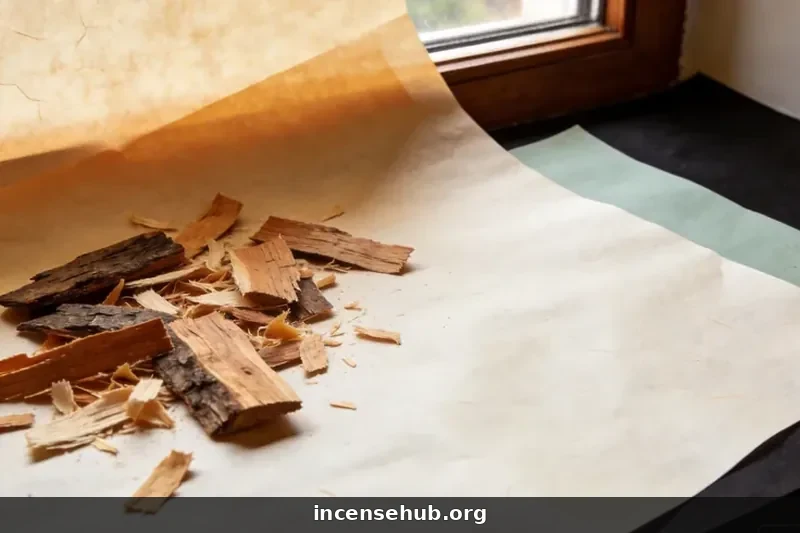
Direct answer: Thuja timber — 崖柏 (yábǎi) in Chinese — is the scented wood of Thuja sutchuenensis, a cypress-family (Cupressaceae) conifer restricted to a small mountainous pocket of southwest China. It offers a cedar-forward, clean, lightly smoked aromatic and acts in Chinese incense as a conifer-wood accent, while its rarity and legal protection turn authentic stock into a real procurement puzzle.
Key facts
| Field | Value |
|---|---|
| Chinese name | 崖柏 (yábǎi) — literally “cliff arborvitae” |
| Botanical source | Thuja sutchuenensis (Cupressaceae) — the timber |
| Material class | A conifer wood, not a resin, flower, or root |
| Aromatic register | Woody, cedar-like, resinous, faintly smoky |
| Traditional role | Conifer-wood note; a recent incense trend |
The reputation gap
Direct answer: 崖柏’s market standing is erected on a “lost and found” biography — a tree documented once in the 19th century, written off as gone, then relocated in the wild during the late 1990s — and that biography, more than any aromatic originality, is what principally sustains its price.
A buyer should fix one distinction early: the timber smells agreeable — woody, cedar-like, faintly smoked — but it is not aromatically singular in the way sandalwood (檀香) or agarwood (沉香) are. What lifts its price and feeds its recent vogue is the biography: a narrowly endemic conifer collected a single time in the late 1800s, declared vanished, then found again on a cliff in its narrow home territory almost a century afterward. That account is genuine and does shape the material’s pull, but it sits in a different drawer from the scent itself, which is a clean conifer note and nothing more remarkable.
The confusion between the two is the commercial trap. A premium resting on scarcity is not the same beast as a premium resting on smell, and a purchaser who cannot tell which one they are paying for is exposed to substitutes marketed on the story alone. This page keeps the pair apart from the first paragraph to the last.
Botanical identity
Direct answer: Thuja sutchuenensis is a compact, low-branching tree placed in the Cupressaceae, native only to a tight mountainous wedge where Sichuan borders Chongqing. It is genuinely scarce — documented from a single 19th-century specimen, then missing for decades, until a find in the closing years of the 1990s returned it to the living record.
Flora of China treats Thuja sutchuenensis as a low tree reaching about 20 m, files it under the Cupressaceae, and cites 崖柏 as the Chinese name. The scarcity is the governing fact: the species rested on a solitary specimen taken in the late 1800s, then stayed effectively absent for close to a century before re-entering the record in the late 1990s within its native range. That find drives both its renown and its conservation burden. See Thuja sutchuenensis in Flora of China.
In botanical terms this is a micro-endemic: a species whose entire natural range squeezes into a sliver of map. Such plants pack their whole evolutionary inheritance into one location, which keeps populations small, renders them sensitive to gathering, and explains the legal shield around wild stock. The very trait that makes the timber rare also makes it ecologically brittle.
Chinese name and terminology
Direct answer: 崖柏 reads as “cliff arborvitae” — 崖 (cliff) joined to 柏 (the cypress/arborvitae register). The 柏 character acts as a category label spanning arborvitae, cypresses, and their near conifer kin, and that categorical sweep is why 崖柏, 柏子, and 雪松 get collapsed in everyday speech, even though they point to unrelated species and unrelated plant parts.
The name does real work: 崖 flags the cliff habitat, and 柏 marks the cypress/arborvitae class. In Chinese botanical naming the 柏 character behaves as a category rather than a single species — it spans arborvitae, cypresses, and neighbouring conifers. That is exactly why 崖柏 (the wood of Thuja sutchuenensis), 柏子 (the seed of Platycladus orientalis), and the broader conifer register get run together in everyday speech. The shared character signals “conifer,” never “same plant,” and mistaking the two is the most common identification slip on this material.
The thuja–cedar–cypress-seed tangle
Direct answer: 崖柏, cedar (雪松), and cypress seed (柏子) are three different conifer materials that share a 柏/松 register and a woody aroma yet are different species harvested for different parts. 崖柏 is the timber of Thuja sutchuenensis; 雪松 denotes the true cedars of genus Cedrus (and, in commerce, Juniperus virginiana); 柏子 names the seeds gathered from Platycladus orientalis.
Three conifer materials overlap in Chinese naming and blur with ease:
- 崖柏 (Thuja sutchuenensis) — a southwest-China conifer that grows nowhere else; the aromatic timber. This page.
- Cedar (雪松) — the Cedrus genus, though shop-labeled “cedarwood” frequently points at Juniperus virginiana; covered on its own page.
- Cypress seed (柏子) — the seeds taken from Platycladus orientalis, a longstanding incense ingredient; covered on its own page.
All three are conifers with woody aromas, but they are distinct species used for distinct parts. This page describes 崖柏 = Thuja sutchuenensis timber. When a source says 雪松 or 柏子, it is discussing a different material. See cedar and cypress-seed.
Where the timber comes from
Direct answer: 崖柏 originates in one tiny native range — the high ground straddling Sichuan and Chongqing in southwest China. It clings to cliff faces and rocky inclines, and with a small, legally shielded wild population, nearly everything that trades hands is farm-grown timber or a stand-in conifer.
Thuja sutchuenensis is boxed into a small zone of the Sichuan and Chongqing highlands, where it hugs cliff faces and rocky slopes — the “cliff” baked into its name. The wild population is minuscule, the plant carries a protective designation inside China, and taking wild stock is barred. The commercial corollary is what deserves attention: most of the 崖柏 offered for sale is plantation-grown material, and a worrying slice is lookalike conifer timber passed off under the name, since genuine wild wood is scarce and the name itself fetches a premium.
Aroma profile
Direct answer: 崖柏 is woody and cedar-forward at its heart, with a clean resinous edge and a faint smoked depth that surfaces under low heat — a green-woody, mildly austere character nearer to a dry conifer register than to sandalwood’s soft sweetness or agarwood’s heavy warmth.
The timber reads as cedar-forward and woody, with a clean resinous edge and a faint smoky undertone that appears only under gentle heat. It occupies a green-woody register: fresh, mildly austere, with a lingering balsamic undertow. Set beside other conifer materials — cedar, cypress, pine — it adds lift without the weight of a true resin.
There is a mechanical basis for how the note behaves under heat, and it is worth spelling out. Conifer timber stores volatile oil in resin canals, and that oil releases in a predictable sequence: gentle heat → the lighter monoterpene fraction vaporizes → a clean, green-woody lift; higher heat → the heavier sesquiterpene and resin fraction scorches → the note drifts into acrid smoke. That is why 崖柏 rewards indirect, low heat and punishes an open flame.
A conifer-volatile primer
Direct answer: The aroma of 崖柏 comes from the volatile oil held in the wood’s resin canals — a blend of monoterpenes and sesquiterpenes shared, in shifting proportions, across the cypress family. The precise blend decides whether a conifer reads piney, cedar-like, or camphoraceous.
Conifer fragrance is, at bottom, terpene chemistry. The light fraction — monoterpenes such as α-pinene, β-pinene, sabinene, and δ-3-carene — vaporizes fast and delivers the sharp, fresh, evergreen lift. The heavier fraction — sesquiterpenes such as cedrene, thujopsene, and cuparene, plus their oxygenated relatives such as cedrol — lingers and supplies the deeper, woody-resinous body. Members of the genus Thuja are also known for thujone-type compounds (α-thujone and β-thujone), a feature they share with some cypress and arborvitae kin. This is general conifer chemistry, not a measured assay of T. sutchuenensis specifically [need-source for a published GC-MS profile of this exact species].
The practical read-out: a conifer whose light monoterpene fraction dominates smells green and sharp; one whose sesquiterpene fraction dominates smells deeper and more cedar-like. 崖柏 sits toward the cedar-like end, which is why it is so often described by reference to cedar.
Why it enters incense
Direct answer: 崖柏 serves as a bright cedar-scented evergreen accent — a crisp, green freshness that settles naturally beside cedar, cypress, and pine without the weight of an actual resin. Its present-day vogue leans on the rarity tale every bit as much as on the smell.
Inside a blend, 崖柏 supplies a crisp, slightly austere evergreen quality that lifts whatever sits around it. It works as neither a resinous foundation nor a sweetener — sandalwood’s soft warmth is absent — and its worth lies in the dry, invigorating freshness it lends beside other conifers. The material’s recent rise in contemporary Chinese incense cannot be detached from its backstory — an endemic timber that vanished and returned — which genuinely shapes both its charm and its cost, even though it must stay separated from the scent itself.
合香 placement and the 君臣佐使 frame
Direct answer: In the 合香 (blended incense) system, 崖柏 functions as a supporting or “assistant” note — the kind of ingredient the classical 君臣佐使 frame would slot below the lead aromatics — adding lift and freshness rather than carrying the blend.
The classical Chinese blending grammar runs on the 君臣佐使 scheme: a chief (君) aromatic that leads, a minister (臣) that reinforces it, an assistant (佐) that harmonizes or moderates, and a guide (使) that steers the overall direction. 崖柏 fits most naturally as an assistant: a green-woody conifer accent that lifts a sandalwood or agarwood lead without competing for the top of the pyramid. It is never the 君 in a blend, because its character is supportive rather than commanding. This framing is a compositional convention, not a measured fact, and 崖柏’s absence from the classical 香乘 canon means it has no historical 君臣佐使 formula to point to.
Aroma-wheel position
Direct answer: On a standard fragrance wheel, 崖柏 belongs to the woody/conifer family, sitting in the dry, green sub-family rather than the creamy or balsamic end — close to cedar and cypress, distant from sandalwood’s milky warmth.
Placing the material on an aroma wheel helps a blender reason about it. The woody family splits into dry-green (cedar, cypress, pine), creamy (sandalwood), balsamic-resinous (benzoin, frankincense), and dense-dark (agarwood). 崖柏 lands firmly in the dry-green sub-family, near cedar and cypress, and nowhere near the creamy or dense-dark ends. That positioning explains both its usefulness — it adds a clean, green lift — and its limitation — it supplies no sweetness and no resinous weight, so it must lean on other materials for body.
How the timber is processed
Direct answer: 崖柏 is put to use as the timber itself — washed, dried, and either broken into chips or shavings for warming, or milled to a powder for blending. No tapping and no distillation enter the process; the aromatic worth sits in the wood.
Handled as timber, 崖柏 goes through drying and cutting, never tapping or distillation. The fragrant wood is washed, dried, and readied as chips or shavings for soft warming, or milled into powder for sticks and cones. Since the fragrance lives in the wood’s own volatile oils, the same practical worries apply as to any aromatic timber: clean, properly seasoned stock, and — for powder — an even grain size that packs and combusts uniformly.
Working with thuja in practice (traditional practice, not measured data)
Direct answer: Working knowledge of 崖柏 comes from traditional incense craft and marketplace observation, not from measured data. The timber is warmed softly instead of burned hard, added in a small ratio as a supporting evergreen note beside sandalwood or agarwood, and usually favored once seasoned rather than freshly cut — none of which rests on published numbers, and all of which this page records as practice rather than verified fact.
Heat and temperature
Conventional handling keeps 崖柏 on soft warmth: set over charcoal tucked beneath a bed of ash, or on an electric warmer dialed low, so the fresh green brightness stays clean. Intense direct flame is avoided, since it shoves the evergreen scent toward a bitter, scorched register (traditional practice, not measured data). No published temperature values exist for this timber, so this page invents none.
Blending with sandalwood and agarwood
In today’s Chinese incense craft, 崖柏 is treated as a subordinate evergreen accent, never the centerpiece:
- With sandalwood (檀香) — a small ratio of 崖柏 laid over a sandalwood base contributes a dry, verdant brightness against sandalwood’s soft, milky tone (traditional practice, not measured data). See sandalwood.
- With agarwood (沉香) — 崖柏 occasionally acts as a bright green upper register above agarwood’s dark, resinous depth, lending freshness without the weight of an actual resin (traditional practice, not measured data). See agarwood.
These pairings are compositional habits of the modern trade rather than classical 香乘 recipes: 崖柏 holds no entry in the classical compendium.
Fresh versus seasoned material
Marketplace observation draws a line between newly cut 崖柏 and stock that has been seasoned or aged: the fresh timber reads greener and more biting, with a turpentine snap, whereas the seasoned material reads smoother, carrying a richer balsam-like depth. Sellers frequently favor the aged or seasoned stock for warming. This is marketplace observation, not measured data, and there is neither an agreed aging schedule nor a published age-versus-aroma comparison — so treat any specific “aged” assertion as a provenance claim to check, never as measured quality.
The seasoning chain, as it is understood in practice: fresh-cut timber → moisture evaporates over months → oxidative and enzymatic change in the resin fraction → the greener turpentine notes mellow into deeper balsamic tones. That is a working model, not a published measurement.
Status of this section
Everything in this section is traditional practice or marketplace observation, flagged as such and unsupported by measured data. This page carries no medical claims of any kind.
Thuja against its conifer neighbours
Direct answer: 崖柏, cedar, juniper, cypress, and pine are all conifer materials with woody aromas, yet they are different genera, different chemical profiles, and different sourcing stories. 崖柏 is the scarce endemic timber; the others are mostly abundant commodities whose names carry their own confusions.
A broad comparison across five conifer materials clarifies where 崖柏 sits:
| Material | Botanical source | Character | Supply status | Chief sourcing risk |
|---|---|---|---|---|
| Thuja 崖柏 | Thuja sutchuenensis (Cupressaceae) | Woody, cedar-like, faintly smoky | Scarce, endemic, protected | Substitution plus legality |
| Cedar 雪松 | Cedrus spp., or Juniperus virginiana in trade | Woody, clean, slightly sweet | Widely available | “Cedarwood” name confusion |
| Juniper 杜松 | Juniperus communis (Cupressaceae) | Woody, piney, resinous, fresh | Widely available | Provenance claims |
| Cypress | Cupressus / Chamaecyparis spp. | Woody, fresh, green | Widely available | Species-level naming |
| Pine | Pinus spp. | Resinous, turpentine-forward | Widely available | Grade and resin content |
See cedar, juniper, pine-resin, and the material comparison matrix.
The pattern to notice: only 崖柏 carries the double burden of scarcity and legal restriction. The other four are abundant commodities whose main risks are naming and provenance rather than outright availability. That asymmetry is the whole sourcing story in miniature.
The sourcing decision, as a table
Direct answer: 崖柏’s grading is unusual because identity and legality come before aroma. A buyer’s first two questions — is it really Thuja sutchuenensis, and is it legally sourced — outweigh the third question of how it smells.
The decision sequence for 崖柏 runs in a specific order that differs from most aromatic woods:
| Check | Question | Failure signal |
|---|---|---|
| Identity | Is it genuinely Thuja sutchuenensis? | Substitute conifer timber passed off under the name |
| Legality | Is it cultivated and documented, not wild? | No provenance, or a wild-origin claim |
| Aroma | Clean, cedar-like, resinous, faintly smoky? | Faded, musty, or acrid |
| Form | Chips, powder, or whole — matched to use? | Wrong particle size or preparation |
The rule that ties the table together: for 崖柏, the scarce and protected thing is the species itself, so identity and legality come first and aroma second — the reverse of most aromatic woods, where scent leads. A buyer who starts with aroma has already skipped the two questions that actually protect them.
Quality-control checklist
Direct answer: A working QC checklist for 崖柏 runs identity, legality, aroma, and physical condition, in that order, because the species is the scarce and protected part of the equation.
For a purchaser building a repeatable specification, the checks are:
- Species confirmation — genuine Thuja sutchuenensis; rule out substitute conifer timber.
- Legal origin documentation — cultivated and traceable, not wild-harvested protected stock.
- Aromatic freshness — a clean, cedar-like, resinous, faintly smoky note; reject faded, musty, or acrid material.
- Physical state — dry, clean, properly seasoned timber with no rot, no bark, and no surplus foreign matter.
- Particle consistency (powder) — uniform mesh that packs and burns evenly against the formula.
A sensory-evaluation method
Direct answer: Evaluating 崖柏 sensibly means smelling it under gentle, indirect heat — the condition under which it is actually used — and scoring the green-woody lift, the resinous body, and the absence of acrid or musty off-notes.
A repeatable, low-cost protocol for one person:
- Cold sniff — the dry timber should offer a faint green-woody, cedar-like impression with no mustiness.
- Warm sniff — on a low-setting electric warmer or charcoal under ash, the note should open into a clean conifer lift with a resinous, faintly smoked depth.
- Off-note check — strong heat should be applied briefly; if the material turns acrid quickly, it is either substitute wood or poorly seasoned.
- Score on three axes — green-woody lift, resinous body, and cleanliness of finish — rather than a single overall judgment.
This is a sensory practice, not a laboratory method, and it produces no published numbers — only a repeatable personal baseline.
A buying decision framework
Direct answer: For 崖柏, a buyer should gate the purchase on identity and legality before aroma, and treat the rarity narrative as provenance context rather than a reason to pay a premium the aroma alone does not support.
The framework folds into four gates, applied in order:
- Gate 1 — Identity: if the species cannot be confirmed as Thuja sutchuenensis, stop; it may be any conifer wood.
- Gate 2 — Legality: if the material is wild-origin and undocumented, stop; the wild plant is protected.
- Gate 3 — Aroma: only after the first two gates clear does the scent matter — clean, cedar-like, resinous, faintly smoky.
- Gate 4 — Narrative discount: treat “lost and found” scarcity as context, and discount any premium that the aroma alone cannot justify.
Storage and shelf life
Direct answer: 崖柏 keeps its conifer volatiles longest when stored dry, cool, and sealed away from light and air exchange; faded or musty timber has already lost the note the buyer is paying for.
Conifer volatiles are fugitive: they evaporate and oxidize over time, and poor storage accelerates the loss. The practical rules are dry, cool, dark, and sealed — low humidity to prevent rot, low temperature to slow vaporization, darkness to limit oxidative degradation, and an airtight container to stop the light fraction from simply drifting away. There is no published shelf-life figure for this specific timber [need-source]; the observable signal is the smell itself, which fades long before the wood visibly deteriorates.
Supply chain and economics
Direct answer: 崖柏’s economics are driven by scarcity and legal status: a tiny wild population plus protection plus a strong demand narrative produces a premium that invites substitution and inflates the value of the name rather than the aroma.
The chain that shapes the market runs: narrow endemic range → tiny wild population → legal protection → restricted supply → a “lost and found” demand narrative → premium pricing → incentive to substitute other conifer timber. Each link compounds the last, and the final link — substitution — is what a buyer must guard against. For a manufacturer, the deeper point is that an irreproducible input is a liability: a timber that cannot be reordered to the same specification breaks a production line, so a well-documented cultivated conifer of known species beats an irreproducible “wild 崖柏” for any repeatable product.
Conservation and cultivation
Direct answer: The wild 崖柏 population is small and protected, so the durable path to a legal supply runs through cultivation — nursery propagation, plantation stock, and botanical-garden ex-situ holdings — rather than wild harvest.
Because the wild plant is protected and its natural range is tiny, the legitimate supply is cultivated. That cultivation takes several forms: ex situ conservation in botanical gardens, seed banking to preserve germplasm, nursery propagation by seed or cutting, and plantation growth for timber. Each of these produces documented, traceable material — the opposite of the undocumented wild stock that fuels the substitution problem. A buyer who insists on cultivated, traceable 崖柏 is doing conservation work by pulling demand toward the legal channel.
Asking a supplier the right questions
Direct answer: A buyer should press a supplier on species, provenance, and processing — not on the story — because the answers to those three questions reveal whether the material is genuine, legal, and fit for the intended use.
Concrete questions that separate a defensible supply from a story:
- Which species, exactly? The answer should be Thuja sutchuenensis, with a scientific name, not just 崖柏.
- Cultivated or wild? The answer should be cultivated, with a document trail.
- Which part and form? Chips, shavings, or powder, and the particle size if powder.
- How was it seasoned? Age, drying method, and storage conditions.
A supplier who answers these flatly is more valuable than one who retells the “lost and found” narrative at length.
A short history of conifer aromatics in China
Direct answer: Conifer woods enter Chinese aromatic history by degrees — cypress-family materials appear in classical compendia as seeds and resins, while 崖柏 itself arrives only in the modern era as a rediscovered timber. The history explains why the material carries no classical lineage.
Chinese incense literature stretches from the Song-dynasty manuals — 香谱 (“incense registers”) and 陈氏香谱 — to the Ming-era 香乘, the great compendium that catalogs hundreds of materials, formulas, and practices. Those texts are thick with woods, resins, seeds, flowers, and barks, and they devote real attention to the cypress family: cypress seed (柏子) and various 柏-adjacent materials appear in classical formulas. But 崖柏 is absent from those pages for a plain botanical reason — the tree was unknown to the classical compilers, having been collected once in the 19th century and then lost. Its entry into the incense vocabulary is therefore a late, modern development that rides on the rediscovery story rather than on any documented classical use.
This matters to a buyer because “classical” is a value signal in the incense trade. A material with a 香乘 pedigree carries heritage weight; a material without one is a modern construction. 崖柏 belongs firmly in the second group, which is neither praise nor dismissal — it is a classification that keeps the price conversation honest.
The literati culture of the Song and Ming dynasties burned incense in studies and tea rooms, and their taste favored woods and resins with deep, layered profiles — agarwood, sandalwood, camphor, borneol. A clean, dry conifer timber like 崖柏 would have read as a supporting player even then, which is consistent with its modern role as an accent rather than a lead.
The wood under a microscope
Direct answer: Under magnification, conifer timber shows a distinctive anatomy — long water-conducting tracheids and resin canals that store the aromatic oil — and this anatomy, not any single compound, is what makes the wood smell when warmed.
Conifer wood is built differently from the wood of broadleaf trees. Its water transport runs through elongated cells called tracheids, which double as structural support; there are no large vessel elements as in an oak or a maple. Running through this tissue are resin canals — ducts lined with secretory cells that manufacture and store the oleoresin, the sticky mixture of volatile terpenes and heavier resin acids that carries the scent. When the wood is warmed, the volatile fraction vaporizes out of these canals, which is why a chip releases aroma on gentle heat but sits nearly silent when cold.
The distribution of those canals also explains a practical grading point. Timber from the outer sapwood is younger, lighter, and lower in accumulated resin; timber from the inner heartwood is older, denser, and richer in the stored oleoresin. A buyer who wants intensity therefore wants heartwood, not sapwood, and wants wood that has had time to accumulate resin rather than fast-grown plantation stock. These are anatomical facts, not trade myths, and they map directly onto the “seasoned is better” observation recorded in the handling section.
Reading an essential-oil report
Direct answer: A lab report on a conifer essential oil lists compounds by their retention times and relative percentages — monoterpenes up front, sesquiterpenes behind — and the shape of that list, more than any single number, tells you whether the wood is fresh, cedar-like, or degraded.
If a supplier hands over a gas-chromatography report, the useful reading goes like this. The instrument separates the oil’s components and plots them as peaks along a time axis; each peak corresponds to a compound, and its area approximates how much of that compound is present. The earliest peaks are the light monoterpenes — the α-pinene, β-pinene, sabinene, and δ-3-carene that deliver the sharp evergreen lift. The later peaks are the heavier sesquiterpenes and oxygenated compounds — cedrene, thujopsene, cuparene, cedrol — that deliver the woody-resinous body. A report whose area is concentrated in the early, light fraction describes a fresh, green, volatile oil; one concentrated in the later, heavier fraction describes a deeper, more cedar-like oil; and one that shows a smear of oxidized artifacts describes a stale or poorly stored oil.
The caveat is that a chromatogram identifies compounds, not provenance. A substitute conifer can produce a superficially similar pattern, so the lab report complements, rather than replaces, the species and legality checks. And because no published GC-MS profile for T. sutchuenensis specifically is cited here, this reading is general chemistry applied to the material, not a claim about any particular lot [need-source for a published GC-MS profile of this exact species].
Conservation status, in detail
Direct answer: 崖柏’s conservation picture is the story of a tiny endemic population: few wild individuals, a restricted range, legal protection, and a reliance on cultivation and ex-situ holdings to keep the species alive outside its cliffs.
The vocabulary of conservation gives precision to what “rare” means here. A species with a small natural range is narrowly endemic; when its few wild individuals cluster in a handful of sites, it faces a population bottleneck and reduced genetic diversity; when those sites are disturbed or collected, the species risks habitat fragmentation and inbreeding. 崖柏’s rediscovery story — one 19th-century collection, then a gap of roughly a century, then a late-1990s find — is a textbook case of a species whose entire future hangs on a sliver of terrain. The protective designation in China reflects exactly that vulnerability.
The conservation response runs on two tracks. In-situ conservation protects the wild sites; ex-situ conservation moves the species into botanical gardens and seed banks, where it can be propagated without touching the wild population. Cultivated 崖柏 — nursery seedlings, garden holdings, plantation stock — is the bridge between the two, and it is the only legal, defensible source for a buyer. The point for incense is plain: every purchase of cultivated, documented 崖柏 supports the legal channel and pulls demand away from wild collection.
Trade, documentation, and traceability
Direct answer: Legitimate 崖柏 moves with paper — a species name, a cultivated-origin statement, and ideally a chain of custody — and the absence of that paper is itself the most useful warning sign a buyer can get.
In the aromatic-wood trade, documentation is the difference between a defensible supply and a gamble. The minimum a buyer should expect is a clear species identification (Thuja sutchuenensis, not a vague “崖柏”), a statement that the material is cultivated rather than wild-collected, and a batch or lot reference that ties the shipment to a source. Beyond that, stronger documentation — a chain of custody, a supplier audit, a phytosanitary certificate where cross-border shipment is involved — separates serious suppliers from storytellers. Because 崖柏 is a protected species, the paper is not bureaucracy; it is the mechanism that keeps the transaction legal and the wild trees in place.
A buyer should read a missing document the way a geologist reads a missing layer of rock: it is information. When a seller cannot or will not name the species, state the origin, or tie a lot to a source, the most economical explanation is that the wood is a substitute or an undocumented wild harvest.
The craft end of the market
Direct answer: Beyond incense, 崖柏 also circulates as carved objects — beads, bracelets, and small ornaments turned and polished from cultivated timber — and this craft demand competes with, and complicates, the incense supply.
A parallel market exists for 崖柏 as a carving wood. From cultivated timber, workshops turn beads and bracelets on a lathe, carve small ornaments, and polish the pieces to a warm sheen; the wood’s fine grain and pleasant scent make it attractive for personal objects that are handled and warmed against the skin. This craft demand is real and it pulls material away from the incense channel, which matters for pricing: a chip supplier and a bead workshop are bidding against each other for the same cultivated stock. For an incense buyer, the practical note is that “cultivated” is the shared requirement across both markets, and that the carving market’s appetite is one more force inflating the premium on a name whose aromatic value does not, on its own, justify the price.
A buyer’s sensory vocabulary
Direct answer: Talking about 崖柏 precisely means using the vocabulary of perfumery — top, heart, and base notes, dry-down, projection, and longevity — so that a buyer can describe what they smell instead of reaching for vague words like “nice” or “strong.”
Perfumery offers a shared language that transfers cleanly to incense materials. The top note is the first, volatile impression — for 崖柏, the sharp evergreen lift. The heart note is the character that emerges as the material warms — here, the cedar-like woody core. The base note is what lingers — the faint balsamic-smoky undertow. The dry-down is the late phase as the light compounds evaporate and the heavier ones remain; projection describes how far the scent travels, and longevity how long it lasts. For a green-woody conifer, projection is modest and longevity is short compared with a resin, which is exactly why 崖柏 is used as an accent rather than a foundation.
Two practical habits follow. First, rest the nose between samples — olfactory fatigue sets in fast with conifer notes and flattens subsequent judgments. Second, compare side by side or blind rather than sequentially, because memory of a scent decays quickly and is easily overwritten.
Comparative ethnobotany: conifer woods elsewhere
Direct answer: Other traditions reach for conifer woods too — Japanese kōdō, Tibetan temple practice, and North American smudging all use cedar, juniper, or cypress — and the comparison shows how unusual 崖柏’s position is: a conifer prized for scarcity rather than for a long, shared ritual lineage.
Conifer aromatics are common property across cultures, but the reasons differ. Japanese 香道 (kōdō) prizes agarwood and sandalwood and treats a handful of conifers as minor players; its emphasis on refined, layered appreciation sits far from 崖柏’s scarcity-driven appeal. Tibetan and Himalayan practice burns juniper branches as cleansing smoke in a communal, everyday way — abundant, renewable, and unpretentious. North American traditions use cedar and juniper in smudging for a similar everyday purification, drawing on abundant local species. In every one of these cases, the conifer is valued because it is common, renewable, and culturally embedded. 崖柏 inverts the pattern: it is valued precisely because it is rare, which makes its cultural logic the exception among conifer aromatics, and makes its sourcing risk correspondingly higher.
A materials-engineering view
Direct answer: As a physical input to a stick or cone, 崖柏 behaves by its density, particle-size distribution, and burn rate — properties that determine how a powder packs, lights, and combusts, and that a formulator must control before the aroma even matters.
Set the fragrance aside for a moment and the wood becomes an engineering material. Its density and specific gravity set how much mass a given volume contributes to a formula; its particle-size distribution — the spread of grain sizes after grinding — controls how the powder packs into a stick and how evenly it burns; its moisture content affects storage stability and combustion. A coarse grind lights poorly and burns unevenly; an over-fine grind smothers airflow and can make a stick self-extinguish; a damp batch clumps and molds. None of these properties has anything to do with the aroma, yet each one can ruin a blend before the scent is ever evaluated.
For a formulator, the takeaway is that 崖柏 powder must be specified the way any powder is: a target mesh or micron range, a moisture ceiling, and a burn test against the finished formula. Treating it as “some nice wood powder” instead of as a set of measurable inputs is how a repeatable product quietly becomes a batch-by-batch lottery.
The economics of rarity
Direct answer: 崖柏’s price is a scarcity premium layered on a modest aromatic value — a market where the name, not the scent, clears at the top, and where the gap between the two is the arbitrage that substitutes exploit.
Economics gives a clean name to what is happening. A scarcity premium is the portion of price that reflects limited supply rather than underlying utility; 崖柏’s aromatic utility is a pleasant conifer note, while its premium reflects rarity and the rediscovery narrative. Where such a gap opens, substitutes enter: other conifer timbers sold under the 崖柏 name capture part of the premium at a fraction of the cost. That is classic arbitrage — profiting from the difference between the name’s price and the wood’s cost — and it works because of information asymmetry: the seller knows what the wood really is, the buyer often cannot tell, and the gap is the seller’s margin.
For a manufacturer, the arithmetic is unforgiving. A repeatable product cannot carry an input whose price rides on a story it cannot verify at scale; the premium must either be justified by a real aromatic contribution, which it largely is not, or it must be refused in favor of a documented cultivated conifer of known species. Rarity, in other words, is a reason to buy cautiously, not a reason to pay more.
Building a repeatable specification
Direct answer: The practical remedy for every 崖柏 risk — substitution, illegality, variability — is a written specification: species, origin, form, particle size, moisture, and aroma reference, checked by sampling and a lot record, so that each shipment is measured against the same standard.
A specification sheet turns a vague purchase into a repeatable one. Its fields are the ones this page has already established: the scientific name (Thuja sutchuenensis), a cultivated-origin statement, the physical form (chips, shavings, or powder), a particle-size target for powder, a moisture ceiling, and a written description of the reference aroma. Against that sheet, a buyer applies acceptance sampling — inspecting a defined number of pieces or a defined weight per lot — and keeps a batch record that ties each accepted lot to its source and its test results. The discipline is the point: when every lot is measured against the same written standard, a substitute or a faded batch shows up as a deviation rather than as a slow drift into worse material.
This is not elaborate; it is what separates a purchaser who is buying 崖柏 from one who is buying a story. The species and legality gates stay first, the aroma reference stays third, and the written spec is what holds the three in order.
The geography of the Daba Mountains
Direct answer: 崖柏’s home is the Daba Mountains, a karst-and-limestone upland on the Sichuan–Chongqing border where steep cliffs, a humid monsoon climate, and a deep history of botanical endemism concentrate rare conifers into tiny, fragmented stands.
The terrain that produced 崖柏 shapes everything about it. The Daba Mountains form a rugged upland where Sichuan meets Chongqing, built from folded limestone that erodes into sheer cliff faces, gorges, and isolated rock towers. The climate is monsoonal — wet summers, fog, and high humidity — and the steep, shaded slopes harbor a flora unusually rich in local endemics, plants that occur nowhere else. A conifer clinging to a cliff in that terrain lives a hard, slow life: thin soil, scarce surface moisture, and strong competition for the few level patches. Those conditions, repeated across millennia, produced a tree that is rare by geography, not by choice.
For a buyer, the geography matters in a concrete way. A species tied to limestone cliffs cannot be farmed cheaply the way a lowland conifer can, and its wild stands are scattered, hard to reach, and easy to over-collect. The same cliffs that made the timber famous make it fragile, and make “cultivated” the only honest label a defensible supplier can offer.
Why conifers smell alike (terpene biosynthesis)
Direct answer: Conifer aromas share a family resemblance because they are all built from the same chemical starter — isoprene units assembled by the mevalonate pathway into monoterpenes and sesquiterpenes — and the differences between cedar, pine, cypress, and thuja are mostly differences in which of those products each species emphasizes.
The biochemistry explains the family resemblance. Conifer resin is manufactured through a shared biosynthetic route that starts with acetyl-CoA and runs through the mevalonate pathway to build five-carbon isoprene units. Those units are then assembled into the ten-carbon monoterpenes (α-pinene, β-pinene, sabinene, δ-3-carene) and the fifteen-carbon sesquiterpenes (cedrene, thujopsene, cuparene), with terpene synthase enzymes deciding which products dominate in any given species. Because every conifer draws from the same toolkit, cedar, pine, cypress, and thuja all land somewhere on a single chemical spectrum, and their aromas overlap precisely because their biosynthetic machinery overlaps.
That is why a casual nose hears “conifer” before it hears “thuja.” Distinguishing 崖柏 from a substitute conifer is therefore a job for careful comparison against a known reference — not a job the nose can reliably do cold, and not a job a story can do at all.
A chemotype comparison across conifers
Direct answer: The practical way to think about conifer identity is chemotype — the characteristic dominant compounds that define each wood’s aromatic signature — and a side-by-side view shows that 崖柏’s expected profile sits in the thujone/cedrene neighborhood rather than the pine’s pinene or the cypress’s carene.
| Conifer | Characteristic volatile markers | Aromatic read |
|---|---|---|
| Thuja 崖柏 | thujone, α-pinene, cedrene, thujopsene | Woody, cedar-like, faintly smoky |
| Pine | α-pinene, β-pinene, δ-3-carene | Resinous, turpentine-forward |
| True cedar | cedrene, cedrol, thujopsene | Woody, clean, slightly sweet |
| Cypress | δ-3-carene, cedrol, sabinene | Woody, fresh, green |
| Juniper | α-pinene, sabinene, myrcene | Piney, resinous, fresh |
This table is illustrative chemistry drawn from the general literature on conifer volatile oils, not a measured assay of any specific T. sutchuenensis lot [need-source for a published GC-MS profile of this exact species]. Its use is orientation: it tells a buyer what to expect, and what a substitute might smell like instead.
The physics of scent release
Direct answer: Why 崖柏 needs gentle heat and not flame comes down to physics: lighter molecules with lower boiling points leave the wood first, so low temperatures release the fresh green fraction while high temperatures burn through to the heavier, harsher residue.
Scent release is governed by volatility. Each aroma molecule has a boiling point and a vapor pressure; at a given temperature, the lighter, more volatile molecules escape first and the heavier ones follow as heat rises. Monoterpenes such as α-pinene boil low and vaporize readily, so a soft warmth fills the air with the fresh, green, evergreen impression. Sesquiterpenes and the resin’s heavier oxygenated compounds boil higher and linger, contributing the woody-resinous body only as the material warms further. Push the temperature too far and you stop vaporizing the pleasant fractions and start pyrolyzing the wood itself — charring cellulose and lignin into smoke that reads as acrid rather than aromatic.
That is the whole heating story in physical terms: low heat → the light monoterpene fraction evaporates → a clean green-woody impression; excessive heat → pyrolysis of the wood → bitter, scorched smoke. No tradition is required to explain it, though the tradition arrived at the same rule by trial and error.
Cultivation agronomy, from seed to timber
Direct answer: Growing 崖柏 legally is an agronomic project — seed stratification, nursery propagation, slow maturation, and thinning — and it is the reason cultivated supply exists at all, and the reason it cannot be cheap.
Turning a rare cliff conifer into a farm crop is slow work. Seed requires stratification — a period of cold, moist treatment to break dormancy — before it will germinate. Young plants are raised in nursery beds, then outplanted to hillside plots where they mature over years or decades, because conifer timber accumulates its resin slowly. Along the way, a grower thins dense stands, manages canopy, and waits, all while documenting the plot’s origin to prove the material is cultivated rather than wild-collected. That documentation is the agronomic mirror of the legality question: a seed-to-timber record is what separates a defensible lot from a laundered one.
The economics fall out of the biology. Because the plant is slow-growing and its wild source is off-limits, cultivated 崖柏 cannot match the price of an abundant conifer — which is exactly why substitutes are tempting, and why the written specification matters.
Regulatory and export considerations
Direct answer: For cross-border trade, 崖柏’s protected status turns paperwork into the central question: export permits, customs classification, and origin documentation determine whether a shipment is lawful, and a missing permit is a deal-breaker, not a formality.
When 崖柏 crosses a border, the legal status stops being abstract. Exporting a protected timber can require a permit tied to the cultivated-origin documentation; the shipment needs a customs classification (an HS code) that accurately describes it; and the destination country may impose its own import restrictions on protected plant material. A buyer who skips these steps is not saving time but converting a legal purchase into a customs risk. The species name on the paperwork must match the species on the label — a shipment declared vaguely as “崖柏” invites scrutiny and delay, while one declared as Thuja sutchuenensis cultivated stock clears cleanly.
The rule folds into everything else on this page: the paper is the product’s passport, and a supplier who cannot produce it is not a supplier to trust.
The arborvitae family tree
Direct answer: 崖柏 belongs to a genus whose close relatives — Thujopsis and Chamaecyparis — are famous aromatic woods in Japan, and the family resemblance explains why thuja, hiba, and hinoki smell like branches of the same fragrant lineage.
The genus Thuja sits among a cluster of aromatic conifers that botanists once lumped together and now split into separate genera. Thujopsis dolabrata, called hiba in Japan, is a slow-growing cypress-family tree whose wood yields a prized, cedar-like, slightly medicinal-sweet oil. Chamaecyparis obtusa (hinoki) and Chamaecyparis pisifera (sawara) are the false cypresses of Japanese temple architecture, valued for a clean, bright, woody fragrance and remarkable rot resistance. All three — thuja, hiba, hinoki — share the Cupressaceae, a similar resin chemistry, and a similar dry-green aromatic register, which is why a nose trained on Japanese woods immediately recognizes the thuja family character.
For a buyer, the family tree is a diagnostic tool. If a “崖柏” sample smells more like hinoki than like cedar, that is a clue, not a verdict; the real confirmation still rests on the species name and the documentation. The botanical kinship is real, but kinship is not identity, and a lookalike relative is still a substitute.
Where the word “arborvitae” comes from
Direct answer: “Arborvitae” means “tree of life” in Latin, a name the genus earned in the 16th century when a French expedition credited the American species with preventing scurvy — a naming history unrelated to 崖柏 but worth knowing because it surfaces whenever thuja is discussed in English.
The genus name carries a story that has nothing to do with incense. In the 1530s, the French navigator Jacques Cartier wintered in what is now Canada, and his crew fell ill with scurvy. According to the historical account, an Iroquoian remedy made from the foliage of Thuja occidentalis — the eastern white-cedar — helped them recover, and the tree was afterward dubbed arborvitae, the Latin for “tree of life.” Whether the attribution was medically sound is beside the point for this page; the name stuck, and it is why English texts on thuja repeatedly circle back to “tree of life” phrasing.
For 崖柏 specifically, the English name is a borrowed convenience: it is the Chinese name that carries the meaning that matters — “cliff arborvitae” — and the “cliff” half is the half that tells the sourcing story.
Vapor versus smoke: what actually reaches the nose
Direct answer: Warming incense releases aroma by vaporization — the gentle evaporation of volatile compounds — whereas burning it produces smoke through combustion, and the two deliver chemically different things to the nose: one the fragrant oils, the other their charred breakdown products.
The distinction between vapor and smoke is the difference between heating and burning. Vaporization lifts the intact volatile molecules — the monoterpenes and sesquiterpenes — into the air unchanged, which is what a low-temperature warmer or a buried coal achieves. Combustion, by contrast, breaks those molecules apart and builds new ones: polycyclic aromatic hydrocarbons, aldehydes, and fine particulate matter that register as smoke and soot. The aromatic reward lives in the vapor; the harsh, acrid edge lives in the smoke. That is why a material like 崖柏, whose value is a clean green-woody freshness, is almost always warmed rather than burned, and why a heavy-smoking blend drowns the very note the material was added to provide.
The practical corollary: a buyer judging a material by burning it on a naked flame is evaluating combustion products, not the material’s actual aroma. Judge by warming, or judge nothing at all.
Comparative wood properties
Direct answer: As a solid material, conifer timbers differ in density, hardness, and dimensional stability — properties that matter to a carver or a chip supplier even when the aroma is identical — and 崖柏’s cultivated stock sits in the soft, light, easily worked end of the conifer range.
Conifer woods are generally soft and light compared with broadleaf hardwoods, but they are not all alike. Two numbers capture most of the difference: specific gravity (density relative to water) and hardness (resistance to indentation). Pine and spruce sit at the light, soft end; yew and some junipers are denser and harder; cypress-family woods such as hinoki and thuja land in between — light enough to turn and carve easily, dense enough to hold a polish. Dimensional stability, the tendency to shrink or swell as humidity changes, also varies, and it matters to anyone who turns beads or mills powder, because a wood that moves during drying cracks and checks.
For 崖柏 specifically, the practical point is that its physical softness and fine grain make it a pleasant carving wood — which is precisely why the craft market competes with the incense market for the same cultivated stock, and why a buyer of chips and a buyer of beads are often bidding on one supply.
The incense-maker’s bench
Direct answer: The apparatus for warming a wood like 崖柏 descends from the Japanese kōdō tradition — a buried charcoal, a mounded ash bed, a mica plate, and a small cup of chips — and knowing the kit explains the “gentle heat” instruction in concrete terms.
The kōdō school of incense appreciation built a precise bench for heating aromatic woods without burning them. A small charcoal ember is buried in a neat mound of ash; a thin mica plate (ginkō) sits on top to diffuse the heat; and the wood chips rest in a tiny cup or directly on the plate, where they warm and release their volatile oils slowly. The ritual around this — monko, literally “listening to incense” — treats the experience as a refined act of attention rather than a casual burn. This is the hardware behind every “warm it gently” instruction on this page.
A buyer or maker needs none of the ceremony to use the technique. The essential transferable ideas are three: bury the heat source, diffuse it through a non-flammable barrier, and keep the wood below the temperature at which it chars. Any setup that does those three things — a ceramic warmer, a mica plate on a coal, an electric heater on low — reproduces the conditions that keep 崖柏’s green-woody note clean.
Grading tiers in the aromatic-wood trade
Direct answer: The aromatic-wood trade grades by density, aroma intensity, and resin content rather than by a single scale, and 崖柏’s grading is complicated by the fact that its scarcity pushes identity and legality ahead of all three.
Aromatic woods are traditionally graded by how they perform rather than by any universal standard. For agarwood, the famous tests weigh density (whether a piece sinks), aroma depth, and resin concentration; for sandalwood, the grade tracks oil content and the color and density of the heartwood; for a conifer timber like 崖柏, the analogous signals would be resin richness, aroma freshness, and the age of the wood. Yet 崖柏’s grading is distorted by its scarcity: the first two questions a buyer must answer — identity and legality — sit above any aroma tier, which is why this page’s checklists lead with species and provenance rather than with a grade.
The takeaway is that “premium 崖柏” is a claim to verify, not a tier to trust. A grade name without a species name and a cultivated-origin statement is marketing, and the whole grading apparatus collapses if the wood is a substitute.
The kōdō tradition, in depth
Direct answer: Japanese kōdō — the formalized art of “listening” to incense — reaches back to the Heian period and organizes its materials into a classical set, the Rikkoku Gomi, into which a modern conifer like 崖柏 does not fit, which is precisely why its use stays informal and contemporary.
Kōdō developed over centuries into a codified aesthetic with its own canon. Its materials are summarized in the Rikkoku Gomi — the “six countries, five scents” — a classical list of agarwoods and sandalwoods grouped by region and character, each carrying a poetic name and a fixed place in the appreciation ceremony. Around that core, the tradition built a refined vocabulary of smell (its own terms for sweet, sour, hot, salty, bitter), a set of formal games for comparing woods, and an etiquette descended from the tea ceremony. A conifer timber like 崖柏 sits outside this canon entirely: it is neither agarwood nor sandalwood, it has no Rikkoku Gomi entry, and its appreciation in China is a recent, informal development rather than a codified school.
The relevance to this page is narrow but real: “classical” and “prestigious” are claims that a material either earns through a documented canon or does not. 崖柏 does not, and a buyer should hear that absence in every sales pitch that leans on heritage.
Terpene chemistry, deeper
Direct answer: Terpenes follow a strict structural logic — isoprene units joined head-to-tail, then cyclized and oxidized into the hundreds of conifer volatiles — and that logic is why a handful of building blocks produces so many closely related, easily confused scents.
The building rule is the isoprene rule: terpenes assemble from five-carbon isoprene units linked head-to-tail. Two units make a monoterpene (ten carbons); three make a sesquiterpene (fifteen); four make a diterpene (twenty). From these skeletons, enzymes perform cyclization — folding the chain into rings — and oxidation — adding oxygen atoms to create alcohols, ketones, and aldehydes such as cedrol, thujone, and camphor. The same few reactions, run in different species with different enzymes, generate the enormous diversity of conifer aromas from a shared starter kit. That is why pinene, cedrene, thujone, and their relatives are all close cousins, and why telling them apart by nose alone is genuinely hard.
The practical consequence for 崖柏: a lab report naming thujone or cedrene is not a fingerprint unless the whole pattern matches a known reference, and even then it identifies chemistry, not the species on the label.
Conservation genetics
Direct answer: A tiny endemic population is also a genetic bottleneck — few individuals mean few alleles and a shrinking effective population size — which is why 崖柏’s future depends less on protecting individual trees than on preserving the genetic diversity the species still holds.
Population size has a genetic shadow. When a species shrinks to a handful of individuals, its effective population size — the number of breeding individuals that actually pass genes on — falls even faster, and rare alleles are lost through genetic drift. The result is reduced heterozygosity, lower resilience, and a population that struggles to adapt to disease or climate shifts. For a narrowly endemic conifer like 崖柏, the conservation goal is therefore not merely to keep trees alive but to keep the full spread of its remaining genetic variants alive, across multiple sites, so that no single catastrophe can erase the species’ evolutionary capacity.
This is more than ecology; it is a purchasing argument. Seed banking and ex-situ collections preserve exactly this diversity, and cultivated stock drawn from them is both legal and genetically valuable. Buying documented, cultivated 崖柏 supports the kind of conservation that keeps the species — and the supply — viable over the long term.
The language of conifer scents across languages
Direct answer: Different languages slice the conifer aroma space differently — the Chinese 柏 register, the Japanese hiba/hinoki distinction, and the English “cedar” all overlap without matching — and that mismatch is a standing source of sourcing confusion.
The naming mismatch is a translation problem with commercial consequences. English “cedar” sprawls across unrelated genera — true cedar (Cedrus), eastern red cedar (Juniperus virginiana), western red cedar (Thuja plicata) — so an English speaker’s “cedar” is botanically three different trees. Chinese 柏 is a register, not a species, covering arborvitae, cypress, and their kin. Japanese distinguishes hiba (Thujopsis dolabrata) and hinoki (Chamaecyparis obtusa) precisely where a casual English speaker would say “cedar” or “cypress.” When these systems collide in trade, a single aromatic concept maps onto several species and vice versa, and a buyer who trusts a common name is trusting a coin that changes value at every border.
The remedy is the one this page repeats: pin everything to the scientific name, treat common names as pointers rather than identities, and let the documentation carry the precision the words cannot.
What this material is not
Direct answer: 崖柏 is not a resin, not a flower, not a classical incense material, and not aromatically unique — four negatives that matter because each one corrects a common misreading that inflates its price.
Four clarifications keep the material in proportion. It is not a resin like frankincense or benzoin — there is nothing to tap; the aromatic value lives in the timber. It is not a flower or a root; the working part is the wood. It is not a classical incense material; it holds no 香乘 entry and no 香道 lineage. And it is not aromatically unique; its cedar-toned conifer note is shared, in rough outline, by abundant cypress-family woods. Each negative deflates a different inflated claim, and together they frame what 崖柏 actually is: a pleasant, scarce, protected conifer timber whose market price is set by its story more than its scent.
A reader’s checklist for this page
Direct answer: The whole page distills to a short sequence — confirm the species, confirm cultivation, then judge the scent — and a reader who takes only that sequence away has taken the practical core.
Boiled down, the guidance on this page is a three-step sequence with a caveat attached. Step one: pin the species as Thuja sutchuenensis, because the name 崖柏 is applied loosely and substitutes hide behind it. Step two: confirm the material is cultivated and documented, because the wild plant is protected and the paper is what keeps a purchase lawful. Step three: only then judge the scent — a clean, cedar-toned, lightly smoked evergreen note — because aroma is the last gate, not the first. The caveat: treat the “lost and found” premium as context, not as a reason to pay more than the aroma alone justifies.
That sequence — species, legality, then aroma — is the entire article in one breath, and it is the part worth remembering when the rest of the detail fades.
A glossary of the compounds behind the note
Direct answer: The scent of 崖柏 resolves into a small dictionary of named compounds, each with a distinct odor character, and learning that dictionary turns a vague “woody” into a set of precise, checkable descriptors.
A working glossary for the note:
- α-pinene — the classic pine-resin terpene, sharp and green, the backbone of most conifer oils.
- β-pinene — a close isomer with a drier, woodier, slightly green character.
- Sabinene — a spicy, woody monoterpene common in junipers and some cypresses.
- δ-3-carene — a sweet, pungent monoterpene that dominates certain pines and cypresses.
- Thujone — a bicyclic ketone, cool and camphoraceous, characteristic of the Thuja genus.
- Cedrene — a sesquiterpene that anchors the “cedar” smell.
- Cedrol — the oxygenated companion of cedrene, soft, creamy, and woody, responsible for the lingering base.
- Thujopsene — another sesquiterpene found in cedar and hiba oils.
- Cuparene — a sesquiterpene with a dry, woody, slightly bitter character.
The value of the glossary is diagnostic: a nose that can name pinene versus cedrol is a nose that can tell a pine-heavy substitute from a cedrene-heavy reference, which is exactly the skill the sourcing section asks for.
A timeline of the material’s rediscovery
Direct answer: The rediscovery of Thuja sutchuenensis spans roughly a century — a late-1800s type specimen, a long silence, then a 1990s find — and the timeline is the factual skeleton behind every scarcity claim in the trade.
The chronology, in outline: a botanist collects the first — and for a long time the only — specimen in the late nineteenth century; the species is described from that single gathering; decades pass with no further record; and toward the end of the twentieth century, field botanists relocate living trees in their native cliff habitat. Each link in that chain is documented botanical history, and each is what a seller’s “rare” or “rediscovered” language ultimately points back to. The timeline matters because it converts a vague aura of rarity into something a buyer can check: the collection date, the gap, and the rediscovery date are all on record.
For sourcing, the timeline is a filter. A supplier who cannot say when or where the material was grown, or who gestures at the rediscovery instead of providing a cultivated-origin date, is trading on the timeline rather than on the wood.
Incense and the literati: a reading note
Direct answer: The classical incense manuals — 香谱 and 香乘 — were compiled by Song- and Ming-dynasty literati, and their silence on 崖柏 is a documentable absence that anchors this material’s modern, non-classical status.
The great incense compilations are scholar’s books. 洪刍’s 香谱 and 陈氏香谱 gather formulas and material lore from the Song; 周嘉胄’s 香乘, completed in the Ming, is the capstone, a systematic encyclopedia of incense materials, recipes, and appreciation. These works name and rank woods, resins, seeds, flowers, and barks with a precision that reflects the literati’s connoisseurship, and they carry the authority that later sellers borrow when they invoke “classical” status. 崖柏 appears in none of them, for the straightforward reason that the tree was unknown to their compilers. The absence is a fact, and it is a useful one: it is why any “ancient tradition” framing for this timber is a modern invention, not a documented lineage.
The economy of a rare timber
Direct answer: A rare, protected, slow-growing timber behaves like a fixed-supply good: its price is set by scarcity rent rather than cost of production, and that rent is exactly what substitutes are built to capture.
Economic logic sharpens the sourcing picture. A commodity priced by its cost of production can be undercut by any cheaper producer; a good priced by scarcity — whose supply cannot expand to meet demand — earns a scarcity rent, a price premium that reflects limited quantity rather than effort. 崖柏 sits in the second camp: its wild supply is fixed by law and geography, its cultivated supply grows slowly, and its price therefore floats on rent. Where rent exists, imitators enter, because selling a cheaper conifer under the 崖柏 name captures part of the rent at a fraction of the cost. The buyer’s defense is not to bargain but to verify: identity and legality, checked against paper, are the only tools that distinguish rent-earning wood from rent-stealing substitute.
How a nose learns the note
Direct answer: Learning to recognize 崖柏 is a calibration exercise, not a vocabulary exercise: smell known samples repeatedly, build a personal reference set, and test blind, because the nose needs a benchmark before any “cedar-like” judgment is meaningful.
Recognizing a scent is training a comparator. The human nose is excellent at discrimination and poor at recall, so a buyer who wants to identify 崖柏 reliably should assemble a small reference kit — a known genuine sample, a cedar sample, a cypress sample, a pine sample — and smell them side by side, repeatedly, until the differences become automatic. Blind testing closes the loop: a sample that cannot be told from the reference under blind conditions is not yet known. This is the same discipline perfumers use, scaled down to a desktop, and it is the only honest answer to “how do I learn to tell real 崖柏 from a substitute.”
In Chinese tradition
- Modern incense trend (industry practice): 崖柏 has turned into a fashionable aromatic timber within contemporary Chinese incense, valued for its clean evergreen character.
- Absent from the classical canon (historical record): 崖柏 never appears in the classical incense compendium 香乘 — its rise is a modern development, not a 香道 heritage material.
- Conservation standing (established fact): as a narrowly endemic, once “lost” species, wild 崖柏 is shielded by law; genuine wild timber is off-limits, and much of what moves through trade is farm-grown material or stand-ins.
Traditional use versus modern evidence
Direct answer: The aromatic employment of 崖柏 is a modern commercial practice rather than a classical materia-medica tradition, and this page advances no medical claims. What stands on record is the botanical identity, the Cupressaceae placement, the endemic-and-protected standing, and the clean woody aromatic role.
The evidence sorts into three buckets:
- Traditional use — there is no classical 崖柏 materia-medica or incense tradition on record to describe; this page notes that absence instead of conjuring one up.
- Historical record — the rediscovery timeline of Thuja sutchuenensis (one late-1800s specimen, an assumed extinction, then a find in the late 1990s) counts as documented botanical history.
- Scientific evidence — the botanical identity of Thuja sutchuenensis (Cupressaceae) and its restricted endemic range are on record. No clinical or medical efficacy assertion is made.
Safety
Burning incense releases smoke and fine particulate matter. Use it in a well-ventilated room, do not breathe in dense smoke, and keep it out of reach of children and pets. This is editorial knowledge content rather than medical advice. See our safety guide.
What the author would flag
Direct answer: The misconception worth correcting is that 崖柏’s premium reflects its scent — it largely reflects its rarity story, and a buyer who pays for the story without verifying the species risks buying substitute timber.
Two editorial judgments stand out.
First, the premium is narrative, not aromatic. 崖柏 is a clean conifer note, pleasant but not unique; what drives its price is the “lost and found” endemic story. The myth to correct is the assumption that the price tracks the scent — it tracks scarcity, and the two should be kept apart. The author’s view, not a verified fact.
Second, the boundary is species and legality. For most aromatic woods, aroma leads. For 崖柏, the scarce and protected thing is the species itself, so identity and legality come first. Unless those two clear, the aroma is beside the point. The author’s view, not a verified fact.
Common mistakes
- Paying for the story without verifying the species. Substitutes appear under the 崖柏 name precisely because the authentic timber is scarce.
- Skipping the legal-origin question. The wild plant is shielded by law; farm-grown, documented stock is the defensible option.
- Burning it hot. Strong heat tips the conifer note toward acrid smoke; gentle, indirect heat keeps it clean.
- Treating it as a classical incense material. 崖柏 has no 香乘 entry; it is a modern favourite, not a 香道 heritage wood.
FAQ
Q: What is 崖柏 (yabai)?
The scented timber of Thuja sutchuenensis, a Cupressaceae conifer native only to the highlands of Sichuan and Chongqing in southwest China. It is a woody, cedar-toned, lightly smoked aromatic used in Chinese incense as an evergreen-wood accent. The plant is scarce and legally shielded: presumed gone from the wild for decades, it turned up again in the late 1990s inside its narrow home range.
Q: How does 崖柏 differ from cedar and cypress seed?
They are unrelated species yielding unrelated parts. 崖柏 is the timber of Thuja sutchuenensis; cedar (雪松) belongs to genus Cedrus — though shop-labeled “cedarwood” frequently means Juniperus virginiana; cypress seed (柏子) is the seed of Platycladus orientalis. Each is a conifer with a woody scent, yet each is its own material with a dedicated page in this encyclopedia.
Q: What does 崖柏 smell like?
Cedar-toned and woody at the center, carrying a clean resinous bite and a soft smoked depth that only shows under gentle warmth. It reads as a fresh, mildly austere green-wood register with a faint balsamic tail — nothing like sandalwood’s soft, milky sweetness or agarwood’s heavy, dark richness.
Q: Why is 崖柏 expensive and hard to source?
Because the plant is genuinely scarce and legally shielded. Thuja sutchuenensis occupies a tiny native pocket straddling Sichuan and Chongqing and was presumed gone from the wild before its late-1990s rediscovery. Collecting wild stock is barred, so genuine material stays limited, and a large part of what trades under the name is farm-grown wood or lookalike conifers. Check the species and the legal origin before buying.
Q: How should I warm 崖柏 for incense?
Softly — the usual craft warms it over charcoal tucked beneath ash, or on an electric warmer set low, which keeps the fresh evergreen scent clean; intense direct flame is avoided because it drags the scent toward a scorched, bitter register. This is traditional practice rather than measured data: no published temperature figures exist for the timber.
Q: Does 崖柏 blend with sandalwood or agarwood?
In today’s trade practice, yes — as a subordinate accent in a small ratio: over a sandalwood base it contributes a dry, verdant brightness against the soft sweetness, and over agarwood it lays a bright green upper register above the deep resinous warmth. These pairings are modern compositional habits, not classical 香乘 recipes.
Sources
These two references document the botanical identity and distribution of Thuja sutchuenensis. They establish the species, the Cupressaceae placement, and the narrow endemic range, but they support no medical claim, and this page makes none. The thuja-versus-cedar-versus-cypress-seed distinction is a practical screening matter, and the handling guidance is traditional practice, not measured data.
Related Resources
- Cedar (雪松) — the other half of the “cedar” name confusion.
- Cypress seed (柏子) — the classical incense material that shares the 柏 character.
- Juniper (杜松) — the modern crossover conifer note.
- Pine resin — the resinous conifer material for comparison.
- Material comparison matrix — the general logic for comparing aromatic materials.
- Scent guide — the full aromatic register this material sits within.
Summary
崖柏 (Thuja sutchuenensis) is the scented timber of a narrowly endemic conifer that hugs the Sichuan–Chongqing border country, presumed gone for a century before a late-1990s find returned it to the record. It is a bright, cedar-toned, lightly smoked evergreen note — a modern incense favorite rather than a classical 香乘 ingredient — and its scarcity plus protected standing push species identity and legal origin to the front of any buyer’s checklist, since lookalike conifer timber circulates under the name. The premium the market assigns it tracks the vanish-and-return tale more than any aromatic originality, a distinction that matters as much to a purchasing agent as to a manufacturer assembling a repeatable product line.