
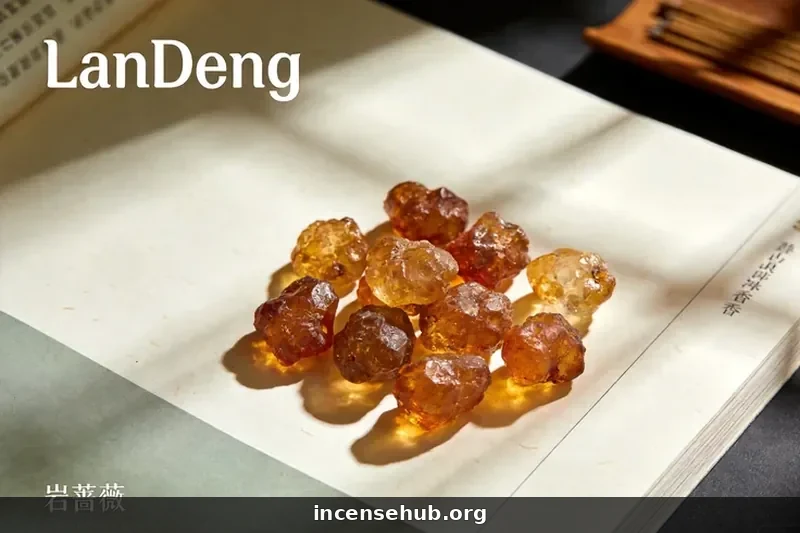
Direct answer: Labdanum (岩蔷薇, yánqiángwēi) is the aromatic resin gathered from Cistus ladanifer, the gum rockrose, a shrub of the western Mediterranean. It smells deep, balsamic, leathery, and amber-like, and it works as a base note and fixative rather than as a bright top. In Chinese incense it is a modern crossover material, not part of the classical 合香 (hé xiāng, blended incense) canon.
Key facts
Direct answer: The essentials are a Mediterranean rockrose resin, a dark leathery scent, and a base-and-fixative role. The table fixes the identity and the vocabulary before the analysis begins.
| Chinese name | 岩蔷薇 (yánqiángwēi), “rock rose”; the resin is also called 劳丹脂 or 赖百当 |
| Botanical source | Cistus ladanifer, family Cistaceae — the resinous exudate |
| Plant part | Resin produced on the leaves and twigs |
| Material class | A plant resin, refined into a concrete or an absolute |
| Scent | Resinous, balsamic, leathery, smoky, amber-like |
| Role | Base note and fixative in modern perfumery |
| Classical Chinese status | Absent from the 香譜 and 香乘; a modern Western import |
| Common confusion | Not fossil amber, not a rose, not a single “amber” substance |
A resin with a misleading name
Direct answer: “Rock rose” is a descriptive name, not a botanical relationship. Cistus ladanifer belongs to the rockrose family, Cistaceae, which is unrelated to the rose family, Rosaceae. The shrub grows in rocky, sunny Mediterranean ground and carries rose-like flowers, and those two facts explain the name. Neither fact makes it a rose.
The mistake is easy to make and hard to shake once the name is in your head. A perfumer’s catalogue lists “rock rose” or “cistus,” a garden centre sells “rock rose” as a drought-tolerant ornamental, and the words suggest a tough little rose. Botanically, the resemblance stops at the flower shape and the habitat. Cistus is in the Malvales order, alongside mallows and rockroses, while Rosa sits in the Rosales. The two are not close relatives, and their chemistry is different: the rose’s characteristic scent comes from a different set of volatiles, while the rockrose’s value lies in a sticky resin rich in labdane-type compounds.
The name “labdanum” itself is old and travelled. It is related to the Greek and Latin names for the resin, and it has passed through Mediterranean languages into the modern perfumery vocabulary. The Chinese names are more revealing of the material’s modern route: 岩蔷薇 is a descriptive translation, “rock rose,” while 劳丹脂 and 赖百当 are transliterations. A descriptive name and two loanwords are the signature of a material that entered Chinese through trade and translation, not through an inherited classical vocabulary.
That naming history matters for buyers. A label that says 岩蔷薇 identifies the plant in descriptive terms. A label that says 劳丹脂 or 赖百当 is transliterating the Western trade name. Neither tells you whether the product is a raw resin, a concrete, an absolute, or a compounded fragrance. The name is a starting point, not a specification.
Where it comes from and how it is gathered
Direct answer: Cistus ladanifer grows on dry, rocky slopes in the western Mediterranean, chiefly in the Iberian Peninsula and North Africa. The resin is gathered from the leaves and twigs, either by combing the sticky exudate from the shrub or by boiling the twigs to release it. The raw material is then refined into a concrete or an absolute.
The shrub is adapted to hard conditions: hot summers, thin soil, strong light. Its leaves carry glands that secrete a sticky, aromatic resin, a protection against heat and herbivory that happens to be valuable to perfumers. The resin darkens and accumulates on the surface of the leaves and young twigs, and the harvest is a matter of separating that sticky fraction from the plant material without destroying its aroma.
Two traditional gathering methods are usually described. The first is combing: workers pass a tool through the shrubs and collect the resin that adheres, a method that requires repeated visits and a good deal of labour. The second is boiling: cut twigs are simmered in water, and the resin is separated from the cooled liquid. Historical accounts also describe resin being combed from the coats of grazing goats, which brushed against the shrubs and picked up the exudate; that detail belongs to the history of the material rather than to modern supply chains, and it is best treated as a traditional account.
The geography is part of the identity. Labdanum is a Mediterranean product at every stage: the shrub, the climate, the gathering, and the refining all belong to that region. There is no classical Chinese counterpart because the plant does not grow there and the material did not enter the Chinese repertoire through the historical incense trade. It arrived later, through the global fragrance industry, and it should be understood on those terms.
The wider Cistus genus
Direct answer: Cistus is a genus of sun-loving shrubs centred on the Mediterranean, and several species are aromatic. Gardeners grow them as rockroses, and some produce resins that have been gathered locally. Commercial labdanum is primarily associated with Cistus ladanifer, the gum rockrose. A garden rockrose is not automatically a perfume source.
The genus is easy to admire and harder to sort out. Cistus species hybridise readily, the flowers are short-lived and similar, and the differences often come down to leaf shape, hairiness, and the colour of the petals. Cistus creticus, Cistus monspeliensis, Cistus salviifolius, and Cistus albidus are among the species a traveller may meet on dry Mediterranean hillsides or in a garden. Several have aromatic foliage, and some have been used locally for incense, medicine, or household scent.
That local diversity is not the same as commercial identity. The perfumery material called labdanum is produced from C. ladanifer, the species whose resin is most strongly associated with the trade. Resins from other species may smell related, and historical accounts sometimes use the same word for them, but a buyer should not assume that every aromatic rockrose is the material in a perfumery catalogue. The species name is the reliable anchor.
This matters for garden enthusiasts who read that rockroses produce labdanum and wonder whether their hedge is a perfume crop. It is not, in any practical sense. The resin yield of an ornamental plant is small, the gathering is laborious, and the refining requires equipment. The commercial material comes from managed harvests and specialist extraction. A garden shrub can be enjoyed for its flowers and its aromatic leaves; it is not a substitute for a supply chain.
The genus also illustrates why common names are unreliable. “Rock rose” can refer to several Cistus species, to a garden cultivar, or to a plant in a different family altogether. “Labdanum” narrows the field to the resin, but not necessarily to the species. The binomial is the only name that travels without ambiguity.
The chemistry behind the amber note
Direct answer: Labdanum’s resin is rich in labdane-type diterpenes, the class of compounds named after the material itself, along with volatile terpenes and other aromatic constituents. The result is a complex, dark, leathery sweetness that perfumers use as a natural amber base. The “amber” is an accord, not a single molecule, and labdanum is one of its main natural supports.
The name “labdane” is a useful reminder of how closely perfumery and phytochemistry are connected: a whole structural family of diterpenes takes its name from the resin. Those heavier compounds contribute body and tenacity. The lighter volatile fraction contributes the aromatic top of the resin — the part that smells resinous and slightly green when the material is fresh. The balance between the two fractions changes with the plant, the harvest, and the refining method, which is why two labdanum absolutes can differ noticeably in character.
The classic amber accord is a construction, not a botanical extract. It is usually described as a combination of labdanum, vanilla, and benzoin. Each material does a different job:
labdanum supplies the leathery, smoky, animalic warmth → vanilla adds sweet, creamy roundness → benzoin contributes balsamic sweetness and its own fixative quality → the three together produce a warm, resinous, sweet base that reads as “amber” → none of the three is fossil amber, and the accord is a perfumery convention rather than a natural substance.
That chain is the single most useful thing to understand about labdanum’s role. The material is not valued for a simple, recognizable top note. It is valued for what it does underneath other notes: it gives an amber base its depth, its slight dirtiness, and its staying power. A labdanum absolute smelled alone can seem dark, heavy, and even rough. In a blend, the same material becomes the floor that the sweeter and brighter notes stand on.
There is a practical consequence for substitution. If a formula calls for labdanum and the cupboard has benzoin, the benzoin will add sweetness and fixative quality but not the leathery, smoky depth. If the cupboard has frankincense, the result will be brighter and more citrus-resinous, with none of the amber weight. The materials overlap in the broad category of “resin” and diverge sharply in what they contribute. Treating one as a drop-in replacement for another is one of the commonest ways to lose the intended base.
Three things called amber
Direct answer: Fossil amber, the amber accord, and labdanum are three different things that share a word. Fossil amber is a mineralized plant resin used mainly in jewellery and occasionally as a curiosity. The amber accord is a perfumery construction, typically labdanum, vanilla, and benzoin. Labdanum is one natural material that contributes to that accord. Confusing the three leads to bad buying decisions and bad descriptions.
| Term | What it is | Origin | Role in fragrance | Common error |
|---|---|---|---|---|
| Fossil amber (琥珀) | Mineralised ancient resin, often yellow-brown | Geological deposits, not a living plant product | Rarely a perfume material; more often a decorative or symbolic object | Assuming a perfume labelled “amber” contains fossil amber |
| Amber accord | A constructed warm, sweet, resinous base | Perfumery convention, built from several materials | The “amber” note in modern fragrance | Treating the accord as a single natural ingredient |
| Labdanum | Resin from Cistus ladanifer | Mediterranean shrub | Leathery, smoky, fixative component of the amber accord | Calling labdanum itself “amber” |
The table is worth keeping in mind when reading product descriptions. “Amber” in a fragrance list almost never means fossil amber. It usually means an accord, and the accord may be built from naturals, synthetics, or both. Labdanum is one possible natural component, not a synonym for the result. A supplier who sells “amber resin” may be selling a compounded mixture, a labdanum-based blend, or something else entirely; the word alone does not settle it.
The Chinese term 琥珀 refers to fossil amber, which adds another layer of confusion for a Chinese reader encountering “amber” in translated perfumery copy. The fossil material has its own cultural associations and its own place in decorative and traditional objects. It is not the same as the perfumery accord, and it is not the same as labdanum. Keeping the three words apart is a small act of consumer protection.
For a formulator, the important distinction is functional. Fossil amber is not a practical fragrance ingredient in the ordinary sense. The amber accord is a goal, not an ingredient. Labdanum is an ingredient that helps reach the goal. A formula should specify the material, not the poetic result.
What labdanum does in a blend
Direct answer: Labdanum is a base note and fixative. It anchors a composition from below, adds leathery and smoky warmth, and gives amber and chypre accords their depth. It is not a bright top note, and it is rarely the first thing a nose notices. Its value is in how it changes the materials above it.
In perfumery, labdanum is often described as a “dry” resin, meaning that its sweetness is accompanied by a leathery, slightly smoky quality rather than a syrupy one. That dryness is why it works so well in chypre structures, where a bergamot top, a floral heart, and a mossy-woody base need a dark, warm bridge. It is also a natural fit for leather accords, where its animalic edge supports the idea of tanned hide without resorting to animal-derived materials.
The fixative effect is real but should be described carefully. Labdanum is a heavy, resinous material with low volatility, and it slows the overall evaporation of a composition by adding a tenacious base. It does not “trap” lighter molecules in a literal cage; it changes the physical and olfactory context in which they evaporate. The practical result is a longer, smoother dry-down, with the top notes fading into a warm resinous floor rather than collapsing into nothing.
In incense, the same logic applies with adjustments. A resin such as labdanum can be burned on charcoal, blended into a stick or cone, or used in a loose incense mixture. Its heavy fraction resists the heat longer than a volatile spice, so it tends to appear in the middle and later parts of a burn. Its smoke is dark and resinous, and it can produce soot if the proportion is high or the burn is starved of air. The material is a base, and the burner rewards a base-like dose: enough to anchor the blend, not so much that the whole session smells of hot resin.
The judgment boundary is worth stating. Labdanum can make a thin blend feel deeper, but it cannot make a badly balanced blend coherent. If the top is sharp and the middle is empty, adding labdanum will produce a sharp, empty blend with a heavy bottom. The material supports structure; it does not create it. A formulator who reaches for labdanum to “fix” a formula that has no clear idea is using a resin as a substitute for a decision.
Chypre, leather, and the architecture of a base
Direct answer: Labdanum is a structural material in two classic fragrance families: chypre and leather. In a chypre it sits in the base beside oakmoss and patchouli, under a bergamot top and a floral heart. In a leather accord it supplies a warm, tanned-hide quality that supports the sharper, tar-like and smoky materials. In both cases its job is architectural rather than decorative.
The chypre structure is one of the oldest conventions in Western perfumery: a bright citrus opening, a floral or fruity heart, and a mossy, woody, resinous base. Labdanum belongs to that base. It adds a warm, leathery sweetness that keeps the moss and patchouli from reading as dry or cold, and it helps the composition descend smoothly from the citrus top. A chypre without a material in the labdanum role can feel top-heavy: bright at the start, thin at the finish.
The leather accord is a different use of the same quality. Leather in perfume is an illusion built from materials that evoke tanned hide, smoke, and animalic warmth. Labdanum contributes the warm, slightly dirty, resinous part of that illusion. It is usually combined with smokier materials and with the sharper, more assertive notes that give leather its bite. On its own, labdanum smells resinous and leathery; in a leather accord, it supplies the human warmth that makes the illusion persuasive.
bergamot and other bright materials open the composition → florals or fruit fill the heart → labdanum, oakmoss, patchouli, and other base materials settle underneath → the resin binds the dark, warm, and mossy notes into a floor → the top notes fade into that floor instead of collapsing → the fragrance ends with depth rather than with a gap.
That chain is why labdanum is described as a fixative even though it is not a fixative in the strict chemical sense. It does not stop evaporation; it provides a base that is still perceptible when the lighter materials have gone. The result is a longer, more coherent dry-down. The same logic explains why the material is hard to replace: a brighter resin changes the colour of the base, and a sweeter resin changes its temperature.
For incense, the chypre and leather templates are less formal but still useful. A blend that wants a dark, warm finish can borrow the chypre idea: a bright resin or citrus note on top, a floral or spicy middle, and labdanum with a woody material underneath. A blend that wants a leather impression can use labdanum with a smoky wood or a tar-like note. The templates are not recipes; they are ways of thinking about where the base sits and what it is doing.
Forms and processing
Direct answer: Labdanum is sold mainly as a concrete and an absolute. The concrete is a solvent extract of the raw resin; the absolute is a further ethanol-washed concentrate. The raw resin is the starting point, but the commercial materials are the refined extracts, and their quality depends on both the harvest and the extraction.
| Form | What it is | Character | Best use | What to check |
|---|---|---|---|---|
| Raw resin | The sticky exudate gathered from the shrub | Dark, thick, strongly aromatic, variable | Traditional or craft use; further processing | Plant debris, moisture, consistency |
| Concrete | Solvent extract of the raw resin | Waxy, dark, rich, with waxes present | Perfumery bases; further processing into absolute | Solvent residue, extraction completeness |
| Absolute | Ethanol-washed concentrate of the concrete | Smoother, more fluid, intense, cleaner | Fine fragrance, amber and chypre bases | Dilution, authenticity, storage history |
The processing sequence is straightforward in outline and demanding in practice:
raw resin gathered → solvent extraction removes the aromatic material from the plant debris and waxes → the solvent is evaporated to leave a concrete → the concrete is dissolved in ethanol and chilled → waxes precipitate and are filtered out → the alcohol is removed to leave an absolute → the absolute is the concentrated perfumery material.
Each step changes the balance of the scent. The concrete retains more of the waxy, heavy, resinous body; the absolute is cleaner and more mobile, with the leathery and balsamic notes more clearly separated. Neither is universally better. A perfumer choosing between them is choosing a texture as much as a smell. For incense, the concrete may be easier to work into a paste, while the absolute is more convenient when a small, precise dose is needed.
The quality of the finished extract depends heavily on the raw material. Resin gathered from young twigs, from older leaves, or from different seasons will vary in aroma. The extraction can be well executed and still produce a mediocre absolute if the starting resin was poor. This is why a certificate of analysis, which may confirm identity and purity, does not by itself confirm that the material smells good. The nose remains the final check.
A grading frame for labdanum
Direct answer: There is no single public grading standard for labdanum. Buyers can use a consistent frame: identity, richness, cleanliness, form, and storage history. The strongest signal is a deep, leathery, balsamic aroma with no harsh solvent edge; the weakest is a thin, flat, or chemically sharp smell.
| Check | Strong sign | Weak sign | Why it matters |
|---|---|---|---|
| Identity | Cistus ladanifer named; a coherent producer story | “Amber resin” or “rock rose” with no species or form | The word “amber” can mean an accord, a fossil, or a blend |
| Richness | Deep, layered, leathery-balsamic; smells complete | Thin, flat, or merely sweet | Richness reflects the resin and the extraction |
| Cleanliness | No harsh solvent, burnt, or rubbery edge | Sharp chemical top note; solvent smell | Residual solvent or poor extraction spoils the base |
| Form | Concrete or absolute clearly stated | Vague “oil” or “resin” | Forms differ in strength and handling |
| Storage | Cool, dark, sealed; no oxidation smell | Sticky, dried-out, or sour | Resins oxidise and lose their finer notes |
The identity check is more important for labdanum than for many materials because the word “amber” is so elastic. A product described as amber resin may be a compounded mixture of labdanum, benzoin, vanilla, and aroma chemicals, or it may be a fossil-derived decorative material, or it may be a labdanum extract with a poetic name. The buyer needs to know which. A species name and a form name cut through most of the ambiguity.
The cleanliness check is the one that separates a good extract from a merely acceptable one. Labdanum naturally has a dark, leathery, slightly animalic quality; that is the point of the material. A harsh solvent note, a rubbery edge, or a burnt smell is not part of the profile. It points to extraction problems, overheating, or poor storage. The difference is obvious when two samples are smelled side by side, which is why samples matter more than descriptions.
Richness is the most subjective check and the one most easily faked by dose. A diluted absolute can smell thin; a concentrated one can smell overwhelming. The useful test is to smell the material at a consistent dilution on a strip, not straight from the bottle. A good labdanum at a sensible dilution unfolds in layers: resin, leather, a hint of smoke, and a sweet balsamic undertone. A poor one collapses into a single dark note.
Labdanum among the resins
Direct answer: Labdanum is one of several plant resins used as bases, and each has a distinct character. Frankincense is bright and citrus-resinous, myrrh is bitter and medicinal, benzoin is sweet and balsamic, opoponax is soft and sweet-resinous, and labdanum is dark, leathery, and amber-like. They can support one another, but they are not interchangeable.
| Resin | Source | Scent character | Role | Contrast with labdanum |
|---|---|---|---|---|
| Labdanum | Cistus ladanifer | Dark, leathery, balsamic, smoky | Amber and chypre base | The reference material |
| Frankincense | Boswellia species | Citrus, pine, resinous, lifting | Top and middle resin work | Brighter, less sweet, more volatile |
| Myrrh | Commiphora species | Bitter, medicinal, earthy-resinous | Base and fixative; traditional incense | More bitter and medicinal, less sweet |
| Benzoin | Styrax species | Sweet, vanilla-like, balsamic | Fixative and sweetener | Sweeter, lighter, less leathery |
| Opoponax | Commiphora species | Sweet, soft, balsamic, slightly spicy | Base and rounding agent | Softer and sweeter, less dark |
The table is a map of a family, not a ranking. Frankincense and labdanum are often paired because one lifts and the other grounds; the contrast is useful rather than redundant. Myrrh and labdanum can overlap in the dark, resinous register, and a blend that uses both needs a clear idea of which one is doing the leathery work. Benzoin and labdanum are the classic amber pair, with benzoin supplying the sweetness that labdanum lacks. Opoponax sits between benzoin and myrrh in sweetness and can soften a labdanum base that has become too austere.
The practical lesson is that “resin” is a category, not a specification. A formula that says “resin base” without naming the material has left the most important choice open. The same is true of “amber accord”: the accord can be built in many ways, and the choice of labdanum, benzoin, vanilla, or a synthetic amber material changes the result substantially. Naming the material is the beginning of a real formula.
In the burner
Direct answer: Labdanum behaves as a heavy base in incense. It releases dark, resinous, leathery notes in the middle and later part of a burn, and it can produce soot if the proportion is high or the burn is poor. It is best used at a base-note dose and supported by brighter resins or woods that keep the composition from becoming heavy.
The sequence in a burning blend runs roughly like this:
the ember heats the resin → the lighter aromatic fraction lifts first → the leathery, balsamic notes arrive → the heavier diterpene fraction resists the heat → the base deepens and lingers → the resin continues to smoulder after the brighter materials have gone → a high proportion or a starved ember produces soot and a burnt-resin smell.
That chain explains both the appeal and the risk. Labdanum gives a blend a long, dark tail that most volatile materials cannot provide. It also keeps burning after the top notes have vanished, which can make the final third of a session feel heavy. A formulator who wants a clean finish should pair labdanum with materials that continue to evolve, or reduce the dose so that the resin supports rather than dominates.
Format matters. In a stick or cone, the binder moderates the heat and the resin is distributed through the mass, so the release is gradual. On a charcoal disc, the resin is exposed to a hot, concentrated source, and it can bubble, smoke heavily, and scorch. Loose incense on charcoal is the least forgiving format for labdanum; a small amount goes a long way, and the burner needs enough air to avoid a smouldering, sooty burn.
The sensory result also depends on the quality of the extract. A clean absolute gives a leathery, balsamic warmth with a relatively controlled smoke. A poor concrete with solvent residue or plant debris can produce a harsh, tarry note that reads as a fault rather than a feature. The difference is not subtle, and it is one more reason to test a new material in the format it will be used in.
Sourcing and storage
Direct answer: Buy labdanum by species and form, ask how the resin was gathered and extracted, and judge the material by smell rather than colour alone. Store concrete and absolute sealed, cool, and dark. Resins oxidise, and an old, badly stored extract loses the finer balsamic notes before it loses its heaviness.
A buying sequence for labdanum starts with the form. If the intended use is a perfume or a small-dose incense accent, an absolute is usually the cleaner choice. If the intended use is a paste, a stick, or a traditional resin blend, a concrete may be more practical. The raw resin is a craft material with more variability; it is not the right starting point for someone who needs a repeatable result.
The second question is species and origin. Cistus ladanifer is the standard source for commercial labdanum. Other Cistus species are aromatic and may be sold under related names, but they are not necessarily the same material. A label that says only “rock rose” or “cistus” does not settle the species. A label that says “amber resin” settles even less.
The third question is process. Solvent-extracted concrete and ethanol-washed absolute are different products. Ask which one is in the container, and ask about the solvent if the material is a concrete. A well-made concrete should smell rich and resinous, not sharp or chemical. An absolute should be smoother and more fluid, with the leathery and balsamic notes clearly present.
Storage is a matter of slowing oxidation. Resins are more stable than volatile oils, but they are not inert. Heat, light, and air gradually change the aroma, often pushing the material toward a flatter, heavier, slightly sour profile. Keep containers sealed and full where possible, store them in a cool dark place, and avoid transferring small amounts into a large jar with a lot of headspace. For a material bought in bulk, dividing it into smaller sealed portions is a simple way to reduce repeated exposure.
Colour is a weak guide. Labdanum extracts range from dark brown to greenish-brown, and the shade depends on the resin, the extraction, and the age. A dark colour does not prove quality, and a lighter colour does not prove dilution. The nose, used consistently, is a better instrument than the eye.
The Chinese name and the classical question
Direct answer: 岩蔷薇 means “rock rose,” a descriptive modern name. 劳丹脂 and 赖百当 are transliterations of “labdanum,” which marks the material as a translated import. None of these names is a classical 香譜 or 香乘 term, and labdanum has no established place in the classical Chinese incense repertoire.
The naming pattern is the same one seen with other Western aromatics: a descriptive Chinese name for the plant, plus one or more phonetic renderings of the trade name. The descriptive name tells a Chinese reader what the shrub looks like; the transliterations tell them that the word came from elsewhere. Neither is evidence of an old Chinese use. A classical material would normally have a name embedded in the older botanical and medical vocabulary, with references in the manuals and a place in the recipe tradition. Labdanum has none of that.
This does not diminish the material. Labdanum is a genuine, well-documented Western resin with a long history in Mediterranean perfumery and a clear role in modern fragrance. It is simply not a classical Chinese incense ingredient. The honest description is “a modern Western resin used in contemporary Chinese incense,” not “an ancient Chinese aromatic.” The difference matters because buyers pay premiums for tradition, and a false pedigree is a form of misrepresentation.
The same caution applies to the word “amber” in Chinese marketing. 琥珀 is fossil amber, a decorative and symbolic material. A product described as 琥珀香 or “amber incense” may be using the word for its associations rather than describing a fossil ingredient. Labdanum, benzoin, vanilla, and synthetic amber materials can all contribute to an “amber” impression. The buyer should ask what the material actually is, not what mood the name evokes.
Safety
Direct answer: Burning labdanum produces smoke, fine particles, and the combustion products of a resin. Use it in a ventilated space, avoid inhaling concentrated smoke, and keep burning material away from children and pets. Resins can produce more soot than dry woods, so a clean burn and a sensible dose matter.
Resin incenses are often treated as “natural” and therefore mild. The combustion chemistry does not support that assumption. A resin burns with a rich, dark smoke that carries particulate matter and a complex mixture of breakdown products. The aromatic experience may be pleasant; the exposure is still smoke. Ventilation and distance from the source are the basic protections, and they apply regardless of how traditional or natural the material is.
Labdanum adds a soot consideration. Resinous materials can burn incompletely if they are overcrowded or starved of air, producing a black, tarry smoke and a burnt-resin smell. That is unpleasant at best and a sign of poor combustion at worst. A clean burn — a small dose, enough air, a suitable burner — reduces the problem and also gives a better scent. The safety advice and the aesthetic advice point in the same direction.
This page is editorial knowledge content, not medical advice. It makes no claims that labdanum treats, cures, or prevents any condition. Anyone with a respiratory condition or a sensitivity to smoke should be especially careful and should seek qualified advice about their own situation. The safety guide covers ventilation, burners, and responsible use in more detail.
The evidence line
Direct answer: The botanical identity of Cistus ladanifer, its Mediterranean origin, and the use of labdanum as a Western perfumery resin are documented. The amber-accord role is established industry practice. The claim that labdanum is a classical Chinese incense material is not supported, and no medical claim is made.
The layers are worth separating. The plant is established: Cistus ladanifer is a described species in the rockrose family, native to the western Mediterranean. The resin and its traditional gathering are documented in perfumery and botanical accounts. The refining into concrete and absolute is standard practice. Those are the stable facts.
The historical layer is thinner and more uneven. Labdanum has a long Mediterranean history, but the details of ancient use are not always well documented, and it is easy to overstate them. This page keeps the historical claims general: a Mediterranean resin with a long perfumery record, not a specific ritual or medical use. Where a claim is traditional, it is labeled as traditional belief; where it is not established, it is labeled as such.
The Chinese layer is the clearest. Labdanum is absent from the classical 香譜 and 香乘 as a 合香 material, and its Chinese names are modern descriptive or transliterated terms. Its presence in contemporary Chinese incense is a crossover from Western perfumery. That is a category statement, not a judgment of quality. The material can be excellent and still be modern.
The health layer is empty by design. Labdanum is not a medicine, and this page makes no therapeutic claims. The “ambergris of the plant world” phrase is a descriptive compliment from perfumery, not a clinical assertion. A reader who wants medical information should consult a qualified professional, not an incense encyclopedia.
FAQ
Direct answer: The short version: labdanum is a rockrose resin, not a rose and not fossil amber, and its place in Chinese incense is modern rather than classical.
What is labdanum? The aromatic resin gathered from Cistus ladanifer, the gum rockrose, a shrub of the western Mediterranean. It is refined into a concrete or an absolute and used in perfumery as a base note and fixative. Its scent is dark, balsamic, leathery, and amber-like.
Is labdanum a classical Chinese incense material? No. It is absent from the classical 香譜 and 香乘 as a 合香 material. Its Chinese names are modern descriptive or transliterated terms, and its use in Chinese incense is a crossover from Western perfumery. The material is genuine; the classical pedigree is not.
Is “rock rose” a rose? No. Cistus ladanifer belongs to the rockrose family, Cistaceae, which is unrelated to the rose family, Rosaceae. The name describes the shrub’s rocky habitat and its rose-like flowers, not a botanical relationship. The useful part is the resin, not the flower.
What is the difference between labdanum and amber? Labdanum is a natural resin from Cistus ladanifer. The “amber” note in perfumery is usually a constructed accord, often built from labdanum, vanilla, and benzoin. Fossil amber (琥珀) is a third, unrelated material. Labdanum contributes to the amber accord; it is not itself amber.
What is the difference between labdanum concrete and absolute? A concrete is a solvent extract of the raw resin, waxy and rich. An absolute is made by dissolving the concrete in ethanol, removing the waxes, and evaporating the alcohol, which yields a cleaner, more fluid, more concentrated material. They differ in strength, texture, and best use.
Sources
Direct answer: These references support the botanical identity, the Mediterranean resin trade, and the perfumery role. They do not support a classical Chinese incense pedigree or any medical claim.
The botanical identity of Cistus ladanifer is documented in the GBIF taxonomic record. The description of labdanum as a Mediterranean resin gathered from the leaves and twigs, refined into a concrete and an absolute, and used as a base and fixative in Western perfumery is drawn from standard perfumery accounts and treated as industry practice. The classical Chinese category statement — that labdanum is absent from the 香譜 and 香乘 as a 合香 material and enters modern Chinese incense as a Western crossover — is a historical and editorial judgment rather than a laboratory finding. The safety note on combustion smoke is an established exposure concern.
Related Resources
Direct answer: The linked pages cover the other classical resins, the amber question, and the site’s scent and aroma-family guides.
Frankincense and myrrh are the other classical resins most often compared with labdanum, and benzoin is its partner in the amber accord. Amber covers the fossil material and the cultural associations that the word carries, while orris root is another Western perfumery material with a modern crossover into Chinese incense. The resinous aroma family places these materials in a wider scent map, and the scent guide explains how base notes shape a composition.
Key Takeaways
Direct answer: Labdanum is a dark, leathery base material whose value lies in structure and tenacity, not in a bright top note.
- Labdanum is the resin of Cistus ladanifer, a western Mediterranean shrub in the rockrose family, Cistaceae. “Rock rose” is not a true rose.
- Its scent is dark, balsamic, leathery, and amber-like; it works as a base note and fixative, not as a bright top.
- The amber accord is a construction, typically labdanum, vanilla, and benzoin. Labdanum is one component, not a synonym for amber, and fossil amber is a different material again.
- The commercial forms are concrete and absolute. They differ in texture, strength, and best use, and they are not interchangeable.
- Labdanum is absent from the classical Chinese 香譜 and 香乘; its Chinese names are modern and its place in Chinese incense is a Western crossover.
- In the burner, it gives a long, dark base and can produce soot at high doses. Use it as a base-note material, in a clean burn, with ventilation.
- The botanical and perfumery facts are documented; the classical Chinese claim is not, and no medical claim is made.