
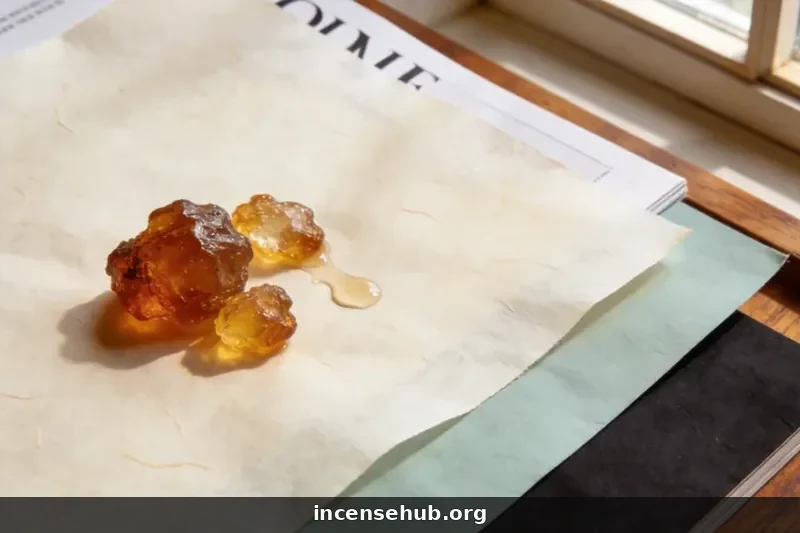
Direct answer: Wound a Commiphora tree and it leaks a fluid that sets hard and dark; that hardened exudate is what the trade calls myrrh, with C. myrrha the species most often meant. Break a tear and the air fills with old resin, dry earth, and a bitterness that sits at the back of the nose. The material has moved between the Red Sea, the Gulf, and Chinese ports for so long that 没药 records its sound rather than its appearance. In Chinese blended incense it is a depth note, classically paired with frankincense (乳香) and almost never burned as the lead material.
Key facts
Direct answer: The commercial essentials fit in six lines: what the name means, what the material is, which species sets the standard, how it smells, how it answers heat, and what job it does in a blend.
- Name — 没药 (mòyào), a borrowed sound rather than a description.
- Material — a wound exudate of Commiphora trees: oil, resin, and gum in one mass.
- Reference species — C. myrrha; sibling species trade under neighbouring names.
- Nose — bitter, earthy, faintly antiseptic: the dark half of the frankincense pair.
- In the censer — melts before it chars, so gentle heat beats an open flame.
- In 合香 — ballast and fixative (佐/使), never the lead.
The single most useful fact on this page is that myrrh is a mixture, not a single substance. It contains a volatile fraction that carries the smell, a resin fraction that gives it body and solubility in alcohol, and a gum fraction that is water-soluble and largely tasteless. Almost every practical behaviour that surprises a first-time user — why it melts instead of burning cleanly, why a tincture works and a water infusion does not, why the powder cakes in humid weather — follows from that three-part structure.
What myrrh is, materially
Direct answer: Three materials arrive in one mass: an aromatic oil, a hard resin, and a gum that swells in water. Nothing about the substance is wood, and nothing about it is simple — the composite structure is the reason it behaves the way it does.
The tree does the manufacturing. When the bark of a Commiphora trunk or branch is wounded — by a knife, by an insect, by wind-driven grit — the tree responds by pushing out a fluid that seals the wound. That fluid is the raw material of myrrh. It leaves the tree pale and slightly sticky, and it darkens as it dries and oxidises in the air.
Each of the three behaves on its own terms, and the practical advice later on this page only makes sense once that separation is clear:
- The volatile fraction is the essential oil. It is what the nose reads as myrrh, it evaporates at low temperature, and it is what steam distillation captures.
- The resin fraction is the hard, glossy, alcohol-soluble part. It gives the tear its structure and its slow melt, and it is the reason a myrrh tincture turns dark and viscous.
- The gum fraction is water-soluble polysaccharide material. It swells in water, it does not carry much aroma, and it is the part that makes a water-based preparation cloudy and bland.
A tear is therefore a composite material. Its quality is not one property but a balance: how much volatile oil survived drying, how clean the resin is, how much bark and grit came along with it, and how the whole mass behaves when warmed. A buyer who evaluates only colour is reading one variable out of four.
Commiphora is a dry-country genus: woody shrubs and small trees with thick bark, sparse foliage, and the patience to sit out long droughts. It shares the family Burseraceae with Boswellia, and that single taxonomic fact carries most of the trade history that follows — two genera, one family, one belt of arid land, one set of roads.
Why the tear is the unit of trade
Direct answer: The fluid sets wherever it hangs, so the harvest comes off the trunk as rounded tears and shapeless lumps rather than as a uniform block. That accident of drying became the commercial unit: buyers judge a lot first by how big, how even, and how clean its pieces are.
The chain from wound to tear is short and physical:
bark cut → resin flows to the wound → the flow slows as it meets air → the surface skins over → the interior continues to lose volatiles → the mass hardens into a tear → harvest by hand → sorting by size and colour.
That chain explains why tears vary so much within a single shipment. A tear that formed in the heat of the day dried faster than one that formed overnight; a tear that hung free is cleaner than one that ran down the trunk and picked up grit; a tear from a younger tree is often paler than one from an older trunk. None of that is a defect. It is the normal spread of a hand-harvested material.
Harvesting is manual and repetitive. The tapper makes shallow cuts, waits for the resin to set, and returns to prize off what has formed. The work is seasonal and depends on temperature: resin flows more freely in heat and sets slowly in cold. That is one reason origin and harvest timing appear in trade descriptions even when the species is the same.
Sorting is where the material acquires its commercial identity. Clean, whole tears of a consistent size are the top of the range. Lumps with bark attached, siftings, and dust are the bottom, and they are not useless — they are simply a different input with different behaviour. The mistake is to price dust as if it were tears, or to build a formula around tears and then accept dust on the repeat order.
Reading the name 没药
Direct answer: 没药 (mòyào) is a transliteration, not a description — the Chinese name reproduces the sound of a foreign word for the resin rather than naming a plant part. That is a strong clue that myrrh arrived in China as an import rather than as a native herb.
The contrast with its classical partner is instructive. 乳香 (rǔxiāng), frankincense, reads literally as “milk incense” — a descriptive name, evoking the milky resin or the pale smoke. 没药 does not describe anything in Chinese; it approximates a sound. The two names sit side by side in the materia medica, and the asymmetry records two different histories of arrival.
That has a practical consequence for anyone reading old recipes. A descriptive name tells you what the material looked like to the person who named it. A transliterated name tells you that the material came from somewhere else and was known by what foreign traders called it. Myrrh’s Chinese identity is commercial before it is botanical, and the same is true of several other imported resins in the tradition.
The pair itself, 乳香没药, is one of the fixed collocations of Chinese incense and materia-medica writing. The two are named together so often that they function as a single idea: a bright resin and a dark one, a lifting note and a grounding one. That pairing is not a Chinese invention. The same coupling appears in Western religious and perfumery writing, where the two are named in a single breath. Geography explains it: one producing region, one set of caravan roads, and two resins that answer each other in the censer.
A reader should resist the temptation to treat the pair as a formula. Naming two materials together is not the same as prescribing equal parts. In practice the proportion is where the work happens, and myrrh’s bitterness means its share is usually the smaller one.
Aroma: bitter-balsamic depth
Direct answer: The scent is low and thick: old resin, damp earth, a bitter tang at the back of the throat, and something faintly antiseptic underneath. Nothing in it sparkles, and that is the point — it works as ballast for lighter materials.
The first impression is sweetness of a dark kind — balsamic, like old resin or dried fruit — and then the bitterness arrives underneath it. There is a dusty, almost mineral quality in the background, and on some lots a faint anise or liquorice shadow. The overall shape is low and round, with very little sparkle at the top.
Several variables move the profile:
- Species. C. myrrha is the reference. Related Commiphora resins traded under other names smell sweeter, or more rubbery, or flatter, and a buyer who has only ever met one of them has not met “myrrh” in general.
- Volatile retention. A tear that dried slowly in cool conditions keeps more of its oil than one that baked on the trunk. The difference shows up as a rounder, more complex top note.
- Age and storage. Resin is more stable than leaf, but it is not inert. Tears held in a hot, open room lose their brighter facets and drift toward a flat, dusty sweetness.
- Preparation. Whole tears warmed gently smell different from powder scattered on a coal. The powder releases faster and harsher because more surface meets heat at once.
The bitterness deserves a separate word, because it is the quality most often misread. In a blend, bitterness is a structural tool: it stops a sweet resin from collapsing into syrup and gives the composition an edge that the nose can follow. On its own, in too large a quantity, the same bitterness reads as medicine. The material has not changed; the dose has.
That is the first editorial judgment on this page: myrrh is not a “rich” material in the sense that more of it makes a blend richer. Past a certain share it makes the blend heavier and more medicinal, and the useful move is almost always to reduce it rather than to add something to cover it.
Where myrrh comes from
Direct answer: Follow the arid rim of the Red Sea and the Gulf of Aden and you are in myrrh country: Somalia and Ethiopia above all, with smaller volumes from neighbouring states and the Arabian shore. The trees tolerate rock, heat, and drought, and the resin is their answer to injury in that setting.
The producing region overlaps almost exactly with the frankincense belt, which is why the two materials share a trade history. Caravans that carried one could carry the other, and ports that handled one handled both. The association is old enough that the pairing reads as natural rather than commercial, even though commerce is exactly what produced it.
For China, myrrh was an import from the start. It came in along the routes that brought aromatics from the west and south, and it entered the materia medica as a foreign material with a foreign name. That status shaped how it was described: as a resin of distant origin, grouped with other imported aromatics, valued for qualities that local herbs did not supply.
The ecology matters for quality. Trees in harsh, dry conditions produce resin slowly and in small quantities, and the material reflects that — dense, aromatic, and relatively clean. Trees in easier conditions may produce more, and the resin may be softer and less concentrated. This is a general pattern in resin-producing plants rather than a rule about any particular shipment, and it is one reason origin is worth recording even when the species is known.
Forms, and how each behaves
Direct answer: Four forms reach the market — whole tears, milled grains, distilled oil, spirit tincture — and each one holds a different portion of what the tree produced. Treating them as interchangeable is the most common formulation error with this resin.
| Form | Composition | How it behaves on heat | Where it earns its place |
|---|---|---|---|
| Intact tears | Everything the tree produced, dried | Softens gradually and gives a long, even release | Slow heating; reference stock; open display |
| Broken lumps and siftings | Identical material, smaller pieces | Ignites sooner and burns less evenly; dusty | Bulk burning; feedstock for milling |
| Milled resin | The whole exudate, reduced to grains | Fast, hot, and hard to hold back; takes up moisture | Pressed pastes, sticks, cones |
| Steam-distilled oil | Aromatic volatiles, nothing else | Volatile and sharp, with no resin weight behind it | Fine fragrance; scenting a carrier |
| Alcohol tincture | Resin and volatiles in spirit | Applied cold, never burned | Perfume work; scenting surfaces |
The distinction between powder and oil is the one that causes the most confusion. Oil is not “concentrated myrrh” in the sense of being the same thing in smaller volume. It is the volatile fraction with the resin body removed, so it smells sharper, thinner, and more one-dimensional than the whole resin. A formulator who replaces resin with oil and expects the same roundness will be disappointed, and the fix is not more oil.
Tincture sits in a middle position. Alcohol dissolves the resin and carries much of the volatile material, while the water-soluble gum stays behind as sediment. The result is a liquid that smells recognisably of myrrh but lacks the smoke and the slow melt. It is a perfumery tool rather than an incense one.
Powder is the workshop form. It disperses evenly through a blend, it takes up binder, and it behaves predictably in a press. The cost is that milling exposes fresh surface to air, and the volatile fraction starts leaving immediately. A powder that smells vivid on the day it is milled can smell flat a fortnight later, which is why storage and batch size matter more for powder than for tears.
Quality: a working decision table
Direct answer: Myrrh has no single formal grade, but buyers separate it by tear integrity, colour consistency, cleanliness, species certainty, and smell. Each of those predicts something specific about how the resin will behave.
| Sort | Appearance and nose | What it tells you | Where it belongs |
|---|---|---|---|
| First sort | Uniform, hard, glossy lumps; sharp bitter-sweet smell when crushed | Even melting; weight can be repeated; little waste | Slow burners; blends that must reproduce; keep one as a sample |
| Unsorted but sound | Same quality, wider size range | Melt varies with piece size; some hand sorting needed | Everyday blending |
| Barky | Brown fragments and grit visible on the surface | Extra ash and a rougher smoke; aroma drifts piece to piece | Utility burning; never a reference lot |
| Fines | Chips and grains at the bottom of the sack | Releases in a rush; clumps in damp air | Paste and stick work |
| Washed out | Pale, dull, faint nose | Thin top note; little left to lift a blend | Background weight only |
| Fused | Lumps welded into one tacky mass | Heat or damp during storage; unpredictable melt | Return to the supplier |
Shade is the easiest thing to photograph and the least reliable thing to grade by. Buyers learn to look for a warm red-brown, and the habit has real use, yet the same colour can come from a different species, from longer oxidation on the branch, or from nothing more than the light in the photograph. A pale lot may be perfectly sound; a dark one may be hiding a flat nose. Trust the crush and the melt over the swatch — an editorial call, offered as such, because colour grading is exactly where a camera can flatter a poor sack.
The other field worth insisting on is dryness. Resin that feels tacky has not finished curing, and tacky resin will fuse in the bag, cake in the mill, and behave unpredictably on heat. A simple squeeze test at the loading door catches more bad lots than any document.
Ten minutes with a sample
Direct answer: A buyer can learn most of what matters about a myrrh lot without a laboratory: break a tear, smell it cold, warm a sliver, and drop a chip in water and in spirit. Each test answers one question and leaves the others open.
| Test | What it reveals | What it cannot tell you |
|---|---|---|
| Break a tear | Fracture and lustre; a clean, glassy break suggests a hard, well-cured resin | Whether the volatile content is high |
| Rub between fingers | Tackiness, grit, and how quickly the surface warms and softens | Species identity |
| Smell cold, then warm | The aromatic register and whether any off-note sits underneath | How the material behaves at full heat |
| Warm a sliver on a heater | Melt behaviour, bubbling, and the point where bitterness takes over | Behaviour in a bound stick |
| Chip in water | Whether gum is present and how much the chip clouds the water | Resin quality |
| Chip in strong spirit | Whether the resin dissolves cleanly or leaves a swollen residue | Aroma balance |
The order matters, and it is deliberately cheap to expensive. Breaking a tear costs nothing and rules out soft, under-cured material immediately. The smell test comes next because it is the only test that speaks to the thing the buyer actually cares about. The water and spirit tests come last because they are informative about composition but tell you little about how the resin will smell in a room.
Two cautions on interpretation. A hard, glossy tear is not automatically a rich one; hardness reflects curing and resin chemistry, not volatile content. And a cloudy water test is not a defect; it is the gum fraction doing what gum does. The test describes the material, not its grade.
What the ten minutes cannot do is predict a blend. That requires the resin in company — with a wood powder, a binder, and a heat source — and it requires more than one burn. A sample protocol narrows the field; it does not close the decision.
One habit turns the protocol into a system. Keep a notebook page per lot — supplier, date, weight, fracture, nose, melt, and a two-line verdict — and photograph the tears beside a ruler under the same lamp. Six months later the page is worth more than memory, because the question that matters then is not “is this good myrrh” but “is this the same myrrh I approved in spring.” Comparison, not judgement, is what protects a formula.
The Commiphora confusion map
Direct answer: “Myrrh” is a trade name that several Commiphora resins have shared, and it also gets attached to materials from unrelated plants. The differences are not cosmetic: they change sweetness, bitterness, and melt behaviour.
| Name in the trade | Actual material | Nose | Why it matters |
|---|---|---|---|
| Myrrh, proper | C. myrrha exudate | Bitter, earthy, faintly antiseptic | The benchmark the others are judged against |
| Opopanax | A sibling Commiphora resin, nicknamed “sweet myrrh” | Amber, powder, soft sweetness | Enters sweet blends posing as myrrh; too soft to ground them |
| Guggul | An Indian Commiphora with a separate tradition | Heavy balsam, sometimes sour | Turns up in cheap lots; melts on its own schedule |
| Bdellium | Another sibling resin, African and Indian trade | Mild, rubbery, low bitterness | Flattens a blend that needed bite |
| Myrrh beads | Hard beads from an unrelated African tree | Almost none of the real character | Curiosity trade; no use in a censer |
| Sweet cicely | Myrrhis odorata, a carrot-family herb | Green anise, sugary | Herb catalogues, not resin counters |
The map has a simple use: whenever a price looks unusually good, ask which row of the table the material came from. Opopanax and guggul are legitimate materials with their own places in perfumery, but neither is a drop-in replacement for C. myrrha. A blend that swaps one for the other changes its sweetness and its weight at the same time.
Sweet cicely is the odd entry, because it is not a resin at all. It is a herb in the carrot family whose common name contains “myrrh” for its scent, and it appears in foraging and kitchen writing rather than in incense commerce. The confusion is linguistic, and it is worth a line here only because search results mix the two freely.
Myrrh and frankincense: complements, not substitutes
Direct answer: One tree genus supplies the dark half of the pair and another supplies the light half: Commiphora yields myrrh, Boswellia yields frankincense. Their family connection explains the shared resinous floor; their difference explains why blenders reach for both.
| Property | 没药 myrrh | 乳香 frankincense |
|---|---|---|
| Source genus | Commiphora | Boswellia |
| Shared family | Burseraceae | Burseraceae |
| Scent direction | Downward: bitter, earthy, faintly medicinal | Upward: citrus peel, cream, clean resin |
| Effect on a blend | Adds weight and fixes lighter notes | Adds air and carries the opening |
| Melt | Softens early, darkens, turns bitter if pushed | Runs to a clear pool and smokes clean |
| Function in the pair | The floor | The ceiling |
| Common counterfeit | Opopanax or guggul passed off as myrrh | A different Boswellia species passed off as the named one |
The pairing works on a simple principle: contrast within a shared family. Both resins have a balsamic base, so they agree at the foundation. Above that foundation, one goes bright and one goes dark. The result reads as a single complex material rather than two materials side by side, which is exactly what a good pair is for.
That is also why the pair is a trap for lazy formulation. Because the two are named together so often, it is easy to assume a fixed proportion and stop thinking. The right proportion depends on what the blend is for: a devotional blend in a large space can carry more of both; a small-room blend needs less of each and more care with the myrrh, whose bitterness concentrates in still air.
The substitution question comes up constantly, and the answer is directional. Frankincense can partly stand in for myrrh when the goal is resinous depth with less bitterness, but it will lift the blend rather than ground it. Myrrh cannot stand in for frankincense at all, because it has no brightness to give. A blend that needs a citrus edge and receives myrrh will simply become heavier.
Myrrh’s job in 合香
Direct answer: In Chinese blended incense, myrrh is a depth note: it grounds a composition, fixes lighter materials, and adds a bitter-balsamic weight. It is assistant or guide material in 君臣佐使 terms, not the chief, and its share is usually small.
The 君臣佐使 framework assigns roles rather than quantities. The chief (君) establishes the character; the minister (臣) supports it; the assistant (佐) adjusts, offsets, or extends it; the guide (使) directs the whole. Myrrh does assistant and guide work. It sits under a brighter material and gives it a floor. It also slows the blend down, in the sense that its heavy molecules linger after the light ones have gone.
That lingering quality is why myrrh appears in blends meant to scent a space over time rather than to make an immediate impression. It is a poor choice for a blend that should feel airy and transparent, and a good choice for one that should feel enclosed and quiet.
Pairing logic, in order of how often it is useful:
- With frankincense — the classical pairing. Frankincense supplies the top, myrrh the floor.
- With sweet woods — sandalwood and agarwood powders. Myrrh adds a bitter counterweight that keeps the wood from reading as pure sweetness.
- With other resins — benzoin, styrax, labdanum. These are heavy materials, and myrrh can easily push a blend from rich into muddy; the dose has to come down as the other resins go up.
- With green herbs — mugwort, rue, calamus. The bitterness of the herb and the bitterness of the resin can either reinforce or collide. In small amounts they reinforce; at higher levels the blend tastes like a pharmacy smells.
- With florals — sparingly. Myrrh can fix a floral note, but it can also bury it.
The editorial judgment behind that list is that myrrh is a structural material rather than a decorative one. It is used to change how a blend holds together, not to add a recognizable top note. Blenders who treat it as decoration tend to overuse it and then wonder why the result feels heavy.
What happens when myrrh meets heat
Direct answer: Heat treats this resin as a solid that first turns liquid. It slumps, spreads, and bubbles while the aromatic oil leaves; only after that does the residue char and turn acrid. Gentle warmth therefore gives a rounder smell than an open flame.
The sequence, in order:
heat applied → the resin softens and loses its glassy surface → trapped volatiles expand and escape → the mass bubbles and spreads → the aromatic peak passes → the remaining resin and gum char → bitter, acrid smoke takes over → ash remains.
Three practical consequences follow.
The aromatic window is early. Most of the pleasant scent is released in the first part of the burn, while the resin is melting. After that, the material is mostly charring, and charring smells like charring. This is why a resin burner that holds a steady low temperature produces a longer pleasant phase than a live coal, which drives straight through the melt into the burn.
Temperature control is the whole skill. On charcoal, the coal’s surface is far hotter than the resin needs. The traditional workarounds — a bed of ash, a mica plate, a metal screen, a small piece at a time — all exist to insert distance or thermal mass between the coal and the resin. On an electric heater, the control is a dial, and the same principle applies: start low, let the resin melt, raise the temperature only when the scent fades.
Bitter smoke is a signal, not an inevitability. When myrrh turns harsh, the usual cause is overheating, and the usual fix is less heat or less material. Adding more resin to compensate for a fading scent does the opposite of what is wanted: it adds mass that will char and produce more harsh smoke.
There is a related point about quantity. Resin is dense, and a piece the size of a pea contains a surprising amount of material. A common beginner error is to load a burner with several large tears, get a dramatic first minute, and then twenty minutes of bitter smoke. Two small pieces, replaced when they fade, give a better experience than one large piece left to char.
Solubility, extraction, and why water fails
Direct answer: Myrrh’s aroma travels in oil and alcohol, not in water. The resin and volatile fractions dissolve in alcohol; the gum dissolves in water; that split is the basis of every extraction method.
The three-fraction structure explains the behaviour directly:
resin + volatiles + alcohol → a dark, aromatic tincture → gum settles out as sediment → the liquid carries the smell, the sediment does not.
resin + water → the gum swells and clouds the water → the volatiles stay locked in the resin → the liquid smells faintly of the raw material and mostly of nothing.
Steam distillation takes a different path. Heat and steam carry the volatile fraction out of the resin, and condensation collects it as an essential oil. What stays behind is the resin and gum, which is why the oil smells sharper and thinner than the whole material: the body has been left in the still.
For incense work, the practical reading is simple. If a process is water-based, it will not carry myrrh’s aroma. If a process is alcohol-based, it will carry the resin and much of the volatile fraction, and it will leave the gum behind. If a process is heat-based, it will carry the volatiles first and the char afterward.
This is also why myrrh behaves differently from a wood powder in a paste. Wood powder is cellulose and lignin: it absorbs water, holds shape, and burns as a solid. Resin powder softens with heat, sticks to itself, and can seal the surface of a paste if it is overworked. A formulator who treats resin powder as a drop-in for wood powder will find the batch behaves differently at every stage, from mixing to drying to burn.
Traditional use and the evidence boundary
Direct answer: Myrrh has a long documented record in ritual, perfume, and traditional medicine across several cultures. A handful of modern studies look at narrow applications; the sweeping claims built on top of them are still traditional or preliminary in status.
| The question | What can be said | What follows for a reader |
|---|---|---|
| Which tree produced it? | Taxonomy is settled | Species names can be checked in botanical references |
| Was it traded and burned historically? | Yes, over a very long period | Documented use, with no implication about effect |
| Does this lot smell right? | Judge it yourself | A sample answers in minutes |
| Is it pure? | Partly by hand, fully only by instrument | Screening narrows the risk; analysis confirms |
| Does it heal anything? | Not established | Outside the scope of this page |
| What grade is it? | Convention, not a standard | Compare lots rather than trust labels |
The honest position is narrower than the marketing. Myrrh was burned because it smelled good and because burning aromatic resin was a meaningful act in many cultures. It was also used in traditional medicine for a range of complaints, and some of those uses have attracted modern study. Neither fact turns the resin into a medicine a reader should self-administer, and neither fact needs to be denied for the incense story to stand.
Two boundaries are worth stating explicitly. First, traditional use is evidence of use, not evidence of effect. A material can have been used for centuries and still fail a clinical test; the two facts are compatible. Second, a preliminary study on a specific preparation is not a licence to generalize. A mouth rinse tested in a trial is not the same thing as resin burned in a room, and neither is the same as resin chewed at home.
This page describes myrrh as an aromatic material. It does not recommend ingestion, does not repeat therapeutic claims, and does not treat traditional authority as clinical proof.
Sourcing, sustainability, and what to ask
Direct answer: The resin comes from trees that grow where they grow, mostly on dry land with no plantation system behind them. Supply therefore tracks the condition of those stands and the restraint of the people cutting them. Buyers should ask for species, origin, harvest timing, and form.
Resin production is not farming in the usual sense. The trees grow where they grow, often on land that is dry, rocky, and unsuited to crops, and the harvest is a matter of finding the trees and wounding them carefully. Over-tapping damages a tree and reduces future yield, so the long-term interest of the producer and the long-term interest of the buyer point the same way: moderate wounding, adequate recovery time, and no cutting for volume.
What a buyer can reasonably ask:
- Species. C. myrrha named explicitly, or the actual species if it is another Commiphora.
- Origin. Country and, where possible, region — the producing belt is wide and the material varies across it.
- Harvest timing. Which season the resin was collected, since heat and drying conditions shape the volatile content.
- Form and grade. Whole tears, siftings, powder, or oil, with the grade described in physical terms.
- Storage history. How the material was held between harvest and shipment, and for how long.
- Documentation. Any paperwork the supplier holds, and a retained sample for comparison.
The list is deliberately physical. Certificates are useful when they exist, but a buyer who cannot describe what a good tear looks, feels, and smells like will not be helped by a document they cannot interpret. The retained sample is the cheapest quality system available: it turns every new delivery into a comparison with a known reference, and it makes drift visible before it reaches a formula.
There is no acute conservation crisis attached to myrrh in the way there is for some aromatic woods, but “not endangered” is not the same as “no concern.” Stand health, land use, and harvesting pressure are real variables in the producing regions, and buyers who ask about them create a market signal that rewards better practice. The wholesale guide sets out the wider sourcing framework.
Myrrh in a pressed stick
Direct answer: Resin powder behaves nothing like wood powder in a stick. It softens with the heat of mixing, sticks to itself and to the press, slows ignition at the tip, and can bleed oil into the wrapper during storage.
Wood powder is a structural material. Its fibres interlock, it takes water without dissolving, and a rolled stick holds its shape because the particles mechanically grip one another. Resin powder has no fibres. It is a thermoplastic solid: warm it and it deforms, cool it and it sets glassy. In a paste it acts as a filler that also glues, which sounds convenient and quickly becomes a problem.
The chain runs like this:
resin grains + water + friction → the surface softens → grains fuse into larger lumps → the paste loses homogeneity → binder has to work harder → the dried stick is dense at one end and crumbly at the other.
Three practical consequences follow.
Mixing order matters. Adding resin powder to a wet mass late, and folding rather than beating, keeps the grains from welding together. A batch that is overmixed turns waxy and stops absorbing water, and no amount of extra binder fixes it.
Ignition suffers at the tip. A stick with a high resin load resists the first flame, because the surface melts and glazes before it can catch. Formulators often accept a slightly slower light in exchange for the rounder burn that resin gives; the trade-off is a choice, not a defect.
Storage can bleed. Oil that is still mobile in a fresh stick can migrate into paper wrappers and cardboard tubes, which is why resin-rich sticks are often wrapped only after a curing period. A wrapper that smells strongly of myrrh before the box is opened has been in contact with a stick that was packed too soon.
None of this makes resin a bad ingredient for sticks. It makes it an ingredient that has to be dosed and sequenced with the rest of the paste in mind, which is why the same formula can work in a cone and fail in a thin extruded stick.
The words on a Chinese specification
Direct answer: A Chinese-language spec sheet describes myrrh with a small set of ordinary trade words — 树脂 for resin, 胶质 for gum, 挥发油 for volatile oil, 净选 for cleaning, 打粉 for milling. Knowing them makes a supplier conversation shorter and much harder to fudge.
| Term | Literal sense | What it means on a sheet |
|---|---|---|
| 树脂 (shùzhī) | tree fat | The resin fraction; the part that melts and holds the tear together |
| 胶质 (jiāozhì) | gum substance | The water-soluble fraction that clouds water and binds dust |
| 挥发油 (huīfāyóu) | volatile oil | The aromatic fraction; what the nose reads and what distillation captures |
| 净选 (jìngxuǎn) | clean-select | Hand sorting to remove bark, grit, and off-colour pieces |
| 打粉 (dǎfěn) | beat to powder | Milling, with an implied mesh or sieve size |
| 过筛 (guòshāi) | pass the sieve | Screening, usually stated as a mesh number |
| 无杂质 (wú zázhì) | no foreign matter | A cleanliness claim that a buyer should verify by eye |
The value of the vocabulary is diagnostic. A supplier who can talk about 挥发油 and 胶质 as separate things understands that myrrh is a composite, and is more likely to be selling material they have handled rather than material they have repackaged. A listing that uses only the word 没药 and a price has told the buyer almost nothing.
There is a limit to what words can settle. No term on a spec sheet describes smell, and smell is the variable that decides whether a lot belongs in a blend. The sheet narrows the field; the sample closes it.
Storage and shelf life
Direct answer: Whole tears keep for years in dry, dark, sealed conditions; powder fades in weeks; oil drifts in months. The enemy is heat, light, and air, and the three act fastest on the form with the most exposed surface.
The reason is the same three-part structure that governs everything else about the resin. The volatile fraction is the part that smells, and volatiles leave through any exposed surface. A tear exposes a small skin relative to its mass. A powder exposes an enormous one. That is why a sack of tears and a tin of powder milled from the same lot can smell noticeably different six months later.
The decline runs in a predictable order:
surface exposed → light volatiles evaporate → the bright top note goes first → the balsamic middle flattens → the resin body remains, smelling dusty and sweet → the material still burns, but it no longer lifts a blend.
Practical storage rules follow from that chain:
- Mill late. Once grains are cut, the clock starts; work to a production date rather than to a stock target.
- Seal first, hide second. An airtight jar inside a closed cupboard does more than any decorative dish.
- Keep it off warm surfaces. A shelf over a stove will soften a whole sack into one lump that has to be chiselled apart before weighing.
- Write the lot on the lid. Species, origin, and the day the seal broke; three-year-old stock is a different ingredient from last season’s.
- Skip the fridge. Cold resin collects condensation, turns tacky, and clouds a tincture, for no gain on a material this stable.
The honest caveat is that shelf life is a range, not a date. A tightly sealed jar of clean tears in a cool climate will outlast the same resin in a hot workshop by a wide margin. Buyers who need reproducibility should treat storage as part of the specification rather than as an afterthought.
What myrrh is not for
Direct answer: Myrrh is a poor choice for light, airy, citrus-led compositions, for anything that must smell clean and transparent, and for any use that involves eating it.
The negative space around a material is as useful as its positive one. Myrrh cannot supply brightness; it has none to give. It cannot make a blend feel lighter; its whole action is downward. It cannot be used as a substitute for frankincense in a composition that depends on a citrus opening, and it cannot be pushed to a high proportion without turning a room into a pharmacy.
That is not a criticism of the resin. It is a description of its job. A material that grounds well will always be a poor material for lifting, and a blender who understands the difference stops asking one to do the work of the other.
Safety
Direct answer: This is a material for the censer, not the kitchen. Its smoke carries particles like any incense, molten resin can spatter, and old medicinal reputations are not a reason to swallow it.
Points that matter in practice:
- Ventilate the space. Resin smoke is dense, and a small closed room concentrates it quickly.
- Keep the burner stable. Hot resin can bubble and spatter; a fire-safe holder on a non-combustible surface is the minimum.
- Use small pieces. Less material, replaced more often, gives a better scent and less char.
- Keep children and pets clear. Curious hands and tails are the usual cause of accidents with live charcoal.
- Do not ingest. Resin is not a food. Traditional-medicine use belongs with a qualified practitioner, not with a kitchen experiment.
- Stop if anyone reacts. Smoke sensitivity is individual, and a reaction is a reason to stop rather than to open a window and continue.
One caution specific to resin: a tear that looks cool on the outside can still be soft and hot inside after the flame is removed. Let the piece sit on the burner rather than handling it, and never move a lit coal with bare fingers.
FAQ
Direct answer: The questions below come up repeatedly in buying and burning; each answer is deliberately short and points to the longer treatment elsewhere on the page.
Is myrrh a wood or a resin? It is a resin — specifically an oleo-gum-resin that the tree exudes from wounded bark. It is not the wood of the tree, not a flower, and not a dried sap in the sense of a watery exudate. The material hardens into tears and lumps, and those tears are what the trade sells. This matters practically because resin melts and softens under heat while wood smoulders and holds shape; the two behave differently in every step from storage to burn.
Why is myrrh so bitter, and can I remove the bitterness? The bitterness is intrinsic to the resin fraction and it is part of what myrrh contributes to a blend. You cannot wash it out without removing much of the material’s character. What you can do is control the dose, pair it with something brighter, and avoid overheating, which amplifies the harsh edge. A blend that tastes medicinal usually has too much myrrh or too much heat, not a defective batch.
How is myrrh different from opopanax? Opopanax belongs to the same genus and travels under the nickname “sweet myrrh,” which is where the trouble starts. It is softer and more ambery, with a powdery sweetness that myrrh proper does not have; myrrh answers with earth and bitterness. Set them side by side and the family resemblance is obvious, but so is the divergence. In a formula the swap reads as a change of mood rather than a change of source.
Can I burn myrrh on an electric heater instead of charcoal? Yes, and for indoor use the heater is usually the better tool. It gives a controlled, lower temperature, so the resin melts and releases aroma without the hot charring that produces bitter smoke. The trade-off is a slower, quieter scent with less smoke drama. Start at a low setting, let the resin melt, and raise the heat only when the scent fades.
Does myrrh go bad? Resin is more stable than leaf or powder, but it is not immortal. Over years, and especially in heat and light, the volatile fraction declines and the tears drift toward a flat, dusty sweetness. Powder loses its top note much faster than whole tears. Store resin dry, dark, and sealed, and judge a lot by smell rather than by the date on the bag.
Summary
Myrrh (没药) is a tree exudate: part volatile oil, part resin, part gum, hardened into tears and shipped out of the Horn of Africa and southern Arabia. Those three fractions account for its behaviour on heat, its solubility in spirit rather than water, and the speed at which milled resin loses its top note.
Inside a 合香 it does structural work rather than decorative work: a floor beneath brighter materials, a hold on the lighter notes, a bitter weight that reads as depth when sparing and as a chemist’s drawer when not. 乳香 is the usual partner for the plain reason that the two pull in opposite directions, and opposition is what makes a pair useful.
Judgement rests on four checks a buyer can make in person: species named, tear sound and dry, dust and bark minimal, smell warm and bitter without a cellar note. Colour helps as a secondary signal and misleads as a primary one. Everything else — grade names, origin stories, claims about health — is either bookkeeping or marketing.
Sources
- Commiphora myrrha on GBIF — used to verify the accepted binomial and the countries where the tree is recorded.
- 本草綱目 (Bencao Gangmu) full text on Wikisource — the full text consulted for 没药 and its pairing with 乳香.
The botanical reference supports the species and genus statements. The classical text supports the material’s place in the Chinese materia medica. Trade observations, grading bands, and burn behaviour are editorial summaries of workshop practice, not laboratory findings. Nothing here is medical advice.
Related Resources
- Frankincense (乳香) — read the two pages together; the contrast is the lesson.
- The frankincense incense guide — a partner resin handled on its own terms.
- Benzoin — sweeter ballast, softer grip, same fixative job.
- Mastic — a useful control, because its melt is nothing like this one.
- Material comparison matrix — the wider field of woods, flowers, and exudates.
- Incense powder and resin — grains, binders, and what happens in a press.
- The scent guide — how the aromatic families relate.
- Safety guide — ventilation and household precautions.