
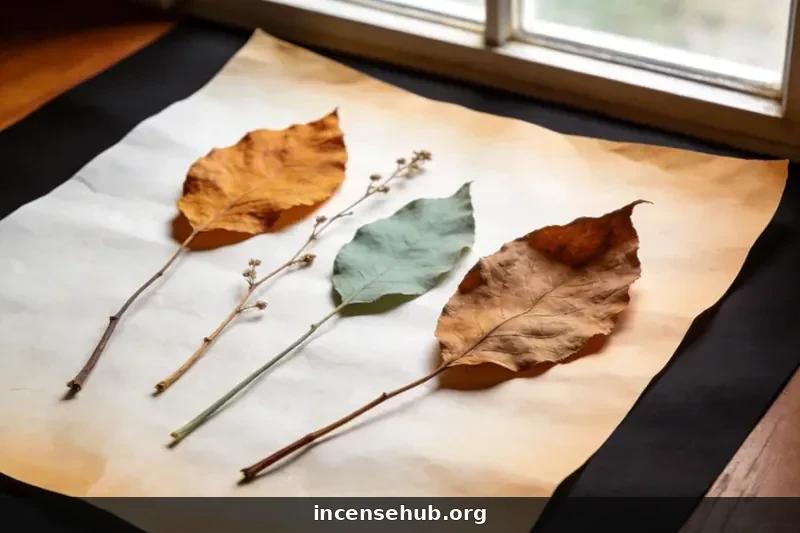
Direct answer: Linglingxiang (零陵香, línglíngxiāng) is the dried herb of Lysimachia foenum-graecum, a primrose-family perennial that grows in damp southern-Chinese valleys. It smells of sweet hay rather than flowers, and in blended incense it works as a softener rather than a lead note. Nearly every practical difficulty with the material comes from the name, which has been attached to more than one plant over the centuries.
Key facts
| Field | Detail |
|---|---|
| Chinese | 零陵香 (línglíngxiāng); classical aliases 熏草 / 薰草 / 蕙草 / 燕草 / 黄零草 / 香草 |
| Modern botanical identification | Lysimachia foenum-graecum, family Primulaceae (the primrose family) |
| Common Chinese trade name | 灵香草 |
| Plant habit | Perennial herb, 20–60 cm, rising from a creeping base |
| Material used | The dried aerial herb — leaf and stem, not wood, root or resin |
| Aroma family | Sweet, hay-like, herbaceous, with a coumarin tonality |
| Classical role | Blender in 合香 (hé xiāng, blended incense); scenting cloth and sachets |
| Range | Northern Guangdong, Guangxi, southwest Hunan, southeast Yunnan; 800–1,700 m |
The plant behind the name
Direct answer: Lysimachia foenum-graecum is an unremarkable-looking primrose-family herb until it dries — then the hay-sweet scent appears. It is a perennial of wet mountain forest, not a cultivated field crop in the classical descriptions.
Botanically the species is modest. It is a perennial that reaches 20–60 cm, with a low creeping base and stems that turn upward. The leaves alternate, broadly ovate to elliptic, 4–11 by 2–6 cm, with a margin only faintly wavy. Flowers sit singly in the leaf axils instead of forming a head; the corolla is yellow and 1.2–1.7 cm across. The fruit is a near-round capsule of 6–7 mm, and the plant flowers in May. Three coordinates come from Flora of China. Altitude: 800–1,700 m. Habitat: wet mixed forest and stream valleys, on humus-rich soil. Provinces: northern Guangdong, Guangxi, southwest Hunan, southeast Yunnan.
Two details in that description matter commercially. The first is habitat: a plant that lives in damp, shaded valleys with rich leaf litter is a plant whose biomass dries unevenly, because thick stems hold water longer than thin leaves. The second is scale: a herb of 20–60 cm yields a light, bulky dried material, so a kilogram of finished herb represents a large volume of fresh growth. Neither point is exotic, but both shape what a buyer receives — uneven dryness in the stem fraction, and a lot of air in the bag.
What the plant does not offer is a resin, a heartwood or an essential-oil-rich root. There is no tapping step, no distillation step, no grading by density or oil content as there is with agarwood or sandalwood. The material is leaf and stem, and the whole craft of it is drying.
A useful correction to a common assumption: the fresh plant is not strongly fragrant in the way a garden herb is. The sweet-hay character is a property of the dried tissue, which is why the classical sources describe the material as it reaches the market rather than as it grows. Anyone judging a living specimen by smell will usually come away disappointed.
Reading the aroma
Direct answer: The scent is sweet hay with a coumarin edge — dried grass, a little tobacco, a faint suggestion of curry leaf — and almost no floral character. It sits close to the skin of the material and does not project.
The single most quoted description comes from Flora of China, which calls the species “curry-scented when dry.” That phrase is worth unpacking, because “curry” misleads readers who expect spice heat. What the descriptor points to is the warm, faintly fenugreek-like sweetness that dried hay-scented plants share, not the aroma of a curry powder. The species epithet makes the same point in Latin: foenum-graecum means “Greek hay,” and it is the identical epithet carried by fenugreek, Trigonella foenum-graecum. The two plants are not related — fenugreek is a legume — but they were named for a similar sweet-hay smell.
Laid out as a sensory map, the material reads in three layers:
| Layer | What you notice | How it behaves in a blend |
|---|---|---|
| Opening | Dry hay, cut alfalfa, a dusting of sweet pollen | Lifts the top of a formula without sharpening it |
| Heart | Coumarin sweetness, soft tobacco, a whiff of curry leaf | Rounds the seam between resins and woods |
| Base | Green herbaceousness, slightly bitter, faintly woody stem | Leaves a dry, clean finish rather than a heavy one |
The coumarin comparison needs a caveat. Coumarin is the standard reference point for new-mown hay, and the descriptor is genuinely useful, but a descriptor is not an assay. We have not seen a published headspace analysis of Lysimachia foenum-graecum that would let anyone say which molecules produce the note, so treat “coumarin-like” as a sensory coordinate rather than a chemical finding. What can be said with confidence is narrower and still useful: the note is sweet, dry and grassy, it fades with heat and age, and it never dominates a room.
There is also a textural dimension that tincture-based perfume writing tends to miss. Burned as loose herb, linglingxiang produces a light, fast, papery smoke; heated indirectly, it gives a warm hay sweetness with very little visible smoke. The same material behaves like two different ingredients depending on how it meets heat. That is not a small technicality — it is the difference between a note that reads as sweet and a note that reads as scorched.
The vocabulary problem
Direct answer: There is no dedicated English word for this smell, so writers borrow from hay, tonka, tobacco and curry. Each borrowed word carries a different assumption, and the borrowing is why descriptions of the same herb can sound like descriptions of different herbs.
Perfume writing has always raided the kitchen and the barn for its vocabulary. “Hay” is a barn word. “Tonka” is a confectionery word. “Curry” is a kitchen word, and it is the one that causes the most trouble here, because a reader who takes it literally expects cumin, coriander and chilli. What Flora of China’s “curry-scented when dry” points at is narrower: the warm, faintly fenugreek sweet note that dried hay-scented plants share, the same note that gave fenugreek its own foenum-graecum epithet.
The Chinese record uses a different vocabulary again. Classical texts describe the herb through function and effect — 和諸香, 令體香 — rather than through a flavour analogy. That is not vagueness; it is a different descriptive convention, one that tells a reader what the material does in a blend instead of what it resembles on a spoon. Put the two conventions side by side and the same herb reads as “curry” in a botanical flora and as “harmoniser” in a Song manual.
For a modern buyer, the practical lesson is to distrust any single descriptor and smell the material on warmth. A hay note, a coumarin note, a curry-leaf note and a tobacco note can all describe related facets of one smell; none of them alone identifies the herb, and a seller who leans hard on one vivid comparison may be describing a memory rather than a batch.
A name that moved between plants
Direct answer: 零陵香 is a place-name, taken from the 零陵 valley where the classical sources placed the herb. Because the name described a place and a smell-role rather than a species, it migrated: by the Song dynasty the sources were already arguing about which plant it named.
The geography is embedded in the word. 零陵 (Línglíng) was a southern district, and the herb was named for growing there, in the same way that a wine might be named for a valley. The oldest stratum of the record describes a plant called 熏草 — literally “fumigating herb” — with hemp-like leaves and a square stem, whose scent was compared to 蘼蕪 and which was said to “stop pestilence” (可以止癘). That plant, the text concludes, “is 零陵香.”
The Song-dynasty Xiangpu (香譜), compiled by Hong Chu (洪芻), gathers these older notices and then does something unusual for a manual: it admits the problem. After listing the aliases and the medicinal formula language — “bitter, non-toxic, dispels bad qi, used to make the body fragrant, blends with other aromatics” (味苦無毒……和諸香) — it states plainly that what was used in antiquity and what was used in its own time “differ in kind” (古今采用,自殊其类,各别). A Song scholar writing a practical handbook chose to record uncertainty rather than resolve it. That sentence is the most valuable line in the whole dossier, because it tells a modern buyer that ambiguity is original to the material, not a defect introduced by careless traders.
The Ming Xiangcheng adds geography and trade practice. It describes the herb in the 零陵 valley and, by then, across the 湖岭 region — “many of the prefectures of Hunan and Lingnan have it” — mostly on low, damp ground, flowering in mid-July, when it becomes most fragrant. Then come the aliases (熏草, 蕙草, 香草, 燕草, 黄零草) and a sourcing judgment any buyer will recognise: the material people called 广零陵香, the Lingnan kind, was held to be the true 熏草, while herb from other districts was reckoned less fragrant (不及岭南者芬熏耳).
Why does a name drift like this? An editorial reading, not a documented one: aromatics before modern taxonomy were classified by where they came from and what job they did in a blend. A name could therefore survive a change of species, because the name was attached to the role — “the sweet hay-scented herb from the south that blends well” — and any herb filling that role could inherit it. Morphology, the thing a modern key relies on, was secondary. Once a name is defined by function and origin rather than by flower structure, substitution stops looking like fraud and starts looking like ordinary linguistic drift.
That reading has a practical consequence. If you ask for 零陵香 by name alone, you are specifying a role, not a species. The specification has to be carried by the botanical name, or by a sample whose identity has been checked.
Telling the candidates apart
Direct answer: Three labels cause most of the confusion: 零陵香 (modern Lysimachia foenum-graecum), 佩兰 (Eupatorium fortunei, an aster-family herb), and 都梁香, a place-name alias inside the same historical tangle. They are not interchangeable, and they do not smell the same.
| Label | What it usually is | Aroma tell | Practical risk |
|---|---|---|---|
| 零陵香 / 灵香草 | Lysimachia foenum-graecum, Primulaceae | Sweet hay, coumarin, soft green base | The correct material, but often sold without a species statement |
| 佩兰 | Eupatorium fortunei, Asteraceae | Sharper, greener, more camphoraceous-herbal, less sweet | Bought as a substitute and used at the same dose; reads harsh and thin |
| 都梁香 | A historical place-name alias applied within the Eupatorium complex | Herbal, dry, not hay-sweet | A name, not a species — you cannot verify it botanically |
| 藿香 | Agastache rugosa, Lamiaceae | Warm, anise-herbal, rounder | Adjacent role in a formula, quite different scent; fine if you wanted agastache |
The botanical separation is cleaner than the historical one. Lysimachia sits in Primulaceae and carries solitary axillary flowers with a yellow corolla; Eupatorium sits in Asteraceae and flowers in composite heads, which is a different architecture altogether. A flowering specimen is therefore easy to place. Dried and cut herb is not, which is exactly how the confusion survives in commerce: the diagnostic features are gone by the time the material is in a bag.
This is where a collector’s habit helps. Buy a small quantity first, smell it on gentle warmth rather than cold, and compare it against a known sample. Cold dry herb holds its note; the difference between a hay-sweet Lysimachia and a greener Eupatorium becomes obvious at the moment the material warms, because the sweet note lifts first and the green note lifts second.
Where it grows, and why the map matters
Direct answer: The modern range is the wet mountain country of southern China at 800–1,700 m. The classical sources place the herb more broadly across the 湖岭 region and single out Lingnan material as superior, which is a trade judgment as much as a botanical one.
The documented range is a monsoon-influenced belt of damp forest rather than a single valley: northern Guangdong, Guangxi, southwest Hunan and southeast Yunnan. Elevation runs from 800 to 1,700 m. Within that band the plant follows moisture and shade — stream valleys, mixed forest floors, humus-rich soil — so the map is really a map of damp ground at middle altitude.
The classical geography is looser and more commercial. The Xiangpu puts the herb in the 零陵 valley; the Xiangcheng widens this to the prefectures of Hunan and Lingnan and notes damp low ground and a mid-July flowering. Then it ranks origins, preferring the Lingnan material. A ranking of this kind usually encodes several things at once — aroma intensity, drying conditions, transport distance — without separating them. Modern readers should take the preference as evidence that origin mattered to the classical trade, not as a laboratory finding that one province’s plants are chemically superior.
What the sources do not tell us is whether commercial material was gathered wild or cultivated. That is a supplier question, and the answer varies. A buyer who needs consistency should ask it directly, because wild gathering and cultivation produce different degrees of uniformity in stem thickness, drying and cleanliness — the three variables that most affect how the herb performs in a blend.
Drying, and why yellow is the target colour
Direct answer: The classical standard was charcoal drying to a yellow colour — “以火炭焙干令黄色乃佳” in the Xiangcheng. Yellow is a proxy for a slow, even dry that stops short of scorching, and it is still the most useful visual signal a buyer has.
Take the instruction apart. “Fire-charcoal bake-dry until yellow, then it is good” specifies a heat source, an endpoint and a colour. Charcoal gives a steady, radiant heat without the flare of open flame, which suits a thin leafy herb. The endpoint is colour rather than time, which is what a processor without instruments would use. And yellow is what leaf tissue does when chlorophyll breaks down under gentle warmth while the leaf still holds some moisture — go further and the leaf browns and scorches, stop earlier and it stays green and retains water.
The chain runs like this: freshly cut herb → high moisture in stems and leaf → slow, even heat drives water out → chlorophyll degrades and the leaf turns yellow-green to yellow → the sweet hay note concentrates in the drying tissue → heat is withdrawn before the leaf brittles → the note is fixed in a dry, intact leaf. Push any step too hard and the sequence reverses: too much heat → leaf surface case-hardens → moisture trapped in the stem → the batch looks dry but smells flat or musty within weeks.
That last failure mode is common enough to be worth naming. A batch that is yellow and crisp on the outside but still cool and damp at the stem will sweat inside its bag. The visible herb looks correct; the smell two weeks later does not. Buyers who only inspect a handful of leaves from the top of a sack will miss it.
The volatile character of the note sets the rest of the processing logic. Anything that raises temperature for a long time — prolonged oven drying, hot pressing, storage near a heat source — costs aroma. Anything that adds moisture — a humid warehouse, a poorly sealed bag, a damp climate — costs aroma and risks mould. Between those two failures, the moisture one is worse, because it is a safety problem as well as a quality one.
What it does in a blend
Direct answer: Linglingxiang is a blender. It softens the join between resins and woods, adds a dry hay sweetness to the top of a formula, and gives a clean finish — but it cannot carry a composition, and it disappears under heavy resins if overdosed.
The Xiangpu states the function in four characters — 和諸香, “harmonises the aromatics” — and the herb turns up in 合香 recipes next to 甘松 (spikenard), 藿香 (agastache), 檀香 (sandalwood) and 白芷 (angelica).
In the 君臣佐使 (jun–chen–zuo–shi, chief–minister–assistant–guide) grammar of Chinese blending, a hay-sweet herb of this kind usually occupies the assistant or guide slot. It is not the chief note, because its projection is low and its character is soft. It is not a minister either, in most compositions, because a minister is expected to carry a substantial secondary theme. Its job is to make the chief note sit better: to take the edge off a sharp resin, to dry out a formula that has become cloying, to bridge a floral top with a woody base.
Three practical consequences follow.
Dose is small and early. Because the note is dry rather than sweet-heavy, it can be pushed further than a floral absolute before it shouts — but pushing it produces a dusty, papery quality rather than more sweetness. Add it in small increments and smell the blend after each one. The failure signature is not “too strong”; it is “suddenly flat and dusty”.
It prefers indirect heat. Loose herb on a coal or an electric element burns fast, and burning leaf smells of scorched paper, which buries the hay note. Gentle heating — the 隔火熏香 method of warming aromatic material through a barrier — releases the sweet layer without combustion. If the material is destined for sticks or cones, the herb is ground and bound, and the combustion problem returns; that is why linglingxiang shows up more often in sachets and loose blends than in high-end stick formulas.
It pairs by contrast, not by similarity. The natural partners are materials that are sweet but heavy — sandalwood, spikenard, benzoin — where the dry hay note cuts through. Pairing it with another light sweet herb tends to produce a blend with no floor.
A mechanism chain for the blend behaviour: dry leafy herb → low resin and low oil content → burns hot and fast → cellulosic smoke dominates → sweet note is masked → the blend reads scorched rather than sweet. The fix is either less heat or a binder that slows combustion, not more herb.
Formats: where the note survives
Direct answer: The same dried herb behaves differently as a sachet, as loose material over a heat source, and as a bound stick. Sachet and indirect warmth keep the sweet note; open combustion destroys it.
A sachet is the gentlest format and the one that suits this material best. The herb sits at room or body temperature, so the volatile fraction leaves slowly and steadily rather than in one hot pulse. A linen or cotton bag allows air exchange without dust, and the scent lasts for months before it fades. The limitation is projection: a sachet scents a drawer, a wardrobe or a small closed room, not a large space.
Loose herb over indirect heat is the classical route. The material is warmed through a barrier — a mica sheet, a metal plate, a bed of ash — so that it releases aroma without catching fire. This is the format that shows the note most clearly, because the sweet layer lifts before any cellulosic smoke appears. The margin for error is narrow: a little too much heat and the leaf chars at the edges, and the smell jumps from hay to scorched paper in seconds.
A stick or cone is the least flattering format for linglingxiang. Grinding the herb, mixing it with a binder and drying it into a stick guarantees that the material itself burns; the smoke of leaf and binder arrives at the same time as the aroma, and the delicate hay note is buried. The herb can still be used in a stick, but it functions there as a minor modifier rather than as a recognizable note.
| Format | How heat reaches the herb | What the note does | Best use | Failure mode |
|---|---|---|---|---|
| Sachet | Ambient or body warmth | Slow, steady, sweet hay | Wardrobes, drawers, small rooms | Dust escaping through coarse cloth; damp sachet |
| Loose over indirect heat | Radiant warmth through a barrier | Clear sweet top, then green base | Scent appreciation, small rooms | Charring at the edges; ash contamination |
| Stick or cone | Direct combustion of herb plus binder | Muted, papery, smoke-dominated | Background blends only | Note disappears; acrid smoke |
| Powder blend, unburned | Cold or gently warmed | Sweet, dry, close to the skin | Compounding, sachet refills | Separation and settling in the jar |
An editorial judgment follows from the table: a formula that showcases linglingxiang should not be a stick. If the note is the point, choose a format that warms the herb instead of burning it, and let the woods and resins carry the combustion load in a separate object. This is the opposite of how most commercial incense is sold, which is why the material’s reputation in sachets is better than its reputation in sticks.
Pairing it without losing it
Direct answer: Linglingxiang pairs best with materials that are sweet but heavy — sandalwood, spikenard, benzoin, aged agarwood — where its dryness cuts through. Pair it with another light top note and the blend loses its floor.
The logic of the pairing is contrast, not resemblance. A dry hay note does its best work against something dense and sweet, because the contrast makes both read more clearly: the resin smells rounder, the herb smells cleaner. Put it next to another airy, sweet material and the two notes compete for the same space, which reads as a blend that never quite settles.
| Partner | What it contributes | What linglingxiang does for it | Risk |
|---|---|---|---|
| Sandalwood (檀香) | Creamy, milky sweetness; steady base | Dries the creaminess, keeps the base from turning heavy | Too much herb makes sandalwood read dusty |
| Spikenard (甘松) | Deep, woody-sweet, slightly animal | Bridges the gap between wood and herb | Two sweet notes can flatten into one |
| Benzoin | Balsamic vanilla sweetness | Cuts the syrup and adds a hay top | Benzoin overwhelms a small dose of herb |
| Aged agarwood | Resinous, complex, sometimes fruity | Sharpens the resin’s sweetness; adds a dry edge | The herb disappears under strong agarwood |
| Patchouli | Earthy, damp-wood, camphoraceous | Softens patchouli’s harsh opening | Both are damp-climate herbs; the blend can smell like a cellar |
| Citrus peel | Bright, sharp, volatile top | Adds a hay middle under the citrus | Two top notes compete; the hay note loses |
An editorial view on proportions: the herb is usually the smallest aromatic component in a formula, not because it is expensive but because its contribution is structural. Its job is to change how the other materials sit, and a structural ingredient that becomes noticeable has usually been overdosed. The exception is a sachet, where the herb can be the whole composition, because there is no combustion and no resin to compete with.
There is a historical argument for the pairing habit as well. Classical 合香 formulas tended to combine a resin or wood base, one or two sweet-woody materials, and a small quantity of a herb that adjusted the whole — 甘松, 藿香, 零陵香 and their relatives. The herb slot was not decorative; it was the tuning step. Read the old formulas with that in mind and the small quantities stop looking like thrift and start looking like technique.
Grading linglingxiang in the hand
Direct answer: There is no published commercial grade ladder for this herb. What follows is an editorial screening ladder built from the properties that actually change performance: identity confidence, colour, aroma on warmth, stem content, moisture and cleanliness.
| Signal | Buy with confidence | Buy with checks | Walk away | Why it matters |
|---|---|---|---|---|
| Identity | Supplier states Lysimachia foenum-graecum and can explain the 佩兰 confusion | Only the Chinese trade name is given | “零陵香” with no species and no willingness to discuss it | The name has covered more than one plant |
| Colour | Even yellow-green to yellow, uniform across the batch | Mixed yellow and green, explained as a blend of drying stages | Brown, black-edged or mould-flecked | Colour is the classical dryness proxy |
| Aroma, cold | Sweet hay, clean, faintly coumarin | Faint but correct | Dusty, musty, or sharply herbal | Cold smell screens the obvious failures |
| Aroma, warmed | Sweet note lifts and fills out | Sweet but thin | Smells of scorched paper or hay mould | Warming reveals the true top note |
| Stem content | Mostly leaf, stems thin and flexible | Visible stem, still aromatic | Thick woody stems with no scent | Stem is weight without aroma |
| Moisture | Crisp leaf that snaps, cool and dry in the hand | Slightly soft, needs re-drying | Cool and limp at the stem | Trapped moisture leads to mould |
| Cleanliness | Leaf and stem only | A little field debris | Sand, soil, foreign leaf, insect damage | Adulteration and spoilage both show here |
The ladder is deliberately ordered by what can be checked fastest. Identity first, because a correct-looking batch of the wrong species is the failure that no amount of careful smelling will fix. Colour second, because it is visible at arm’s length. Aroma third, because it requires warming a pinch. Moisture fourth, because it requires opening the bag and feeling the stem.
One editorial judgment: buyers overweight colour. A slightly uneven yellow-green batch that smells vivid on warmth is a better purchase than a uniformly golden batch that smells of nothing, because the uniform gold may have been achieved by longer, hotter drying at the cost of the volatile note. Colour is a proxy, and proxies can be gamed by the same process that damages the material.
Reading a supplier’s specification
Direct answer: A specification for a leafy aromatic should answer six things: species, origin, harvest timing, drying method, moisture and foreign matter. Most sheets answer two and leave the rest implied, which is where the risk sits.
Species comes first because everything else is secondary to it. A sheet that says only 零陵香 or 熏草 has named a historical role, not a plant. What a buyer wants is the binomial Lysimachia foenum-graecum, ideally with a herbarium or reference-voucher link the supplier can point to. A supplier who cannot supply the binomial is not necessarily selling the wrong herb; they may simply be trading in a name-based market. The point is that the risk is now yours to manage.
Origin is the second field, and it should be specific enough to mean something — a province and a district, not a country. The classical preference for Lingnan material is a trade judgment rather than a chemical finding, but it does tell you that origin was considered a quality variable by people who handled the herb professionally.
Harvest timing and drying method are the fields most often missing, and they are the ones that predict how the batch will smell in six months. A July flowering harvest, dried slowly to the yellow stage, behaves differently from herb cut late and dried fast. The supplier may not know; the question still has diagnostic value, because an evasive answer is information.
| Field | What a usable answer looks like | What silence suggests |
|---|---|---|
| Species | Binomial Lysimachia foenum-graecum | Material bought and sold by trade name only |
| Origin | Province plus district, with elevation if known | Blended lots from several regions |
| Harvest | Season or month, tied to the flowering note in the texts | Stored stock of unknown age |
| Drying | Charcoal or low-temperature air drying, yellow endpoint | Fast high-heat drying, or unknown |
| Moisture | Stated as dry and crisp, with a storage recommendation | Herb that may sweat in the bag |
| Foreign matter | Leaf and stem only, with a screening step described | Field debris, sand or other leaf included |
A practical note on samples: ask for a sample from the lot you will actually receive, not a reference sample kept for buyers. Leafy herbs vary by harvest and by drying run, and a beautiful reference sample can sit in a drawer for a year while the production lots move on. The sample should be smelled cold, then warmed, then felt at the stem. Three minutes of that tells you more than a page of specification.
Substitution, and what changes
Direct answer: If linglingxiang is unavailable, the nearest stand-ins are other dry-sweet or green-herbal materials, but each one changes the blend in a specific direction. Fenugreek is not a substitute, despite the shared epithet.
| Missing note | Workable stand-in | What changes | Where it fails |
|---|---|---|---|
| Dry hay sweetness | 甘松 (spikenard) | Deeper, woodier, more persistent; adds weight | Too heavy for a light floral formula; can dominate |
| Soft green-herbal middle | 藿香 (agastache) | Warmer, anise-leaning, rounder | Loses the dry hay dryness; sweetens instead of drying |
| Blending bridge between resin and wood | 佩兰 (Eupatorium fortunei) | Sharper and greener; still blends | Reads thin and slightly camphoraceous; dose must drop |
| Scenting-cloth character | 零陵香 alone, in sachet | No substitute preserves the specific note | A sachet is a different delivery format, not a different material |
The fenugreek point deserves its own line, because the shared epithet foenum-graecum invites the mistake. Fenugreek is a legume grown for seed; its aroma comes from the seed and from cured hay, and it behaves in heat like a food spice — it browns, it turns bitter, it does not carry a delicate top note. A blender looking for a cheap hay-sweet note may be tempted. The result smells of curry and toasted seed rather than of hay, and it will not behave like a leafy herb in a sachet.
Storage, spoilage and the moisture problem
Direct answer: Store the dried herb whole, airtight, dark and cool. The two enemies are volatile loss, which flattens the note, and moisture, which brings mould — and mould is the one that makes the material unsafe rather than merely disappointing.
Whole herb keeps better than cut herb for a simple reason: aroma compounds leave through surfaces, and cutting multiplies surface area. A bag of whole dried herb retains its sweet note noticeably longer than the same herb ground to powder, which is why the traditional trade moved the material whole and ground it at the point of use. The chain: intact leaf → small exposed surface → slow volatile loss → note survives storage; ground powder → large exposed surface → rapid loss → flat, dusty material within a short time.
Moisture is the harder failure. Damp herb supports mould, mould produces spores and off-odours, and a mouldy batch cannot be rescued by re-drying — the off-note is already in the tissue, and the spores remain. For anyone burning incense indoors, that is an air-quality issue, not just a quality issue. Discard mouldy material rather than trying to salvage it.
Practical storage rules that follow: keep the herb in a sealed glass or food-grade container rather than a paper bag in a humid kitchen; keep it out of sunlight, which accelerates colour loss and volatile degradation; do not store it above a stove or radiator; and inspect periodically rather than assuming a sealed bag is a stable environment. In a humid climate, a sachet of the herb inside a sealed jar is more stable than the same sachet hanging in a room.
Historical record versus modern evidence
Direct answer: The historical record is rich and specific; the modern evidence base is thin. What is established is the botanical identity and the classical use. What is not established is any clinical efficacy, and this page makes no medical claims.
| Layer | Status | What that means for a reader |
|---|---|---|
| Botanical identity | Established for the modern species; disputed for the historical name | You can verify L. foenum-graecum; you cannot verify that every classical 零陵香 was that plant |
| Classical use in 合香 | Historically documented | The blending role is well attested in the Xiangpu and Xiangcheng |
| Classical medicinal language | Traditional, not clinical | “Dispels bad qi” is materia-medica vocabulary, not a trial result |
| Aroma chemistry | Descriptor-level only | “Coumarin-like” is a sensory comparison, not an assay |
| Health claims | Not established | No therapeutic claim is made here |
What would change this page? Three findings, specifically. A published headspace or GC-MS analysis of Lysimachia foenum-graecum would let us replace the descriptor-level aroma discussion with compound-level statements. A herbarium-linked study comparing classical 零陵香 material with modern commercial lots would settle whether the historical name maps onto one species or several. And a pre-Song source that fixes the identity of 熏草 would change how the drift is dated. Until then, the honest position is that the botany is settled for the modern species and unsettled for the historical name.
The distinction between “documented” and “true” matters here. It is documented that the Xiangpu attributed those properties to the herb; that is a fact about the text. It is not evidence that the herb produces those effects in a person. Keeping those two statements apart is the whole discipline of writing about traditional aromatics, and it is especially important for a material whose identity was already uncertain in its own sources.
Safety
Burning incense releases smoke and fine particles into the air. Ventilate the room, keep your face out of the smoke plume, and never leave a lit burner unattended. The dried herb is not a food ingredient and is not for consumption; keep it, and any finished incense, away from children and pets. Discard material that smells musty or shows mould instead of burning it indoors. Editorial knowledge content; not medical advice. See our safety guide.
FAQ
What does linglingxiang smell like? Sweet dried hay with a coumarin edge, a little soft tobacco and a faint curry-leaf warmth, over a green herbaceous base. Flora of China describes the species as “curry-scented when dry,” which refers to that fenugreek-like hay sweetness rather than to spice heat. It is a soft note that blends into a formula instead of projecting from it.
Is linglingxiang the same as 佩兰 (eupatorium)? One is a primrose-family herb, Lysimachia foenum-graecum; the other belongs to the aster family, Eupatorium fortunei. The names collided because 零陵香 and its alias 熏草 were used for more than one aromatic plant over the centuries, and because cut dried herb loses the floral features that would separate them.
Why is the identity of this herb so uncertain? Because the name encodes a place and a role rather than a species. 零陵 is a district; 熏草 means “fumigating herb.” When a name is defined that way, a different plant filling the same role can inherit it. The Song Xiangpu says as much, noting that ancient and modern material “differ in kind” (古今采用,自殊其类,各别) — an admission of drift written into the manual itself.
Can I use it in a sachet instead of burning it? Yes, and for this material a sachet is often the better format. The sweet note is volatile and the leaf burns fast, so loose herb on a heat source tends to scorch before it releases its sweetness. A sachet warms slowly at body or room temperature and gives a gentle, sustained hay scent. Keep the sachet dry; damp cloth against damp herb is how mould starts.
Is linglingxiang the same as fenugreek? No, despite the shared species epithet. Lysimachia foenum-graecum and Trigonella foenum-graecum were both named for a sweet-hay smell, but they belong to different families and different trades. Fenugreek is a legume grown for seed and behaves like a food spice under heat; linglingxiang is a leafy aromatic herb used in blended incense.
What did the Xiangcheng say about processing? The Ming Xiangcheng records a charcoal-drying standard for the Lingnan material — “以火炭焙干令黄色乃佳,” bake over charcoal fire until yellow, then it is good. The same text ranks origins. Lingnan herb, sold as 广零陵香, was judged the genuine 熏草; material from other districts was thought to smell weaker (不及岭南者芬熏耳).
Summary
Linglingxiang is the dried herb of Lysimachia foenum-graecum, a primrose-family perennial of damp southern-Chinese mountain valleys, and its value in incense is a dry, hay-sweet, coumarin-like note that softens a blend rather than leading it. The classical record is unusually candid: the Song Xiangpu lists the aliases, gives the formula language 和諸香, and then admits that the material used in different eras “differs in kind.” The Ming Xiangcheng adds the geography, the Lingnan preference and the charcoal-drying standard that turned the leaf yellow. For a modern buyer, the practical order is identity first, aroma second, moisture third — because the name has covered more than one plant, and a correct-looking batch of the wrong species is the one failure that no amount of careful smelling will repair.
Sources
- Lysimachia foenum-graecum in Flora of China — morphology, habitat, altitude band and provincial range, as cited above.
- Lysimachia foenum-graecum on GBIF — accepted taxonomic name and occurrence records.
- 香譜 on Wikisource — the Song manual: aliases, the 和諸香 formula language and the remark on changing identity.
- 香乘 on Wikisource — the Ming compilation: geography, the Lingnan ranking and the charcoal-drying standard.
Sources: botanical references for Lysimachia foenum-graecum, together with the Song-dynasty Xiangpu (香譜) and Ming Xiangcheng (香乘) notices on 零陵香. Where this page touches the 零陵香, 佩兰 and 都梁香 tangle, it reports what the record says instead of pretending the question is closed. Traditional medicinal language is quoted as historical text. Editorial knowledge content; not medical advice.
Related Resources
- Patchouli — the other damp-climate herb in the same blending register, heavier and earthier.
- Agastache — 藿香, the warm anise-herbal partner that often appears beside linglingxiang in formulas.
- Paicao — a green-herbal material with a different drying logic and a similar role in sachets.
- Eupatorium — 佩兰, the species most often confused with linglingxiang.
- Scent guide — the site’s orientation to aroma families and how to read a blend.