
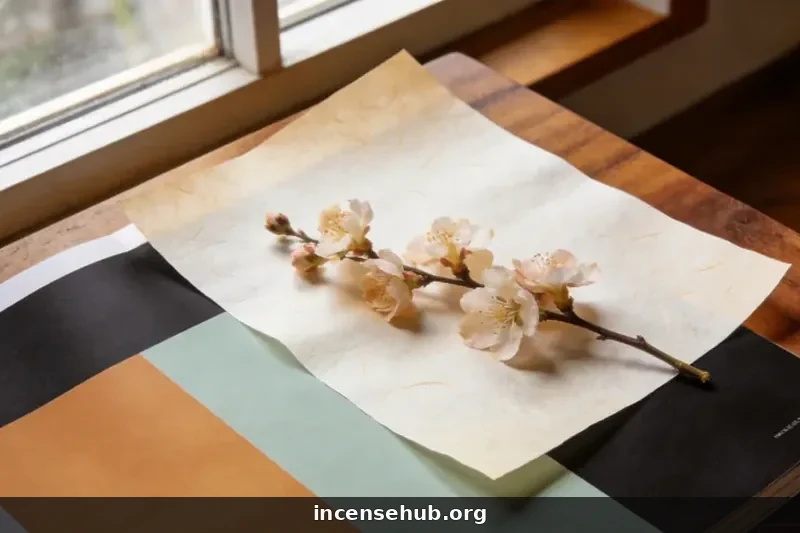
Technical answer: Lotus flower — 莲花 (liánhuā), also 荷花 (héhuā) — is the blossom of Nelumbo nucifera, an aquatic perennial in the family Nelumbonaceae. In Chinese incense it is a symbol before it is a material: the fresh flower’s scent is too faint and too fragile to survive burning, so classical formulators built the idea of lotus from other aromatics, and only later manuals used real petals. True lotus is not a water lily, and “blue lotus” is a water lily.
Key facts
| Chinese names | 莲花 (liánhuā), 荷花 (héhuā) |
| Species | Nelumbo nucifera Gaertn. |
| Family | Nelumbonaceae |
| Habit | Aquatic perennial rooted in mud, leaves and flowers held above water |
| Part used in incense | Flower petals, fresh or dried; rarely a concrete or absolute |
| Scent | Faint, fresh, sweet, watery-floral |
| Classical role | A constructed “lotus” accord, and later a real-petal accent |
| Main confusion | Water lily (Nymphaea), including “blue lotus” |
The plant, not just the flower
Direct answer: Nelumbo nucifera is an aquatic perennial with thick rhizomes buried in mud, long leaf stalks that lift circular leaves above the water, and flowers that open above the surface. The flower is the aromatic part, but the plant’s commercial weight sits in its root and seed.
Lotus is a crop before it is an aromatic. The rhizome — 莲藕, lián’ǒu — is a vegetable sold fresh, sliced, stir-fried, or pickled. The seed — 莲子, liánzǐ — is used in soups and sweet dishes and sold dried. The leaf wraps food. The flower is the beautiful by-product, and in most agricultural supply chains it is a small one.
That matters for anyone buying “lotus” for incense. There is no large dedicated flower trade behind the material, because the flower is not the reason the plant is grown. A supplier who offers dried lotus petals is usually working through a culinary or botanical channel, not an incense-specific one.
The plant’s habit is worth knowing because it explains the flower’s texture. The rhizome anchors in anaerobic mud; the petioles rise through the water; the leaves and flowers are held in the air. The flower is built for pollination above the surface, not for long storage, and its tissues are watery and perishable.
What Flora of China records
Direct answer: Flora of China describes Nelumbo nucifera with petioles 1–2 m long, orbicular water-repellent leaf blades 25–90 cm across, and flowers 10–23 cm in diameter with pink or white tepals. The receptacle is turbinate, 5–10 cm across. Flowering is June–August.
The dimensions are useful because they separate lotus from the water lilies at a glance. A lotus leaf stands above the water on a stiff stalk and can be the size of a serving platter. A water lily leaf floats on the surface, is smaller, and typically has a notch or a slit where the stalk attaches.
| Feature | Lotus (Nelumbo) | Water lily (Nymphaea) |
|---|---|---|
| Leaf position | Held above water | Floating on the surface |
| Leaf shape | Circular, peltate, entire | Round to oval, often notched |
| Stalk attachment | Centre of the leaf | Edge notch |
| Flower position | Above water | Floating or slightly above |
| Seed pod | Large, shower-head-like receptacle | Fleshy berry, different structure |
| Family | Nelumbonaceae | Nymphaeaceae |
The seed pod is the most reliable field character. Lotus forms a flat-topped, spongy receptacle with seeds set in visible sockets — the “shower head” that appears in so much Buddhist art. Water lilies do not make that structure. Once you have seen a lotus pod, the identification stops being abstract.
Flora of China records the species as native to Asia and widely cultivated, growing in lakes and ponds throughout China except Nei Mongol, Qinghai, and Xizang. The distribution is broad because the plant is useful, not because it is rare.
The lotus effect
Direct answer: Lotus leaves repel water because their surface is covered in microscopic bumps and a waxy layer, so droplets bead and roll off, carrying dirt with them. The phenomenon is named after the plant and has nothing to do with the flower’s scent, but it is a useful reminder of how physically distinctive this species is.
The leaf surface is structured at two scales: tiny papillae and, on top of them, a waxy crystal layer. Water sits on the peaks rather than wetting the valleys, so a droplet stays nearly spherical and rolls away at the slightest tilt. Dirt particles adhere to the droplet rather than the leaf, which is why the leaf stays clean in muddy water.
This is the origin of the term “lotus effect” in materials science, where it describes self-cleaning surfaces. The plant did not evolve the structure to be imitated; the structure evolved to keep pores clear and to shed water. The name is a later tribute.
For an incense page, the effect is a useful piece of natural history rather than a formulation fact. It explains why lotus leaves feel dry and slick, why water gathers in beads, and why the plant can live in stagnant water without its leaves fouling. It also explains why “lotus leaf” as an incense material is a different proposition from the flower: the leaf is tough, waxy, and faintly aromatic, not floral.
Names: 莲花, 荷花, and the water lily problem
Direct answer: 莲花 and 荷花 are two everyday names for the same blossom. The name that causes trouble is “lotus” itself, because English and commerce apply it to water lilies, and “blue lotus” is a water lily from a different family.
The Chinese names carry no botanical conflict. 莲 and 荷 both refer to Nelumbo nucifera, and the compounds 莲花, 荷花, 莲叶, 藕, and 莲子 all belong to the same plant. A recipe that says 莲花 means the lotus flower.
The English name is looser. “Lotus” appears in the common names of several water lilies, in the name of a legume ( Lotus corniculatus, bird’s-foot trefoil), and in various ornamental plants that have nothing to do with Nelumbo. The most consequential confusion is with Nymphaea caerulea, the blue water lily of the Nile, which is widely sold as “blue lotus.”
| Name in commerce | Actual plant | Family | What it is |
|---|---|---|---|
| Lotus, 莲花 | Nelumbo nucifera | Nelumbonaceae | True lotus |
| Blue lotus | Nymphaea caerulea | Nymphaeaceae | A water lily |
| White water lily | Nymphaea species | Nymphaeaceae | A water lily |
| Sacred lotus | Nelumbo nucifera | Nelumbonaceae | True lotus |
| Lotus root | Nelumbo nucifera rhizome | Nelumbonaceae | Culinary vegetable |
A buyer who specifies “lotus” without a binomial is leaving the door open. A buyer who writes Nelumbo nucifera has closed it. That is the whole discipline of naming in one sentence.
There is a commercial motive behind some of the confusion. Blue lotus has a romantic story and a following in wellness markets, and it is cheaper and more available than true lotus absolute. Products labelled “blue lotus” may contain the water lily, a extract of it, or nothing botanical at all. This page does not endorse any therapeutic use of either plant; the point here is identification.
Where lotus grows and how it reaches the trade
Direct answer: Lotus is native to Asia and cultivated in warm, shallow water across China and beyond. It reaches the incense trade through agricultural and culinary channels, with the flower as a minor line rather than a dedicated aromatic crop.
The plant wants still or slow water and full sun. Farmers grow it in ponds and paddies, harvest the rhizomes in autumn and winter, and collect seeds through the season. The flowers are picked for markets, for temples, and for ornamental use, and a small fraction is dried for herbal and aromatic trade.
That supply structure shapes what is available. Fresh flowers are seasonal and local. Dried petals are available year-round but are a preserved product with a faded scent. Lotus absolute, a solvent extract used in perfumery, exists but is costly and rare. Most of what the incense market calls “lotus” is none of these; it is an accord built from other materials.
| Supply form | Availability | Cost level | Aroma strength |
|---|---|---|---|
| Fresh flowers | Seasonal, local | Low per flower | Faint but alive |
| Dried petals | Year-round | Moderate | Faint, often hay-like |
| Lotus absolute | Scarce | High | Concentrated, closer to the flower |
| “Lotus” accord | Unlimited | Depends on materials | Designed to carry in a blend |
A workshop that wants a real-flower note has to plan around seasonality or pay for an absolute. A workshop that wants a reliable product at scale builds an accord. Both are legitimate; the mistake is claiming one is the other.
Why the flower’s scent is so faint
Direct answer: Lotus fragrance is delicate because the flower releases a small amount of volatile material into the air around it, and the compounds involved are light and easily lost. Heat, drying, and time remove them faster than they can be replaced.
A flower’s scent is a signal, not a store of perfume. The plant produces small quantities of volatile molecules to attract pollinators, and those molecules diffuse into the air. The total amount in a petal is tiny compared with the aromatic load in a resin or a spice.
That is why a lotus flower smells wonderful at a pond and almost nothing in a jar. The flower is designed to release its scent into moving air over a short period, not to hold it for later use. Once picked, the release continues and the reservoir depletes.
| Condition | What happens to the scent | Result |
|---|---|---|
| On the plant | Continuous slow release into air | Fresh, living fragrance |
| Picked, cool, damp | Slower release, some retention | Faint sweetness for hours |
| Dried quickly | Water and volatiles leave together | Hay-like, faint remnant |
| Dried slowly | Oxidation and loss | Dull, dusty, sometimes musty |
| Heated | Volatiles flash off | Almost nothing left |
This is the physical basis for the whole “accord versus flower” story. You cannot get a strong lotus note from a material that contains very little aromatic oil and loses it readily. You can get the impression of lotus by combining materials that carry the same qualities — freshness, softness, a watery-floral lift — in a form that survives heat.
The classical accord: 芙药衣香
Direct answer: The 香乘’s lotus clothes incense (芙药衣香) builds a lotus impression without any lotus. It combines clove, sandalwood, spikenard, tonka, peony bark, and fennel, and the text describes the result as smelling “like a freshly opened lotus” (其香如新开莲花).
This is the most instructive formula in the lotus literature because it is explicit about its own artifice. The composer is not hiding the substitution; the formula’s name and its comment tell you that the goal is an impression. The ingredients are chosen for qualities that together read as a fresh flower.
| Material | Likely contribution | Why it belongs |
|---|---|---|
| Clove | Warm, sharp spice | Gives the “cool air” edge of a fresh flower |
| Sandalwood | Creamy, soft wood | Provides a smooth base under the florals |
| Spikenard | Earthy, heavy, root-like | Adds depth and a faint animalic undertone |
| Tonka | Sweet, hay-like, almond | Rounds the blend with a soft sweetness |
| Peony bark | Bitter, cool, medicinal | Supplies a green-bitter structure |
| Fennel | Sweet anise | Lifts the top with a light sweetness |
The reading is editorial, but it is grounded in the materials. Clove supplies the sharpness that a fresh flower has in the air; sandalwood supplies the creaminess that keeps the blend from feeling thin; spikenard and tonka add the weight and sweetness that make the impression last. None of them smells like lotus alone. Together they create a space in which the nose is willing to find lotus.
What the formula teaches is that an accord is a structure, not a single note. A formulator who tries to build lotus by adding more and more floral materials will end up with a sweet, soapy blend. A formulator who builds the structure — sharp top, creamy middle, earthy base — gets something that reads floral without being floral.
The real-flower tradition: 燕居香语
Direct answer: A later manual, the 燕居香语 (Yànjū Xiāngyǔ), pairs fresh lotus petals with saffron, agarwood, and dendrobium. This is the real-material tradition: the flower is present, but as one component in a composed blend rather than as a solo incense.
The formula is interesting because it treats the petal as a fresh ingredient, not a dried powder. Fresh petals carry water and a living scent; they also carry problems, because water and incense don’t mix well. The other materials in the blend have to absorb the moisture and carry the burn.
| Material | Role in the blend | What it brings |
|---|---|---|
| Fresh lotus petals | Aromatic centre | The living floral note |
| Saffron | Warm, leathery, honeyed | A golden, slightly bitter depth |
| Agarwood | Structural wood | Smoke, body, and a resinous base |
| Dendrobium | Botanical body | A soft, starchy texture and a faint green note |
The presence of agarwood is the tell. A fresh petal cannot carry a burn on its own; it needs a wood to hold the coal and a resin to give the smoke body. Saffron adds a warm, almost medicinal glow that makes the floral note feel richer. Dendrobium, an orchid used in traditional preparations, contributes texture more than a strong scent.
This formula is a useful counterweight to the idea that all classical lotus incense was an accord. It shows that real petals were used when the maker had them fresh and when the blend could support them. The two traditions coexisted: the accord for reliability, the fresh petal for a seasonal luxury.
The symbol: purity, mud, and the lotus throne
Direct answer: Lotus symbolism runs deeper than its use as a material. The phrase 出淤泥而不染 — “emerges from the mud unstained” — and the Buddhist lotus throne make the flower a figure of purity and awakening. That symbolism is why “lotus” sells as an idea, and why the material is often secondary.
The image is botanically apt. The rhizome sits in anaerobic mud, the stalk rises through murky water, and the flower opens clean and dry above the surface. The contrast is visible to anyone who has stood at a pond, which is why the metaphor travels across cultures.
In Buddhist art the lotus is the seat of the Buddha and a sign of a mind that has opened above the mire. The flower appears in painting, sculpture, and architecture, and its name carries a moral charge that no other incense material quite matches.
| Register | What “lotus” means | Consequence for incense |
|---|---|---|
| Botanical | Nelumbo nucifera | A specific plant with a faint scent |
| Symbolic | Purity, awakening, detachment | A marketable idea |
| Formulaic | An accord that smells like the idea | A reproducible product |
| Commercial | A note name on a label | Often no lotus at all |
The symbolic register is where marketing lives. A stick called “Lotus” is selling an atmosphere, and the atmosphere is built from the symbol as much as from the smell. That is not fraud when the buyer understands it; it becomes misleading when the label implies a rare material that is not present.
For a knowledge platform, the useful move is to hold both registers at once. The symbol is real and historically important. The material is faint and difficult. The accord is the practical bridge between them.
Reading a “lotus” label
Direct answer: “Lotus” on an incense label can mean four different things: the species, a floral accord, a symbolic theme, or a water lily. The word alone does not tell you which. A buyer has to ask a second question.
The four meanings are not equally common. The accord is the most common by far, because it is cheap, reliable, and can be tuned. The species is rare in mass-market products because the real material is costly and faint. The symbolic theme is common in gift and ritual lines, where the name matters more than the chemistry. The water lily appears mostly in wellness products that use “blue lotus” as a selling point.
| Label says | Most likely meaning | What to ask |
|---|---|---|
| “Lotus incense” | A floral accord | Is there any Nelumbo material? |
| “Blue lotus” | Nymphaea caerulea | Which species, and what claims are being made? |
| “Lotus absolute” | A solvent extract | Origin, dilution, and cost per gram |
| “Lotus petals” | Dried plant material | Species, harvest date, and storage |
| “Sacred lotus” | Usually a theme | What is actually in the stick? |
A supplier who can answer the second question is a supplier worth talking to. A supplier who repeats the label is not answering.
The practical consequence is that a buyer should specify what they want before shopping. If the goal is a fresh floral note that carries in a stick, the accord is the right product. If the goal is a real botanical material for a special blend, the petals or the absolute are the right products, with the costs and limitations that come with them.
Building a lotus accord
Direct answer: A lotus accord is built in layers: a light floral top, a creamy woody middle, and a soft base that holds the whole thing together. The materials are chosen for qualities, not for the name “lotus,” and the balance matters more than any single ingredient.
The first layer is freshness. Citrus peel, neroli, or a light green note gives the “open air” quality that a fresh flower has. The second layer is softness: a floral absolute or a sweet resin provides the creamy body that reads as petals. The third layer is structure: sandalwood, or a similar soft wood, gives the blend a floor.
| Layer | Function | Candidate materials | Common error |
|---|---|---|---|
| Top | Freshness, lift | Citrus peel, neroli, light green herbs | Too sharp; reads as cleaning product |
| Heart | Floral softness | Light floral absolutes, sweet balsam | Too sweet; reads as candy |
| Base | Creamy structure | Sandalwood, soft woods | Too heavy; buries the floral |
| Fixative | Holds the top | A low-dose resin | Overdose; turns soapy |
The soap problem is the classic failure of floral accords. It appears when the top layer is sharp and the base is fatty, so the nose reads the combination as a detergent rather than a flower. The fix is not more floral material; it is a softer bridge between the top and the base, usually a creamy wood or a small amount of a sweet resin.
Read as a chain: a sharp top sits over a fatty base → the nose reads detergent → the floral idea collapses → the formulator adds more floral material → the soapiness gets stronger. The loop only breaks when the bridge between top and base is softened.
A second failure is over-sweetening. Lotus is a fresh scent, not a sugary one. A formulator who adds tonka, vanilla, or a heavy balsam to make the accord “last” will get a blend that smells like dessert. The freshness has to be protected, which usually means keeping the sweet materials low and the woody base clean.
The accord should be judged in the burn, not in the bottle. A blend that smells floral and fresh on a blotter can turn soapy or hollow when heated. The only reliable test is a small trial stick burned against a reference.
Processing real petals
Direct answer: Fresh petals are picked, kept cool, and used quickly, or dried gently for storage. Drying preserves color and structure but takes much of the scent with it. Powdered petals are convenient and even fainter, and a true absolute is a different, costly product.
The first hours after picking decide most of the quality. A petal kept cool and damp retains its scent longer than one left in a warm basket. A petal left in the sun wilts, browns at the edges, and loses the fresh note that made it worth picking.
Drying is a compromise. Fast drying with warmth preserves color and reduces mold risk, but it drives off the volatile fraction. Slow drying in shade preserves more of the delicate note but invites browning and, in humid conditions, mold. Commercial dried petals are usually traded on appearance first, which is why the prettiest lot is not always the best-smelling one.
The loss follows a predictable path: petals are mostly water → drying removes the water → volatile aromatics leave with it → the dried tissue keeps its colour but not its scent → the accord has to rebuild the note from other materials. A dried petal is a memory of the flower, not a concentrate of it.
| Method | Effect on color | Effect on scent | Risk |
|---|---|---|---|
| Used fresh | Full color | Closest to the living flower | Wilts within hours |
| Shade dried | Good color | Some sweetness retained | Mold in humid air |
| Warm dried | Pale, stable | Much reduced | Loss of top notes |
| Powdered | Uniform | Faint, fades fast | Absorbs moisture and odors |
| Solvent extracted | Not visible | Concentrated, different | Cost and solvent residues |
Grinding petals is awkward. The tissue is fibrous and light, and it tends to ball up rather than powder evenly. A workshop that wants petals in a stick usually mixes them as a small fraction of the dry blend, or uses an absolute instead. Petal powder is more common in loose incense and in decorative blends than in production sticks.
An absolute is not simply a stronger petal. Solvent extraction changes the material: it concentrates the aromatic compounds and leaves behind the fibrous structure. The result is a dark, thick liquid that smells closer to the flower than any dried petal, and costs far more. It is dosed in tiny amounts and behaves like a perfume material, not like a botanical powder.
Forms and what they do
Direct answer: Lotus appears in five practical forms: fresh petals, dried petals, petal powder, an absolute or concrete, and a constructed accord. Each has a different relationship to the original flower, and each belongs in a different kind of product.
| Form | What it is | Best use | Limitation |
|---|---|---|---|
| Fresh petals | Living plant material | Seasonal blends, ritual, display | Water content, short life |
| Dried petals | Preserved botanical | Loose incense, decorative blends | Faint, hay-like scent |
| Petal powder | Milled dried petals | Small fraction in sticks or cones | Very faint, clumps |
| Absolute / concrete | Solvent extract | Fine fragrance, high-end blends | Cost, dosage, color |
| Accord | A blend of other materials | Mass-market incense, consistent products | Contains no lotus |
The form decision is really a decision about what the buyer is paying for. Fresh petals are paying for the living plant. Dried petals are paying for the botanical presence. An absolute is paying for concentration. An accord is paying for a reliable impression.
A label that says “lotus” without naming the form leaves the buyer unable to tell which of these they are getting. That is the single most useful question to ask before a purchase.
What counts as quality
Direct answer: For real petals, quality means clean, well-colored, fragrant material of the right species. For an accord, quality means balance, freshness, and a burn that does not turn soapy. The two standards are different because the products are different.
Real petals are judged like any botanical: color, cleanliness, absence of mold or browning, and a scent that is faint but clean. A musty or dusty smell is a defect, not a character note. The species should be confirmed, because water lily petals are sometimes sold in the same channels.
An accord is judged like a fragrance: does the opening read fresh, does the middle hold, does the base support it, and does the whole thing avoid soapiness or candy sweetness. The standard is functional, not botanical. A good accord can contain no lotus at all and still be a good product.
| Criterion | Real petals | Accord |
|---|---|---|
| Identity | Nelumbo nucifera | Declared formula, if any |
| Freshness | Clean, faint sweetness | Bright opening, no stale note |
| Color | Natural pink or white, not browned | Uniform, appropriate to the theme |
| Moisture | Dry, no clumping | Consistent, no cracking in the stick |
| Burn behavior | Not applicable alone | Even, no soapy or acrid edge |
| Storage | Cool, dark, sealed | Cool, dark, sealed |
The trap is applying one standard to the other. A buyer who judges an accord by asking “how much lotus is in it” is asking a question the product was never designed to answer. A buyer who judges real petals by how strongly they smell is asking a fresh flower to behave like a perfume.
Failure modes
Direct answer: Lotus products fail in five recognizable ways: the accord turns soapy, the clove dominates, the blend is over-sweetened, the “lotus” is a water lily, or real petals mold in storage. Each has a signature, and each has a fix.
| Failure | Cause | Signature | Fix |
|---|---|---|---|
| Soapy accord | Sharp top over a fatty base | Detergent note, thin middle | Soften the bridge, reduce sharp citrus |
| Clove dominance | Too much warm spice in the accord | Medicinal, numbing edge | Cut clove, rebuild with softer spice |
| Over-sweet | Too much tonka, vanilla, or balsam | Dessert-like, cloying | Reduce sweets, raise woody base |
| Wrong species | Water lily sold as lotus | Different petal shape, no lotus pod | Confirm Nelumbo nucifera |
| Mold in petals | Damp storage | Musty, grey patches | Reject; improve drying and storage |
| Hollow tail | Top note with no support | Bright opening, empty finish | Add a slower resin or wood |
The soapy failure is the most common in commercial “lotus” incense because it is easy to create and hard to notice in a scented room. A sharp citrus top over a creamy but fatty base reads clean at first and then turns to detergent as the top fades. The fix is a softer transition, not more perfume.
The clove failure is specific to the classical accord. Clove is a powerful material with a numbing, medicinal edge, and a little goes a long way. A formulator who follows the old formula without adjusting for the strength of modern clove will produce something closer to a dentist’s office than a lotus pond.
The wrong-species failure is a naming problem, not a scent problem. Water lily petals can look similar when dried, and the fragrance is faint in both cases. The seed pod is the reliable difference, but dried petals rarely include one. Paperwork and a supplier who knows the binomial are the practical defences.
How the note behaves by format
Direct answer: A lotus note is fragile in every format, but the format changes how long it lasts and how it fails. Loose incense gives a brief impression, a stick stretches it, a cone sharpens it, and a coil loses it.
| Format | Behavior of a lotus note | Best use | Risk |
|---|---|---|---|
| Loose on coal | Immediate, faint, gone quickly | Ritual, seasonal, evaluation | Scorched petals, thin smoke |
| Stick | Longer window, more body | Consumer products, daily use | Soapy middle if unbalanced |
| Cone | Sharp opening, fast fade | Short rituals, strong impression | Harsh top, hollow tail |
| Coil | Spread thin, easily lost | Long, slow settings | Note disappears entirely |
The stick is the hardest format for lotus because the binder and the base compete with the floral note. A stick needs structure, and structure usually means wood and resin, which are exactly the materials that can bury a delicate floral. The formulator’s job is to keep the floral layer light enough to be present but strong enough to survive the base.
Loose incense is the most honest format for real petals. The petal is visible, the scent is immediate, and the burn is short. It is also the least controllable, which is why it is better for ritual and evaluation than for a repeatable product.
A cone concentrates heat and produces a sharp opening. A lotus accord in a cone can read vivid for a few seconds and then collapse. A coil spreads the material so thin that the floral note often vanishes, leaving the base to carry the product.
Storage
Direct answer: Dried lotus petals are hygroscopic and absorb odors, so they need a sealed, dark, cool container. An accord should be stored like any incense, away from heat and light. An absolute is best kept cool and tightly closed.
Petals are a dried botanical, and dried botanicals are thirsty. They take up moisture from the air, which invites mold and dulls the scent. They also absorb smells from their surroundings, so a bag of petals stored next to spices will smell of the spices within weeks.
| Material | Main risk | Storage |
|---|---|---|
| Fresh petals | Wilting, browning | Cool, damp, used within hours |
| Dried petals | Moisture, odor pick-up | Sealed, dark, cool |
| Petal powder | Clumping, aroma loss | Small lots, sealed, used quickly |
| Absolute | Oxidation, evaporation | Tightly closed, cool, dark |
| Accord | Top-note loss | Standard incense storage |
The practical rule is the same as for any aromatic botanical: buy the amount you will use in a season, store it well, and replace it rather than trying to revive it. A faded petal cannot be brought back by adding heat or moisture.
Lotus among the floral materials
Direct answer: Lotus is the weakest of the florals commonly used in incense. Osmanthus, jasmine, rose, and champaca all carry more aromatic material and survive heat better; plum blossom is similarly delicate and is usually evoked rather than used. Lotus sits at the far faint end of the family.
The comparison is useful because it shows that “floral” is a range, not a category. A formulator who treats lotus like jasmine will be disappointed: the same dose produces a fraction of the scent, and the heat destroys what little is there.
| Material | Strength | Character | Behavior in heat | Usual approach |
|---|---|---|---|---|
| Lotus | Very faint | Watery, fresh, green-sweet | Mostly lost | Accord, or a rare absolute |
| Plum blossom | Faint | Cool, thin, slightly bitter | Lost | Evoked with woods and spices |
| Osmanthus | Strong | Apricot, peach, honeyed | Survives well | Absolute or concrete |
| Jasmine | Very strong | Sweet, indolic, heady | Survives well | Absolute, low dose |
| Rose | Strong | Honeyed, spicy, deep | Survives well | Absolute or oil |
| Champaca | Strong | Fruity, orange-like, rich | Survives well | Absolute, very low dose |
The pattern is a lesson in aromatic load. Materials with a high concentration of volatile oil can be used at a small fraction and still dominate. Materials with a low concentration need either a large amount, which brings plant tissue and moisture into the blend, or an extract, which is costly. Lotus belongs to the second group.
There is also a difference in kind. Osmanthus, jasmine, rose, and champaca are sweet and heavy; their presence is unmistakable. Lotus is light and watery, closer to the smell of a clean pond than to a perfume. A blend that uses lotus as a substitute for a sweet floral will not work, because the two occupy different sensory spaces.
The practical consequence is that lotus pairs best with materials that share its lightness: citrus peel, neroli, light green herbs, and soft woods. It clashes with heavy sweets and with strongly indolic florals, which overwhelm it. A formulator who respects that pairing gets a fresh accord; one who ignores it gets a muddle.
A sensory protocol for lotus products
Direct answer: Evaluate a lotus product by comparing it with a reference, not by smelling it in isolation. Score the unlit material, the opening, the middle, and the tail, and note whether the floral impression survives the base. The protocol is simple, and it catches the soapy and hollow failures that a single sniff misses.
The first step is to establish what the product claims to be. A real-petal blend and an accord are judged by different standards, so the reference has to match the claim. Comparing a petal blend against an accord tells you which you prefer, not which is better made.
| Checkpoint | What to look for | Failure signal |
|---|---|---|
| Unlit | Fresh, clean, faintly sweet | Dusty, musty, or sharply perfumed |
| Opening | Light floral lift, no alcohol sharpness | Detergent or solvent edge |
| Middle | Softness, balance with the base | Soapy, waxy, or hollow |
| Tail | A quiet woody warmth, not ashes | Acrid smoke, sudden emptiness |
| Ash | Even, pale, no hard crust | Black crust or unburned powder |
Blind comparison is worth the small effort. Code two or three samples, have someone else hand them to you, and score them without knowing which is which. Expectation is a powerful flavour, and a label can change what the nose reports.
The protocol has limits. It cannot tell you whether a petal is Nelumbo or Nymphaea, and it cannot measure the aromatic content. It can tell you whether the product does what it claims in the burn, which is the question most buyers actually have.
One editorial note: a faint result is not automatically a failure. Lotus is a faint material, and a delicate accord that reads softly may be more faithful to the flower than a loud one. Judge the product against its own intention, not against the strongest thing on the shelf.
Seasonality as a truth check
Direct answer: Lotus flowers in summer, and fresh petals are a seasonal material. A product that claims fresh lotus in the wrong season is making a claim the calendar does not support. Seasonality is one of the few marketing statements a buyer can check without a laboratory.
Flora of China records flowering from June to August. In most of the plant’s range that is the window when fresh flowers are available in quantity, and it is the only window in which a genuinely fresh-petal product can be made from local material. Outside it, a maker is using dried petals, an absolute, an accord, or imported flowers grown in a different climate.
| Claim on the label | What it requires | When it is plausible |
|---|---|---|
| “Fresh lotus petals” | Flowers picked and used within days | Local flowering season |
| “Dried lotus petals” | Preserved material | Any time, with a harvest date |
| “Lotus absolute” | Solvent extract | Any time, if the supply is real |
| “Lotus scent” | An accord or a blend | Any time |
| “Wild lotus” | Uncultivated source | Hard to verify; ask for detail |
The check is not proof of fraud. A maker in a warm region may have a longer season, and a maker with cold storage or imports may have fresh material outside the local window. The point is that the claim needs an explanation, and a supplier who cannot give one is asking for trust rather than offering evidence.
Seasonality also shapes product planning. A workshop that wants a genuine fresh-petal blend has a narrow production window and a short shelf life to manage. A workshop that wants a year-round product has to choose between dried petals, an absolute, and an accord, each with its own cost and sensory result. Pretending the constraint does not exist is how a product ends up with a label that outruns its material.
There is a wider lesson here about floral incense in general. Flowers are seasonal, fragile, and low-yielding; the products that carry their names are usually built to be reliable rather than literal. That is not a defect in the product. It becomes a defect when the marketing borrows the prestige of the fresh flower without disclosing the substitution.
What is documented, what is claimed
Direct answer: The botanical identity, the classical formulas, and the cultural symbolism are documented. The scent of the flower and the practice of building an accord are documented in the formulas. Claims about therapeutic or spiritual effects are not made here.
| Claim | Status | Note |
|---|---|---|
| Lotus is Nelumbo nucifera | Established | Flora of China and GBIF |
| Lotus is not a water lily | Established | Different families |
| 香乘 contains a lotus accord | Historically documented | 芙药衣香, built without lotus |
| 燕居香语 uses real petals | Historically documented | Petals with saffron, agarwood, dendrobium |
| Lotus is a symbol of purity | Cultural record | 出淤泥而不染, Buddhist throne |
| Lotus incense treats illness | Not established | No medical claim here |
| “Blue lotus” is a lotus | False | It is Nymphaea caerulea |
The distinction between a cultural symbol and a material fact is the spine of this page. The symbol is real: it shapes how the product is named, sold, and used. The material is faint: it cannot carry a strong scent on its own. Both statements can be true at once, and the page is more useful when it keeps them apart.
The note-or-flower decision
Direct answer: Choose an accord when you need a reliable, repeatable floral note that survives burning. Choose real petals when the botanical presence is the point and you can work with seasonality and faintness. Choose an absolute when you need concentration and can pay for it.
The decision is not about authenticity in the abstract. It is about the product’s job. A consumer stick that must smell the same in every batch needs an accord. A seasonal ritual blend that celebrates the flower needs petals. A fine fragrance that needs a true floral heart needs an absolute.
| If the goal is | Choose | Because | Accept |
|---|---|---|---|
| A repeatable consumer product | Accord | Consistent, tunable, survives heat | No lotus material |
| A seasonal or ritual blend | Fresh petals | The living flower is the point | Short shelf life |
| A botanical display mix | Dried petals | Visible, stable, decorative | Faint scent |
| A concentrated floral heart | Absolute | Closest to the flower | High cost, tiny dose |
| A “lotus” gift line | Accord plus symbolism | The idea is the product | Label honestly |
The honest label is the ethical minimum. A product can be an accord and still be good; it becomes misleading when the packaging implies a rare flower that is not there. A buyer who understands the four meanings of “lotus” can read a label accurately and choose accordingly.
FAQ
Is lotus incense made from real lotus flowers? Usually not. The fresh flower’s scent is faint and fragile, and it does not survive drying and burning well. Most products called lotus are floral accords built from other materials. Some traditional formulas do use real petals, and a true absolute exists, but both are uncommon and costly.
What is the difference between lotus and water lily? They are different plant families. True lotus is Nelumbo nucifera in Nelumbonaceae, with leaves held above the water and a shower-head seed pod. Water lilies are Nymphaea in Nymphaeaceae, with floating leaves and a different fruit. “Blue lotus” is a water lily.
What does lotus smell like? Faint, fresh, sweet, and watery-floral, with a clean green edge. It is not a heavy or sugary scent. Because the living flower releases only a small amount of volatile material, the smell is subtle at a pond and almost absent in a dried petal.
Why is lotus more symbol than ingredient? Because the flower’s cultural meaning is enormous and its aromatic yield is small. 出淤泥而不染 and the Buddhist lotus throne made the flower an emblem of purity. Classical formulators could build the impression of lotus from other materials, so the symbol travelled further than the material.
What is the lotus clothes incense 芙药衣香? A formula from the 香乘 that creates a lotus impression without lotus. It combines clove, sandalwood, spikenard, tonka, peony bark, and fennel, and the text says the result smells “like a freshly opened lotus” (其香如新开莲花). It is the clearest classical example of an accord.
Can I burn dried lotus petals directly? You can, but the result is faint and the smoke dominates. Dried petals are better used as a small fraction of a loose blend or as a decorative element. If you burn them, do it in a ventilated space and keep the material away from children and pets.
Which part of the lotus is used? In incense, the flower petals. In the wider plant economy, the rhizome (莲藕), the seed (莲子), the leaf, and the seed pod all have uses. The flower is the aromatic part; the root and seed are the agricultural mainstays.
Is “blue lotus” safe to burn? This page makes no therapeutic or safety claims for any plant product beyond general combustion safety. Burning any material produces smoke and particulate matter. Use ventilation, avoid inhaling concentrated smoke, and treat wellness claims on blue lotus products with caution.
Summary
Lotus flower is the blossom of Nelumbo nucifera, an aquatic perennial of Nelumbonaceae, grown across Asia for its rhizome, seed, leaf, and flower. Its scent is faint, fresh, and watery, and it does not survive drying or burning well. That single fact explains why Chinese incense treats lotus as a symbol first and a material second.
The classical record shows both approaches. The 香乘’s 芙药衣香 builds a lotus impression from clove, sandalwood, spikenard, tonka, peony bark, and fennel, with no lotus in the formula. The later 燕居香语 uses fresh petals with saffron, agarwood, and dendrobium. One is an accord, the other a real-material blend; both are legitimate, and they answer different needs.
The practical lesson is to know which product you are buying. “Lotus” can mean the species, an accord, a symbol, or a water lily. Confirm Nelumbo nucifera when the material matters, judge an accord by its balance in the burn, and label honestly when the note is constructed. The flower’s meaning is real; its chemistry is delicate.
Sources
- Nelumbo nucifera in Flora of China — botanical description, dimensions, distribution, and flowering period.
- Nelumbo nucifera on GBIF — the global occurrence record for the species.
The botanical description follows Flora of China and GBIF. The 芙药衣香 and 燕居香语 references follow the classical formula tradition. Cultural symbolism is presented as cultural record, not as a therapeutic claim. This is editorial knowledge content, not medical advice.
Related Resources
- Plum blossom — another floral idea that classical incense built rather than picked.
- Osmanthus — a floral material with a stronger natural scent.
- Jasmine and honeysuckle — florals used in accords.
- Lotus incense recipe — the formula treatment in practice.
- Lotus incense — the product context.
- Floral aroma family — where lotus sits among florals.
- Hexiang blending system — the 君臣佐使 framework behind the accord.
- How incense is made — binding, drying, and burning.
- Scent guide and safety guide — reference and combustion safety.