
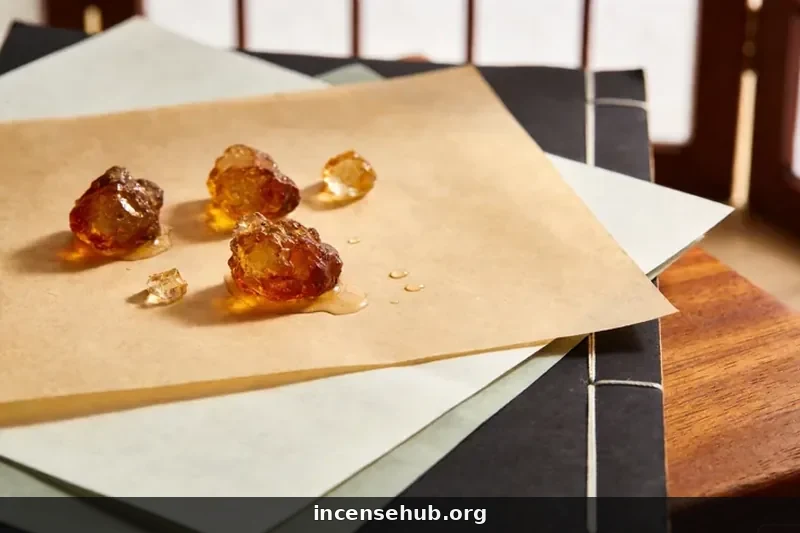
Technical answer: Mastic — 玛蹄脂 (mǎtízhī) — is the resin of Pistacia lentiscus, a small evergreen tree of the cashew family (Anacardiaceae) that grows around the Mediterranean. The tree is scored, the resin runs to seal the wound, and it hardens into pale, translucent tears. The most famous supply comes from the Greek island of Chios, where the material is protected by a designation of origin. In incense it is a bright, piney top note; in Chinese sources it appears as an imported resin under names that overlap with frankincense, which is a different plant in a different family.
Key facts
| Chinese name | 玛蹄脂 (mǎtízhī); also written 乳香脂 or 洋乳香 |
| Species | Pistacia lentiscus L. |
| Family | Anacardiaceae — the cashew family |
| Material | A trunk resin, tapped from scored bark and dried into tears |
| Scent | Fresh pine, balsam, a lemon edge, a dry cedar background |
| Famous origin | Chios, Greece; protected designation of origin |
| Main identity risk | Confusion with 乳香 (frankincense, Boswellia) |
| Role in a blend | Bright top note; not a base resin |
The tree and the tear
Direct answer: Mastic is a wound resin. The tree produces it to seal damage to its bark, and people harvest it by making controlled wounds and collecting what the tree exudes. A tear is therefore a record of a healing event, not a fruit or a sap in the ordinary sense.
Pistacia lentiscus is an evergreen shrub or small tree with leathery, pinnate leaves and a dense habit, native around the Mediterranean basin. It belongs to Anacardiaceae, the same family as pistachio, cashew, mango, and sumac. That family placement is the first fact to hold on to, because it separates mastic from the resins it is most often confused with: frankincense and myrrh are Burseraceae, and pine resin comes from Pinaceae.
The resin itself is produced in canals in the bark. When the bark is cut, resin flows into the wound, spreads over the exposed surface, and begins to set. The outer layer hardens first, forming a skin; the interior stays softer for longer. Over days and weeks the tear firms up into the pale, irregular lump that reaches the market.
The sequence explains the tear’s layered character: bark is scored → resin flows to the wound → the exposed surface oxidises → a skin forms → the interior stays soft → the tear sets from the outside in. Cut one open and the difference between crust and core is still visible.
This is why tears vary so much. Each one formed at a different wound, in different weather, on a different tree, and stayed on the bark for a different length of time. A sack of mastic is not a uniform material; it is a sorted population of small events. The sorting is where much of the commercial quality is made.
| Stage | What happens | What it means for the material |
|---|---|---|
| Scoring | Bark is cut in shallow lines | Resin flows to the wound |
| Exudation | Resin spreads and begins to set | The tear takes its shape |
| Setting | Outer skin hardens first | Interior stays softer and stickier |
| Collection | Tears are lifted from bark and ground | Dirt and bark may cling |
| Cleaning | Debris is removed by hand or sieve | Sorting begins |
| Grading | Tears are separated by size and color | The lot becomes a product |
The tear’s shape carries information. A round, clear, pale tear formed on a clean surface and set slowly. A dark, angular, bark-flecked tear formed close to soil or was collected late. Neither is a different species; they are different histories, and the market prices them accordingly.
Names: 玛蹄脂, 乳香脂, 洋乳香
Direct answer: 玛蹄脂 is a transliteration, while 乳香脂 and 洋乳香 are descriptive names that borrow the word for frankincense. The 洋 prefix marks the material as imported. The naming overlap is the root of most mastic confusion in Chinese.
The three names tell a story about how a foreign resin enters a local vocabulary. 玛蹄脂 sounds like the source word and carries no description; it is a label, not an explanation. 乳香脂 literally reads as “frankincense resin,” which is descriptive of a smell but wrong about the plant. 洋乳香 reads as “foreign frankincense,” and the 洋 is the useful part: it flags an import.
| Written form | Literal reading | What it actually names |
|---|---|---|
| 玛蹄脂 | Phonetic loan | Pistacia lentiscus resin |
| 乳香脂 | “Frankincense resin” | Mastic, by smell, not by botany |
| 洋乳香 | “Foreign frankincense” | Imported mastic |
| 乳香 | “Frankincense” | Boswellia resin, a different family |
A reader who encounters 乳香 in a classical Chinese formula should normally read frankincense. A reader who encounters 洋乳香 is looking at mastic, or at least at an imported resin described by analogy. The distinction is not pedantic: the two materials smell different, burn differently, and belong in different places in a blend.
What follows for anyone writing a spec or a label is to use the binomial. Pistacia lentiscus cannot be misread. The Chinese names can.
Mastic is not frankincense
Direct answer: Mastic and frankincense are different resins from different plant families. Frankincense comes from Boswellia species in Burseraceae and reads sweet, citrusy, and church-like; mastic comes from Pistacia lentiscus in Anacardiaceae and reads piney, balsamic, and fresh. The Chinese names overlap; the materials do not.
This is the single most important disambiguation on the page, because the two resins are sold side by side and both are called 乳香 in some contexts. The mistake is easy to make and expensive to discover after a batch is blended.
| Feature | Mastic | Frankincense |
|---|---|---|
| Genus | Pistacia | Boswellia |
| Family | Anacardiaceae | Burseraceae |
| Tear look | Pale, slightly cloudy, often irregular | Pale to amber, often larger and more brittle |
| Behavior in the hand | Softens with warmth, chews | Stays brittle, fractures |
| Smell | Pine, balsam, lemon, cedar | Citrus, sweet resin, faint pepper |
| Burn character | Bright, quick, astringent | Slower, sweeter, more smoke-heavy |
| Chinese name | 玛蹄脂 / 洋乳香 | 乳香 |
The hand test is the fastest field distinction. Mastic is a soft resin: body heat makes it pliable, and a tear will deform rather than shatter. Frankincense is brittle and snaps. That difference comes from the resin’s composition, and it survives storage well enough to be a useful first check.
The smell test confirms it. Mastic has a green, piney sharpness that reads almost like a cleaning agent at full strength; frankincense is rounder and sweeter, with the citrus-and-incense character most people associate with church smoke. Put the two side by side once, and the confusion stops being plausible.
There is a third material in the same conversation: pine resin. It is cheaper, stickier, and much more turpentine-like. A buyer who knows mastic will not mistake pine resin for it, but a buyer who has only been told “it is a piney resin” might. The binomial and the family name settle all three.
Where mastic grows
Direct answer: Pistacia lentiscus grows around the Mediterranean, from southern Europe through North Africa and the Levant. The resin is gathered in several countries; the Chios material is the most famous and the only one with the protected name.
The plant is a common component of Mediterranean scrub. It tolerates poor soil, salt wind, and drought, which is why it appears along coastlines and on dry hillsides rather than in rich farmland. Its wide range means that resin can be collected in many places, and some of it enters trade without a famous name attached.
Chios is a Greek island close to the Anatolian coast, and its mastic has been a commercial material for centuries. The island’s production is not simply a matter of a different tree; it is a set of practices — how the ground is prepared, how the bark is scored, when the tears are collected, how they are cleaned — that have been refined around a single place. That combination is what the protected designation recognizes.
The wider Mediterranean supply is less documented and less standardized. Resin from other regions may be the same species and still differ in color, cleanliness, and aroma because the harvesting and cleaning practices differ. A buyer who needs consistency should ask where the lot came from and how it was sorted, not just which species it is.
| Origin type | What it usually means | What to check |
|---|---|---|
| Chios PDO | Protected name, defined area and method | Certification paperwork, lot traceability |
| Other Greek | Same species, different practice | Cleaning, tear size, aroma |
| North African / Levantine | Wider supply, variable handling | Debris, moisture, storage history |
| Unstated | Unknown | Treat as unidentified until proven |
Origin is not a guarantee of quality on its own. A Chios-labeled box can contain poorly stored tears, and a resin from elsewhere can be clean and fresh. The label tells you where and how it was made; the sample tells you what happened afterwards.
Chios and the meaning of a protected name
Direct answer: Chios mastic carries a protected designation of origin, a legal status that ties the name to a place and a method. The protection is a guarantee of provenance and practice, not a promise that every tear in the box is flawless.
A designation of origin works like a naming rule. It says that a product sold under a particular name must come from a defined area and be made in a defined way. For a resin, that is unusual: most aromatics are sold by species and grade, with origin as a secondary note. Chios mastic is sold by name first, and the name carries the place.
The commercial effect is to make provenance legible. A buyer can ask for Chios mastic and expect a specific origin, in the way a buyer asks for a named wine region. That is valuable in a trade where “mastic” alone could mean resin from several countries and several levels of care.
The limit is equally important. A protected name certifies origin and method; it does not certify that the tears were stored cool, that the box was sealed, or that the lot is fresh. Those are post-production facts, and they are exactly the facts that determine how the resin behaves in a blend. Provenance is the beginning of a specification, not the end.
| The name certifies | The name does not certify |
|---|---|
| Geographic origin | Freshness of the lot |
| Traditional production method | Cleanliness of the individual tears |
| That the resin is from the protected plant | Absence of debris or bark |
| A defined supply chain | Suitability for a particular blend |
| Legal protection of the name | Sensory quality of the batch |
This is where a knowledge-platform view differs from a marketing one. The protected name is genuinely useful and worth paying for when provenance matters. It is not a substitute for opening the box, smelling the tears, and checking the lot.
How a tear is made
Direct answer: The tree is scored in shallow cuts, resin flows to the wounds, and the tears are left to set before being collected and cleaned. The process is seasonal and manual, and each step leaves a mark on the final material.
The work begins with preparing the ground under the trees so that tears can be recovered cleanly. The bark is then scored in patterns that experience has shown to produce a good flow without killing the branch. Resin moves to the wounds over the following days.
Collection is a matter of timing. Tears that are lifted too early are soft and smear; tears left too long become dark and brittle. The collector reads the weather and the resin together, which is why the skill is local and hard to transfer.
Cleaning follows. Larger pieces of bark and soil are picked out, and the tears are sorted by size and clarity. Some producers wash the tears; others dry-clean them. Water can dull the surface and introduce moisture, so the choice is not trivial.
| Step | Risk if rushed | Effect on the tear |
|---|---|---|
| Ground preparation | Debris in the resin | Grit, dark specks |
| Scoring | Too deep, damaged branch | Lower yield, irregular tears |
| Setting time | Too short or too long | Smearing or darkening |
| Collection | Contamination with soil | Earthy note, opaque patches |
| Cleaning | Surface damage | Cloudy, dull appearance |
| Drying | Trapped moisture | Mold risk in storage |
The process explains why “tear” is the right word and “lump” is not. A good tear is a small, distinct, translucent piece with a clean surface and a shape that formed naturally. A lump suggests tears that melted together in storage, which is a different and less desirable state.
Sorting and the working grades
Direct answer: Mastic is graded by eye: size, color, clarity, and freedom from bark. There is no universal numbered ladder, and different buyers use different words. The durable distinctions are large pale tears, small pale tears, dark or dirty tears, and material that has fused into a mass.
Sorting is the step that turns a harvest into a product. The same tree can produce first-quality tears and dirty fragments in the same season, and the sorter’s job is to separate them so that each finds the right buyer.
| Working grade | Appearance | Typical use | What it signals |
|---|---|---|---|
| Large pale tears | Clear, uniform, clean surface | Premium incense, display, high-end blends | Careful collection and sorting |
| Small pale tears | Clear but smaller | General blending, powder | Good material, less visual value |
| Mixed / second grade | Some cloudiness or bark | Utility blends, extraction | Acceptable if smell is clean |
| Dark or soiled | Brown, opaque, gritty | Not recommended for fine work | Late collection or poor handling |
| Fused mass | Tears stuck together | Rework or extraction | Heat exposure in storage |
The grade names are working language, not standards. A supplier’s “first grade” may be another supplier’s “second.” The way to make the words mean something is to tie them to a sample: keep a reference lot, photograph it, and compare each delivery against it.
There is a sensory limit to visual grading. A pale, clean tear can still be stale, and a slightly cloudy tear can smell excellent. Color and clarity predict handling; the nose predicts freshness. Both checks belong in the same inspection.
What mastic smells like
Direct answer: Mastic opens with fresh pine and a lemon-like brightness, then shows a balsamic sweetness and a dry cedar background. It is more astringent and less sweet than frankincense, and its freshness is the quality that fades first.
The first impression is green and resinous, close to the smell of a pine forest after rain rather than the heavy turpentine of raw pine resin. A citrus edge sits on top, which is why mastic can read as “clean” or even “cool.” Under that, a balsamic sweetness gives the resin body, and a dry woody note keeps it from turning syrupy.
This profile places mastic in a different sensory family from the deep resins. Frankincense is sweeter and more incense-like; myrrh is bitter and earthy; benzoin is vanilla-warm; labdanum is leathery and ambered. Mastic is the bright, astringent one — the resin that freshens a composition rather than deepening it.
| Resin | First impression | Weight | Best role |
|---|---|---|---|
| Mastic | Pine, lemon, balsam | Light | Top note, lift |
| Frankincense | Citrus, sweet resin, pepper | Medium | Top to middle |
| Myrrh | Bitter, earthy, medicinal | Medium to heavy | Middle, fixative |
| Benzoin | Vanilla, balsam, sweetness | Heavy | Base, fixative |
| Labdanum | Leather, amber, honey | Heavy | Base |
| Pine resin | Turpentine, sharp, green | Light | Solvent, cheap lift |
The table is a map of weight, not a ranking. A light resin is not better or worse than a heavy one; it does a different job. Mastic’s job is to make a blend feel airier and cleaner in the opening, and to leave the depth to materials that can carry it.
One caution about vocabulary: “piney” does not mean “pine.” Mastic contains terpenes that read as pine-like, but it is not a pine resin and does not behave like one in a blend. A formulator who substitutes pine resin because the description sounds similar will get a harsher, stickier result.
Where mastic sits in a blend
Direct answer: Mastic is a top-note resin. It adds lift, freshness, and a clean piney edge in the opening, then steps back. It pairs well with citrus, light florals, frankincense, and cedar, and poorly with heavy sweet bases that smother it.
In the 君臣佐使 (chief–minister–assistant–guide) framework, mastic is an assistant or a guide rather than a chief. It does not have the weight to define a fragrance, and it does not have the fixative power to anchor one. What it does is change the air of a blend: it makes the opening feel cooler, drier, and more transparent.
| Role in the framework | What mastic can do | What it cannot do |
|---|---|---|
| 君 chief | Nothing; too light | Carry a composition |
| 臣 minister | Support a citrus or floral chief | Add weight to a woody base |
| 佐 assistant | Freshen, cut sweetness, add lift | Replace a structural resin |
| 使 guide | Brighten the opening | Fix the dry-down |
Pairing follows from that role. Citrus peel, neroli, and light floral notes sit naturally beside mastic because they share its brightness. Frankincense and cedar make good partners because they extend the resinous idea without competing for the same top space. Heavy benzoin, labdanum, or sweet balsams can bury mastic if dosed carelessly.
The dose question is a matter of proportion rather than a fixed number. A top note is usually the smallest structural fraction in a formula, and mastic is no exception. A formulator who treats it as a base will use too much and wonder why the blend smells sharp and hollow.
There is also a cultural placement to respect. In Chinese usage mastic is an imported resin, not a classical native material. It belongs in a blend as a foreign bright note, in the same way a citrus peel or a distant balsam might. Treating it as a Chinese classical ingredient overstates its record.
How mastic behaves in the burn
Direct answer: Mastic releases its aroma early and quickly. The resin’s light terpenes flash off near the coal, giving a bright opening that fades into the base. It is a poor material for the tail of a stick and a good one for the first minute.
Combustion is brutal on delicate aromatics. The heat at the coal front is far above the point at which the resin’s volatile fraction leaves, so the brightest part of mastic’s profile arrives almost immediately. What follows is the slower burn of the less volatile resin and the materials around it.
That behavior has a practical consequence for evaluation. A mastic blend should be judged in the first third of the burn, where the resin is doing its work. Judging it at the end is judging the base, not the mastic.
The chain is short and unforgiving: a light resin releases its volatiles early → the opening is bright → the middle loses brightness → the base has to carry the tail → adding more mastic only makes the collapse louder.
| Burn stage | What mastic contributes | What to watch |
|---|---|---|
| First minute | Pine, lemon, lift | Sharpness if overdosed |
| First third | Fresh resin body | Balance with citrus or floral notes |
| Middle | Fading brightness | Base may feel hollow if unsupported |
| Tail | Little or nothing | Depth must come from other resins |
The fix for a hollow middle is structural. Add a resin or a wood that burns slower, or reduce the mastic so that the transition is less abrupt. Adding more mastic does not extend the note; it only makes the opening louder and the collapse more obvious.
Moisture changes the picture. A damp tear or a damp powder produces steam inside the stick, which cracks the matrix and creates channels. The burn races, the smoke turns acrid, and the bright note is replaced by a scorched edge. Drying the material before blending is not optional.
Forms: tears, powder, extract, oil
Direct answer: Mastic is sold as tears, as powder, as a resin extract, and as an oil. Tears are the traditional form and the easiest to inspect. Powder is convenient but short-lived. Extracts and oils belong to fragrance work and dose very differently.
| Form | How it is made | Best use | Trade-off |
|---|---|---|---|
| Tears | Tapped and cleaned | Incense blending, display, chewing | Must be milled; varies piece to piece |
| Powder | Tears milled and sieved | Sticks, cones, loose blends | Loses aroma; can clump |
| Resin extract | Solvent extraction | Fragrance, flavor, fine blends | Changes the material’s behavior |
| Oil | Distillation | Perfumery, flavor | No resin body; tiny doses |
The form decision is a decision about control. Tears give the buyer the most information: color, clarity, smell, and the behavior in the hand are all available. Powder gives convenience and takes away information, because the piece-to-piece variation is averaged into a lot and the aroma clock starts at the mill.
Extracts and oils are different materials in practical terms. They carry the aromatic idea without the resin’s physical body, so they cannot simply replace tears in a formula that depends on how the resin packs, melts, or burns. A formulator who wants the smell without the body is making a different product.
For most incense workshops, the sensible sequence is tears → in-house milling → use within a defined window. That keeps inspection possible and keeps the grinding date under the workshop’s control. Buying pre-ground mastic is buying convenience at the cost of both.
Working with a soft resin
Direct answer: Mastic is soft and sticky at room temperature, which makes it harder to mill and blend than a brittle resin. Chilling, coarse grinding, and dry sieving help; warm rooms and damp powder do not.
A brittle resin such as frankincense can be broken with a pestle and sieved. Mastic deforms instead. The force that would shatter a frankincense tear will flatten a mastic tear, and the flattened pieces stick to the tool and to each other.
The practical workarounds are simple. Cool the resin before milling so that it becomes brittle enough to fracture. Grind in short bursts rather than one long run, so that friction heat does not soften the powder again. Sieve promptly, and keep the sieved fraction dry.
| Problem | Why it happens | Workaround |
|---|---|---|
| Resin smears on the mill | Friction heat softens it | Chill the resin and mill in bursts |
| Powder clumps | Soft particles fuse under pressure | Sieve and store dry |
| Sticks slump | Resin softens in a warm room | Lower the resin fraction or cool the room |
| Uneven burn | Resin pockets in the matrix | Grind finer and mix longer |
| Sticky tools | Resin adheres to metal | Warm tools, then clean with oil |
The formulation consequence is that mastic is easier to use at a lower fraction than a brittle resin. It contributes aroma at small doses and causes process problems at large ones. A formula that needs a lot of resin body should get it from a harder material and use mastic only for the top note.
There is a quality-control angle too. A workshop that stores mastic in a warm room will find the tears fused into a single mass by the end of the season. The material is still mastic, but it is no longer sortable, and the buyer has lost the ability to inspect it piece by piece.
Failure modes in a blend
Direct answer: Mastic fails in predictable ways: overdose gives a sharp, hollow opening; stale tears read dull; soft resin causes sticky mixes and uneven burn; and a heavy base can bury the note entirely. Each failure has a signature in the finished stick.
| Failure | Mechanism | What you notice | Fix |
|---|---|---|---|
| Overdose | Light terpenes dominate the opening | Sharp, cleaning-fluid edge; empty middle | Cut the dose, add a slower resin |
| Stale tears | Volatiles lost in storage | Dull, waxy, faintly dusty smell | Reject the lot; buy sealed and cool |
| Soft-resin clumping | Warm resin fuses in the mix | Dense pockets, uneven draw | Chill, grind coarser, mix longer |
| Heavy base | Base overwhelms the top note | Mastic disappears after the first minute | Rebalance toward citrus or light woods |
| Moisture | Steam cracks the matrix | Cracking, spitting, acrid smoke | Dry the resin and the powder |
| Wrong resin | Frankincense or pine substituted | Sweeter or harsher profile than expected | Confirm the binomial and the family |
The overdose failure is the most instructive because it looks like success at first. The opening is strong and bright, and a perfumer testing the top note may approve it. The problem appears later, when the brightness collapses and the blend has nothing underneath. Mastic is a top note; asking it to be more than that is the root of the failure.
The wrong-resin failure is the most common in markets where names overlap. A buyer asks for 乳香脂 and receives a frankincense-based material, or asks for a piney resin and receives pine resin. The smell is close enough at a glance and different enough in the burn. Paperwork with the binomial is the defence.
Telling mastic from its substitutes
Direct answer: The substitutes fall into three groups: other true resins (frankincense, myrrh), cheap pine resin, and compounded “mastic” products that contain little or no mastic. Each has a tell, and the tells are physical before they are chemical.
| Material | Why it is used as a substitute | How to tell |
|---|---|---|
| Frankincense | Similar pale tear, resinous use | Sweeter smell, brittle fracture, Burseraceae |
| Pine resin | Cheap, piney, available | Sticky, turpentine-like, softens differently |
| Myrrh | Resinous, traditional | Bitter, darker, earthy |
| Compounded “mastic” | Lower cost, consistent smell | Uniform pieces, no natural variation, label vagueness |
| Mastic oil on a carrier | Cheaper than tears | Liquid or paste, no tear structure |
The physical tells are more reliable than a description. Mastic softens with warmth and deforms; frankincense stays brittle; pine resin is sticky and smells of turpentine; myrrh is darker and bitter. A compounded product often looks too uniform, because it has been pressed or extruded rather than formed by a tree.
The paperwork tells matter as much. A supplier who cannot name the genus is not selling a verified material. A label that says “mastic” without a binomial, origin, or lot number is a label that has not committed to anything.
There is a limit to what a buyer can check without a laboratory. Species adulteration at low levels is hard to detect by eye, and a compounded product can be designed to smell right. The practical response is to buy from a supplier who provides traceability and to keep a reference sample, not to attempt a field test that the material does not support.
Storage and aging
Direct answer: Mastic keeps best cool, dry, and sealed, away from heat and strong odors. Warm storage softens and fuses the tears; air and light dull the surface; moisture invites mold. The aroma declines slowly compared with a powder, but it does decline.
The tear’s own skin is a decent barrier. That is why whole tears outlast powder by a wide margin: the interior is protected until the piece is broken or milled. Storage strategy should preserve that barrier for as long as possible.
| Condition | Effect on mastic | Prevention |
|---|---|---|
| Warm room | Softens, fuses, loses shape | Cool, stable storage |
| High humidity | Surface dullness, mold risk | Sealed container with dry environment |
| Strong light | Surface oxidation, color change | Opaque or dark container |
| Strong odors | Absorption of foreign smells | Separate from camphor, spices, smoke |
| Physical pressure | Tears pressed into a mass | Shallow, loose packing |
The freezer is not a simple solution. Cold storage slows change, but repeated opening and closing brings condensation, and condensation is worse than warmth for a water-sensitive resin. A cool, dark cupboard is usually better than a freezer that is opened daily.
A small workshop can do three things well: buy whole tears, store them in a sealed opaque container, and mill only what a production run needs. Those three practices address most of the decline that a buyer will ever see.
The traditional record
Direct answer: Mastic has a long record in Mediterranean incense and perfumery, a place in traditional medicine, and a minor presence in Chinese sources as an imported resin. The incense and perfumery record is historical; the medicinal language is traditional and carries no clinical claim here.
Mediterranean cultures used mastic as an aromatic resin, a chewing material, and a component of preparations that had nothing to do with incense. Its fresh, clean smell made it useful wherever a resin needed to lighten rather than deepen. That functional identity — the bright resin — is consistent across the record.
In Chinese sources, mastic appears as a foreign aromatic under names that borrow the frankincense vocabulary. The 洋 in 洋乳香 is the tell: this is an imported material, not a native one. Its role was correspondingly modest, and it never became a classical Chinese incense staple in the way agarwood or sandalwood did.
The medicinal record exists and should be read carefully. Traditional sources describe uses for mastic, as they do for many resins. This page does not repeat those uses as recommendations and makes no medical claims. The documented, non-medical facts are the botanical identity, the family placement, the resin’s physical behavior, and the Chios provenance.
| Layer | Status | Note |
|---|---|---|
| Botanical identity | Established | Pistacia lentiscus, Anacardiaceae |
| Mediterranean incense use | Historically documented | Resin, perfume, chewing material |
| Chinese use | Historically documented as an import | 洋乳香 names mark it as foreign |
| Chios PDO | Established provenance | Origin and method protected |
| Medicinal effects | Traditional, not established | No clinical claim made here |
What the record supports
Direct answer: The plant’s identity, its family placement, its use as a resin, and the Chios designation are documented. The medicinal uses are traditional language. The claim that mastic is “the same as frankincense” is false, and the claim that a protected name guarantees a good batch is overstated.
The distinction between documented use and proven effect matters here as much as anywhere. A historical text that lists mastic tells a reader what people did with the resin. It does not tell a reader what the resin will do to a body, and it does not settle whether a particular lot is fresh.
| Claim | Status | How to read it |
|---|---|---|
| Mastic is Pistacia lentiscus | Established | Botanical references agree |
| Mastic is in Anacardiaceae | Established | Same family as pistachio and cashew |
| Mastic was used in incense | Documented | Mediterranean and Chinese records |
| Chios mastic has PDO status | Established | Legal protection of origin |
| Mastic treats illness | Traditional, not established | No clinical claim here |
| Mastic and frankincense are interchangeable | False | Different genera and families |
| A PDO label guarantees quality | Overstated | Certifies origin, not storage |
The last row is the one that matters commercially. Provenance is a strong signal because it constrains where and how the resin was made. It does not constrain what happened after the box was sealed. A buyer who treats the label as a complete specification will eventually be disappointed.
A buyer’s decision sequence
Direct answer: Confirm the genus first, then the form, then the grade, then the provenance, then the lot. Each step eliminates a class of error, and the order matters: a perfect Chios tear of the wrong species is still the wrong material.
The sequence is a filter, not a checklist to run in any order. Identity comes first because everything else is meaningless without it. Form comes second because tears, powder, and extract are different products. Grade comes third because it sets expectations for cleaning and appearance. Provenance comes fourth because it explains the supply route. The lot comes last because it is the only step that tells you about this delivery rather than the category.
| Step | Question | Evidence | Failure if skipped |
|---|---|---|---|
| 1. Identity | Is it Pistacia lentiscus? | Binomial on label, supplier confirmation | Frankincense or pine resin |
| 2. Form | Tears, powder, extract, or oil? | Physical inspection | Wrong behavior in the blend |
| 3. Grade | Pale, clean, sorted? | Sample, reference lot | Debris, dark tears, off-notes |
| 4. Provenance | Where and how was it made? | PDO paperwork, origin statement | Unknown handling |
| 5. Lot | Is this delivery fresh and clean? | Smell, moisture, storage history | Stale or fused material |
A buyer who runs the sequence in this order will catch most problems before money changes hands. A buyer who starts with price will be comparing materials that are not the same product.
The final step deserves a sample, not a description. Ask for a photograph of the actual lot, a small sample, and the lot number. Compare the sample against a reference you trust. That is more work than reading a certificate, and it is the only way to know what will arrive.
FAQ
What exactly is mastic? The hardened resin of Pistacia lentiscus, a Mediterranean tree in the cashew family. The tree is scored, the resin flows to the wound, and it sets into pale, translucent tears that are collected, cleaned, and sorted. It is used as an aromatic resin, a chewing material, and a historical ingredient in perfumery and incense.
Is mastic the same as frankincense? No. Mastic comes from Pistacia in Anacardiaceae; frankincense comes from Boswellia in Burseraceae. The resins look vaguely similar and the Chinese names overlap, which is where the confusion starts. Mastic is piney and astringent; frankincense is sweeter and more church-like.
Why is it called 洋乳香 in Chinese? The 洋 means “foreign,” and 乳香 is the word for frankincense. The name describes an imported resin by analogy to a familiar one. It is a useful signal that the material is not a native Chinese aromatic, and a misleading signal about its botany.
What does mastic smell like? Fresh pine and lemon at the opening, with a balsamic sweetness underneath and a dry cedar finish. It is brighter and more astringent than frankincense, and its freshness is the first quality to fade in storage.
Why is Chios mastic special? Chios is the island where mastic production has been most carefully developed, and its resin carries a protected designation of origin. The protection ties the name to a place and a method. It does not guarantee that a particular box was stored well.
Can I use mastic powder instead of tears? Yes, with a trade-off. Powder is easier to blend but loses aroma faster and can clump because the resin is soft. Buy tears and mill them close to production if you want both control and freshness.
How should I store mastic? Cool, dry, dark, and sealed, away from strong odors. Avoid warm rooms, which soften and fuse the tears, and avoid repeated freeze-thaw cycles, which bring condensation. Whole tears keep far better than powder.
Is mastic safe to burn? Burning any resin produces smoke and particulate matter. Burn in a well-ventilated space, avoid inhaling concentrated smoke, and keep burning material away from children and pets. This page is editorial knowledge content, not medical advice.
Summary
Mastic is the wound resin of Pistacia lentiscus, a Mediterranean tree in the cashew family. It is tapped by scoring the bark, collected as pale tears, cleaned, and sorted. Its smell is bright and piney with a lemon edge and a balsamic base, which makes it a top note in incense rather than a structural resin.
The commercial story is provenance. Chios mastic carries a protected designation of origin, a rare case of a resin defined by a place and a method. That protection is worth understanding and worth paying for when origin matters. It is not a guarantee of freshness, and it does not turn every Chios lot into a good batch.
The practical story is identity and handling. Mastic is not frankincense, despite the Chinese naming overlap, and it is not pine resin, despite the smell. It is soft, so it needs cool milling and dry storage. Buy tears, confirm the binomial, keep a reference sample, and dose it as the bright note it is.
Sources
- Pistacia lentiscus on GBIF — the global occurrence record for the species, used here to confirm its Mediterranean range.
The botanical identity follows the GBIF record. The Chios designation and the mastic-versus-frankincense distinction are presented as established provenance and practical screening. Medicinal language is traditional, not clinical evidence. This is editorial knowledge content, not medical advice.
Related Resources
- Frankincense — the sweet Boswellia resin most often confused with mastic.
- Myrrh — a darker, bitter Burseraceae resin with a different role.
- Pine resin — the cheap, turpentine-like material that is not mastic.
- Benzoin and labdanum — heavier base resins that pair with a bright top note.
- Resinous aroma family — how the resin families differ in weight and use.
- Frankincense vs myrrh — a parallel disambiguation.
- Incense storage and spec sheet & COA — handling and documentation.
- Bulk ingredient sourcing — the wider buying frame.
- Scent guide and safety guide — reference and combustion safety.