
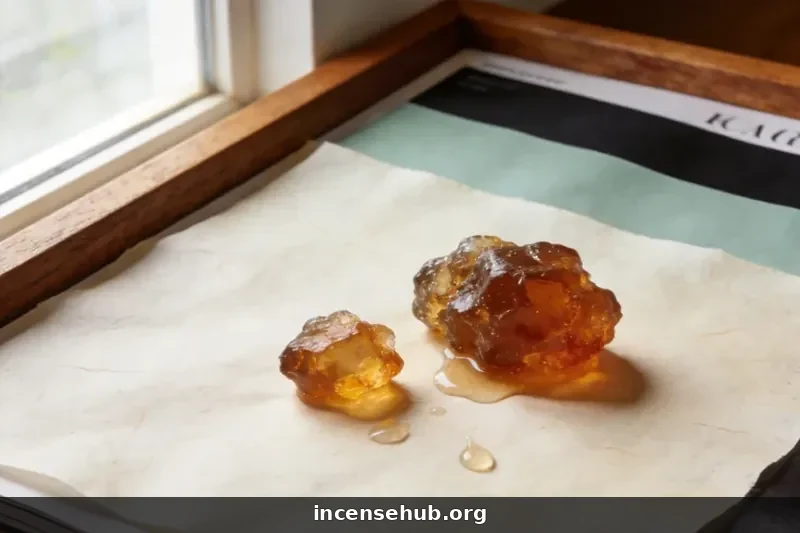
Direct answer: Peru balsam (秘鲁香脂, bìlǔ xiāngzhī) is an aromatic resin from the tree Myroxylon balsamum, a legume (Fabaceae) native to Central America. It is a sweet, vanilla-like, balsamic resin used in Western perfumery as a fixative and sweetener. It enters Chinese fragrance as a modern crossover — it has no classical Chinese incense origin, and none is claimed.
Key facts
| Chinese | 秘鲁香脂 (bìlǔ xiāngzhī) — “Peru balsam” |
| Botanical source | Myroxylon balsamum (family Fabaceae) — the resin |
| What it is | A sweet, vanilla-like balsamic resin |
| Aroma | Sweet, vanilla, balsamic, warm |
| Traditional role | None in classical Chinese incense; modern perfumery resin |
Aroma profile
Direct answer: Peru balsam is deeply sweet and warm, with a rich vanilla-cinnamon balsamic character and a soft, resinous depth. It functions as a Western perfumery base note and fixative, prized for anchoring sweeter compositions and lending a gourmand, almost caramel warmth — a register classical Chinese incense rarely pursued.
Peru balsam is deeply sweet and warm, with a rich vanilla-cinnamon balsamic character and a soft, resinous depth. It is a classic Western perfumery base note and fixative, prized for anchoring sweeter compositions and lending a gourmand, almost caramel warmth. This Western profile — not any Chinese classical record — is what brings 秘鲁香脂 into modern Chinese fragrance, where it overlaps with resins like benzoin (安息香).
The defining trait is its sweetness profile: where classical Chinese resins such as frankincense (乳香) and benzoin (安息香) read as dry, resinous, or faintly sweet, Peru balsam leans into an almost edible vanilla-cinnamon warmth. That is a distinctly Western perfumery value — the “gourmand” sweet register — and it explains why the material appears in Chinese fragrance only as a modern import rather than as a 香材 with a history.
A provenance note (read this)
Direct answer: 秘鲁香脂 is a modern crossover, not a classical Chinese incense material. The tree is Central American, the name is a trade label (not from 香乘 or 本草纲目), and the material has no place in the classical 香材 canon — its Chinese use is entirely modern perfumery.
秘鲁香脂 is a modern crossover, not a classical Chinese incense material:
- The tree Myroxylon balsamum is native to Central America, and the resin entered global trade through Western perfumery and pharmacy.
- The name 秘鲁香脂 (“Peru balsam”) is a geographic label — the resin’s name in trade — not a term from 香乘 (Xiang Cheng) or the Bencao Gangmu (本草纲目).
- It does not appear in the classical 香材 canon; its Chinese use is modern perfumery and fragrance.
This page records it honestly as a modern resin — no classical Chinese origin is claimed, and none is fabricated.
Botanical source and origin
Direct answer: Myroxylon balsamum is a leguminous tree (Fabaceae) native to Central America. Despite the name, the resin is not Peruvian in native origin — it was long shipped through Peruvian ports, which gave it the commercial name “Peru balsam.” It has no Flora of China entry, being a New World species grown in China only as an exotic.
Myroxylon balsamum is a leguminous tree (Fabaceae) native to Central America, whose aromatic resin — Peru balsam — is collected by tapping and is prized for its sweet, vanilla-like warmth. Despite the name, the resin is not from Peru in its native origin (it was long shipped via Peruvian ports, giving the trade name). It has no Flora of China entry, being a New World species grown in China only as an exotic.
Two points of botanical precision matter for readers. First, the modern name Myroxylon balsamum has absorbed an older, narrower name — Myroxylon balsamum var. pereirae — under which Peru balsam was long listed; the distinction between “Peru balsam” and the closely related “Tolu balsam” (Myroxylon balsamum var. balsamum) is one of the standing traps in the balsam trade, since both come from the same species complex but differ in consistency and aroma. Second, “balsam” here means a true oleoresin tapped from the trunk, not a gum or a distilled oil — a category fact that places it alongside benzoin and storax rather than alongside frankincense.
Chinese name and terminology
Direct answer: The name 秘鲁香脂 is a modern, literal geographic label — “Peru balsam” — not a classical term. It belongs to the modern Chinese vocabulary for imported perfumery resins, a different naming layer from the classical 香材 terms like benzoin (安息香) and storax (苏合香).
The name 秘鲁香脂 (bìlǔ xiāngzhī) is transparent and modern: 秘鲁 “Peru” + 香脂 “fragrant resin / balsam.” It is a trade-and-translation coinage of the modern era, not a classical term. This matters for disambiguation because Chinese has a separate, genuinely classical vocabulary for balsamic resins — benzoin (安息香), storax (苏合香), frankincense (乳香) — and 秘鲁香脂 sits outside that canon as an imported modern label. A reader who hears “香脂” should not assume a classical 香材; the specific name must be pinned to the specific tree.
Why is it used in fragrance?
Direct answer: Peru balsam is used in perfumery as a sweet base note and fixative — it anchors and warms a composition from below while adding a vanilla-cinnamon sweetness. It is not a classical Chinese incense material, so its role in Chinese fragrance is entirely modern, as a crossover sweet resin alongside benzoin and storax.
Peru balsam’s job is the fixative’s job with a sweet signature: it anchors and extends a fragrance from below, while its vanilla-cinnamon warmth rounds the blend. In modern Chinese perfumery it appears as a sweet, balsamic resin alongside benzoin (安息香) and storax (苏合香), where the three overlap in warm, sweet, vanilla-balsamic character but differ in botanical source and precise scent. Its absence from the classical 香材 canon is the key point: in the historical Chinese system, sweet-anchoring was served by benzoin and storax; Peru balsam is the modern-era addition that brought a fuller “gourmand” sweetness.
How is it processed?
Direct answer: Peru balsam is produced by wounding the trunk of Myroxylon balsamum and collecting the exuded oleoresin, which is then cleaned and packaged as a dark, viscous balsam (or, for perfumery, further processed into a resinoid by solvent extraction). No distillation is required for the balsam itself.
The resin is tapped like a tree sap: the bark is cut, the oleoresin exudes and is collected, and it is then strained and packaged. The raw balsam is a dark, viscous, strongly aromatic liquid that hardens with age. For perfumery, the material is often converted into a resinoid (a solvent-extracted concentrate) or used directly as a fixative in its natural balsam form. Because the material is viscous and sticky, its handling in a manufacturing line differs from a dry resin like frankincense — a practical point for anyone compounding it into a product.
What determines quality?
Direct answer: Peru balsam quality turns on purity, viscosity, and aroma character. A good balsam is clean, free of solvent residue, and reads as a rich vanilla-cinnamon sweetness without a smoky or chemical off-note. Because the material can be a skin sensitizer, purity and documentation matter as much as aroma.
The practical checks are: purity (freedom from adulterants and solvent residue), consistency/viscosity (a stable, viscous balsam rather than a watery or over-thickened one), and aroma (a clean vanilla-cinnamon sweetness, not a chemical or “burnt” edge). The contact-sensitizer note is a documented perfumery safety fact — Myroxylon balsamum balsam is a recognized allergen under fragrance-labeling rules — which is why specification sheets and IFRA-style usage limits, rather than aroma alone, govern how much is used in a formula.
Common forms
Direct answer: Peru balsam is traded as the raw viscous balsam, as a perfumery resinoid (solvent extract), and as a constituent of compounded fragrance bases. The balsam and the resinoid are different forms of the same material, chosen by how the downstream formula is built.
| Form | Typical use |
|---|---|
| Raw balsam | Natural fixative and sweetener in compounded fragrance |
| Resinoid | Solvent-extracted concentrate for fine perfumery |
| Fragrance base constituent | Blended into sweet/balsamic accords |
The distinction between raw balsam and resinoid is functional, not a quality statement — the resinoid is a more standardized, easier-to-dose concentrate, while the raw balsam carries the full natural character.
Traditional use vs modern evidence
- Traditional Use — none in classical Chinese incense. 秘鲁香脂 is a modern crossover with no place in the 香材 canon, and no traditional Chinese use is claimed.
- Historical Record — no classical Chinese incense record exists for Peru balsam; the name and use are modern trade-and-perfumery additions. Its documented history is Western (pharmacy and perfumery).
- Scientific Evidence — the botanical identity (Myroxylon balsamum, Fabaceae) is established; its status as a recognized contact sensitizer is a documented perfumery safety fact, not a fragrance virtue.
There is no classical Chinese incense record for 秘鲁香脂; its position is entirely modern. We make no medical claims. The documented facts are botanical identity, the Fabaceae placement, and the resin’s modern perfumery role.
Quality notes
Practical points:
- 秘鲁香脂 is Peru balsam, the resin of Myroxylon balsamiferum — now treated as Myroxylon balsamum; expect a sweet, vanilla-like, balsamic warmth.
- It is a modern perfumery resin, not a classical 香材, and not a burned incense ingredient in the Chinese tradition.
- It can be a contact sensitizer in some individuals — a documented perfumery safety note, not a fragrance virtue.
Peru balsam vs related balsamic resins
Direct answer: Peru balsam, benzoin, and storax are all sweet, warm, vanilla-balsamic fixatives, but from different plants. Peru balsam is Myroxylon balsamum (Fabaceae); benzoin (安息香) is Styrax resin; storax (苏合香) is Liquidambar orientalis. They overlap in character but differ in botanical source, sweetness, and classical standing.
| Peru balsam (秘鲁香脂) | Benzoin (安息香) | Storax (苏合香) | |
|---|---|---|---|
| Botanical source | Myroxylon balsamum (Fabaceae) | Styrax spp. | Liquidambar orientalis |
| Character | Sweet, vanilla-cinnamon, warm | Sweet, vanilla-like, softer | Balsamic, smoky-sweet |
| Classical Chinese status | None (modern crossover) | Classical 香材 | Classical 香材 |
| Key identification note | Contact sensitizer; modern fixative | Species and resin quality | Smoky-balsamic profile |
The distinction matters because the three are often grouped as “sweet balsamic resins” yet only two of them — benzoin and storax — belong to the classical Chinese canon. See benzoin, storax, and the material comparison matrix.
Summary
Peru balsam (秘鲁香脂) is the sweet, vanilla-cinnamon oleoresin of Myroxylon balsamum (Fabaceae), a Central American tree whose trade name reflects Peruvian shipping ports rather than botanical origin. It is a modern Western perfumery fixative with no classical Chinese incense record, entering Chinese fragrance as a crossover sweet resin alongside benzoin and storax. Its key identification points are the geographic-misnomer caution and the documented contact-sensitizer status, which makes specification and usage limits more important than aroma alone.
FAQ
What is Peru balsam (秘鲁香脂)? An aromatic resin from the tree Myroxylon balsamum, a legume (Fabaceae) native to Central America. It is sweet, vanilla-like, and balsamic, and it is used in Western perfumery as a base note and fixative. Its name is a trade label, not a Chinese classical term.
Is Peru balsam (秘鲁香脂) a classical Chinese incense ingredient? No. The tree is native to Central America, and the resin entered Chinese use through modern perfumery. It does not appear in the 香乘 (Xiang Cheng) or the Bencao Gangmu (本草纲目), and the name 秘鲁香脂 is a geographic trade label. Its position is a modern crossover resin, and no classical origin is claimed.
Why is it called “Peru” balsam if the tree is from Central America? The name is a trade artifact, not a botanical origin. The resin was historically shipped through Peruvian ports, giving the material its commercial name “Peru balsam,” even though the tree Myroxylon balsamum is native to Central America. The name stuck in trade and persists today.
What does Peru balsam smell like? Deeply sweet and warm, with a rich vanilla-cinnamon balsamic character and a soft, resinous depth. It is a classic base note and fixative in Western perfumery, prized for anchoring sweeter compositions and lending a gourmand, almost caramel warmth.
How does Peru balsam relate to benzoin and storax? They are all sweet, balsamic resins used as fixatives, but from different plants. Peru balsam is Myroxylon balsamum (Fabaceae), benzoin (安息香) is Styrax resin, and storax (苏合香) is Liquidambar orientalis. They overlap in warm, sweet, vanilla-balsamic character but differ in botanical source and precise scent — and only benzoin and storax are classical Chinese 香材.
Is Peru balsam safe in fragrance? It is a recognized contact sensitizer for some people, which is a documented perfumery safety fact rather than a fragrance virtue. Its use in fragrance is governed by specification, purity, and usage limits, and it is not an incense material to burn. This is editorial knowledge content, not medical advice.
See also: benzoin, storax, vanilla, copaiba and the full scent guide.
Evidence & Sources
Botanical identity
Source: Myroxylon balsamum on GBIF. Evidence type: Established.
Modern use
Source: Peru balsam as a Western perfumery base note and fixative, and a modern Chinese fragrance crossover. Evidence type: Modern perfumery — no classical Chinese record; none claimed.
Authenticity / provenance
Source: 秘鲁香脂 is a modern crossover (Central American origin, Fabaceae); it is not in the classical 香材 canon. Evidence type: Practical screening.
Safety
Source: incense combustion produces smoke and particulate matter; Peru balsam is a known contact sensitizer. Evidence type: Established.
Evidence status
| Layer | Status |
|---|---|
| Botanical identity | Established |
| Traditional use | None (modern crossover) |
| Authenticity test | Practical screening |
| Health claims | Not established |
Sources
Sources: botanical references on Myroxylon balsamum. 秘鲁香脂 is a modern crossover resin with no classical Chinese incense record; no such origin is claimed. This is editorial knowledge content, not medical advice.