
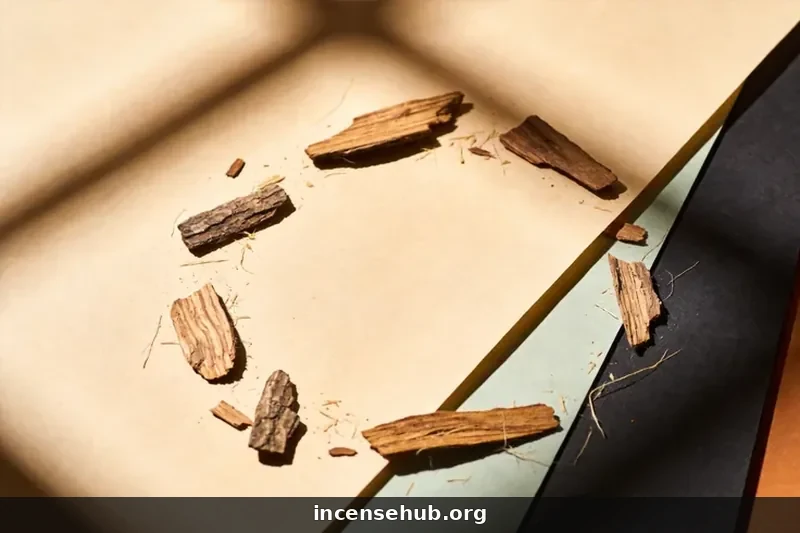
Definition: 檀香 (tánxiāng) is the scented core of Santalum trees, above all the Indian tree Santalum album. It has filled censers, temple halls, carving benches, and perfume laboratories for centuries, and it remains one of the quietest and most persistent materials in the incense cabinet.
Key facts
| Chinese term | 檀香 (tánxiāng) |
| Plant family | Santalaceae |
| Benchmark tree | Santalum album |
| Part used | The dark inner wood, not the pale outer layers |
| Scent register | Creamy, sweet, soft, faintly buttery |
| Job in a blend | Floor and fixative |
| Common failure | Wrong kind of tree, or liquid scent passed off as wood |
Direct answer: This is a wood, not a resin or a flower. Its aroma sits inside the fibre, leaves slowly when warmed, and outlasts almost everything else in a stick — which is why it works as a base rather than a decoration.
What the material actually is
Direct answer: Santalum trees are half-parasites: they photosynthesise like any green tree, yet they also plug into the roots of neighbours for water and minerals. The scented part is the dark inner core, and it forms slowly over decades.
Picture the tree first. It has leaves, it is green, and it manufactures its own sugar from sunlight. Now look underground. Its roots have found the roots of other plants and joined onto them. Water and dissolved minerals cross that join. The tree is not a freeloader — it pays its own carbon bill — but it is not independent either.
Gardeners call the arrangement hemiparasitism. Growers call it a headache. You cannot plant the crop alone in a field and wait; hosts have to be planted too, managed, and replaced. Then comes the long part: a tree lays down pale wood for years before the dark, fragrant core develops. Cut it early and the yield is fibre with barely any scent. Mill the whole trunk and the good fraction is diluted by the bland one. That is the first thing to understand about this material: the aroma is not in the tree as such, it is in a particular part of a particular age.
The family is Santalaceae. The genus is Santalum, and several of its members reach the market. They are not interchangeable, even when a label uses one word for all of them.
The GBIF record for Santalum album settles the binomial and the range. It cannot tell you the age of a log, the proportion of dark core, or how the wood was kept after felling — and those decide whether a jar is worth its price.
Inside the wood
Direct answer: The scent lives in the dark core, in a network of vessels, fibres, and ray cells that store aromatic alcohols. Density and oil content are properties of that tissue, not of the tree as a whole, which is why two pieces from one log can behave differently.
Wood is not a uniform solid. It is a composite of cells with different jobs: vessels that once carried water, fibres that gave the stem strength, and ray cells that stored starch and moved materials sideways. In a scented wood, the aromatic compounds accumulate in the spaces and cell walls of the dark core, and the way those cells are packed determines how much scent a gram of powder contains.
A slow-grown tree packs its cells more tightly. The growth rings are narrow, the fibre walls are thick, and the proportion of void space is lower. A fast-grown tree lays down wider rings and more open tissue. The difference is visible in the grain and measurable in the weight, and it is one reason a dense, fine-grained piece commands a higher price than a light, coarse one.
The aromatic fraction itself is a mixture of sesquiterpene alcohols, with the santalols dominant. These molecules are heavy, and heavy molecules do not evaporate quickly. That is the chemistry behind the slow release that makes the material useful as a fixative. It is also the reason a powder that has lost its top notes can still smell of something: the heavier fraction lingers after the lighter one has gone.
Oil content varies through the tree, not just between trees. The centre of the core is usually richer than the margin, and the base of the trunk is often richer than the upper limbs. A producer who cuts the core into uniform chips averages those differences; one who sorts by position can sell a more consistent product. Neither approach is wrong, but the buyer should know which one produced the bag.
Moisture sits in the cell walls and in the void spaces, and it changes how the wood behaves. A damp piece is heavier, burns cooler, and releases its aroma more slowly. A bone-dry piece is lighter and more brittle. The moisture range a supplier works to is therefore part of the specification, not a detail to be discovered on delivery.
Growing a slow crop
Direct answer: Sandalwood is grown like an orchard and harvested like timber. Host plants must be established first, the rotation is measured in decades, and the return arrives long after the cost. That mismatch explains most of the supply economics.
A plantation begins with hosts. The young sandalwood needs a living root system to attach to, so the ground is prepared with companion species that will support it through the years it takes to establish. The choice of host affects growth rate, form, and survival, and the wrong host can stall a block for years.
Then comes waiting. The tree puts on height and diameter, but the dark core develops slowly. Thinning and pruning may be needed to keep the stand healthy, and the harvest is planned decades in advance. A grower who plants this year will not see a return this decade, which is why plantation supply cannot respond to a price spike the way an annual crop can.
The harvest itself is selective. Trees are assessed for core development before felling, and the usable fraction is separated from the pale outer wood at the stump or at the mill. The residue has other uses, but it does not carry the value that justified the wait.
The economics follow from the biology. Long rotations tie up land and capital, so the cost of the first harvest is carried for years before any income arrives. That cost is passed into the price of the wood, and it is why a sudden shortage cannot be solved by planting more this season. It can only be solved by waiting, or by substituting a faster species.
For a buyer, the practical consequence is that supply is inelastic. Prices move further and faster than production can respond, and the gap between regulated and unregulated material widens when demand rises. That is the environment in which substitution becomes attractive, and the reason documentation matters more in a tight market than in a loose one.
The smell, in plain terms
Direct answer: Warm, creamy, softly woody, and sweet in a way that resembles butter or milk more than sugar. Good material is round and smooth, never sharp, and it stays close rather than filling a room.
“Buttery” is the word that does the most work here. It is not decoration. Real wood has a fat, rounded, almost milky softness under the woody note. Imitations tend to be drier, brighter, and more obviously perfumed — a hard woody top with a soapy tail. Once you have smelled both, the difference is easy to hear.
The chemistry behind that softness involves a group of large alcohols, the santalols, which dominate the characteristic fraction of the distilled liquid. They are big molecules, and big molecules move slowly. That slowness produces the whole effect: instead of flaring and vanishing, the aroma hugs the surface for hours and drags the release of lighter materials along with it.
The same trait explains the word people reach for when they describe this scent: meditative. It does not project. It accumulates. A room scented with it does not announce anything; it simply becomes, over time, a room that smells of sandalwood.
Heat changes the reading. At gentle warmth — a heated bead, a plate over a low burner — the wood opens and the creamy core comes forward. At combustion temperatures, smoke adds its own ashy, sharp notes that sit on top of the finer facets. That is the practical argument for warming rather than burning when the goal is to judge material:
gentle warmth → aromatic fraction lifts without burning → creamy, sweet, complex profile → a clean reading of the wood itself.
A sample that smells dull in a cold jar may simply be cold. A sample that smells wonderful in the jar may be carrying something added. Warming is the honest test.
What the label is hiding
Direct answer: Four trees do most of the work in this trade, and one word covers all of them. Santalum album from India is the benchmark; Santalum spicatum from Australia is the volume alternative; Santalum austrocaledonicum and Santalum paniculatum fill niche parcels from New Caledonia and Hawaii.
The distinction is not academic. It changes what the material smells like, what it costs, and whether the paperwork will survive a customs check.
Start with the benchmark. Santalum album, sometimes sold as white sandalwood, is the Indian tree that gave the material its reputation. Its dark core is creamy, buttery, sweet, and complex, with a soft tail that lasts. When people describe sandalwood as “meditative”, this is usually the smell they mean.
Then the volume alternative. Santalum spicatum grows in Australia and supplies a large share of the legal market. It reads drier and more resinous, with less of the buttery roundness. A good parcel is excellent in its own right; it is simply a different instrument.
The remaining two are smaller stories. Santalum austrocaledonicum from New Caledonia is generally softer and lighter in the creamy register, and Santalum paniculatum from Hawaii carries a regional character with limited supply. Both are legitimate materials with their own followings.
Every one of those descriptions is a trade characterisation, not a measured profile. Logs vary within a tree, and provenance inside a country can matter as much as the country itself. What the list establishes is narrower and more useful: the botanical name is real information, and the single English word withholds it.
The muddle is old. Xiangcheng (香乘), a Ming compilation, quotes Su Song: 「檀香有数种黄白紫之异,今人盛用之」 — several kinds of 檀香, yellow, white, and purple, all in use. The purple one is the dye wood. The habit of shelving unlike goods together outlived the compilers.
老山檀 and 新山檀: reading the label
Direct answer: 老山檀 (“old mountain”) is trade language for mature Indian wood with a deep creamy profile, often linked to Mysore. 新山檀 (“new mountain”) is looser, used for younger or non-Indian material. Neither is a botanical name, a formal grade, or a certificate.
These two phrases carry a lot of weight in Chinese-language commerce, and almost none of that weight is standardized. Precision helps.
老山檀 reads literally as “old mountain sandalwood.” In use it gestures at three things at once: Indian origin, mature wood, and a sensory profile — dense, oily, deeply creamy, with a long sweet tail. The old Mysore country of Karnataka is the historic reference, and “Mysore sandalwood” is a recognised origin name in the wider trade. Sellers use the phrase because those associations sell; no authority issues 老山檀 papers.
新山檀 reads as “new mountain sandalwood.” It is vaguer. It may mean estate-grown Santalum album, may mean Australian wood, may mean simply “not the premium thing.” Its usefulness as a description is limited, and its usefulness as a warning is real: a seller who reaches for it is often signalling that the material is not the classic article.
| Term | Literal sense | What it implies | What it may hide | How to probe |
|---|---|---|---|---|
| 老山檀 | Old-mountain | Mature Indian core, dense and creamy | A blend; a good Australian parcel under a prestige name | Ask tree, region, and age; warm a sample; compare weight and tail |
| 新山檀 | New-mountain | Younger or non-Indian material | Estate Santalum album; Santalum spicatum; unnamed Santalum | Ask which tree; judge scent rather than story |
| 印度檀香 | Indian sandalwood | Santalum album from India | Estate wood grown outside India | Ask country of harvest, not just the name |
| 白檀 | White sandalwood | Santalum album | Usually accurate, but says nothing about grade | Treat as a species hint only |
The practical point: 老山檀 is a story, not a certificate. It may be a true story. Plenty of honest sellers use the phrase for genuinely old, genuinely Indian wood. The words themselves prove nothing, and a buyer who treats them as a guarantee is trusting the seller rather than the evidence.
A second trap hides inside the first. Very old wood stored badly can smell flat, while younger wood handled well can be vivid. Age is an input, not an outcome. The nose has to settle the argument.
The 檀 family of names
Direct answer: Buy the binomial, not the character. One sound covers three plants: 檀香 is the aromatic wood, 白檀 points at Santalum album, and 紫檀 belongs to Pterocarpus santalinus, a crimson dye wood with no creamy scent at all.
Chinese plant names lean on single characters, and 檀 is among the most treacherous. Start with the rule and the rest follows.
檀香 names the incense wood. The 香 is a signal, not decoration: this is the fragrant one.
白檀 — “white sandalwood” — usually points at Santalum album, separating the pale Indian tree from its relatives. It says something about botanical identity, nothing about grade. A sack marked 白檀 may hold first-rate core or floor sweepings.
紫檀 — “purple sandalwood” — is Pterocarpus santalinus, a legume grown for deep red wood and dye. Creamy it is not. It does not smell like the incense wood, it does not burn like it, and it sits in a different family. A buyer who confuses the two has not made a small mistake; they have ordered a different commodity.
The textual root of the muddle sits in the Su Song line quoted above, where yellow, white, and purple “sandalwoods” are listed side by side and the purple entry is the dye wood. Readers who inherit the list inherit the error with it.
When ordering, ask for the Latin binomial or, at minimum, the full Chinese name with its second character intact. 檀香 and 紫檀 do not substitute for one another, no matter how similar a photograph makes them look. The red sandalwood entry treats the dye wood on its own terms.
Reading a Chinese label
Direct answer: A Chinese-language label carries more information than an English one, if you can read the characters. The second character usually tells you what the material is; the first tells you which claim is being made.
| Label | Literal sense | What it should mean | What to verify |
|---|---|---|---|
| 檀香 | sandalwood fragrance | Aromatic Santalum wood | Which tree |
| 白檀 | white sandalwood | Santalum album | Grade |
| 紫檀 | purple sandalwood | Pterocarpus santalinus, a dye wood | That it is not sold as incense |
| 老山檀 | old-mountain sandalwood | Mature Indian core | Age and origin |
| 新山檀 | new-mountain sandalwood | Younger or non-Indian material | Which tree |
| 印度檀香 | Indian sandalwood | Santalum album from India | Country of harvest |
| 檀香粉 | sandalwood powder | Milled wood | Wood or spent material |
| 檀香油 | sandalwood oil | Distilled extract | Tree and method |
| 线香 | incense stick | A finished stick | Wood content |
| 合香 | blended incense | A composed formula | The role of each material |
Two habits make the table useful. Read the whole phrase rather than the first character, and ask what the second character is doing. 檀 alone is a sound; 檀香 is a material; 紫檀 is a different material altogether.
Where it grows and who controls the trade
Direct answer: The benchmark tree is Indian, and the old trade grew up in Karnataka and Tamil Nadu. Harvest has been supervised for generations because wild supply cannot keep pace. Australia’s Santalum spicatum now fills much of the legal gap, with smaller parcels from New Caledonia and Hawaii.
The historic centre lies in the Indian south, with the old Mysore country as its most famous address. Santalum album is native there. Growers have worked under permits and quotas for generations, not because the tree is delicate in a nursery but because it is slow, valuable, and easy to cut faster than it regrows.
Years of overcutting did what overcutting always does. Standing stock fell, restrictions tightened, and the market looked elsewhere. Two answers emerged. One was the managed estate: Santalum album planted with hosts, often far from India, on a rotation measured in decades. The other was Australia’s Santalum spicatum, now a substantial part of what legally moves through the trade. New Caledonia and Hawaii supply smaller parcels, usually to specialty buyers.
Regulation turns provenance into a product feature. Standing stock falls, quotas tighten, estate wood and substitute trees move in, and every parcel acquires a story about where it came from. Without documents, a buyer inherits both the legal exposure and the doubt.
The CITES checklist entry is where the current position should be read; rules move, and secondhand summaries go stale. Domestic law adds a second control, listing the tree at Grade II on the national protected-plants roster (国家重点保护野生植物二级).
Does any of this reach a stick of incense? Yes, by two routes. A chain that can name a tree and a region has usually done the work of knowing what it is selling, which makes the material more likely to be what the label says. And scarcity is the condition that makes substitution pay, so the more regulated a material becomes, the more carefully its identity has to be checked.
What happens between log and jar
Direct answer: The pale outer wood is removed first; the dark core is kept. Then the route forks: mill it for sticks, distil it for liquid scent, or carve it. Each fork produces a material with its own behaviour.
The first decision is made with an axe, not a machine. Core and shell look different — the inner wood is darker, denser, heavier — and a producer who cares removes the pale shell before milling. A producer who does not sells the whole trunk under one name. That single choice can decide whether a jar smells creamy or like sawdust.
Milling. The dark wood is chipped, then ground to a chosen particle size. In stick work the grind is a variable, not a standard: too fine and the pack chokes the draw, too coarse and the burn goes uneven. The right answer depends on binder, forming method, and target burn.
Distilling. Steam carries the aromatic fraction out of the wood over a long cycle. The result is a separate product with its own market, its own grades, and its own history of adulteration. Distilling also creates a quieter problem further down the chain:
wood steamed for its liquid → aromatic fraction removed → spent fibre remains → spent material dried and sold as wood powder → the jar looks right and smells faint → the stick burns flat.
This is one of the commonest ways a buyer ends up disappointed without being cheated in any obvious way. The material is real sandalwood in the sense that it came from a sandalwood tree. It has simply had most of its value boiled out.
Carving. Dense core goes to beads, pendants, and figures. Offcuts become chips, which is why carving shops and incense suppliers sometimes share a supply chain. Carved pieces are judged by different criteria — figure, colour, freedom from cracks — and a piece that is beautiful in the hand is not automatically the most aromatic.
How it burns
Direct answer: Slowly, and for a long time. The material is heavy and low in volatility, so it releases its own scent gradually and slows the release of everything blended with it. It also changes the physical behaviour of a stick, not just the smell.
Three things happen when this wood enters a formulation.
The blend slows down. Lighter materials that would flash off in the first minute find themselves held in a denser matrix and released over a longer window. The opening feels fuller, and the handover to the heart is less abrupt. A small proportion can make a floral blend feel more expensive without adding an obvious new note; what it changes is timing.
The stick changes. Dense powder needs more water and binder to form a workable stick, and a wetter stick has to be dried more carefully. Dry it too fast and the surface sets while the core is still shrinking, which is a reliable route to cracks:
dense powder → more water for extrusion → higher green moisture → fast drying sets the surface first → the core shrinks away → cracks and an uneven burn.
None of this is visible in a sample bag, and all of it shows up on the production floor. A maker changing suppliers should expect to re-learn the water and drying step even when the scent is exactly right.
The formula can go monolithic. The wood is gentle, but it is not neutral. At a high proportion everything smells of it, and the other materials become decoration. Classic use is as a floor or a substantial minority, not the whole recipe. The exact share is a matter of intent and editorial judgment, not a rule.
Putting it in a formula
Direct answer: In Chinese practice this wood is agarwood’s opposite number: 沉香 is restless and complex, 檀香 is steady and soft, and the two are usually combined rather than opposed. In the 君臣佐使 (chief, minister, assistant, guide) vocabulary it is a minister or an assistant.
The pairing is one of the oldest reflexes in the tradition: a creamy, dependable wood beside a resinous, unpredictable one. The logic is complementary. Agarwood supplies movement — resin pockets that release at different temperatures, a scent that shifts across the burn. Sandalwood supplies a floor. Without it, a resin-heavy stick can feel restless; with it, the resin has something to sit on.
| Role | What the role demands | Fit for this wood |
|---|---|---|
| 君 Chief | Defines the stick from light to ash | Possible in a dedicated stick, though the scent is quiet |
| 臣 Minister | Supports and extends the lead | Strong — creamy body under resin or floral |
| 佐 Assistant | Corrects harshness, rounds seams | Strong — softens edges without adding an idea |
| 使 Guide | Carries and harmonises the mixture | Moderate — fixative action helps, but it is not a carrier |
The vocabulary is traditional craft language, not a laboratory taxonomy, and different periods used it loosely. Its value is that it forces a formulator to name a job. “Sandalwood because it is classic” is not a job description. “Sandalwood to hold the floral opening and soften the agarwood transition” is.
Two consequences follow. A sandalwood-forward stick is a legitimate product, but it is a different product from a sandalwood-supported blend: the wood has to carry the whole arc, and its quietness becomes the point rather than a limitation. And a small addition can change a formula more than its percentage suggests, because what it alters is the timing of everything else. Test a new lot in its intended role, not in isolation.
There is a ritual dimension too. Buddhist and Taoist settings have burned this wood for centuries, often in the simplest form — a chip, a spoon of powder, a single stick — where the scent marks a period of practice rather than entertains. That history explains part of the material’s authority, and part of why the smell feels familiar to people who cannot name it.
The Japanese reading: byakudan and kōdō
Direct answer: In Japan the wood is called byakudan, and it appears in kōdō — the way of incense — where small heated pieces are judged as much for their behaviour over time as for their first impression.
Kōdō treats incense as a discipline rather than a purchase. A session is quiet, attentive, and structured: a small piece of aromatic wood is placed on mica over a gentle heat source, and the participants take turns noticing what happens. The verb often translated as “smell” is closer to “listen”, which says something about the intended posture. The point is not to enjoy a fragrance but to attend to one.
Byakudan is one of the classic woods in that practice. It is used as a reference point — creamy, sweet, steady — against which other woods are heard. The vocabulary of the session is one of temperature, sweetness, depth, and duration, and it maps poorly onto retail adjectives. A piece that seems quiet at first may reveal most of its character in the second and third minute, and a piece that opens loudly may have nothing left to say.
The practice offers a transferable lesson for buyers. Judge a sample warm, in a small amount, over time, and against a reference you know. That is exactly the method a serious sandalwood buyer should use, and it costs nothing to borrow. The ceremony also explains why “byakudan” appears in Japanese craft writing as a marker of quality: the word carries the authority of a tradition, not a laboratory certificate.
Kumikō, the matching game played with several scent packets, adds another idea worth stealing. The game asks participants to distinguish and remember, not to rank. Applied to a purchase, that is a better frame than “which is best”: can you tell this parcel from the one you bought last year, and can you say how?
The Indian reading: chandana and ritual
Direct answer: In India the wood is chandana, and its use runs through ritual, personal care, and carving. The paste is ground from the wood; the liquid is distilled from it; the same tree supplies temple, cosmetic, and craft demand.
Chandana is the Sanskrit word behind the trade’s older names, and the material has a long life in Hindu practice. A paste is made by grinding a piece of wood on a stone with a little water, then applied to the skin or to an image as part of ritual. The act is both practical and symbolic: the cooling, fragrant paste marks a moment of respect, and the scent lingers after the ritual is over.
The same wood supplies the oil used in personal care for centuries, and the carving traditions of the Mysore region, where sandalwood figures and boxes have been made for generations. That triple demand — ritual, cosmetic, craft — explains why the Indian trade developed the regulatory apparatus described earlier. A material that serves several markets at once is under pressure from all of them.
For a reader, the Indian context clarifies something the Chinese context leaves implicit: this is not only a censer material. It is a substance that people put on their skin, carve into objects, and offer in temples. That breadth is part of its cultural weight, and part of why the aroma feels familiar even to people who have never burned it.
The boundary is the same as everywhere else on this page. Traditional ritual use is a fact about culture. It is not a medical claim, and it does not establish that the wood treats anything.
What grade language actually means
Direct answer: Most grade words describe a seller’s judgment, not a measured standard. “Premium”, “selected”, “first cut”, and “old material” are claims about intent; only tree, origin, and form are checkable facts.
A short decoding, offered as editorial guidance rather than as trade law.
“Premium.” A judgment, usually meaning the seller believes the parcel is above average. It carries no threshold and no audit. It is not meaningless — a seller’s reputation sits behind it — but it is not a specification.
“Selected.” Suggests hand-sorting. Hand-sorting is real work and can genuinely improve consistency, but the word does not say what was selected for: colour, weight, scent, or size.
“First cut.” Usually implies material from the outer part of the core, or from an early stage of processing. The phrase is ambiguous across regions, and its quality implication is not fixed.
“Old material.” Refers to the age of the wood, which may mean decades of slow drying or simply a long time in a warehouse. Age can improve solid wood and do very little for powder.
“Wild.” Describes an origin. It says nothing about handling, storage, or grade, and wild material can be excellent or poor.
The practical response is to translate every adjective into a question. “Premium” becomes “what makes it premium, specifically?” “Old material” becomes “how old, and how was it stored?” A seller who can answer is worth listening to. One who repeats the adjective is not answering.
Judging a lot
Direct answer: Five things decide whether a parcel is good: the tree, how much dark core it contains, how much scent that core carries, how old the tree was, and how clean the material is. Only the first is ever printed on a label, and even that is sometimes wrong.
Take each axis on its own, and note what a good result does not prove.
Tree. Good material is named, consistent, and documented. That does not prove the named tree was used; paperwork can be copied, and honest mistakes happen at every link.
Core share. Good material is dense and dark, with little pale shell. That does not prove the whole bag is core, because a photograph shows the top and a sample shows one handful.
Scent load. Good material opens richly when warmed and leaves a long tail. That does not prove nothing was added; a scented batch can be very convincing in the short term.
Age and weight. Good material is heavy, fine-grained, and slow-burning. That does not prove “old” means well stored, since a decade in a damp shed is still a decade.
Colour. Good material is even, from pale yellow to warm brown. That does not prove the colour is natural, and dark wood is easy to fake.
Grind and cleanliness. Good material is consistent within its intended distribution, with no grit, bark, or foreign wood. That does not prove it was stored well, and it says nothing about what was mixed in before milling.
The colour point deserves emphasis. The dark core ranges from pale yellow through reddish brown, and hue varies with tree, age, and exposure. Buyers read dark as old and good, which creates an obvious incentive to darken material. Colour is a weak signal on its own.
Scent load is the axis that matters most and is hardest to see. It is not visible in a photograph, not measurable by eye, and only partly inferable from weight. Warm a pinch and smell it. Rich, creamy, sustained aroma suggests load; faint, dusty, or sharp aroma suggests otherwise.
Questions to ask before you buy
Direct answer: Ask which tree, which origin, which form, and how old the wood is; then warm a sample and judge how long the scent lasts. Price belongs in the conversation, not in the verdict.
The order is deliberate, because each answer narrows what the next one should be.
1. Which tree? Santalum album, Santalum spicatum, Santalum austrocaledonicum, or Santalum paniculatum. “Sandalwood” alone is not an answer. A serious seller names the binomial without being pushed.
2. Which origin and harvest basis? Country and region, plus estate-grown or managed harvest. This is where CITES and national rules become relevant.
3. Which form, exactly? Chips, milled wood, liquid, or a finished stick. The milled material and the liquid are different products, and a label that blurs them is hiding something.
4. How old, and how much core? Age is a proxy for scent load and density. Core share is a proxy for how much of the bag is actually aromatic.
5. Does the sample match the story? Warm a pinch, or burn a sliver on a small coal in a ventilated space. Real core gives a creamy, sweet, rounded smoke with a long tail. A sharp solvent top, a soapy middle, or an abrupt disappearance are warnings.
6. Is the price plausible for the claim? The weakest test, and the one buyers lean on most. Prices move with tree, origin, grade, and channel, so a low price proves nothing by itself. What it can do is flag a contradiction: material described as rare old Indian core, sold at a price that cannot cover the raw material, is probably not what the description says.
| Claim | What to check | A result that should change your mind |
|---|---|---|
| “Pure Santalum album” | Documentation, origin, aroma | A dry, sharp profile with no creamy base |
| “Old mountain core” | Age, region, weight, tail | Pale, light, faintly scented chips |
| “100% wood powder” | Whether it is spent material | A jar that smells only when liquid is added |
| “Natural distilled scent” | Tree, method, price context | A thin, uniform profile with an alcohol top |
Moving a parcel across a border
Direct answer: Regulated wood travels on paperwork, not on trust. Expect a CITES permit where the species requires one, a certificate of origin, and a phytosanitary certificate for plant material. The documents must agree with each other and with the parcel.
The first surprise for a new buyer is how much of the transaction happens before the wood moves. A protected species needs an export permit from the country of origin and an import permit from the destination, and the two are matched by quantity, species, and sometimes by a unique reference number. A parcel that arrives without the matching import document can be held, returned, or seized.
The second surprise is the number of documents that describe the same box. A commercial invoice states a value. A packing list states a weight. A certificate of origin states where the goods were grown or processed. A phytosanitary certificate states that the plant material has been inspected and is considered free of listed pests. A bill of lading states who is carrying it and to whom it is consigned.
These documents have to agree. A weight that differs by a few percent between the packing list and the bill of lading is ordinary. A species name that differs between the permit and the invoice is a problem that stops the shipment. A quantity larger than the permit allows is a problem that cannot be fixed at the border.
The tariff code matters too. Customs classify goods by a harmonised code, and the duty and the inspection regime follow from that classification. A parcel declared under a generic “wood” code may attract a different treatment from one declared under the specific code for the species and form. Ask the seller which code they use, and check that it matches what is actually in the box.
A customs broker earns their fee at this stage. They know which documents the local authority wants, in which order, and in what format. For a first import, that knowledge is worth more than a small saving on freight.
The practical checklist is short: confirm the species and the form in writing, confirm which permits apply, confirm that the documents name the same species and quantity, and keep copies of everything. Paperwork is not the romantic part of the trade, but it is the part that decides whether the wood arrives.
Specifications a buyer can write
Direct answer: A useful purchase specification names the species, the form, the moisture range, the particle size, the permitted foreign matter, and the batch code. It does not use the word “premium”.
Most sandalwood transactions run on adjectives. A specification runs on measurements, and it protects both sides: the buyer knows what will be delivered, and the seller knows what will be accepted.
Species and origin. The binomial, and the country or region of harvest. Written as a line, not as a story.
Form. Chips, milled wood, distilled liquid, or a finished stick. Each has its own handling and its own tests.
Moisture. A range, measured on delivery. Moisture affects weight, burn, and storage life, and it is one of the commonest reasons a batch behaves differently from the sample.
Particle size. A distribution rather than a single number, because a powder is a mixture. A sieve analysis, stated as the fraction passing a given mesh, is more useful than “fine”.
Foreign matter. A limit for bark, pale shell, grit, and other wood. The limit can be generous or strict; what matters is that it is stated and testable.
Aromatic reference. A retained sample from the approved batch, kept sealed, against which future deliveries are compared. This is the only way to manage a claim about scent, which is otherwise a matter of opinion.
Batch code and traceability. A code on the bag that links to the supplier’s records. Without it, a problem in one delivery becomes a problem with the whole relationship.
A specification does not need to be long. It needs to be specific enough that two people reading it would accept and reject the same parcel. That is a higher bar than it sounds, and it is the difference between buying material and buying hope.
A small bench kit
Direct answer: You need very little to evaluate a parcel properly: a warm surface, a small scale, clean jars, a loupe, and a notebook. The tools matter less than using the same ones every time.
A warm plate is the single most useful item. It can be a ceramic tile on a radiator, a mica sheet over a low burner, or a purpose-made heater. The point is controlled warmth below combustion, so the aromatic fraction lifts without smoke. Improvise badly and you will smell the improvisation.
A scale that reads small increments lets you compare doses honestly. Without it, “a little more” is a feeling rather than a quantity, and a formula cannot be repeated.
Clean jars matter more than they sound. A residue of last month’s resin will scent this month’s sample, and the contamination is invisible. Glass with a good seal, labelled with a date and a supplier, is enough.
A loupe or a strong magnifier helps with structure: grain, cracks, whether a powder is uniform or a mixture of colours. A notebook closes the loop. Write the date, the supplier, the claim, and the impression while the sample is in front of you; memory rewrites itself within a day.
Running a comparison
Direct answer: Compare samples blind, in the same session, on the same plate, and write before you discuss. The goal is to rank the parcels, not to confirm a favourite.
A comparison is a small experiment, and most home comparisons are ruined by order and expectation.
Prepare three samples. Label them A, B, and C on the underside of the dish, not on a card the tester can read. Include one sample you already know well as an anchor.
Warm the plate once. Let it reach a stable temperature before the first sample. A plate that is still heating will make the first sample look weaker than the others.
Smell in short passes. Bring the sample to the nose, take two or three short breaths, then move away. Long inhalations fatigue the nose and flatten the differences.
Wait between samples. A minute of clean air, or a sniff of your own sleeve, resets the palate enough to matter.
Write first, discuss later. Independent notes catch disagreements that a group discussion would smooth over. If two testers disagree, that is data, not a problem.
Repeat on another day. A ranking that survives a second session is worth acting on. One that does not was probably noise.
Working with whole pieces
Direct answer: Whole wood keeps better than milled wood. Split only what you need, keep the rest intact, and cut across the grain to expose a fresh surface for evaluation.
A whole piece is a storage vessel for its own aroma. The outer surface oxidises and dries, and the interior stays protected. That is why a chip from the centre of an old piece can smell stronger than a fresh powder made from the same wood.
Splitting takes a small saw or a chisel and a steady hand. Cut across the grain rather than along it, and work on a clean surface so the shavings can be collected. The dust from cutting is itself a sample; smell it before you commit the piece to a batch.
Keep the offcuts. Small pieces dry faster and are useful for tests, and a bag of labelled fragments is a reference library that costs nothing to maintain.
Label the piece, not the shelf. A number written on the end grain, with the supplier and the date in the notebook, survives longer than a sticky note and does not fall off in a drawer.
Liquid versus solid
Direct answer: The distilled liquid and the milled wood are cousins, not twins. One is extracted from the other; they smell related but not identical, behave differently in a stick, and cannot be swapped by weight.
Distilling captures the volatile fraction and leaves the fibre behind. The liquid is brighter, more uniform, more immediate. The wood is deeper, slower, and carries a “cooked” quality that comes from aroma bound inside a solid matrix.
In a finished stick the difference is audible. Liquid on a core leaves almost at once, giving a strong opening and very little development; by the time the stick settles, the tail belongs to the core rather than to the sandalwood. That is the thin, abruptly quiet stick that disappoints a buyer. Milled wood works the other way round: the aromatic fraction is distributed through the stick and released as the coal advances, so the presence builds gradually and stays for the length of the burn.
None of this makes the liquid inferior. It is a legitimate perfumery material with a long history, and the right choice when the goal is to scent a liquid, a cream, or a dipped product. The error is treating the two as interchangeable when specifying a combustible formula. They are different tools with different curves.
Beads, wear, and the second market
Direct answer: The same tree supplies a market that never burns anything. Beads, pendants, and figures are judged on grain, soundness, weight, and finish, and a piece can be superb in the hand while being ordinary as incense.
Carving and incense look like one trade from a distance. They are not. A carver wants a solid block with even grain, no internal checks, and enough size to yield the intended shape. A stick maker wants aromatic core ground fine. The two can come from one log, but the criteria diverge quickly.
Grain. Straight, close grain takes a clean finish and holds a shape. Wild figure is prized in some objects and treated as waste in others, depending on the tradition and the form being carved.
Soundness. Cracks, hollows, and repaired sections are disqualifying. A check that is invisible on a new piece can open as the wood equilibrates with indoor air, and a bead that splits after a month of wear cannot be repaired invisibly.
Weight. Dense pieces generally carry more aromatic core and more scent load. Light, porous pieces are often pale outer wood or young material, and they feel wrong in the hand before they smell wrong in the air.
Warmth. A bead worn against the skin warms slowly and releases a faint creamy note. A piece that smells of nothing when warmed is unlikely to improve with age. This is the simplest test available to a buyer, and it costs nothing.
Finish. Wax and oil can mask a dry surface, and a heavy finish can seal in an unpleasant smell as easily as a pleasant one. A matte, open finish that lets the wood breathe is usually a better sign than a high gloss.
The bead trade has its own folklore. Pieces are described as “old material”, “temple wood”, or “collected from a demolished building”. Some of those stories are true. Many are not, and none can be verified from the object itself. The buyer’s defence is the same as in any other purchase of this wood: species, weight, grain, and the behaviour of the scent when warmed, judged directly.
There is a practical link back to sticks. Carving produces offcuts, and offcuts become chips. A workshop that turns beads all year generates a steady stream of aromatic scrap, and some of that scrap enters the incense supply. This is efficient use of a slow-growing material rather than a scandal, but it does mean that “sandalwood chips” can vary enormously depending on what they were cut from.
Reading the burn
Direct answer: Watch the coal, the ash, and the last third of the stick. A well-made stick advances evenly, holds its coal, and finishes cleanly; a poorly made one tunnels, cracks, or turns harsh as it ends.
A burning stick is a small physical experiment, and most of what goes wrong is visible if you watch.
The coal. It should advance at a steady rate, neither racing down one side nor dying in the middle. Tunnelling usually points to an uneven grind or an uneven pack. A coal that keeps going out points to density, moisture, or a binder that is doing too much.
The ash. Pale, light ash that holds its shape is a good sign. Dark, heavy ash or ash that falls in clumps often accompanies a high load of starchy or mineral material. Ash colour is not a grade, but a sudden change between batches is worth investigating.
The smoke. Thin, blue-grey smoke that rises steadily is what a well-dried stick produces. Dense white smoke, or smoke that smells acrid at the edges, suggests moisture or incomplete combustion.
The finish. The last third is where structure shows. A stick that smells pleasant for two minutes and sour afterwards has a problem that more aromatic material will not fix.
The crack. A stick that splits along its length while burning was usually dried too fast or formed too wet. The crack is a manufacturing signature, not a property of the wood.
For a buyer evaluating a supplier, these observations are more useful than a description of the scent. A maker who can explain why a batch tunnelled is a maker who understands the process. One who blames the weather for everything is telling you something else.
Building a stick around it
Direct answer: There is no universal recipe, but the order of operations is stable: sift, dry-blend, add water gradually, rest, form, dry slowly, then test. The wood’s density shapes every step.
A general sequence, offered as craft guidance rather than a formula:
- Sift the powders. Remove coarse fragments and clumps. A consistent particle distribution is the foundation of a consistent burn.
- Dry-blend thoroughly. The aromatic material is a small fraction of most recipes, and an uneven blend produces sticks that differ from one another.
- Add water in small increments. Dense wood powder takes water slowly and can seem drier than it is. Stop when the mix holds together without sticking.
- Rest the paste. A short rest lets the water distribute evenly through the powder. Skipping it produces a mix that feels right and behaves unevenly.
- Form consistently. Pressure matters as much as shape. A stick packed harder on one end will burn differently from that end.
- Dry slowly and evenly. Fast drying sets the surface first, and the core then shrinks away from it. That is the recipe for cracks.
- Test after full drying. A stick that is still damp will read differently from the same stick a week later.
The proportions are the formulator’s business, and they depend on the binder, the target burn, and the other materials. What can be said with confidence is that changing the wood supplier changes the water demand, and a maker who does not adjust for that will blame the wood for a problem created at the bench.
A sensory timeline
Direct answer: A stick of this wood unfolds in stages: a brief warm opening, a creamy middle, and a long, dry tail. Knowing which stage you are judging keeps a comparison honest.
Light a stick and wait. The first thirty seconds are the least representative. The flame has just been applied, the paper or bamboo core is still catching, and the smoke carries a burnt edge that has nothing to do with the wood. Blow out the flame, let the coal settle, and only then begin.
The opening is warm and slightly sweet, with a toasted quality that comes from the coal rather than the resin. It lasts a short time and is easy to mistake for the whole scent, especially in a small room where the smoke concentrates.
The middle is where the material shows its character. Creamy, soft, faintly buttery, with a sweetness that sits close to the skin rather than filling the air. If the stick is well made, the middle is steady: no surges, no gaps, no sudden sourness.
The tail is longer than most people expect. The wood burns down to a dry, quiet, slightly dusty sweetness that lingers after the coal has gone out. This is the part that tells you about the base, and it is the part most comparisons ignore.
The afterglow matters too. A room that smelled of sandalwood at eight in the evening may still carry a trace at midnight, long after the stick is ash. That persistence is the fixative effect in action, and it is the reason the material is used in small amounts rather than large ones.
Quiet wood in a loud room
Direct answer: This is a low-projection material. It does not fill a room the way a resin does; it accumulates near the burner and on fabrics. Judging it in a large, airy space will make good wood seem weak.
Projection and tenacity are different things, and sandalwood is the clearest example. Tenacity is how long the scent lasts; projection is how far it travels. A material can be tenacious without being loud, and this one is.
In a small room with still air, the wood reads clearly within a minute or two. In a large room with a draught, the same stick may seem to disappear. The material has not changed; the measurement conditions have. This is why a buyer testing a sample in a warehouse will get a different impression from the same sample in a study.
Nose fatigue compounds the problem. The aroma is soft and familiar, and the nose stops registering it faster than it stops registering a sharp floral. A person who has been in the room for an hour may report that the stick has gone out when it is burning steadily.
The practical response is to judge from a fixed distance, in a fixed room, with a fixed burn time, and to step out for a minute before the final assessment. Consistency of method matters more than the absolute strength of any single impression.
What changes between batches
Direct answer: Moisture, grind, age, and storage all shift the impression before the wood itself changes. A batch that seems weaker may simply be damper, coarser, or older in the jar.
Moisture is the first variable. A powder that has taken up water from the air burns cooler and slower, and the aromatic release is muffled. The same powder dried for a day in a warm room may seem noticeably stronger.
Grind is the second. A fine powder releases quickly and can read sharp at the opening; a coarse powder releases slowly and can read thin throughout. Neither is better in the abstract; they suit different formulas and different burn times.
Age in the jar is the third. The top notes fade first, and a jar opened repeatedly loses its opening brightness before it loses its base. A sealed jar of the same age may still be vivid.
Storage is the fourth. A batch kept beside a resin will smell of that resin at the edges, and the contamination reads as a change in the wood. Move the jar, air the sample, and the original character returns.
The lesson is to change one variable at a time when evaluating a supplier. A new batch that seems worse may be wetter, coarser, older, or simply stored badly. The wood is only one of the things that can change.
Among the other base notes
Direct answer: Compared with vetiver, cedar, agarwood, and the sweet resins, this wood is the softest and the most neutral. It adds weight without adding a strong idea, which is why it is used as a floor rather than a statement.
A base note is a job description, and several materials can do the job. They do it differently.
Against vetiver. Vetiver is earthy, rooty, and dry, with a sharp mineral edge. It brings the smell of soil after rain, and it can dominate a blend if used carelessly. Sandalwood brings cream and sweetness instead of earth, and it sits further back. A formulator wanting a grounded base without the root character reaches for the wood; one wanting the root reaches for vetiver.
Against cedar. Cedar is drier, sharper, and more obviously “wood” in the pencil-shaving sense. It projects more and softens less. Cedar is a structural material that announces itself; sandalwood is a structural material that disappears into the blend. See cedar for the other side of that contrast.
Against agarwood. Agarwood is resinous, complex, and unpredictable, with a scent that shifts as the burn advances. It is the dramatic middle of a composition. Sandalwood is the quiet floor under it. The two are more often paired than compared, because they solve different problems.
Against the sweet resins. Benzoin and myrrh add sweetness and a balsamic weight, but they can turn sticky and cloying. Sandalwood sweetens without the resinous heaviness, which is why it can support a floral blend that a resin would smother. See benzoin and myrrh for those materials in their own right.
The comparison has a practical use. When a formula feels top-heavy, the question is which kind of base it needs: earthy, dry, resinous, or creamy. Sandalwood answers only the last. Reaching for it when the blend wants vetiver is a common mistake, and it produces a stick that is soft where it should be grounded.
Paperwork and pressure
Direct answer: The legal trade no longer rests on wild Indian trees. Estates and managed Australian harvest carry most of it, and paperwork has become part of the product: tree, region, and harvest basis should all be answerable before money changes hands.
The conservation story is not a marketing overlay. It is why the supply looks the way it does. Indian wild stock was overharvested for generations, and regulation followed. Estate production and Australian Santalum spicatum filled the gap. A buyer who ignores this history eventually meets it as a shipment that cannot be documented.
Two editorial judgments are worth stating plainly.
Estate wood is not a dirty word. A well-managed estate with documented hosts and a known harvest age can produce excellent core, and it takes pressure off wild stands. Assuming that only wild wood is good is a romantic position, not a quality assessment.
“Wild” is not automatically better. Wild material can be old and superb, or a badly stored, unverifiable parcel with a good story attached. The word describes an origin, not a grade.
Put four questions in writing: which tree, which country and region, estate or managed wild harvest, and what paperwork travels with the parcel. Answers to all four amount to a specification. Anything less is optimism with a shipping label.
The ritual record and the evidence gap
Direct answer: The historical record is rich: ritual, carving, perfume, and a place in classical materia medica. What it does not contain is evidence that burning the wood treats a medical condition. Aroma is not pharmacology, and long use is not a clinical trial.
The cultural footprint is wide: Buddhist and Taoist practice, temple offering, carving, and the classical materia medica. For the last, Bencao Gangmu (本草綱目) is the usual reference; the full text on Wikisource is there for readers who want the primary text.
What the record supports is use, not efficacy. People have burned this wood for centuries because they valued the experience. That is a real fact about culture and preference. It is not a trial.
The marketing, though, promises something else: better sleep, less worry, measurable hormonal change, even immune support. Some of that is hedged as aromatherapy opinion; some is dressed as medical fact. None of the physiological claims is established. When a page calls the wood “calming,” the defensible reading is modest — a slow, familiar, pleasant smell can be part of an evening routine a person finds settling. That is a claim about atmosphere and habit, not about pharmacology.
| Layer | Status | What it means for a reader |
|---|---|---|
| Botanical identity | Established | Santalum spp.; Santalum album is the benchmark |
| Ritual and cultural use | Historically documented | Long practice, not proof of effect |
| Aroma character | Descriptive and reproducible | Creamy, sweet, tenacious |
| Fixative use in perfumery | Established practice | A craft fact, not a health claim |
| Medical benefits | Not established | Treat as traditional belief or marketing |
| Smoke exposure | Established risk | Combustion produces particulate matter |
For a collector or a buyer the practical significance is straightforward. Buy the wood for how it smells and how it burns. Do not buy it for a health outcome, and do not accept a health claim as evidence of quality. The two questions are separate, and confusing them is how people pay premium prices for ordinary wood with a good story.
Handling and storage
Direct answer: Wood outlasts powder. A chip can sit in a jar for years and still open on a warmer; a fine powder loses its top notes in a fraction of that time, and both absorb whatever smells are nearby. Sealed, dark, and dry is the whole method.
People describe this material as improving with age. There is something to that for solid wood: slow drying and equilibration can mellow a piece, and old beads often smell deeper than new ones. The claim misleads when it is applied to powder.
Surface area is the whole story. A chip offers the air a small face; a fine powder offers almost every fibre. The volatiles leave the top of the jar first, and the batch ends up judged by its weakest layer.
Three habits follow. Seal it — a screw-top jar or a heat-sealed bag, not a folded paper packet; the wood does not need to breathe. Keep it dry — moisture encourages mould and dulls the aroma, and a humid kitchen shelf is a bad home for any incense material. Keep it away from other scents — this wood absorbs readily, and a neighbour’s resin will take up residence in it.
For solid pieces, the same rules apply with less urgency. Avoid direct sun, which bleaches and dries the surface, and avoid sealed cases that trap humidity. A carving that has lived in a dry room for decades is probably stable; one fresh from a humid climate needs time to settle before it is finished or worn.
A note on “old wood” claims: age is not self-authenticating, and a dark colour can be induced. The honest signals are weight, grain, and the behaviour of the scent when warmed. Those cannot be painted on.
Keeping a reference library
Direct answer: Save a sealed sample of every lot you buy, label it with the date, supplier, species, and price band, and revisit it once a year. A small archive turns vague memories into comparisons.
The archive does not need to be elaborate. A handful of small glass jars in a dark drawer will do, provided each one is labelled and sealed. What matters is that the sample is representative of the lot, not the handful that happened to be on top.
Label with four things: the date received, the supplier, the species or claimed species, and the form. Add a short note on the impression while it is fresh — creamy, dry, sharp, faint — and date that too. A year later, the note will be more useful than the memory.
Revisit the archive once a year, in the same session, with the same plate. The exercise is not to rank the lots but to see how they have changed. Some will have faded. Some will have mellowed. A few will have picked up a neighbouring smell from a badly sealed jar, which is itself a useful lesson about storage.
The archive also settles arguments with suppliers. A retained sample is evidence, and a conversation that begins with “the batch you sent in March smelled like this” is different from one that begins with a feeling. Most disputes about quality are really disputes about memory, and a labelled jar removes the ambiguity.
Keep the archive small. A few dozen samples is enough for years of buying, and a large collection becomes a storage problem of its own. Discard the ones that have gone flat, and keep the ones that taught you something.
Safety
Direct answer: Burning wood is burning wood. The plume carries fine particles and carbon monoxide along with the fragrance, so ventilation is part of the method, not an afterthought.
Keep air moving through the room, resist leaning into the smoke, and place lit material where children and pets cannot reach it. Anyone with a respiratory condition should be especially careful around any incense.
The distilled liquid is a concentrated essential oil. It should not be swallowed or applied undiluted to skin. This page is not medical advice, and nothing here should be read as a recommendation to use the material for a health condition. The site’s safety guide sets out the general principles.
FAQ
What is the difference between sandalwood and agarwood? The two are made by different processes, which is why they smell and cost so differently. This wood’s aroma is simply present in the core of a healthy Santalum tree. Agarwood is a reaction: Aquilaria wood that has been wounded, infected, and slowly loaded with resin over years. That reaction is unpredictable, which is part of why agarwood is scarcer and dearer. On the burner, sandalwood is the creamy floor; agarwood is the shifting, resinous middle.
Is 老山檀 a species or a grade? Neither. It is marketing language, literally “old mountain sandalwood”, and it gestures at mature Indian core with a deep creamy scent. Nobody certifies the term, nobody polices its edges, and whether it is true depends on who is speaking. It can name wonderful wood, and it can dress up ordinary wood. Ask for the tree, the region, and the age, then decide with your nose.
Is “sandalwood incense” always real sandalwood? Far from it. Many sticks are a cheap core scented with a compound, and some contain no Santalum at all. Useful labels name the tree and say whether the scent is wood or liquid. “Sandalwood” alone is an atmosphere, not an ingredient list.
Does sandalwood help you sleep? Not in any sense a doctor would recognise. No established clinical evidence shows that burning the wood treats insomnia or any sleep disorder. It has been used for centuries as an evening and meditation scent, and a slow, creamy aroma can genuinely help a room feel calmer. That is a fact about atmosphere and habit, not a therapeutic effect. Anyone selling a cure is selling something they cannot demonstrate.
What is the difference between sandalwood and red sandalwood? One character, two unrelated commodities. 檀香 is aromatic Santalum core. 紫檀 is Pterocarpus santalinus, a dense crimson wood valued as a dye material, with no creamy scent and no place in a formula as a substitute. Check the binomial rather than the Chinese character.
Sources
Three references anchor this page. The GBIF record for Santalum album fixes the accepted name, the taxonomy, and the natural range. The CITES checklist entry is where the current trade status should be confirmed, since regulation changes and secondhand summaries do not. For the traditional record in its own words, the full text of 本草綱目 on Wikisource is the primary source.
The tree distinctions, grade language (老山檀, 新山檀, 白檀, 紫檀), and processing descriptions are editorial synthesis of standard trade and botanical knowledge. They are presented as trade usage and craft practice, not as laboratory findings.
Related resources
- Red sandalwood — a red dye wood.
- Sandalwood incense guide — field notes on burning it.
- How incense is made — where a heavy powder alters the workflow.
- Makko and natural binders — binder ratios for dense materials.
- Incense powder and resin — solid material versus distilled extract.
- Incense substitution cross-reference — how one label can hide several substances.
- Material comparison matrix — ranking the standard woods.
- Bletilla — the sticky root used in stick making.
- Wholesale guide — ordering at volume.
- Scent guide — the full aroma map.
Summary
檀香 is the scented inner wood of Santalum trees, with Santalum album as the benchmark and Australian Santalum spicatum as the major legal alternative. Its creamy, sweet, buttery profile makes it a floor and a fixative, and its density shapes how a stick forms, dries, and burns. The labels 老山檀 and 新山檀 describe expectations rather than certified grades, and 紫檀 is a different plant altogether. Verify tree, origin, core share, and form; judge the sample by warming it; and treat health claims as traditional belief rather than established evidence.